Reviewed by Kratom Verdict Editorial Team
Last Updated: July 2026
Estimated Reading Time: 18–22 minutes
Review Type: Independent Editorial Analysis
Research Basis: Publicly available company information, third-party laboratory transparency, industry reporting, publicly available regulatory resources, and independent editorial research.
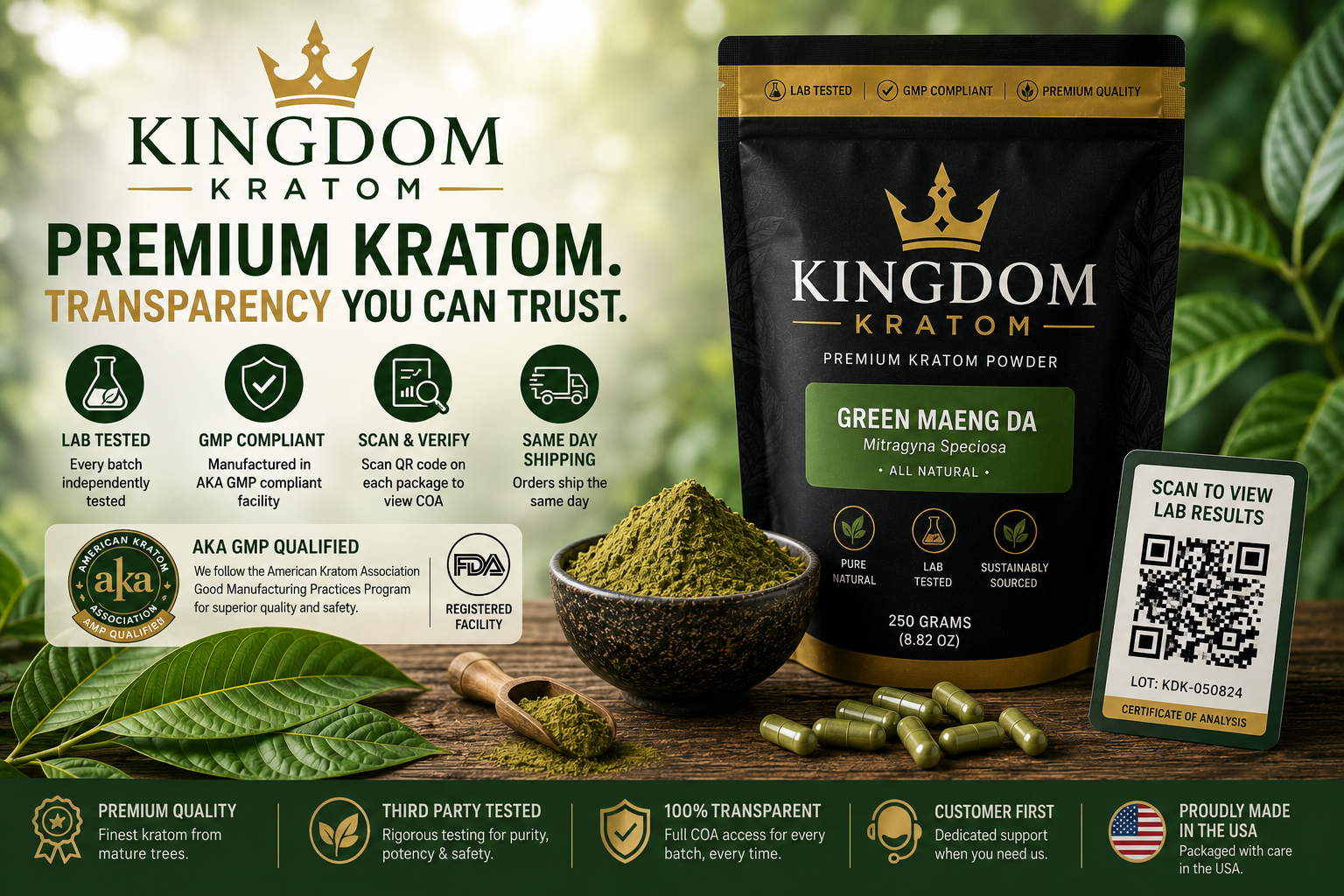
Kingdom Kratom markets itself around an extensive 35+ strain catalog and aggressive pricing — but the certification and lab-transparency picture here is more consistently cautionary than most vendors in this review series. Unlike some brands covered elsewhere, where sources gave directly contradictory answers on AKA certification, the majority of independent reviews researched for this piece agree on a specific point: Kingdom Kratom is not currently AKA GMP certified. That consistency is itself useful information, and it shapes most of what follows.
Disclosure: This site earns commissions when you purchase through some vendor links below. That doesn’t change our evaluation criteria — we’re upfront about it because transparency is the whole point of this review. One quick note: don’t confuse this vendor with “King Kratom,” a similarly named but separate Nevada-based extract brand — different company, different product focus.
Company Background
Kingdom Kratom is a San Antonio, Texas-based vendor established in 2017, positioning itself in the mid-range market with an unusually large catalog — 35+ strains across powder, capsules, extracts, gummies, and fermented varieties. The fermented product line is a genuine point of differentiation; it’s a less common processing category that several competitors in this review series don’t offer at all.
The brand appears to have built a strong regional presence in Texas, reflected in a notably high Google rating (4.9 stars from hundreds of reviews) alongside a comparatively thin Reddit footprint — one review specifically notes this pattern, suggesting the brand may be stronger in local/regional recognition than in the online kratom communities (like r/kratom) that tend to drive national vendor reputation.
AKA Certification: Where Sources Actually Agree
This is worth stating plainly, since it’s more consistent than the certification disputes found for some other vendors in this series: multiple independent reviews state directly that Kingdom Kratom is not AKA GMP certified. This isn’t a single outlier claim — it’s repeated across several separately authored sources, including a dedicated Texas-vendor analysis that states it without hedging: “Kingdom Kratom is not certified by the American Kratom Association (AKA).”
One review specifically frames the practical implication: without independent AKA verification, the responsibility for verifying quality and purity shifts more heavily onto the buyer. That doesn’t automatically mean the product is unsafe or low quality — plenty of non-certified vendors sell perfectly fine products — but it does mean you can’t rely on third-party audit as a quality backstop the way you could with an AKA-certified brand.
As always: certification status can change, so confirm current status directly on the AKA’s own published vendor list rather than relying on this review or any other source.
Lab Testing and Transparency
Kingdom Kratom states that all products undergo lab testing for purity and potency, covering heavy metals, microbial contamination, and alkaloid content. The gap consistently identified across independent 2026 analyses isn’t whether testing happens, but how accessible the results are: multiple sources describe Certificates of Analysis (COAs) as available only upon request, rather than displayed directly on product pages or accessible via QR code the way several other vendors in this series (Super Speciosa, Kats Botanicals, Viable Kratom) now offer.
One detailed industry analysis specifically classified Kingdom Kratom’s quality-to-price positioning as “low quality relative to pricing,” citing the inability to verify potency or purity before purchase as the core issue — a direct consequence of the COA-on-request model rather than a claim about the product itself being contaminated or mislabeled.
Product Lineup and Pricing
Kingdom Kratom’s pricing is a genuine competitive advantage: kilo pricing around $122, working out to roughly $0.12 per gram — notably below the $0.17–$0.29 per gram range cited for many competitors. Combined with the 35+ strain catalog spanning powder, capsules, extracts, gummies, and fermented kratom, the brand offers real breadth and value on paper.
The tension worth understanding: aggressive pricing paired with limited public lab-testing access is a combination that warrants more buyer diligence than a vendor charging a premium specifically tied to visible, verifiable testing infrastructure (the way Super Speciosa or Golden Monk position themselves, for instance).
User Reports
Feedback is genuinely mixed rather than uniformly positive:
- Positive: several Reddit users in smaller kratom-focused communities have spoken favorably about specific products, particularly Gold Bali and a “Bliss” blend capsule line; the Maeng Da category is specifically cited for good strain consistency by multiple users
- Negative: at least one Reddit report describes a gummy product failing to produce noticeable effects despite its labeled potency — though individual response varies significantly by tolerance and body chemistry, so a single report shouldn’t be over-weighted
- General pattern: reviews describe “generally positive, with batch-to-batch variation” as the typical experience — consistent with what you’d expect from a vendor without independently audited batch consistency requirements
What Reviewers Consistently Praise
- Aggressive, competitive pricing — among the lower per-gram costs cited in this review series
- Wide catalog, including a less common fermented kratom line
- Strong regional reputation and Google review volume
- Same-day shipping and responsive customer service, per multiple sources
- Strain consistency specifically in the Maeng Da line, per user reports
What Reviewers Consistently Flag as Weaknesses
- Not AKA GMP certified — the most consistently repeated finding across independent sources reviewed here
- COAs available on request only, not displayed publicly on product pages
- Industry analysis specifically flags “low quality relative to pricing” given the inability to verify potency/purity pre-purchase
- Mixed potency reports on at least one product, per Reddit feedback
- Limited presence in national kratom communities (Reddit) relative to Google review volume, making broader independent sentiment harder to assess
How Kingdom Kratom Compares
| Factor | Kingdom Kratom | Super Speciosa | Golden Monk |
|---|---|---|---|
| AKA GMP status | Not certified (consistent across sources) | Consistently confirmed | Claimed; verify directly |
| COA accessibility | On request only | Public, QR-code | Product-page (verify current) |
| Pricing | Aggressive (~$0.12/gram) | Mid-premium | Low per-gram (bulk) |
| Catalog breadth | Very wide (35+ strains, fermented line) | Moderate | Moderate |
| Founded | 2017 | 2016 | 2016 |
Vendor Evaluation Checklist (Apply This to Any Vendor, Kingdom Kratom Included)
- AKA GMP certification status, confirmed directly on the AKA’s published list — the majority of available evidence suggests Kingdom Kratom currently isn’t on it, but verify for yourself given how quickly status can change
- Request an actual, current, batch-specific COA before ordering, since it’s reportedly not published proactively — judge the vendor based on what you receive, not just the offer to provide it
- Recent, dated user reports rather than aggregate star ratings alone, given the mixed potency feedback found in at least one case
- Realistic expectations about price-to-verification tradeoffs — Kingdom Kratom’s pricing is genuinely competitive, but that competitiveness comes without the third-party audit backstop that pricier, certified competitors offer
Frequently Asked Questions
Is Kingdom Kratom AKA GMP certified? No, according to the majority of independent sources reviewed for this piece — this is one of the more consistent findings in this review series. Confirm current status directly on the AKA’s published vendor list, since certification status can change.
Does Kingdom Kratom publish lab results publicly? Not proactively, according to multiple sources — COAs are reportedly available upon request rather than displayed on product pages or accessible via QR code.
Is Kingdom Kratom good value? On price alone, yes — its per-gram cost is notably lower than many competitors. Whether that represents genuine value depends on how much you weigh independent verification, which is harder to access here than with certified competitors.
Is Kingdom Kratom the same company as King Kratom? No — Kingdom Kratom (San Antonio, Texas, broad strain catalog) and King Kratom (Nevada-based, concentrated extract specialist) are separate companies with similar names. Don’t conflate reviews of one with the other.
What do actual users say about Kingdom Kratom? Feedback is mixed. Several users report good experiences and strain consistency, particularly with Maeng Da products, while at least one report describes underwhelming effects from a specific product. This pattern — generally positive with batch variation — is consistent with a vendor operating without independently audited batch-consistency requirements.
The Bottom Line
The title of this review asks whether Kingdom Kratom is a premium selection or just another online vendor, and the evidence points fairly clearly toward the latter: competitive pricing and a genuinely wide catalog, but without the AKA certification or public batch-testing access that distinguish the stronger-verified vendors in this review series (Super Speciosa, Kraken, Viable Kratom). That’s not a condemnation — plenty of buyers have reported satisfactory experiences — but it does mean the verification burden sits more squarely with you as the buyer. If independent, third-party-audited quality assurance matters to your purchasing decision, request a current COA directly before ordering and weigh that against the lower price.