Reviewed by: Kratom Verdict Editorial Team
Last Updated: July 2026
Estimated Reading Time: 12 Minutes
Review Type: Independent Editorial Buyer’s Guide
Research Basis: Publicly available company information, Certificates of Analysis (COAs), third-party laboratory testing policies, industry standards, consumer transparency practices, vendor documentation, and publicly available regulatory resources.
Among the dozens of kratom strain names circulating on vendor websites, Red Riau has carved out a specific reputation: a red-vein product from Sumatra, Indonesia, often described as gentler and more “balanced” than heavy-hitters like Red Maeng Da or Red Bali. If you’ve searched “Red Riau kratom” and landed here, you’re probably trying to sort marketing language from reliable information before making a purchasing decision.
This guide covers where Red Riau comes from, how it’s processed, how it’s typically compared to other red-vein strains, what users report, and — most importantly — the safety and legal information every buyer should understand in 2026. This is an educational resource, not medical or legal advice, and nothing here should be read as an endorsement of kratom use.
What Is Kratom, Exactly?
Kratom is the common name for Mitragyna speciosa, an evergreen tree in the coffee family (Rubiaceae) native to Southeast Asia, including Indonesia, Malaysia, and Thailand. Rural communities across the region have used the leaves — chewed fresh or brewed as tea — as part of traditional practices for generations, particularly among agricultural workers.
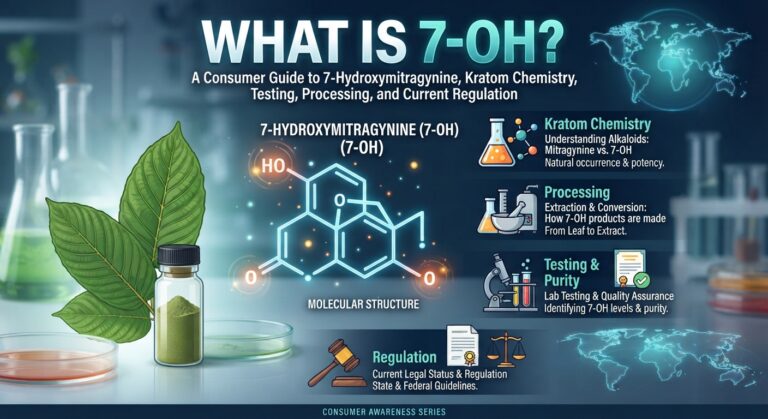
The leaves contain naturally occurring alkaloids, primarily mitragynine, along with a much smaller amount of 7-hydroxymitragynine (7-OH). Both interact with opioid receptors in the brain, which is why kratom is frequently discussed in the same regulatory conversations as opioids even though it’s botanically unrelated to the poppy plant. In the United States, kratom is typically sold as a powder, capsule, or extract, usually labeled “not for human consumption” to avoid FDA dietary supplement rules. It is not FDA-approved to treat, cure, or prevent any disease.
Where Red Riau Kratom Comes From
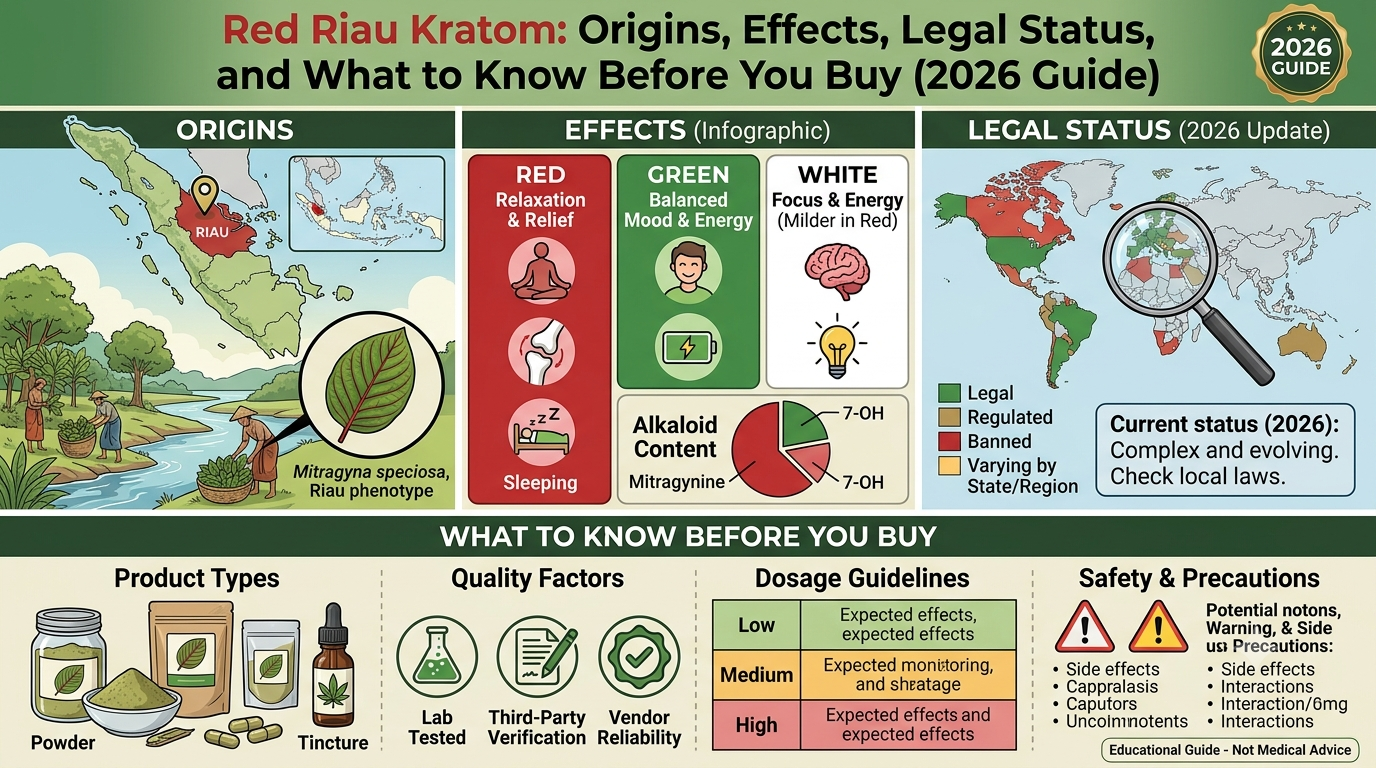
Red Riau takes its name from Riau, a province on the eastern coast of the island of Sumatra, Indonesia, which also includes the outlying Riau Islands. Kratom cultivation associated with this name is generally concentrated in the province’s inland rainforest zones, where high rainfall, humidity that regularly exceeds 80%, and nutrient-dense peat soil create growing conditions vendors say influence the leaf’s alkaloid content.
Vendors commonly note that Riau kratom was originally sold in the West under the broader label “Sumatra Kratom” before being rebranded and marketed under the more specific regional name Riau, distinguishing it from other Sumatran-origin products. As with most kratom strain names, “Red Riau” functions primarily as an informal marketing and regional designation rather than a scientifically standardized cultivar, so sourcing claims are difficult for individual buyers to independently verify.
It’s also worth understanding the broader context of the region: Riau province has an active law enforcement presence around narcotics more generally, with local police reporting over a thousand narcotics cases uncovered in the region in early 2026 alone. Kratom’s own legal standing within Indonesia varies by province and continues to evolve, which is a separate question from its legality in destination markets like the United States.
How Red Riau Gets Its Red Color
Vein color in kratom — red, green, white, or yellow — mostly reflects the maturity of the leaf at harvest combined with the drying method used afterward, rather than distinct tree varieties. Red vein kratom, including Red Riau, is generally produced from leaves harvested later in the tree’s growth cycle and dried using methods vendors describe as slower and often more shielded from direct light than the processes used for green or white vein leaf — sometimes including a fermentation phase.
Vendors marketing Red Riau frequently describe the leaves used as notably large and mature by harvest time, and note the resulting powder is prized for a fine, smooth grind and a mild, sweet aroma. As with strain claims generally, the specific drying and curing method varies by grower, and there’s no regulatory body standardizing these descriptions across the industry.
The Alkaloid Profile of Red Riau
The two alkaloids most associated with kratom’s effects are mitragynine, the most abundant alkaloid in most kratom leaf, and 7-hydroxymitragynine, present naturally in much smaller amounts. Vendor product descriptions for Red Riau are notably inconsistent on this point: some describe it as containing comparatively low levels of both alkaloids relative to more potent-marketed reds like Red Bali or Red Thai, positioning it as a gentle, entry-level option, while others market it as leaf harvested specifically for a higher concentration of 7-hydroxymitragynine, marketed toward users seeking stronger relaxation effects.
This inconsistency is worth sitting with as a buyer: it illustrates how much strain-specific marketing in the kratom industry is generated by individual vendors rather than drawn from standardized, independently verified lab data. Nearly every source describing Red Riau’s alkaloid profile is a vendor’s own product page rather than a peer-reviewed or third-party analytical study, and even legitimate independent lab testing (Certificates of Analysis, or COAs) reflects only the specific batch tested — not a fixed, universal profile for “Red Riau” as a category.
Red Riau Compared to Other Riau and Red-Vein Strains
Riau kratom is typically sold across three vein colors, and vendors commonly describe the differences this way:
White Riau is marketed as the most energizing of the three, often compared to a strong cup of coffee and recommended by vendors for daytime or morning use.
Green Riau is generally positioned as a middle-ground option — described as balanced, versatile, and suited to use throughout the day, though some vendors note its effects are shorter-lived than the other two.
Red Riau is consistently marketed as the slowest and most grounding of the three, with vendors describing effects that set in more gradually and last longer than white or green Riau.
Compared against other well-known red-vein strains from across Indonesia — Red Bali, Red Thai, Red Maeng Da, Red Borneo — Red Riau is frequently marketed as the milder, more approachable option, often recommended by vendors specifically for people who are new to kratom or who are sensitive to stronger strains. Whether that reputation reflects a genuine, consistent difference in alkaloid content or is simply a marketing niche the strain has settled into is not something independently verified data can currently confirm one way or the other.
What Users Report
In online kratom communities and vendor reviews, people describe Red Riau most often in terms of muscle relaxation, a calmer mental state, and mood lift without what they describe as heavy sedation. Some users specifically mention it in the context of winding down in the evening or managing everyday stress, describing the onset as gradual rather than abrupt.
As with any strain-specific discussion, it’s important to be clear about what this evidence actually is: self-reported, subjective accounts shared on forums and vendor sites, not findings from controlled or blinded studies. Individual response to kratom varies widely based on body weight, tolerance, metabolism, what else has been consumed that day, and the actual alkaloid content of a specific batch — which, absent independent lab verification, can vary considerably even among products sold under the identical strain name.
Safety, Risks, and What Regulators Are Saying in 2026
This is the section that matters most for anyone actually considering a purchase, because the regulatory and safety landscape around kratom has shifted substantially through 2026.
The FDA’s long-standing position. The FDA has not approved kratom for any medical use and has repeatedly warned about risks including liver toxicity, seizures, respiratory depression, and dependence with withdrawal symptoms resembling those seen with opioids. The agency has also raised concerns about kratom products contaminated with heavy metals or, in documented cases, adulterated with other substances.
The 2026 shift toward regulating concentrated 7-OH products specifically. Rather than targeting natural kratom leaf broadly, federal regulators in 2026 have focused on concentrated and synthetic forms of 7-hydroxymitragynine. On July 1, 2026, the DEA filed notice of intent to temporarily place concentrated and synthetic 7-OH — along with several related lab-made compounds — into Schedule I, the same category as heroin, a move supported by the Department of Health and Human Services and following a July 2025 FDA recommendation that concentrated 7-OH be scheduled. The DEA has been explicit that this action does not apply to natural kratom leaf containing 7-OH below a low threshold (about 0.05% by dry weight) — the target is synthesized and concentrated products, not whole-leaf material. The notice published in the Federal Register on July 6, 2026 triggers a required 30-day waiting period, meaning the earliest the order could take effect is early August 2026, after which it would run for two years with a possible one-year extension while the DEA pursues permanent scheduling.
The concern driving this action is the proliferation of gas station and smoke shop products engineered to contain 7-OH concentrations far beyond what occurs naturally in the leaf — concentrations regulators say behave pharmacologically like a potent opioid, with correspondingly higher risks of dependence and overdose than traditional leaf powder.
Why this distinction matters for a product like Red Riau. As a traditionally processed, whole-leaf red vein product, Red Riau generally falls on the “natural leaf” side of this regulatory line rather than the concentrated-extract side. That said, the kratom industry is not tightly standardized, and buyers shouldn’t assume any product labeled “natural” or “leaf” is automatically free of concentrated additives without checking for independent lab verification.
Ongoing federal pressure beyond 7-OH. In March 2026, a group of U.S. senators sent a letter to the FDA urging broader federal scheduling action on kratom itself, signaling that regulatory attention extends past 7-OH alone and that the landscape could keep shifting through the rest of the year.
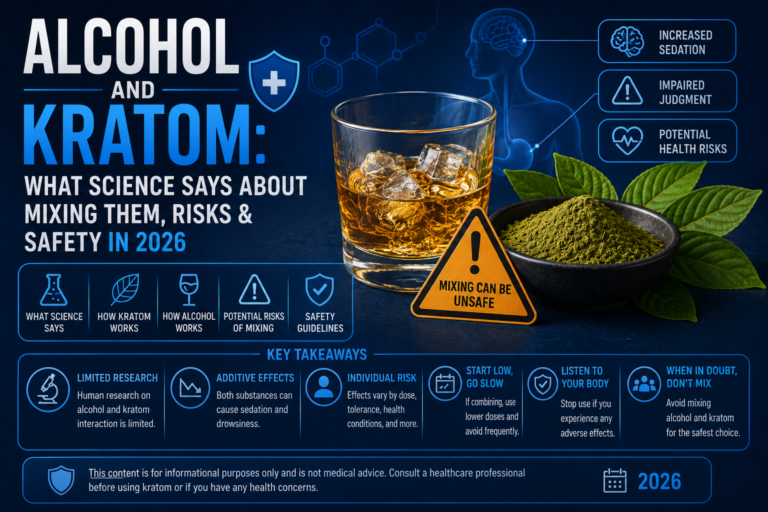
Given all of this, anyone considering Red Riau or any kratom product should treat it as a substance with documented, real risks rather than a risk-free herbal supplement, and should be cautious of any vendor that doesn’t disclose independent lab testing for both alkaloid content and contaminants. People who are pregnant, nursing, managing a health condition, or taking other medications — particularly anything affecting the central nervous system — should talk to a healthcare provider before considering kratom, and no one should use kratom as a substitute for professional treatment of pain, anxiety, or substance use disorder. Because of kratom’s activity at opioid receptors, combining it with alcohol, benzodiazepines, or other sedatives carries elevated risk.
Is Kratom Legal? State-by-State Snapshot (2026)
Kratom’s legal status in the United States remains a genuine patchwork, and it has continued to shift through 2026.
Federal level: Kratom remains unscheduled under the federal Controlled Substances Act as of mid-2026 — the DEA has not classified natural leaf kratom as a controlled substance, the FDA has not approved it as a drug, and Congress has not passed a federal ban. The regulatory focus in 2026 has centered specifically on concentrated 7-OH products rather than natural leaf.
States with bans: As of 2026, seven states ban kratom outright: Alabama, Arkansas, Connecticut, Indiana, Louisiana, Vermont, and Wisconsin, along with Washington, D.C. Various city and county ordinances add further restrictions on top of state law even in places where kratom is otherwise permitted.
States moving toward regulation instead of bans: A growing number of states have adopted or are considering a Kratom Consumer Protection Act (KCPA) framework, which allows kratom sales under defined consumer-safety rules — typically 21+ age limits, mandatory lab testing, and labeling requirements — instead of outright prohibition. Rhode Island became the first state in U.S. history to reverse a kratom ban, signing its KCPA into law in July 2025, with the regulated framework taking effect April 1, 2026.
States actively debating new restrictions: Legislative activity has been particularly heavy in 2026. Georgia’s House Bill 968, for example, has proposed placing both mitragynine and 7-hydroxymitragynine on the state’s Schedule I list, which would effectively criminalize possession, while other states have introduced bills ranging from repealing existing consumer-protection laws to imposing steep new taxes on kratom sales.
The bottom line for buyers: Because rules can change at the state and even city level with little notice, anyone considering purchasing Red Riau or any kratom product should verify current law in their specific state and locality before ordering. What’s legal in one state can be a criminal offense in a neighboring one, and shipping into a banned jurisdiction can expose a buyer to legal risk regardless of where the product was purchased.
How to Evaluate a Kratom Vendor
Given how little the kratom industry is standardized, vendor selection is the single biggest safety factor a consumer actually controls. A few things worth checking before buying Red Riau or any kratom product:
Independent, third-party lab testing. Look for vendors who publish current Certificates of Analysis (COAs) from independent labs, testing both alkaloid content (mitragynine and 7-OH levels) and contaminants such as heavy metals and microbial contamination, including salmonella. A vendor claiming their Red Riau is tested for “no fillers, no synthetics, no blended leaf” should be able to back that up with an actual, current lab report — not just marketing copy.
Industry quality program membership. The American Kratom Association’s Good Manufacturing Practices (GMP) qualification program is one benchmark some vendors reference, requiring adherence to specific processing, testing, and labeling standards.
Transparency about sourcing. Vendors who can speak specifically to how their Red Riau was grown, harvested, and processed — rather than relying on interchangeable, generic strain copy — tend to be more reliable sources of accurate information.
Conservative, compliant labeling. Under FDA rules, kratom cannot legally be marketed as treating or curing any disease. Vendors that lean heavily on explicit medical claims are both on shakier legal ground and generally less trustworthy sources of accurate product information.
Age verification and legal compliance. A vendor that verifies buyer age and declines to ship into states where kratom is banned is signaling it takes regulatory compliance seriously — a pattern that tends to correlate with better practices elsewhere in the business, including testing and labeling.
Frequently Asked Questions
Is Red Riau a different plant species than other kratom strains? No. All kratom strains, including Red Riau, come from the same species, Mitragyna speciosa. Strain names reflect growing region, leaf maturity at harvest, and drying method, not different botanical species.
Is Red Riau stronger or weaker than other red vein strains? Vendor descriptions are inconsistent on this point — some market it as a milder, entry-level red strain, others market it as containing relatively high 7-OH levels. Because strain-name claims aren’t independently standardized, the only reliable way to know a specific product’s alkaloid content is a current, independent lab test (COA), not the name on the label.
Is kratom addictive? Public health agencies, including the FDA, have warned that regular kratom use carries a risk of dependence and withdrawal symptoms similar to those associated with opioids, particularly with frequent, higher-level use. This concern is part of why federal regulators have increased their focus on the substance in 2026, especially around concentrated 7-OH products.
Can I legally buy Red Riau kratom online? It depends entirely on your state and local jurisdiction. Kratom remains unscheduled at the federal level but is banned outright in several states and restricted in various cities and counties. Confirm your specific state and local law before ordering, since legal status has been actively changing throughout 2026.
Should I talk to a doctor before trying kratom? Yes. Anyone considering kratom — Red Riau or otherwise — should speak with a healthcare provider first, particularly if pregnant or nursing, managing an existing health condition, taking other medications, or in recovery from substance use, given kratom’s activity at opioid receptors and its documented potential to interact with other central-nervous-system-affecting substances.
Final Thoughts
Red Riau occupies a fairly specific spot in the kratom market: a Sumatran-origin, red-vein product marketed as slower, more grounding, and generally milder than higher-profile reds like Bali, Thai, or Maeng Da. As with most strain-specific claims across the kratom industry, much of what’s written about it — its aroma, its gentleness, its “balanced” alkaloid profile — comes from vendor marketing and user forums rather than controlled, independently verified research, and vendor descriptions of its actual potency aren’t even fully consistent with each other.
What has genuinely changed in 2026 is the regulatory environment surrounding it. Federal action is now drawing a clearer line between natural kratom leaf and concentrated 7-OH extracts, state legislatures are actively rewriting kratom law in both more permissive and more restrictive directions, and public health warnings about dependence and toxicity risk remain firmly in place. Anyone researching Red Riau — or any kratom product — right now should treat vendor claims with appropriate skepticism, confirm current law in their own state, prioritize vendors who publish independent lab testing, and talk to a healthcare provider before use.
This article is for general informational purposes only and does not constitute medical or legal advice. Kratom is not approved by the FDA to diagnose, treat, cure, or prevent any disease. Laws governing kratom vary by state and locality and are subject to change; consult current local law and a licensed professional before making any purchasing or health decisions.