Finding cheap kratom is easy. Finding affordable kratom with meaningful laboratory documentation, identifiable batches, transparent labeling and reasonable quality controls requires considerably more work.
That distinction should guide the entire buying decision.
Low price is not automatically a warning sign. Larger package sizes, efficient distribution, direct sourcing, limited packaging and competitive pricing can all reduce the cost of a botanical product. But cheap kratom becomes a poor value when a low price is achieved alongside missing laboratory reports, weak traceability, questionable labeling or uncertainty about what the product actually contains.
Kratom Verdict therefore evaluates affordability differently from simply asking, “Which bag costs the least?”
The more useful question is:
How much documented product quality are you receiving for the money you spend?
For consumers comparing cheap kratom in 2026, that means examining price per gram alongside batch-level laboratory testing, contaminant screening, product format, manufacturer transparency and the growing distinction between traditional kratom leaf products and concentrated 7-hydroxymitragynine products.
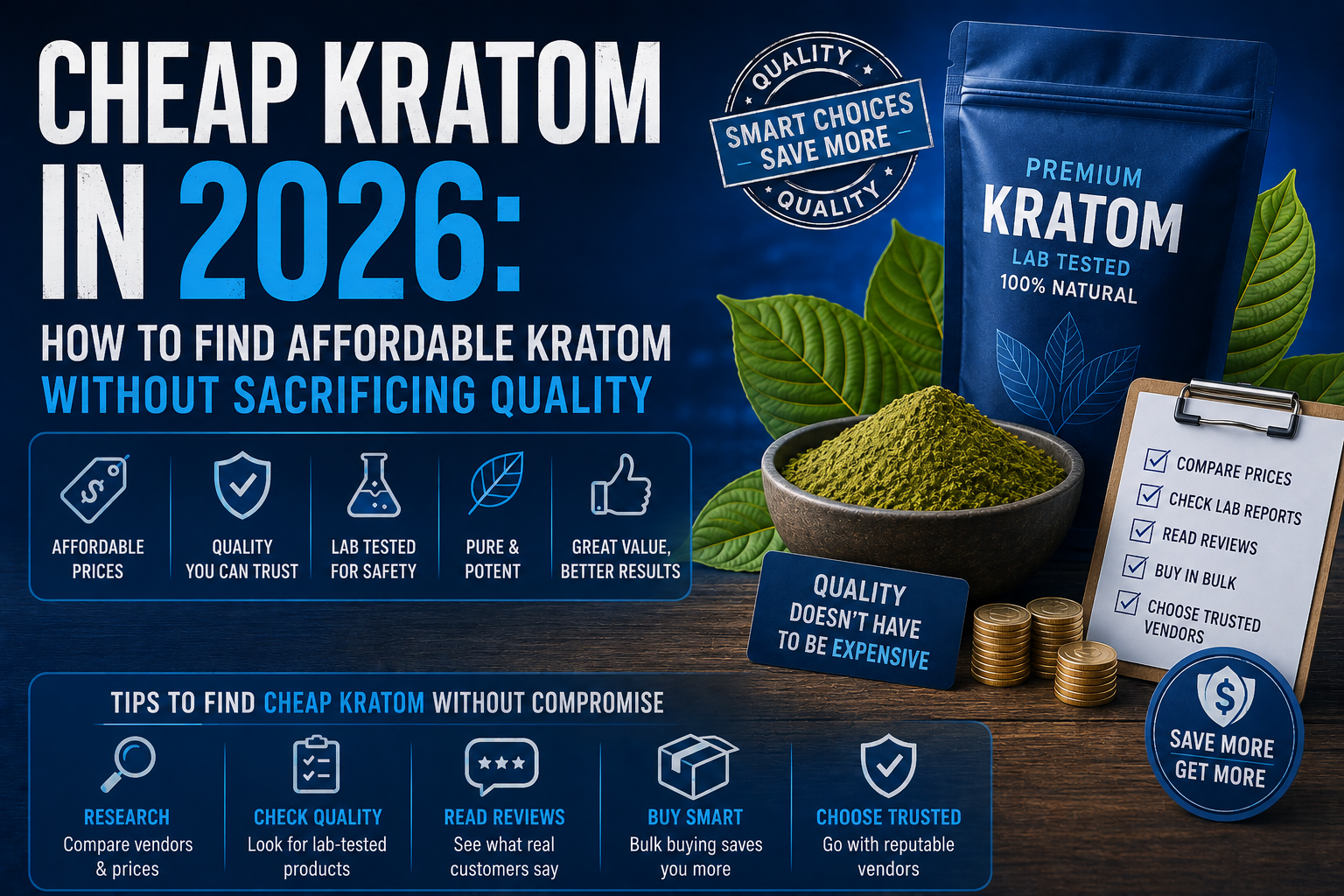
Cheap Kratom: Quick Buying Checklist
Before purchasing cheap kratom, check whether you can answer these questions:
- Who manufactured or distributed the product?
- Is there a batch or lot number?
- Can you find a COA for that batch?
- Is the testing laboratory identified?
- Was the product screened for relevant heavy metals?
- Was microbial testing performed?
- Is mitragynine reported where appropriate?
- Is 7-hydroxymitragynine reported or otherwise addressed?
- Does the label clearly identify the product format?
- Is the ingredient list understandable?
- Is the package sealed and traceable?
- Are the marketing claims realistic?
- Is there a clear customer-support contact?
- Are shipping charges included when comparing prices?
- Is a bulk discount genuinely cheaper per gram?
A product does not need luxurious packaging to satisfy these criteria.
That is one reason cheap kratom and quality kratom are not necessarily opposites.
What Does Cheap Kratom Actually Mean?
“Cheap” is relative.
A $20 package may appear cheaper than a $50 package, but that tells you very little until you compare the quantity and product format.
For example, consumers should distinguish among:
- Price per package
- Price per gram
- Price per ounce
- Price per kilogram
- Powder versus capsules
- Ordinary leaf versus extract
- Shipping cost
- Promotional discounts
- Subscription discounts
- Bulk pricing
A smaller package may have the lowest checkout price but a considerably higher price per gram.
Likewise, cheap kratom powder should not be compared directly with a concentrated extract merely because both packages weigh the same.
Buying Option
They are different products.
Price Per Gram Is More Useful Than Package Price
When comparing ordinary kratom powder, price per gram is one of the simplest ways to normalize prices.
Suppose:
- Product A contains 100 grams for $18
- Product B contains 250 grams for $32
- Product C contains 500 grams for $52
Product A has the lowest checkout cost.
But Product C may provide the lowest price per gram.
This distinction becomes especially important when looking for cheap kratom because retailers frequently advertise the lowest package price rather than the strongest unit value.
Consumers should calculate:
Total product price ÷ total grams
Shipping should then be included if it materially changes the final cost.
This provides a much better comparison than the sticker price alone.
Can Cheap Kratom Still Be Good Quality?
Yes, price alone cannot establish quality.
There is no scientific rule stating that inexpensive kratom must be poor quality or that expensive kratom must be superior.
Price can reflect many things:
- Supply-chain efficiency
- Package size
- Marketing costs
- Retail markup
- Shipping
- Branding
- Packaging
- Wholesale purchasing
- Product format
- Extraction costs
The problem arises when cheap kratom also lacks basic quality evidence.
A simple pouch of powder with batch-specific third-party testing may provide more useful transparency than an expensive product with premium branding but no accessible COA.
Kratom Verdict therefore does not use price as a substitute for documentation.
Laboratory Testing Should Not Be Sacrificed for Price
This is where bargain hunting deserves particular caution.
FDA has previously tested kratom products for heavy metals and found significant concentrations of lead and nickel in some of the samples analyzed. FDA concluded that certain tested products could create concerning exposure under patterns of repeated consumption.
More recent peer-reviewed work has reinforced the relevance of this issue. A 2024 Clinical Toxicology analysis examined published individual-product testing covering 68 kratom products and found that some products could produce elemental-impurity exposures exceeding selected regulatory thresholds, particularly at higher assumed consumption amounts.
Those findings do not mean every inexpensive product is contaminated.
They also do not establish that expensive products are contaminant-free.
Instead, they demonstrate why cheap kratom should still come with meaningful contaminant documentation.
What Should a Cheap Kratom COA Show?
A Certificate of Analysis, or COA, reports laboratory results for a tested sample.
Depending on the testing program, a kratom COA may include:
Alkaloid testing
Commonly reported analytes may include:
- Mitragynine
- 7-hydroxymitragynine
Heavy-metal testing
A laboratory panel may include:
- Lead
- Arsenic
- Cadmium
- Mercury
- Nickel
Microbial testing
Testing may include:
- Salmonella
- E. coli
- Yeast
- Mold
- Other microorganisms
The exact panel varies.
The important point when purchasing cheap kratom is not merely whether the seller uses the phrase “lab tested.”
Consumers should examine what was actually tested.
Batch Matching Is More Important Than a Generic Lab Report
Suppose a retailer displays a beautiful laboratory report on its website.
That sounds reassuring.
Now compare the report’s batch number with the product being sold.
If they do not match, the report may not document the batch you are purchasing.
A stronger transparency system connects:
Product → Lot number → Laboratory report
When evaluating cheap kratom, look for that chain.
A generic laboratory report from years ago is substantially less useful than a current report corresponding to the actual batch.
Why Heavy Metals Matter in Kratom
Kratom is an agricultural botanical, and botanical products can be exposed to contaminants through soil, water, processing, storage and manufacturing.
FDA’s historical kratom testing found concerning concentrations of metals in some tested products.
A separate peer-reviewed study of kratom products purchased around the western suburbs of Chicago found variable mitragynine concentrations as well as metals and microbes in tested products. The study’s limited sample should not be generalized to every product on the market, but it demonstrates why quality control cannot be assumed from appearance or price.
This is why cheap kratom without contaminant testing can represent false economy.
Saving a few dollars is not meaningful if the product’s composition is inadequately documented.
Microbial Quality Matters Too
Contaminants are not limited to metals.
Botanical powders can also face microbial-quality issues.
The Chicago-area product study detected various bacteria and fungi in most of its tested samples, although none tested positive for Salmonella.
Historical FDA investigations have also highlighted microbial contamination as an important kratom-quality concern.
Therefore, consumers comparing cheap kratom should look beyond alkaloid potency.
A product can contain mitragynine and still have poor contaminant controls.
Potency does not prove purity.
Cheap Kratom Powder Is Usually Easier to Compare
For consumers focused primarily on value, ordinary powder is often easier to compare than complex extracts.
Why?
Because powder packages can generally be compared using:
- Weight
- Price per gram
- Batch information
- Alkaloid testing
- Contaminant testing
Extracts introduce another variable: concentration.
Two 10-gram extracts may differ substantially in composition.
Therefore, a cheap kratom powder comparison can often be more straightforward than trying to determine whether two extracts offer equivalent value.
This does not mean powder is inherently safe or superior.
It simply makes unit-price comparison easier.
Cheap Kratom Capsules: Convenience Has a Cost
Capsules contain additional materials and require encapsulation, packaging and handling.
As a result, consumers may pay more per gram for capsules than for loose powder from the same product line.
When comparing cheap kratom capsules, determine:
- Number of capsules
- Approximate amount per capsule
- Total amount of kratom
- Total package price
- Testing documentation
Do not compare capsule count alone.
A bottle containing more capsules may not contain more total kratom if capsule sizes differ.
Cheap Kratom Extracts Require Different Math
Extract pricing is more complicated.
Terms such as:
- 10x
- 20x
- 50x
- Full spectrum
- Enhanced
- Ultra
- Premium
do not automatically provide standardized measures of chemical composition.
When considering cheap kratom extracts, look for quantitative information rather than relying on dramatic marketing terminology.
Useful information may include:
- Total product weight
- Mitragynine concentration
- Amount per unit
- Batch number
- COA
- Ingredient disclosure
A cheap extract with unclear concentration is difficult to compare meaningfully with another product.
Be Especially Careful With Cheap 7-OH Products
The 2026 marketplace requires a distinction that older kratom buying guides often did not make.
Traditional kratom leaf and concentrated 7-OH products should not be treated as interchangeable.
7-hydroxymitragynine occurs naturally in kratom in trace quantities. However, FDA warns consumers to avoid products containing added or enhanced 7-OH, describing these products as novel potent opioid products that have not been proven safe or effective.
In July 2026, FDA reported that DEA had begun a temporary scheduling process involving 7-OH above a proposed threshold as well as three synthetic kratom-related compounds.
Therefore, an unusually cheap kratom product advertised primarily around 7-OH concentration should not be evaluated using the same framework as ordinary leaf powder.
Read the label carefully.
Cheap Does Not Mean FDA Approved
Another consumer-protection issue is regulatory language.
A seller should not imply that a product is “FDA approved kratom.”
FDA’s current materials continue to treat kratom and its alkaloids within an unapproved regulatory context, and FDA specifically warns consumers about concentrated 7-OH products.
Consumers comparing cheap kratom should therefore distinguish between claims such as:
- Manufactured under certain procedures
- Third-party tested
- Made in a registered facility
- Industry GMP participation
and:
FDA approved
These are not equivalent concepts.
Is Bulk Kratom the Cheapest Option?
Bulk purchasing can reduce the price per gram.
But a bulk discount only represents value if the product itself meets your quality criteria.
Before buying cheap kratom in bulk, compare:
- Price per gram
- Batch number
- COA
- Heavy-metal screening
- Microbial testing
- Alkaloid information
- Product quantity
- Shipping
- Return/refund restrictions
A kilogram that costs less per gram may look attractive.
But purchasing more of an inadequately documented product simply increases your commitment to that product.
Verify first.
Then compare quantity.
Small Packages Can Be Better for First-Time Evaluation
The lowest price per gram is not always the lowest-risk purchasing decision.
A consumer unfamiliar with a manufacturer may prefer a smaller package before making a large bulk purchase.
This is particularly relevant to cheap kratom because aggressive bulk discounts can encourage buyers to focus on savings before evaluating the product.
A lower unit price only creates value if you actually want the product and its documentation meets your standards.
Shipping Can Change Which Kratom Is Cheapest
Online price comparisons often ignore shipping.
For example:
Vendor A
- Product: $30
- Shipping: $10
- Total: $40
Vendor B
- Product: $34
- Shipping: Free
- Total: $34
Vendor A advertises the cheaper product.
Vendor B produces the cheaper checkout.
When searching for cheap kratom, compare the landed price rather than the advertised product price.
Also check whether free shipping requires a minimum order that causes you to purchase more than intended.
Discount Codes Can Improve Value—But Verify the Base Price
Coupons are useful when they reduce the actual final price.
But consumers should not assume that a 20% discount automatically creates a better deal than a competitor offering no coupon.
Compare the post-discount price.
A product listed at $60 with a 20% coupon costs $48.
A comparable product priced normally at $42 is still cheaper.
When evaluating cheap kratom, discounts should be treated mathematically rather than emotionally.
The size of the coupon matters less than the final cost.
Subscription Discounts Require More Thought
Some retailers offer recurring-order discounts.
These can reduce the effective cost for repeat customers.
Before subscribing, check:
- Cancellation rules
- Billing frequency
- Shipping charges
- Ability to skip orders
- Refund terms
- Whether the discount continues
- Whether product batches remain independently verifiable
A subscription should not turn a cheap kratom purchase into an unwanted recurring expense.
Do Expensive Kratom Brands Have Better Quality?
Not necessarily.
Price can fund legitimate quality-control costs.
But it can also fund:
- Advertising
- Influencers
- Packaging
- Retail markup
- Brand positioning
There is no universal relationship in which price reliably predicts contaminant levels or alkaloid composition.
A 2024 assessment of elemental impurities found meaningful variation among kratom products and emphasized the importance of actual exposure and product analysis.
So instead of asking whether expensive kratom is better than cheap kratom, ask which product provides stronger verifiable evidence.
Do Strain Names Affect Price?
Commercial names such as:
- Green Maeng Da
- Red Bali
- White Borneo
- Green Malay
- Red Maeng Da
may influence how products are marketed.
But a strain name does not prove:
- Alkaloid concentration
- Purity
- Freshness
- Contaminant status
- Manufacturing quality
Recent scientific literature continues to describe substantial variation in mitragynine content associated with botanical and environmental factors.
Therefore, cheap kratom should not automatically be rejected because its strain branding is less elaborate.
Documentation is more useful than a dramatic product name.
How Important Is Mitragynine Percentage?
Mitragynine is a principal kratom alkaloid.
Its concentration can provide useful information about a product.
But higher mitragynine should not automatically be interpreted as higher quality.
Quality includes more than potency.
For cheap kratom, consider mitragynine alongside:
- Identity
- Contaminants
- Microbiology
- Batch traceability
- Label accuracy
- Manufacturing controls
A highly concentrated product with poor contaminant documentation does not become high quality simply because its mitragynine number is impressive.
Why Extremely Low Prices Deserve Investigation
There is no universal price below which kratom becomes suspicious.
Market prices change.
Package sizes differ.
Wholesale arrangements differ.
But a price substantially below comparable products should prompt questions.
Ask:
- Is this clearance inventory?
- Is the batch identifiable?
- Is the COA current?
- Is the product close to an indicated shelf-life date?
- Is the manufacturer identifiable?
- Is the package damaged?
- Is the advertised quantity accurate?
- Is this actually ordinary leaf powder?
The goal is not to assume cheap kratom is bad.
The goal is to understand why it is cheap.
Seven Red Flags in Cheap Kratom
1. No batch number
Without traceability, connecting the product to laboratory results becomes difficult.
2. No accessible COA
“Lab tested” without documentation provides limited verification.
3. Unidentified laboratory
Consumers should know who performed the testing.
4. Medical cure claims
Kratom should not be marketed as an FDA-approved treatment for disease.
5. Unclear 7-OH labeling
Concentrated 7-OH products require particular caution.
6. Suspiciously vague ingredients
Consumers should know what product they are purchasing.
7. No responsible company identity
A seller should provide a way to identify and contact the business responsible for the product.
If several of these appear together, the low cheap kratom price becomes much less attractive.
Buying Option
A Better Way to Define Kratom Value
Kratom Verdict suggests evaluating value using four dimensions:
1. Price
What is the actual cost per gram or equivalent product unit?
2. Documentation
Can you verify the batch, laboratory and COA?
3. Quality controls
Does testing address relevant contaminants and product composition?
4. Transparency
Can you identify the manufacturer, ingredients, policies and product type?
The strongest cheap kratom candidate is not necessarily the lowest-priced option.
It is the product that delivers a competitive price without requiring you to abandon these standards.
Cheap Kratom vs Low-Quality Kratom
These concepts should never be treated as synonyms.
| Feature | Good-Value Cheap Kratom | Poor-Quality Bargain Product |
|---|---|---|
| Competitive price | Yes | Yes |
| Identifiable manufacturer | Yes | Maybe not |
| Batch number | Expected | Often unclear |
| COA | Accessible | Missing/generic |
| Heavy-metal testing | Documented | Unknown |
| Microbial testing | Documented | Unknown |
| Ingredient transparency | Clear | Vague |
| Product format | Clear | Potentially confusing |
| Customer support | Available | Difficult to identify |
| Medical claims | Avoided | May be exaggerated |
This distinction is at the center of responsible cheap kratom shopping.
What Scientific Evidence Does—and Does Not—Tell Us
Scientific research can identify genuine quality and safety concerns.
It can show that:
- Kratom products can vary chemically.
- Some tested products have contained concerning elemental impurities.
- Microbial contamination can occur.
- Kratom contains pharmacologically active alkaloids.
- Concentrated 7-OH products deserve separate consideration.
- Kratom has complex pharmacology and potential adverse effects.
Research cannot tell you that a particular cheap kratom product is contaminated simply because it is inexpensive.
That conclusion requires evidence about the specific product or batch.
This is why Kratom Verdict favors documentation over assumptions.
The Kratom Verdict 12-Point Cheap Kratom Test
Before purchasing, score the product against these questions:
- Is the price genuinely competitive per gram?
- Is the manufacturer clearly identified?
- Does the package have a lot or batch number?
- Can you locate the corresponding COA?
- Is the laboratory identified?
- Does testing include relevant heavy metals?
- Does testing include relevant microbial contaminants?
- Is alkaloid information provided where appropriate?
- Is the product format clearly disclosed?
- Is enhanced or added 7-OH clearly identifiable?
- Are the marketing claims responsible?
- Can you contact the company if something goes wrong?
A cheap kratom product that performs strongly across these criteria can represent genuine value.
A product that fails most of them is simply inexpensive.
Those are not the same thing.
Frequently Asked Questions
Is cheap kratom safe?
Price alone cannot establish whether a kratom product is safe. Consumers should evaluate the specific product’s batch traceability, contaminant testing, labeling and composition. Kratom itself also carries pharmacological risks, so laboratory quality control does not make use risk-free.
Can cheap kratom be high quality?
Yes. A competitively priced product can still have strong batch documentation, contaminant screening and transparent labeling. Conversely, an expensive product is not automatically high quality.
Where can I find cheap kratom?
Prices vary among online and physical retailers. Rather than choosing solely by advertised price, compare price per gram, shipping, product format, laboratory documentation and batch traceability.
Is cheap kratom powder better value than capsules?
Powder often has fewer packaging and manufacturing costs associated with encapsulation and can therefore be easier to compare on a price-per-gram basis. The actual value still depends on the individual product.
Is bulk cheap kratom worth buying?
Bulk purchasing may reduce price per gram, but consumers should verify the batch and testing documentation before committing to a large quantity.
What should I check before buying cheap kratom?
Check the manufacturer, lot number, batch-specific COA, laboratory identity, heavy-metal testing, microbial testing, ingredients, product type and total checkout price.
Does cheap kratom contain less mitragynine?
Not necessarily. Price alone does not determine alkaloid concentration. Mitragynine levels can vary among products and botanical material, so actual laboratory data are more useful than assumptions based on price.
Should I buy cheap kratom extract?
Extracts require more careful comparison because concentration varies. Examine quantitative alkaloid information, ingredients, batch documentation and contaminant testing rather than comparing package weight alone.
Are cheap 7-OH products the same as cheap kratom leaf?
No. Products containing added or enhanced 7-OH should not be treated as equivalent to traditional kratom leaf. FDA recommends consumers avoid added or enhanced 7-OH products.
Does a COA guarantee that cheap kratom is safe?
No. A COA reports results for particular tests performed on a particular sample. It does not prove zero risk. Its usefulness also depends on whether the report corresponds to the product batch and whether relevant analyses were actually performed.
Kratom Verdict: Final Assessment
Cheap kratom can represent genuine value, but price should be the beginning of the comparison rather than the end of it.
The evidence does not support the assumption that inexpensive kratom is automatically contaminated or low quality.
It also does not support assuming that expensive products are automatically cleaner, safer or better manufactured.
Consumers need evidence about the actual product.
FDA testing and peer-reviewed research have demonstrated that contaminants such as heavy metals can occur in kratom products. Published research has also documented microbial-quality concerns and substantial variation among tested products.
Those findings make laboratory transparency especially important when comparing cheap kratom.
Kratom Verdict would prioritize five things:
Batch traceability.
Accessible laboratory documentation.
Heavy-metal and microbial screening.
Clear product composition.
Competitive total price.
Consumers should also recognize how much the market has changed. Traditional leaf powder, concentrated extracts and added/enhanced 7-OH products should not be lumped into one category merely because they are all marketed around kratom. FDA specifically recommends avoiding products containing added or enhanced 7-OH.
So what should a buyer looking for cheap kratom actually do?
Compare unit price.
Include shipping.
Check the batch.
Open the COA.
Identify the laboratory.
See what was tested.
Read the ingredient label.
Determine whether the product is ordinary leaf or a concentrated formulation.
Then decide whether the savings are genuine.
A plain package with strong documentation can be a better cheap kratom value than an expensive package supported mainly by marketing.
Likewise, the lowest-priced cheap kratom on the market is not a bargain when consumers cannot determine who made it, what batch it came from or whether meaningful contaminant testing was performed.
Kratom Verdict’s final position is straightforward:
The goal is not to find kratom at the lowest possible price. The goal is to find the lowest reasonable price that still meets a serious documentation and transparency standard.
That is the difference between cheap kratom and genuinely good-value kratom.
Sources & References
1. U.S. Food and Drug Administration — Laboratory Analysis of Kratom Products for Heavy Metals
FDA laboratory testing of 30 kratom products found significant concentrations of lead and nickel in some tested samples. The results concern the products analyzed and should not be generalized to every current kratom product.
Source: FDA — Laboratory Analysis of Kratom Products for Heavy Metals
2. U.S. Food and Drug Administration — Elemental Analysis of Kratom Products Using ICP-MS (2023)
FDA Science Forum work describing elemental analysis of kratom products and the detection of multiple metals in tested samples.
Source: FDA — Elemental Analysis of Kratom Products Using ICP-MS
3. Caroti KS, Joseph A, Sapowadia A, White CM — Elemental Impurities (Heavy Metals) in Kratom Products: An Assessment of Published Individual Product Analyses (2024)
Peer-reviewed Clinical Toxicology assessment evaluating elemental-impurity data from 68 kratom products and estimated exposures at different assumed amounts of consumption.
Source: PubMed — PMID 39235176
4. Prozialeck WC et al. — Public Health Implications and Possible Sources of Lead as a Contaminant of Poorly Regulated Kratom Products in the United States (2022)
Peer-reviewed discussion of lead contamination in kratom products and its potential public-health significance.
Source: PubMed — PMID 35878303
5. Prozialeck WC et al. — Evaluation of the Mitragynine Content, Levels of Toxic Metals and the Presence of Microbes in Kratom Products Purchased in the Western Suburbs of Chicago (2020)
Product-analysis research documenting variability in mitragynine and detecting metals and microbes in a limited sample of commercially purchased kratom products.
Source: PubMed — PMID 32751712
6. Henningfield JE et al. — Kratom Safety and Toxicology in the Public Health Context: Research Needs to Better Inform Regulation (2024)
Peer-reviewed review synthesizing recent research concerning kratom pharmacology, toxicology, epidemiology, benefits claimed by consumers and remaining evidence gaps.
Source: PubMed — PMID 38887550
7. U.S. Food and Drug Administration — Products Containing 7-OH Can Cause Serious Harm
FDA consumer guidance distinguishing trace naturally occurring 7-OH in kratom from products containing added or enhanced 7-OH and recommending that consumers avoid concentrated 7-OH products.
Source: FDA — Products Containing 7-OH Can Cause Serious Harm
8. U.S. Food and Drug Administration — Hiding in Plain Sight: 7-OH Products (Updated July 13, 2026)
Current FDA information describing the July 2026 federal regulatory process concerning 7-OH above a proposed threshold and three synthetic kratom-related compounds.
Source: FDA — Hiding in Plain Sight: 7-OH Products
9. Sgambato D, et al. — Kratom at a Crossroads: Trends, Controversies, and the Evidence Gap (2026)
Recent peer-reviewed clinical review discussing the expanding U.S. kratom market, safety questions and continuing evidence gaps.
Source: PubMed — PMID 42547284
10. U.S. Food and Drug Administration — Better Weather Fix Elixir Recall (May 28, 2026)
FDA-posted company recall concerning products potentially containing undeclared mitragynine and mitragynine pseudoindoxyl, illustrating the importance of accurate ingredient disclosure.
Source: FDA — Better Weather Fix Elixir Recall
Related Kratom Verdict Guides
Expand your knowledge of Best Kratom Brands for Pain Relief through our independent educational guides covering botanical science, laboratory testing, Certificates of Analysis, transparency standards, and vendor evaluation.
Kratom Fundamentals
- What Is Kratom? (2026): The Complete Beginner’s Guide
- Kratom Buying Guide (2026)
- Kratom Safety & Side Effects (2026)
- Kratom Legality Guide (2026)
Laboratory & Transparency
- Kratom Alkaloids Explained
- Kratom Lab Testing Explained
- Third-Party Lab Testing Explained
- How to Read a Kratom Certificate of Analysis (COA)
- How to Verify a Kratom COA
- AKA GMP Certification Explained