If you want to buy kratom in 2026, the most important decision is not which strain has the most impressive name or which website offers the biggest discount. It is whether you can verify what you are actually purchasing. Kratom products can differ in laboratory testing, batch traceability, contaminant screening, alkaloid composition, product format, labeling and seller transparency.
For consumers, that makes documentation important.
A responsible buying process should begin with a current Certificate of Analysis (COA), an identifiable lot or batch, meaningful contaminant screening, clear product labeling and a seller whose claims can be independently checked.
That is particularly important because the U.S. Food and Drug Administration does not consider kratom an FDA-approved treatment for any medical condition and continues to raise safety and regulatory concerns. At the same time, newer controlled human research on specific dried-leaf preparations has added nuance to the evidence base.
Kratom Verdict therefore approaches this subject from a consumer-protection perspective rather than treating every product—or every claim about kratom—as equivalent.
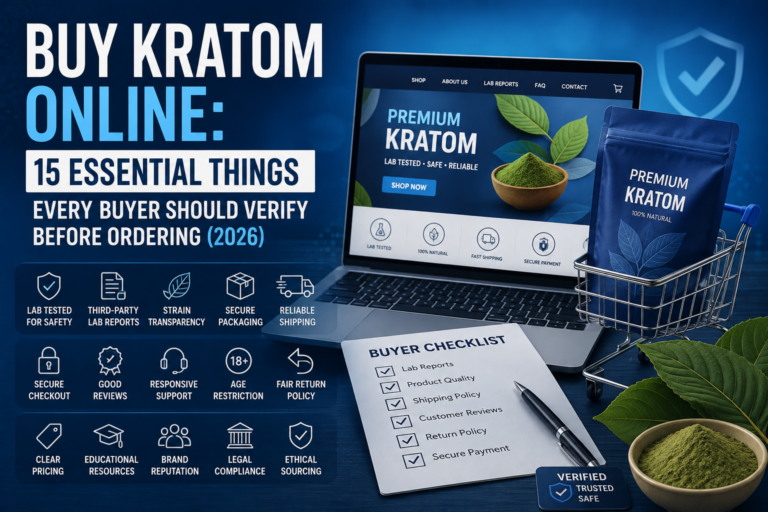
Buy Kratom: The 2026 Kratom Verdict Checklist
Before you buy kratom, answer these questions:
- Can you see a current laboratory report?
- Does the COA correspond to a specific batch or lot?
- Is the laboratory identifiable?
- Does testing include heavy metals?
- Does it include microbial contaminants?
- Is alkaloid content reported where relevant?
- Is the product clearly identified as leaf, powder, capsules, extract or another formulation?
- Are concentrated 7-OH products clearly distinguished from ordinary kratom leaf?
- Does the seller avoid unsupported medical claims?
- Are shipping and return terms clear?
- Can you identify and contact the company?
- Is the product legal to purchase and possess where you live?
A vendor does not automatically fail because one feature is absent. But the more evidence consumers can verify, the less they must rely on marketing.
Where Can You Buy Kratom?
Depending on jurisdiction, consumers encounter kratom through several channels:
- Specialist online kratom vendors
- Botanical retailers
- Smoke shops
- Convenience stores
- Some independent physical retailers
Availability is not the same as quality.
A local store can stock a well-documented product, while a professional-looking online website can sell products with weak traceability. Conversely, established online vendors may provide substantially more documentation than a consumer can inspect on a retail shelf.
For anyone planning to buy kratom, the sales channel should therefore be secondary to the evidence attached to the actual product.
Online Kratom Vendors
The main advantage of buying through a transparent online seller is the opportunity to investigate before paying.
A good website may let you examine:
- Laboratory reports
- Testing methodology
- Batch information
- Product descriptions
- Alkaloid information
- Company policies
- Shipping restrictions
- Refund terms
- Contact information
This can make comparison easier.
Buying Option
Local Kratom Stores
A physical store gives consumers the opportunity to inspect packaging before purchase.
Look for:
- Manufacturer name
- Lot number
- Batch number
- QR code
- Product type
- Ingredient information
- Warnings
- Laboratory-access instructions
Do not assume that a product is verified merely because a retailer agreed to stock it.
What Should You Check Before You Buy Kratom?
Kratom is botanical material, so quality assessment requires a different mindset from buying a standardized FDA-approved pharmaceutical.
Agricultural materials can vary between harvests and batches.
The most useful approach is therefore to investigate the product that is actually being offered.
1. Certificate of Analysis
A COA is one of the first documents worth looking for.
But simply finding a PDF titled “Certificate of Analysis” is not enough.
Determine:
- Which product it covers
- Which batch was tested
- When testing occurred
- Which laboratory performed the analysis
- What tests were performed
- What the results actually say
Consumers who buy kratom should prefer documentation that can be connected to current inventory.
2. Batch or Lot Number
Batch traceability is one of the strongest practical transparency signals.
Ideally, the chain looks like this:
Package → Lot Number → Laboratory Report → Test Results
Some established online vendors provide searchable systems allowing consumers to enter a batch number or scan a QR code to retrieve corresponding laboratory documentation.
That is substantially more useful than a generic “lab tested” badge.
3. Contaminant Screening
Laboratory testing should not focus solely on potency.
Relevant testing may include heavy metals and microbiological contaminants.
4. Product Identification
Determine exactly what you are buying.
“Premium kratom” is marketing terminology.
“Plain dried kratom leaf powder” is a product description.
The second tells consumers considerably more.
Lab-Tested Kratom: What Does the Phrase Really Mean?
“Lab tested” has become one of the most common quality claims in the kratom market.
Unfortunately, it is incomplete without context.
A seller could test a sample for alkaloid concentration and accurately say that it was laboratory tested, even if the report provides no information about heavy metals or microbial contaminants.
Before you buy kratom, ask:
What exactly was tested?
Heavy-Metal Testing
Heavy-metal screening deserves particular attention.
FDA has previously analyzed commercial kratom products for heavy metals and has publicly raised concerns about potential exposure to substances such as lead and nickel in tested products.
Vendor testing panels may include:
- Lead
- Arsenic
- Cadmium
- Mercury
The presence of a heavy-metal panel does not automatically mean every result is acceptable. Consumers should examine the actual report and its stated limits or specifications.
The broader lesson is important:
Potency is not purity.
A product can contain a measurable concentration of mitragynine while still requiring separate contaminant testing.
Microbial Testing
Kratom begins as plant material.
Between harvest and final packaging it may undergo drying, transportation, storage, grinding, handling and repackaging.
Those stages create opportunities for microbial contamination if controls are inadequate.
This is not merely theoretical. FDA and CDC investigated a multistate Salmonella outbreak associated with kratom products in 2018.
That historical event is one reason consumers looking to buy kratom should take microbial screening seriously.
Testing may include:
- Salmonella
- E. coli
- Yeast
- Mold
- Aerobic microbial counts
The exact testing panel varies, so read the report rather than assuming all vendors test for the same organisms.
How to Read a Kratom COA in Five Minutes
Laboratory reports can look technical, but consumers can perform several meaningful checks quickly.
Step 1: Identify the Sample
Does the report identify a product, sample, lot or batch?
Step 2: Match the Batch
Compare the report identifier with the number printed on the package.
If they do not correspond, find the correct report.
Step 3: Check the Laboratory
Determine who conducted the analysis.
Look for an identifiable third-party laboratory rather than relying solely on the vendor’s interpretation.
Step 4: Check the Date
An old report may provide historical information about a vendor’s product, but it may not describe current inventory.
Step 5: Read the Test Categories
Look beyond a simple PASS result.
Determine whether the report addresses:
- Alkaloids
- Heavy metals
- Microbial contamination
- Other relevant analyses
This process gives consumers who buy kratom more meaningful information than reviews alone.
Why Batch Traceability Matters
Imagine two products.
The first has a beautiful laboratory certificate on the vendor’s website but no obvious connection between the certificate and the package being shipped.
The second has a printed batch number that can be entered into a laboratory lookup system to retrieve documentation for that lot.
The second system provides stronger consumer verification.
Batch traceability cannot guarantee safety or suitability, but it answers an essential question:
Does this laboratory report actually relate to what I purchased?
That is why Kratom Verdict considers traceability a major quality criterion.
Kratom Powder, Capsules and Extracts Are Not the Same Product
Before you buy kratom, identify the format.
Kratom Powder
Plain leaf powder is produced from dried and milled kratom leaf.
Consumers should still investigate batch testing, labeling and contaminants.
Kratom Capsules
Capsules typically contain measured quantities of powder or another kratom formulation inside a capsule shell.
Their primary advantage is convenience.
Capsulation itself does not prove superior purity.
Kratom Extract
Extracts are concentrated preparations.
Because concentration can materially change product composition, consumers should pay particular attention to labels and alkaloid information rather than assuming an extract is equivalent to ordinary powder.
Kratom Shots
Liquid products vary substantially in composition.
The word “shot” alone tells consumers very little about the underlying formulation.
Read the ingredient and alkaloid information carefully.
Concentrated 7-OH Products
Highly concentrated or enhanced 7-hydroxymitragynine products require separate consideration.
They should not be casually grouped with ordinary kratom leaf.
The 7-OH Distinction Every Buyer Should Understand in 2026
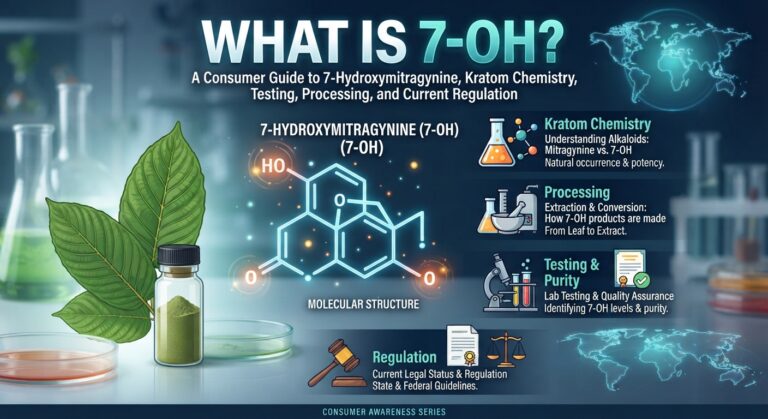
The distinction between natural kratom leaf and concentrated 7-OH has become one of the most important issues in the U.S. kratom marketplace.
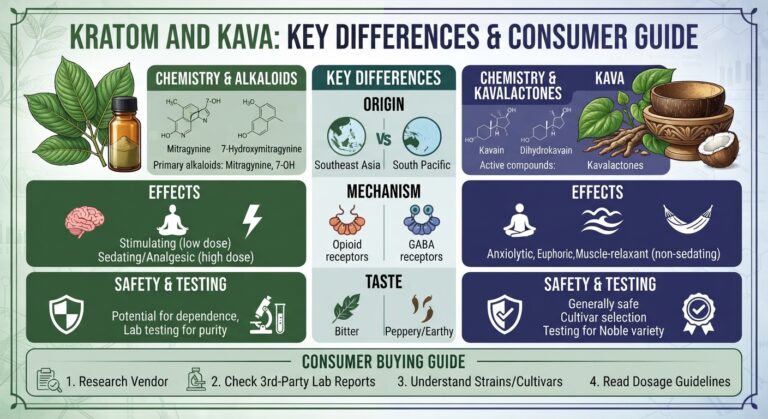
7-hydroxymitragynine—usually shortened to 7-OH—occurs naturally in kratom in trace quantities.
But concentrated or enhanced 7-OH products have emerged in formats including tablets, gummies, drink mixes and shots.
FDA recommends that consumers avoid products containing added or enhanced 7-OH and states that these products have not been demonstrated to be safe or effective for any use.
Federal activity intensified further in 2026.
On July 1, 2026, according to FDA, the Drug Enforcement Administration announced the beginning of a temporary scheduling process involving 7-OH above a proposed specified threshold and three synthetic derivatives: mitragynine pseudoindoxyl, MGM-15 and MGM-16.
FDA explains that the federal actions are intended to target concentrated and synthetic 7-OH products rather than natural kratom leaf containing naturally occurring trace levels.
The process and applicable thresholds should be checked against current federal information because the regulatory situation is developing.
For consumers who buy kratom, this creates an essential rule:
Read the actual product composition rather than assuming everything marketed around kratom is equivalent.
Is Kratom FDA Approved?
No FDA-approved kratom treatment is currently legally marketed in the United States.
FDA states that there are no legally marketed prescription or over-the-counter drug products containing kratom or its known alkaloids.
The agency also states that, under its current regulatory interpretation, kratom is not lawfully marketed as a dietary supplement and cannot lawfully be added to conventional food.
This means terms such as:
- Lab tested
- GMP
- Third-party tested
- AKA GMP qualified
- Registered facility
should never be interpreted as meaning FDA approved.
Consumers who buy kratom should treat claims implying FDA product approval as a significant reason to investigate further.
What Does AKA GMP Qualified Mean?
The American Kratom Association operates an industry Good Manufacturing Practices Standards Program.
Its qualified-vendor program can provide consumers with information about participating companies and manufacturing practices.
But context matters.
AKA is an industry organization, not the FDA.
Its vendor program should therefore be treated as one piece of evidence rather than a government product approval.
Kratom Verdict recommends combining manufacturing-program information with:
- Current batch testing
- COA accessibility
- Traceability
- Product labeling
- Contaminant screening
- Responsible marketing
No badge should eliminate the need for verification.
Should You Buy Kratom Based on Strain Name?
Not by itself.
Retail kratom commonly uses names such as:
- Red Bali
- Green Maeng Da
- White Borneo
- Green Malay
- Red Maeng Da
These labels can be useful for product identification within a seller’s catalog, but consumers should be cautious about assuming that strain names function like standardized pharmaceutical formulations.
The scientific evidence does not establish that every commercial product sharing a strain name has identical alkaloid composition or predictable effects.
Agricultural variation, processing and vendor labeling practices can matter.
Before you buy kratom, laboratory documentation and batch information provide more objective information than color or strain name alone.
Does More Mitragynine Mean Better Kratom?
No.
Mitragynine is a major alkaloid in kratom and is scientifically important.
But a higher percentage does not prove:
- Better contaminant control
- Better manufacturing
- More accurate labeling
- Better traceability
- Greater suitability for an individual
- Better overall value
Consumers should therefore resist marketing that reduces quality to a single potency number.
When you buy kratom, composition and quality should be evaluated separately.
What Current Human Research Says
The scientific evidence surrounding kratom is evolving.
A randomized, double-blind, placebo-controlled study published in 2026 evaluated a specific standardized dried kratom leaf powder in 116 healthy volunteers.
Researchers studied single doses and 15 daily administrations under controlled conditions.
No serious adverse events or deaths were reported in that study. Treatment-emergent adverse events generally increased with dose, with reported effects including dizziness and nausea after single doses and headache, feeling hot, increased alanine aminotransferase and nausea among common events after repeated dosing.
A separate 2026 analysis of abuse-potential-related outcomes from controlled oral dried-leaf administration reported modest dose-related subjective effects, minimal withdrawal symptoms under the tested conditions, and no serious adverse events or deaths.
These findings add valuable controlled human evidence.
But they do not establish that every commercial kratom product is safe.
The research involved a particular characterized dried-leaf preparation, selected healthy participants and defined experimental conditions. The results should not automatically be extrapolated to extracts, concentrated 7-OH products, different patterns of use, polysubstance exposure or people with medical conditions.
FDA continues to express significant safety concerns regarding kratom and reports adverse events including liver toxicity, seizures and substance use disorder.
The responsible interpretation lies between oversimplified extremes.
Safety Cannot Be Determined From a COA Alone
A clean contaminant report answers a product-quality question.
It does not answer every medical question.
A COA may tell you about:
- Lead
- Arsenic
- Mercury
- Cadmium
- Salmonella
- E. coli
- Alkaloid concentrations
It cannot tell you whether a particular person will experience an adverse effect.
Health status, medications, other substances, product composition and patterns of use can all matter.
People who are pregnant or nursing, have significant health conditions, take prescription medication, or have concerns about dependence or interactions should seek appropriately qualified professional medical advice.
A guide explaining how to buy kratom responsibly should not substitute commercial product testing for medical guidance.
Drug Interactions Deserve Serious Attention
Kratom contains pharmacologically active alkaloids.
Research has identified potential mechanisms for pharmacokinetic and pharmacodynamic interactions with other substances and medications.
Clinical evidence remains incomplete, and interaction risk can vary substantially depending on the substances involved.
Consumers should therefore be cautious about combining kratom with prescription drugs, alcohol or other psychoactive substances without appropriate medical guidance.
A vendor claiming that its product is universally safe because it is “natural” is not providing adequate scientific context.
Medical Claims Are a Major Vendor Red Flag
Consumers often encounter claims that kratom can help with pain, mood, energy or opioid withdrawal.
Anecdotal reports and survey findings about why people use kratom are not equivalent to FDA-approved therapeutic indications.
A seller should receive additional scrutiny if it promises its product will:
- Cure chronic pain
- Treat anxiety
- Treat depression
- Treat opioid use disorder
- Guarantee withdrawal relief
- Replace prescription medication
- Cure a disease
- Produce guaranteed medical results
FDA has previously taken enforcement action against companies making unapproved therapeutic claims involving kratom.
When deciding where to buy kratom, responsible marketing matters.
Is It Legal to Buy Kratom?
Legal status varies by jurisdiction.
Federal regulatory status does not tell you everything about state or local law.
Some jurisdictions restrict or prohibit kratom, while others regulate aspects such as age, labeling or product composition.
The regulatory environment for concentrated 7-OH is also changing separately.
Before purchasing, verify:
- Current state law
- Applicable local ordinances
- Minimum-age requirements
- Product-specific restrictions
- Vendor shipping exclusions
Do not rely solely on a retailer accepting your ZIP code.
A checkout system is not a legal opinion.
Consumers who buy kratom should confirm the rules applicable to their location at the time of purchase.
How Much Should Kratom Cost?
There is no universal price that establishes quality.
Pricing depends on:
- Quantity
- Format
- Processing
- Packaging
- Laboratory testing
- Shipping
- Vendor overhead
- Product concentration
Consumers commonly see lower per-gram prices when purchasing larger quantities.
But “cheap” and “good value” are different concepts.
A slightly more expensive product with batch-specific testing and transparent contaminant screening may offer more documented value than an inexpensive product whose origin and laboratory status cannot be verified.
The reverse is also true: expensive branding does not prove superior quality.
When you buy kratom, compare the evidence alongside the price.
Shipping Matters—But Do Not Let Speed Replace Due Diligence
“Fast shipping” is a popular commercial search term.
It is understandable. Nobody wants an order sitting unprocessed for a week.
But shipping speed should come after product verification.
Check:
- Processing cutoff times
- Carrier options
- Tracking
- Shipping fees
- Free-shipping thresholds
- Destination restrictions
- Lost-package procedures
- Delivery estimates
Remember that estimated shipping times are not always guaranteed delivery times.
Carrier delays, weekends, weather and address issues can affect delivery.
The fastest seller is not automatically the best place to buy kratom.
Check the Refund Policy Before Checkout
A clear return policy is another useful transparency signal.
Before purchasing, determine:
- Return-window length
- Whether opened products can be returned
- Whether clearance products are excluded
- Whether return authorization is required
- Who pays return postage
- Whether refunds or store credit are issued
- How damaged orders are handled
Policies vary significantly.
Checking them before purchase prevents unpleasant surprises later.
Can Customer Reviews Tell You Which Kratom Is Best?
Reviews can be useful.
But their usefulness has limits.
Customer feedback may help evaluate:
- Shipping experience
- Packaging
- Customer support
- Ordering convenience
- Refund handling
- Repeat-purchase satisfaction
Reviews cannot independently establish:
- Heavy-metal concentration
- Microbial contamination
- Alkaloid content
- Laboratory accuracy
A customer cannot see lead or Salmonella in powder.
That is why Kratom Verdict uses different evidence for different questions.
If you buy kratom based on reviews, use those reviews for the things consumers can reasonably observe and laboratory documentation for analytical claims.
Buying Option
Online Vendor vs Local Store: Which Is Better?
Neither automatically wins.
An online specialist may provide detailed COAs, batch lookups and testing policies.
A physical retailer may let you inspect packaging immediately and purchase without shipping.
The determining factor should remain transparency.
Ask:
Can I identify the manufacturer?
Can I identify the product?
Can I identify the batch?
Can I verify the laboratory documentation?
If the answer is yes, the purchasing channel becomes less important.
How to Spot a Questionable Kratom Seller
Before you buy kratom, watch for patterns rather than one isolated imperfection.
Major warning signs include:
- No accessible laboratory documentation
- No identifiable company information
- No lot or batch information
- “FDA approved” product claims
- Disease-treatment promises
- Generic testing badges without supporting evidence
- Reports that cannot be linked to inventory
- Unclear product composition
- Concentrated products disguised as ordinary leaf
- No return information
- Unclear shipping restrictions
- Extraordinary potency claims
- Unverifiable certifications
- High-pressure countdown marketing
- Claims that a product is completely risk-free
The more extraordinary the promise, the stronger the supporting evidence should be.
The Kratom Verdict 15-Point Buying Test
Consumers can use this framework before making a purchase.
Give the vendor one point for each “yes.”
Product Verification
- Is the exact product clearly identified?
- Is a batch or lot number available?
- Can that number be linked to a COA?
Laboratory Transparency
- Is the laboratory identifiable?
- Is the report reasonably current?
- Is heavy-metal testing included?
- Is microbial testing included?
- Is alkaloid information available where relevant?
Business Transparency
- Can you identify the company?
- Is customer support accessible?
- Is the shipping policy clear?
- Is the refund policy clear?
Responsible Marketing
- Does the company avoid FDA-approval misrepresentation?
- Does it avoid disease-treatment promises?
- Does it clearly distinguish concentrated products from ordinary leaf?
This is not a scientific safety score.
It is a due-diligence tool.
A seller scoring well gives consumers more independently verifiable information before they buy kratom.
What to Check When the Package Arrives
Consumer verification should continue after checkout.
When the package arrives:
Check the Seal
Look for damaged or compromised packaging.
Confirm the Product
Make sure the item received matches what was ordered.
Find the Batch Number
Compare it with the laboratory documentation.
Check the Label
Confirm the product type and relevant ingredient information.
Recheck the COA
If the vendor shipped a different batch from the one displayed online, retrieve the report corresponding to the batch you actually received.
This final step closes the traceability loop.
Frequently Asked Questions
Where is the best place to buy kratom?
There is no universally best seller for every consumer. A stronger purchasing choice is a vendor providing current third-party laboratory testing, batch traceability, contaminant screening, clear product labeling, transparent policies and responsible marketing. Evaluate the evidence attached to the actual product rather than relying solely on rankings.
Is it better to buy kratom online?
Online purchasing can make it easier to compare COAs, testing policies, prices and product information. However, an online sales channel does not automatically establish superior quality. Product-level evidence matters more than where checkout occurs.
How do I know whether kratom is real?
Start with manufacturer identification, product labeling, batch information and laboratory documentation. A COA can provide analytical information about a sample, but consumers should confirm that the report corresponds to the product and batch being purchased.
Should I buy kratom powder or capsules?
The choice depends largely on format preference and product characteristics. Capsules can be convenient, while powder may offer different pricing and packaging options. Neither format automatically provides better quality. Verify testing and traceability for either.
Is lab-tested kratom completely safe?
No. Laboratory testing can provide evidence about the characteristics actually tested, such as selected contaminants and alkaloids, but cannot guarantee a product is risk-free or appropriate for a particular person.
Is kratom FDA approved?
There are currently no legally marketed FDA-approved prescription or over-the-counter drug products containing kratom or its known alkaloids. Consumers should not interpret terms such as “GMP” or “lab tested” as FDA product approval.
Are kratom extracts stronger than powder?
Extracts are concentrated formulations and can differ materially from plain leaf powder. Avoid judging products simply by terms such as “strong.” Read concentration and alkaloid information carefully.
Are 7-OH products regular kratom?
Concentrated or enhanced 7-OH products should not be treated as equivalent to natural kratom leaf. FDA specifically distinguishes concentrated 7-OH products from the trace levels naturally occurring in kratom and recommends consumers avoid added or enhanced 7-OH products.
Can I legally buy kratom in every U.S. state?
No. State and local rules vary, and product-specific restrictions may also apply. Check current government information for your jurisdiction before ordering or possessing kratom.
What is the most important thing to check before buying?
If only one habit is adopted, make it product verification: identify the exact product and batch, then locate the corresponding laboratory documentation. From there, evaluate contaminant testing, labeling and vendor transparency.
Kratom Verdict: Final Assessment
Consumers who buy kratom in 2026 face a market that is more complicated than a simple comparison of Red Bali, Green Maeng Da or White Borneo.
The real differences often exist behind the label.
Laboratory testing matters.
Batch traceability matters.
Contaminant screening matters.
Product identification matters.
Responsible marketing matters.
And increasingly, distinguishing ordinary botanical leaf from concentrated 7-OH products matters.
Current scientific evidence also requires nuance.
Controlled 2026 human research involving a specific standardized dried-leaf preparation reported no serious adverse events under the studied conditions and contributes important new evidence. But those results cannot establish the safety of every commercial kratom product or every pattern of use.
FDA continues to identify serious safety concerns and maintains that no kratom-containing prescription or OTC drug is legally marketed in the United States. The agency has also intensified its focus on concentrated 7-OH products, with significant federal regulatory developments occurring in July 2026.
These facts are not contradictory when interpreted carefully.
Different evidence can address different products, populations and questions.
For someone preparing to buy kratom, Kratom Verdict recommends a straightforward hierarchy:
Verify what the product is.
Verify which batch you are buying.
Find the laboratory report.
Check what was actually tested.
Look for heavy-metal and microbial screening.
Distinguish plain leaf from concentrated products.
Verify current legal restrictions.
Read shipping and return policies before paying.
Reject unsupported medical promises.
Recheck the batch when the package arrives.
No vendor deserves permanent trust simply because it appears first in a ranking, has attractive packaging or has accumulated thousands of customer reviews.
Trust should be supported by evidence that remains open to inspection.
That is the principle Kratom Verdict believes consumers should carry into every decision to buy kratom:
The more important the claim, the easier a responsible seller should make it for you to verify.
Kratom Verdict investigates the details consumers should check before making decisions in the kratom market. Our objective is not to tell consumers what they must purchase, but to provide a stronger framework for determining what deserves their confidence.
Sources & References
1. U.S. Food and Drug Administration (FDA) — FDA and Kratom
Federal information covering kratom’s regulatory status, scientific research, safety concerns, reported adverse events and FDA’s current position on kratom-containing products.
Source: FDA — FDA and Kratom
2. U.S. Food and Drug Administration — Hiding in Plain Sight: 7-OH Products (Updated July 13, 2026)
Current federal information covering concentrated 7-OH products and the July 2026 DEA/HHS regulatory developments involving 7-OH above a proposed threshold and synthetic derivatives.
Source: FDA — Hiding in Plain Sight: 7-OH Products
3. U.S. Food and Drug Administration — Products Containing 7-OH Can Cause Serious Harm
FDA consumer guidance distinguishing naturally occurring trace 7-OH in kratom leaf from products containing added or enhanced levels and explaining the agency’s safety concerns.
Source: FDA — Products Containing 7-OH Can Cause Serious Harm
4. Huestis MA et al. — Safety and Tolerability of Single and Multiple Daily Oral Doses of Dried Kratom Leaf Powder in a Randomized Trial in Healthy Volunteers (2026)
Randomized, double-blind, placebo-controlled research involving a specific standardized dried kratom leaf preparation.
Source: PubMed — PMID 41486478
5. Coe M et al. — Assessment of Abuse Potential-Related Effects of Oral Dried Kratom Leaf Powder in Healthy Normal Participants Following Single and Multiple Daily Doses (2026)
Randomized controlled research evaluating abuse-potential-related outcomes following administration of a defined dried-leaf preparation.
Source: PubMed — PMID 42144893
6. U.S. Food and Drug Administration — Laboratory Analysis of Kratom Products for Heavy Metals
Federal laboratory analysis of 30 commercial kratom products providing important context for heavy-metal screening and product-quality evaluation.
Source: FDA — Laboratory Analysis of Kratom Products for Heavy Metals
7. U.S. Food and Drug Administration — Multistate Salmonella Investigation Linked to Kratom Products (2018)
Historical federal investigation documenting a multistate Salmonella outbreak associated with products reported to contain kratom, demonstrating why microbial screening and supply-chain controls matter.
Source: FDA — Salmonella Investigation Linked to Kratom
8. U.S. Food and Drug Administration — Better Weather Fix Elixir Recall (May 28, 2026)
Recall announcement involving Better Weather Fix Elixir because products may contain undeclared mitragynine and mitragynine pseudoindoxyl, illustrating the importance of accurate composition disclosure and labeling.
Source: FDA — Better Weather Fix Elixir Recall
9. American Kratom Association — GMP Qualified Vendors
Current industry directory for companies participating in the AKA GMP Standards Program. AKA states that qualified vendors must complete an annual independent third-party audit and that inclusion should not be interpreted as AKA endorsement of a vendor or product.
Source: American Kratom Association — GMP Qualified Vendors
Related Kratom Verdict Guides
Expand your knowledge of Best Kratom Brands for Pain Relief through our independent educational guides covering botanical science, laboratory testing, Certificates of Analysis, transparency standards, and vendor evaluation.
Kratom Fundamentals
- What Is Kratom? (2026): The Complete Beginner’s Guide
- Kratom Buying Guide (2026)
- Kratom Safety & Side Effects (2026)
- Kratom Legality Guide (2026)
Laboratory & Transparency
- Kratom Alkaloids Explained
- Kratom Lab Testing Explained
- Third-Party Lab Testing Explained
- How to Read a Kratom Certificate of Analysis (COA)
- How to Verify a Kratom COA
- AKA GMP Certification Explained