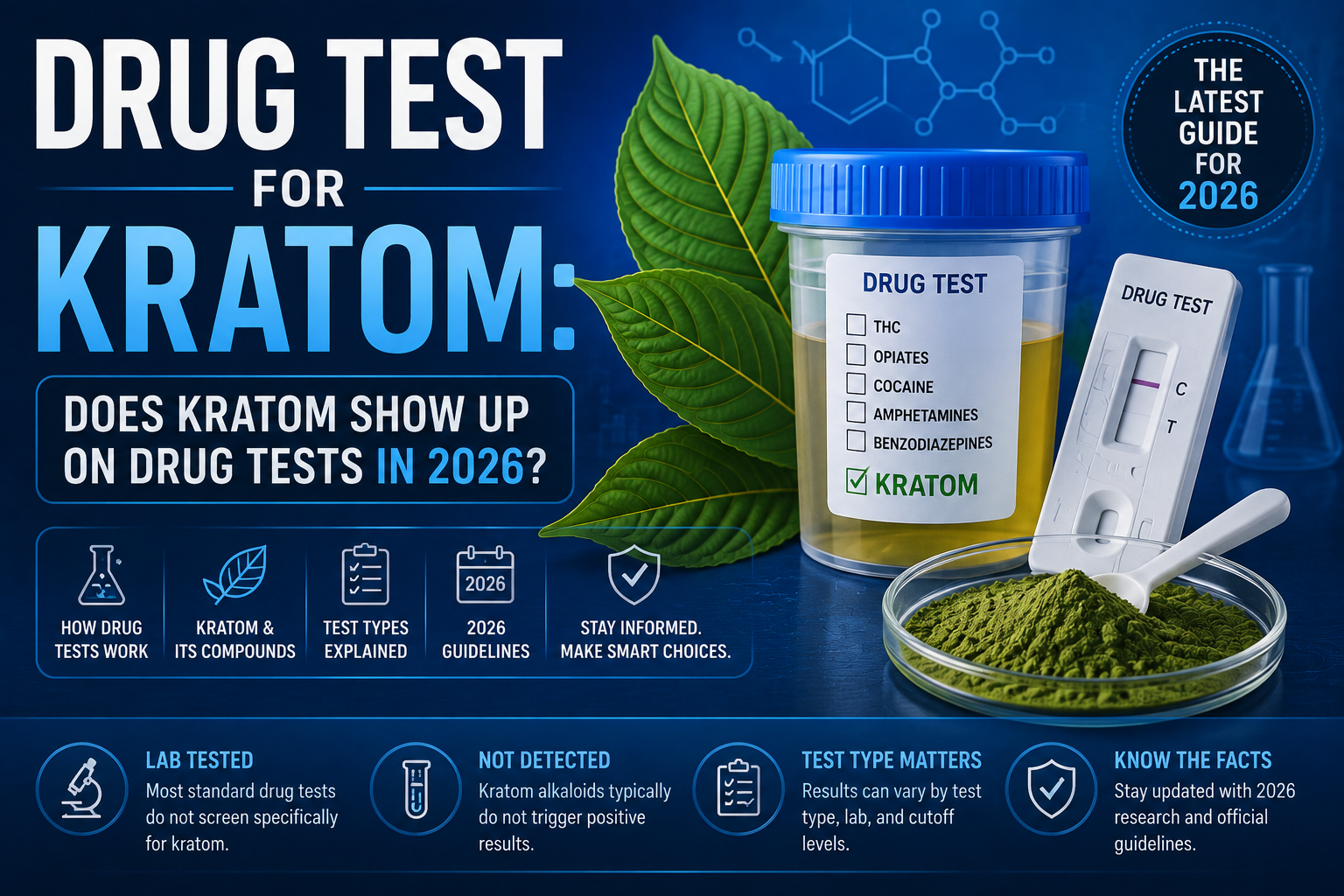
A drug test for kratom is possible, but kratom is not automatically detected by every routine workplace drug screen. Standard federally regulated testing panels focus on specified drug classes and do not currently list mitragynine—the major alkaloid associated with kratom—as a required analyte. Specialized laboratory testing, however, can identify mitragynine and other kratom-related alkaloids or metabolites in biological samples, particularly urine.
That distinction answers the most common question immediately: kratom can be tested for, but whether it will be detected depends on what the laboratory is actually instructed and equipped to test.
A standard workplace panel and a specialized toxicology test are not the same thing.
For anyone facing employment, clinical, legal, probation, treatment-program or other testing, the safest assumption is that the testing organization determines its own applicable panel unless a specific federal testing rule controls it. Kratom Verdict does not recommend trying to predict or defeat a drug test; when the consequences matter, obtain the actual testing policy from the employer, agency, clinician, laboratory or program involved.
Drug Test for Kratom: Quick Answer
Here is the central distinction:
| Testing situation | Is kratom routinely included? | Can kratom be specifically detected? |
|---|---|---|
| DOT-regulated drug test | Kratom is not one of the required drug classes | Not as part of the standard DOT panel |
| Federal workplace testing | Mitragynine is not listed on the standard federal panel | Specialized testing exists outside the standard panel |
| Typical multi-drug screening | Depends on the panel ordered | Yes, if an appropriate kratom/mitragynine assay is included |
| Specialized toxicology testing | Potentially | Yes |
| Targeted urine testing for mitragynine | Yes, when specifically ordered | Yes |
| Forensic toxicology | Depends on scope | Specialized mass-spectrometry methods can identify kratom alkaloids |
The important phrase is “what was ordered.”
There is no single universal “drug test” that checks every psychoactive substance.
Does Kratom Show Up on a Standard Drug Test?
Usually, consumers asking this question are thinking about a standard employment urine test.
Kratom is different from the substances explicitly included in federally regulated drug-testing panels.
Under current U.S. Department of Transportation rules, DOT laboratories test specimens for marijuana metabolites, cocaine metabolites, amphetamines, opioids and phencyclidine (PCP). Kratom or mitragynine is not listed as an additional DOT drug category.
That means a routine DOT test is not itself a drug test for kratom.
The European Union Drugs Agency has likewise noted that conventional immunological drug screening is not known to detect kratom alkaloids.
However, this should not be interpreted as meaning kratom is impossible to detect.
It means the laboratory must use testing capable of identifying kratom-related compounds.
Buying Option
What Does a Drug Test for Kratom Actually Detect?
Testing does not usually search for the word “kratom.”
Laboratories identify chemical analytes.
For kratom, one of the most important analytes is mitragynine, a major naturally occurring alkaloid in Mitragyna speciosa.
Other compounds that may be relevant to specialized testing include:
- 7-hydroxymitragynine
- Speciociliatine
- Speciogynine
- Mitraciliatine
- Mitragynine metabolites
Researchers have developed laboratory methods capable of identifying several of these compounds in urine.
This makes the wording of the test important.
A test specifically designed for mitragynine is fundamentally different from a conventional multi-drug immunoassay that does not include mitragynine.
Can Kratom Be Detected in Urine?
Yes.
The scientific literature clearly demonstrates that mitragynine and other kratom-related compounds can be measured in human urine using appropriate analytical methods.
A 2009 study published in the Journal of Chromatography B developed a high-performance liquid chromatography-tandem mass spectrometry method for measuring mitragynine in human urine.
Researchers reported an analytical detection limit of 0.02 ng/mL under that specific laboratory method.
Later research expanded the analytical picture.
A 2018 validation study developed a liquid chromatography-tandem mass spectrometry method capable of quantitatively detecting mitragynine and selected metabolites in human urine.
Another 2018 study used high-resolution mass spectrometry to identify multiple Mitragyna alkaloids in urine, including mitragynine, speciociliatine, speciogynine, paynantheine and 7-hydroxymitragynine.
So if someone asks whether a drug test for kratom can use urine, the evidence-based answer is clearly yes.
What cannot be inferred from that answer is whether a particular employer, clinic or testing program has ordered such an analysis.
Standard Drug Screen vs Specialized Kratom Testing
This is the distinction that many online explanations miss.
Standard Screening
Many drug-testing programs are designed to detect a defined group of commonly tested substances.
A testing panel might include analytes related to:
- Cannabis
- Cocaine
- Amphetamines
- Opioids
- PCP
Other panels may include additional substances.
But inclusion is determined by the specific test.
Targeted Kratom Testing
A targeted drug test for kratom uses an assay or analytical method intended to identify mitragynine or other relevant compounds.
Specialized methods can include techniques such as:
- Liquid chromatography-tandem mass spectrometry (LC-MS/MS)
- Liquid chromatography-high-resolution mass spectrometry (LC-HRMS)
- Other validated analytical approaches
Mass spectrometry provides substantially greater chemical specificity than simply assuming that all psychoactive substances trigger the same screening assay.
Is Kratom Included in a DOT Drug Test?
Under current DOT regulations, no.
The Department of Transportation states that DOT drug-testing laboratories must test for five drugs or drug classes:
- Marijuana metabolites
- Cocaine metabolites
- Amphetamines
- Opioids
- Phencyclidine (PCP)
DOT further states that laboratories must not test DOT specimens for other drugs.
Mitragynine is not included in that required list.
Therefore, a federally regulated DOT specimen is not a routine drug test for kratom.
This is an important distinction for transportation workers because people often confuse private employer testing with DOT-regulated testing.
A company may have policies outside the DOT testing process, but those should not be conflated with the federally regulated DOT specimen.
Is Kratom Included in Federal Workplace Drug Testing?
Federal workplace testing also operates under defined HHS/SAMHSA guidelines and authorized testing panels.
SAMHSA’s current federal workplace materials provide specific authorized drug-testing panels and procedures.
Kratom/mitragynine is not listed as a routine analyte on the standard federal workplace panel.
Again, that does not mean laboratory science cannot identify kratom.
It means a standard federal workplace test and a specialized drug test for kratom have different scopes.
This distinction matters because broad statements such as “kratom doesn’t show up on drug tests” are misleading.
The accurate statement is:
Kratom is not part of certain standard federally regulated panels, but targeted laboratory methods can detect kratom-related alkaloids.
Can an Employer Test Specifically for Kratom?
Potentially, depending on applicable law, employer policy, the testing program and laboratory capabilities.
Private workplace testing is not necessarily identical to DOT or federal-employee testing.
An employer, treatment program, healthcare organization or other entity may use a broader or different testing panel where legally permitted.
Commercial laboratory technology for mitragynine screening exists.
For example, Thermo Fisher Scientific markets a CEDIA Mitragynine assay specifically designed to detect mitragynine.
Therefore, someone should not assume that a workplace test excludes kratom merely because the standard federal DOT panel does.
If employment consequences depend on the answer, obtain the actual written drug-testing policy rather than relying on assumptions about a “5-panel” or “10-panel” test.
Can a 5-Panel Drug Test Detect Kratom?
A conventional five-panel test is generally aimed at specified commonly tested drug categories rather than every psychoactive compound.
Kratom requires consideration of its own alkaloids, particularly mitragynine.
Therefore, a conventional five-panel test should not be described as a dedicated drug test for kratom.
But consumers should avoid relying on the label “5-panel” alone.
Different organizations may order additional tests separately, and testing practices outside federally regulated programs can differ.
The laboratory requisition or testing policy is more authoritative than an informal description.
Can a 10-Panel Drug Test Detect Kratom?
The same principle applies.
“10-panel” does not automatically mean “kratom test.”
The number tells you how a particular test is organized, not that every possible substance is covered.
The correct question is:
Does this specific panel include mitragynine or another kratom-related analyte?
Without the analyte list, it is unsafe to make a categorical prediction.
Can Kratom Cause a Positive Opioid Test?
Kratom has pharmacological activity involving opioid receptors, but pharmacology and toxicology screening are different subjects.
A substance does not automatically produce a positive opioid screen merely because it interacts with opioid receptors.
Drug tests identify particular chemicals, metabolites or patterns of chemical reactivity.
Mitragynine is chemically distinct from conventional opioid analytes targeted in federally regulated opioid testing.
That is why a drug test for kratom generally requires analytical attention to mitragynine or related compounds rather than simply treating kratom as another standard opioid analyte.
False-positive and cross-reactivity questions should be evaluated in relation to the exact assay being used.
If an initial screening result has serious consequences, confirmation by a more specific analytical method and review under the applicable testing program can be important.
Screening Tests and Confirmatory Tests Are Different
Understanding this distinction helps make sense of drug-testing terminology.
Initial Screening
An initial test is designed to efficiently screen specimens for particular analytes or drug classes.
Immunoassays are commonly associated with screening because they can process many specimens efficiently.
Confirmation
More specific analytical techniques may be used to identify and quantify compounds with greater precision.
Mass-spectrometry-based methods play an important role in modern toxicology.
For a specialized drug test for kratom, researchers have repeatedly demonstrated the usefulness of liquid chromatography coupled with mass spectrometry.
This distinction is also why a screening result should not automatically be interpreted as a complete chemical analysis of everything in a specimen.
How Laboratories Identify Kratom Use
Research has become increasingly sophisticated.
A 2023 paper in Drug Testing and Analysis examined analytical challenges surrounding mitragynine and kratom.
Kratom contains several structurally related alkaloids, including:
- Mitragynine
- Mitraciliatine
- Speciogynine
- Speciociliatine
These compounds are diastereomers: they share the same molecular formula and connectivity but differ in spatial arrangement.
Researchers found that a routine LC-HRMS method did not adequately separate several of these compounds. An improved chromatographic method allowed the individual substances to be separated.
In 29 patient urine samples previously testing positive for mitragynine using the routine method, researchers identified all four diastereomers in varying proportions.
The presence of multiple characteristic alkaloids can therefore provide more information than measuring one compound alone.
This illustrates why a sophisticated drug test for kratom is a laboratory analytical problem, not simply another line on a basic home drug-test strip.
Kratom Biomarkers in Urine
Mitragynine is not the only potential marker.
A 2020 study investigated urinary biomarkers associated with kratom.
Researchers identified mitragynine along with other compounds that could contribute to detecting exposure, including speciociliatine, speciogynine, 9-O-demethylmitragynine and 7-hydroxymitragynine.
Some alternative biomarkers occurred at substantial concentrations in the studied specimens.
This research is particularly important because botanical products contain mixtures of related alkaloids.
Future toxicology testing may therefore become increasingly capable of distinguishing patterns associated with kratom plant material from individual isolated compounds.
How Long Can a Drug Test for Kratom Detect Kratom?
There is no scientifically responsible universal answer such as “exactly three days” or “exactly seven days.”
Detection depends on multiple factors:
- What analyte is being measured
- Test sensitivity and cutoff
- Specimen type
- Product composition
- Exposure pattern
- Individual pharmacokinetics
- Metabolism
- Time between exposure and specimen collection
- Laboratory methodology
Human pharmacokinetic research demonstrates substantial complexity.
An early human study involving chronic regular users estimated a median terminal mitragynine half-life of approximately 23 hours, with considerable variability.
More recent controlled research has reported different half-life estimates under different study conditions.
A 2024 controlled study of encapsulated dried kratom leaf powder found that mitragynine pharmacokinetics varied by dose and single versus repeated exposure, with the highest reported mean half-life estimates substantially longer than those in some earlier work.
A 2026 study of concentrated kratom extract further demonstrated that pharmacokinetics differ according to formulation and exposure conditions.
These findings are precisely why Kratom Verdict does not publish a countdown claiming when someone will “pass” a drug test for kratom.
Pharmacokinetic half-life is not the same thing as a guaranteed drug-testing detection window.
Why Online “Detection Window Calculators” Can Be Misleading
A calculator may ask for body weight, amount consumed and time since use and then produce a precise-looking result.
That precision can be false.
A laboratory result depends on the analyte, assay, cutoff and specimen—not merely a person’s weight and elapsed time.
Kratom products themselves also vary.
Plain leaf powder, tea, extracts and concentrated alkaloid products are not chemically identical exposure scenarios.
Repeated exposure may also produce different pharmacokinetic patterns from a single exposure.
For this reason, a responsible article about a drug test for kratom should explain uncertainty rather than manufacture a guaranteed timetable.
Can a Hair Test Detect Kratom?
The strongest published analytical evidence for kratom testing has historically centered heavily on urine and blood/plasma methods.
Whether hair is analyzed for mitragynine depends on the laboratory, test methodology and purpose of the investigation.
Hair toxicology can be used for various drugs, but consumers should not assume that a standard hair panel automatically includes kratom.
If a specific program claims to conduct a drug test for kratom using hair, the relevant questions are which analyte is tested, which laboratory performs the analysis, what method is validated and what cutoff or interpretation criteria are used.
Can a Blood Test Detect Kratom?
Yes, mitragynine and 7-hydroxymitragynine have been measured in human plasma in pharmacokinetic research.
Controlled human studies have repeatedly used validated analytical techniques to measure kratom alkaloids in plasma after administration of defined kratom preparations.
However, clinical pharmacokinetic measurement is not synonymous with routine workplace testing.
Blood/plasma testing may be relevant in clinical, forensic or research contexts, but urine remains particularly important in drug-testing literature.
Can a Saliva Test Detect Kratom?
Oral-fluid testing exists for many drugs, but standard federal oral-fluid panels should not automatically be assumed to include mitragynine.
As with every specimen type, the critical issue is the analyte and method.
A testing organization specifically interested in kratom would need an appropriate validated approach.
The existence of oral-fluid drug testing generally does not mean that every oral-fluid specimen is a drug test for kratom.
Can Home Drug Tests Detect Kratom?
Most ordinary consumer multi-panel home drug tests should not be assumed to test for mitragynine unless the manufacturer explicitly identifies kratom or mitragynine as an analyte.
Consumers should read the test documentation.
Do not infer kratom coverage from statements such as:
- “12-panel”
- “complete drug test”
- “opioid test”
- “all-in-one test”
The analyte list matters.
Specialized mitragynine assays exist, but that is different from saying every home drug-testing kit detects kratom.
Does Kratom’s Legal Status Determine Whether It Can Be Tested?
No.
Drug-testing capability and legal classification are separate questions.
A substance does not need to be included on a particular controlled-substance schedule before a laboratory can develop an analytical method for it.
Likewise, a substance being legal in a particular jurisdiction does not necessarily prevent an employer, treatment program, sports organization or other entity from establishing policies concerning it where permitted by law.
Therefore, legality does not answer whether a drug test for kratom can detect mitragynine.
Testing policy, analytical capability and applicable law must be considered separately.
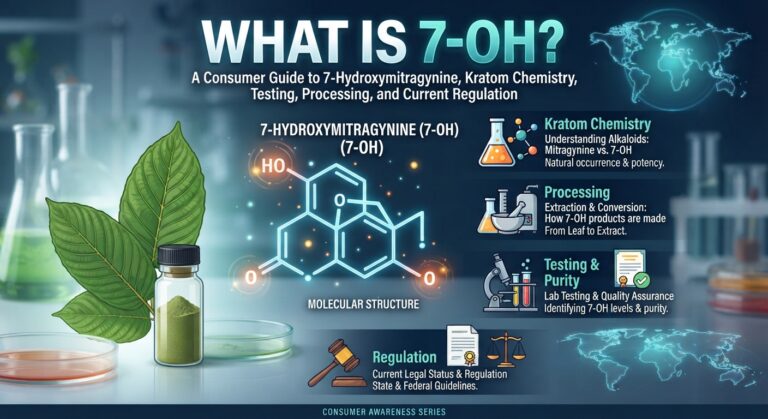
What About Concentrated 7-OH Products?
Consumers should also understand that the modern kratom marketplace contains products that differ substantially from ordinary dried kratom leaf.
7-hydroxymitragynine, commonly abbreviated 7-OH, occurs naturally in kratom in relatively small amounts, but concentrated or enhanced 7-OH products have created separate regulatory and public-health concerns.
FDA has recently taken significant action concerning concentrated 7-OH products.
From a toxicology perspective, the distinction matters because the composition of the product affects which analytes may be present and at what concentrations.
Someone asking about a drug test for kratom should therefore avoid assuming that every product sold under kratom-related marketing creates an identical analytical profile.
Drug Testing Does Not Establish Impairment by Itself
Another important distinction is frequently overlooked.
Detecting a compound or metabolite in a biological specimen establishes analytical evidence of its presence above the applicable reporting criteria.
That does not automatically establish the degree of impairment at a specific earlier time.
Interpretation depends on:
- Specimen type
- Analyte
- Concentration
- Pharmacokinetics
- Timing
- Testing purpose
- Scientific validation
This distinction matters in forensic, clinical and workplace contexts.
A drug test for kratom answers a toxicological question. It should not automatically be converted into conclusions the test itself was not designed to establish.
Buying Option
What Should You Do If a Kratom Test Has Serious Consequences?
If testing could affect employment, licensing, probation, treatment, athletics or another significant matter, rely on official documentation rather than internet predictions.
Useful questions include:
- What testing panel is being used?
- Is mitragynine specifically included?
- What specimen is being collected?
- Is the result based on screening, confirmation or both?
- Which laboratory performs the analysis?
- Is there a Medical Review Officer or equivalent review process?
- What policy governs the result?
- Is retesting or review available under that policy?
Do not attempt to alter, dilute, substitute or manipulate a specimen.
Apart from potentially invalidating a test, specimen tampering can carry employment, programmatic or legal consequences depending on the circumstances.
The correct way to resolve uncertainty about a drug test for kratom is through the testing policy and laboratory process.
Common Myths About Kratom Drug Testing
Myth 1: “Kratom can never be detected.”
False.
Peer-reviewed analytical methods can identify mitragynine and other kratom-related compounds in urine.
Myth 2: “Every drug test detects kratom.”
Also false.
Standard testing panels examine defined analytes. Kratom is not part of the current standard DOT panel.
Myth 3: “Kratom will automatically test positive as an opioid.”
This oversimplifies toxicology. Mitragynine’s pharmacological activity at opioid receptors does not make it chemically identical to the opioid analytes targeted by standard federal testing.
Myth 4: “A negative five-panel test proves there is no kratom in the specimen.”
No. A test cannot rule out something it was not designed to detect.
Myth 5: “Everyone has the same detection window.”
Human pharmacokinetic research shows substantial variability, and testing methods and cutoffs differ.
These misconceptions are why the phrase drug test for kratom needs to be interpreted according to the actual analytical method.
Frequently Asked Questions
Does kratom show up on a drug test?
It can. Specialized laboratory tests can identify mitragynine and other kratom-related compounds. Kratom is not, however, automatically included in every routine drug-testing panel.
Will kratom show up on a standard 5-panel drug test?
A conventional five-panel test is not generally a dedicated drug test for kratom. The exact analyte list should always be checked because organizations may order additional testing separately.
Is kratom tested on a DOT drug test?
Current DOT regulations require testing for marijuana metabolites, cocaine metabolites, amphetamines, opioids and PCP. Mitragynine is not listed as part of the DOT drug-testing panel.
What does a kratom urine test look for?
Specialized testing commonly focuses on mitragynine, although scientific methods can identify additional kratom alkaloids and metabolites.
Can a laboratory specifically test for kratom?
Yes. Peer-reviewed studies have validated LC-MS/MS and LC-HRMS approaches for detecting mitragynine and related compounds in biological specimens.
How long does kratom stay detectable?
There is no universal guaranteed detection period. Detection depends on the specimen, analyte, laboratory method, cutoff, product, exposure pattern and individual pharmacokinetics. Published half-life values should not be treated as guaranteed pass/fail timelines.
Does kratom cause a false positive for opioids?
Kratom’s activity at opioid receptors does not mean mitragynine is chemically identical to standard opioid test analytes. Cross-reactivity questions depend on the particular assay. Unexpected screening results should be interpreted through appropriate confirmation and review procedures.
Can kratom be detected in blood?
Yes. Controlled human pharmacokinetic studies have measured mitragynine and 7-hydroxymitragynine in plasma using validated analytical techniques.
Can home drug tests detect kratom?
Only if the particular test is designed to detect an appropriate kratom-related analyte such as mitragynine. Do not assume a multi-panel home test includes kratom without checking its documentation.
Can an employer order a drug test for kratom?
Potentially, depending on applicable law, workplace policy and laboratory capabilities. Private workplace testing should not automatically be assumed to follow the exact scope of federally regulated DOT testing.
Kratom Verdict: Final Assessment
A drug test for kratom is scientifically possible, and peer-reviewed toxicology research has demonstrated multiple analytical methods capable of identifying mitragynine and related kratom compounds in biological specimens.
But that fact needs context.
Kratom is not currently one of the drug categories required in standard DOT drug testing, and mitragynine is not automatically included in every routine workplace panel.
That does not mean kratom is “undetectable.”
Specialized testing can identify it.
Urine is particularly well documented in the scientific literature. Researchers have developed and validated mass-spectrometry methods for mitragynine, its metabolites and several other characteristic Mitragyna alkaloids. Commercial mitragynine screening technology also exists.
The evidence therefore supports three conclusions.
First: a routine drug screen and a targeted kratom test are different things.
Second: the only reliable way to determine whether a particular testing program includes kratom is to identify the actual analytes and policy governing that test.
Third: there is no scientifically defensible universal countdown telling every person when a drug test for kratom must become negative.
Human pharmacokinetic research has produced varying half-life estimates under different exposure conditions, and detection also depends on assay sensitivity, cutoff, specimen type, product composition and individual biology.
Kratom Verdict therefore recommends caution with websites offering guaranteed “pass times,” detox formulas or strategies for defeating testing.
Those claims go beyond what the evidence can reliably establish.
If a test has employment, legal, clinical or other serious consequences, obtain the official testing policy and seek appropriate professional guidance rather than trying to infer the result from a generic internet detection-window chart.
The most accurate answer to “Will kratom show up?” is not simply yes or no.
It is:
What is the laboratory testing for?
That is the question that determines whether an ordinary drug screen is actually a drug test for kratom.
Sources & References
1. U.S. Department of Transportation — 49 CFR Part 40 §40.82: What Drugs Do Laboratories Test For?
Official DOT regulation identifying the drugs or drug classes required for DOT testing and explaining the permitted scope of DOT specimen testing.
Source: U.S. Department of Transportation — §40.82
2. Substance Abuse and Mental Health Services Administration (SAMHSA) — Drug-Free Workplace Forms and HHS Mandatory Guidelines
Federal resources covering workplace drug-testing forms, procedures and HHS mandatory guidelines.
Source: SAMHSA — Drug-Free Workplace Forms
3. Lu S, Tran BN, Nelsen JL, Aldous KM — Quantitative Analysis of Mitragynine in Human Urine by High Performance Liquid Chromatography-Tandem Mass Spectrometry (2009)
Peer-reviewed analytical research describing measurement of mitragynine in human urine using HPLC-MS/MS.
Source: PubMed — PMID 19577523
4. Lee MJ et al. — Method Validation in Quantitative Analysis of Phase I and Phase II Metabolites of Mitragynine in Human Urine Using Liquid Chromatography-Tandem Mass Spectrometry (2018)
Validation research describing quantitative analysis of mitragynine and selected metabolites in human urine.
Source: PubMed — PMID 29248503
5. Basiliere S, Bryand K, Kerrigan S — Identification of Five Mitragyna Alkaloids in Urine Using LC-Q/TOF Mass Spectrometry (2018)
Peer-reviewed research examining the identification of multiple Mitragyna alkaloids in urine using high-resolution mass spectrometry.
Source: PubMed — PMID 29459087
6. Helander A et al. — Drug Testing for Mitragynine and Kratom: Analytical Challenges and Medico-Legal Considerations (2023)
Research examining analytical challenges involved in mitragynine and kratom drug testing, including differentiation of related alkaloids.
Source: PubMed — PMID 36258649
7. Kerrigan S et al. — Identification of Metabolites and Potential Biomarkers of Kratom in Urine (2020)
Research investigating mitragynine metabolites and potential urinary biomarkers relevant to toxicological identification of kratom exposure.
Source: PubMed — PMID 32058315
8. Trakulsrichai S et al. — Pharmacokinetics of Mitragynine in Man (2015)
Human pharmacokinetic research examining mitragynine concentrations and pharmacokinetic characteristics.
Source: PubMed — PMID 25995615
9. Huestis MA et al. — Human Mitragynine and 7-Hydroxymitragynine Pharmacokinetics After Single and Multiple Daily Doses of Oral Encapsulated Dried Kratom Leaf Powder (2024)
Controlled human pharmacokinetic research examining mitragynine and 7-hydroxymitragynine following single and repeated administration of a defined dried-leaf preparation.
Source: PubMed — PMID 38474495
10. Huestis MA et al. — Mitragynine and 7-Hydroxymitragynine Plasma Pharmacokinetics in Humans After Single and 15 Multiple Oral Kratom Extract Doses (2026)
Human research characterizing mitragynine and 7-hydroxymitragynine pharmacokinetics following administration of a defined kratom extract preparation.
Source: PubMed — PMID 42266029
11. European Union Drugs Agency (EUDA) — Kratom Drug Profile
Scientific drug profile discussing kratom chemistry, pharmacology and analytical identification of kratom alkaloids.
Source: European Union Drugs Agency — Kratom Drug Profile
Related Kratom Verdict Guides
Expand your knowledge of Best Kratom Brands for Pain Relief through our independent educational guides covering botanical science, laboratory testing, Certificates of Analysis, transparency standards, and vendor evaluation.
Kratom Fundamentals
- What Is Kratom? (2026): The Complete Beginner’s Guide
- Kratom Buying Guide (2026)
- Kratom Safety & Side Effects (2026)
- Kratom Legality Guide (2026)
Laboratory & Transparency
- Kratom Alkaloids Explained
- Kratom Lab Testing Explained
- Third-Party Lab Testing Explained
- How to Read a Kratom Certificate of Analysis (COA)
- How to Verify a Kratom COA
- AKA GMP Certification Explained