Reviewed by Kratom Verdict Editorial Team
Last Updated: July 2026
Estimated Reading Time: 5 minutes
Guide Type: Independent Editorial Comparison Guide
Research Basis: Publicly available botanical literature, regional sourcing information, third-party laboratory documentation, publicly available regulatory resources, scientific literature, and independent editorial research.
Borneo vs Sumatra Kratom are both named for the Indonesian islands they’re grown on, which makes them more geographically grounded than trade names like Bali or Maeng Da. But “grown on the same general region of the world” doesn’t mean interchangeable — climate, harvesting practices, and drying methods differ enough between the two that vendors and long-time users treat them as genuinely distinct origins.
This guide covers what’s actually tied to geography versus what’s reputation and marketing, and — as with any strain comparison — where the lab report should carry more weight than the name on the label.
When comparing Borneo vs Sumatra Kratom, independent laboratory testing provides a more reliable basis for evaluation than regional names alone. Although Borneo and Sumatra are widely recognized commercial classifications, product quality depends on cultivation practices, harvesting methods, post-harvest processing, manufacturing standards, storage conditions, and quality-control procedures. A comprehensive Borneo vs Sumatra Kratom comparison should therefore prioritize objective laboratory documentation instead of promotional descriptions. Consumers should review current batch-specific Certificates of Analysis (COAs), verify independent laboratory testing, and compare measurable quality indicators including alkaloid analysis, heavy metal screening, microbial testing, and moisture content. Throughout this Borneo vs Sumatra Kratom guide, laboratory transparency remains one of the strongest indicators of responsible manufacturing and informed purchasing decisions.
Origin and Growing Conditions
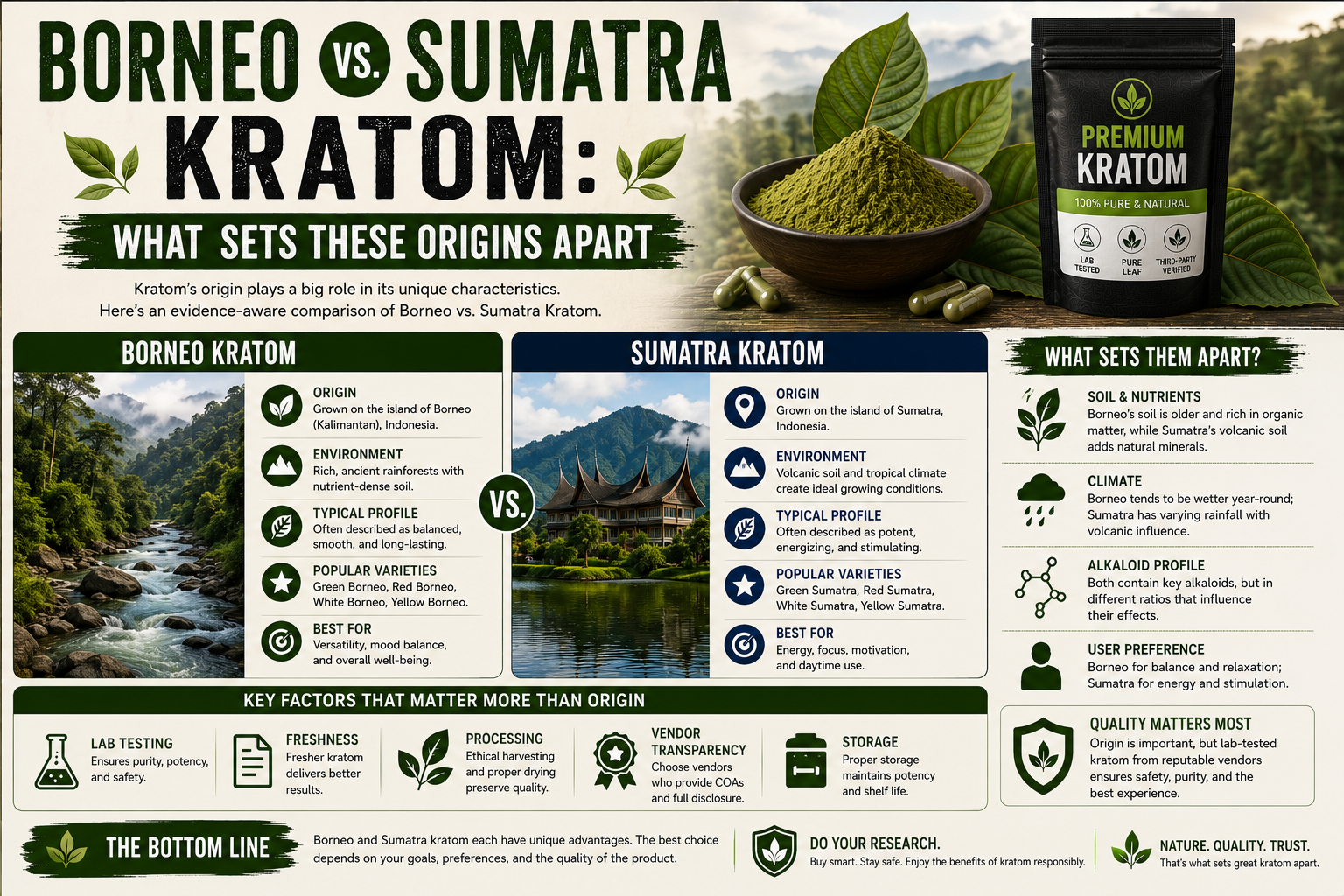
Borneo kratom is grown primarily in the Kalimantan region of Borneo, Indonesia’s largest island. The region’s dense rainforest, high rainfall, and mineral-rich soil support slow, steady tree growth, which vendors commonly associate with a dense, consistent alkaloid profile. Much of what’s sold as “Borneo” comes from wild or semi-wild trees rather than large commercial plantations.
Sumatra kratom comes from Sumatra, Indonesia’s largest island by area, which has a slightly drier and warmer climate profile in the regions where kratom is cultivated. This is commonly cited as the reason Sumatra leaf is associated with a different alkaloid balance and a lighter, sometimes sweeter aroma compared to Borneo.
Both are considered relatively well-established, “classic” origins — used regionally for generations before either became commercial export names — as opposed to more recently developed or selectively bred lines.
Processing Differences
- Borneo is traditionally shade-dried using slower, more traditional methods, which vendors describe as helping preserve the leaf’s natural alkaloid balance.
- Sumatra more commonly undergoes sun-drying or a different fermentation timeline, which is cited as one reason for its distinct color and aroma profile compared to Borneo.
As with any kratom origin, processing details vary meaningfully by vendor and even by batch — “traditional shade-drying” isn’t a certified or standardized process, just a description a vendor may or may not actually follow consistently.
Regional Origins and Commercial Classification
Understanding Borneo vs Sumatra Kratom requires looking beyond regional marketing names and examining documented production practices. While these names generally reference different Indonesian regions, they do not independently determine product quality or consistency. A balanced Borneo vs Sumatra Kratom comparison should evaluate cultivation methods, harvesting techniques, processing standards, storage conditions, and vendor transparency. Consumers researching Borneo vs Sumatra Kratom should compare objective laboratory documentation and publicly available quality information before making purchasing decisions rather than relying solely on commercial product names.
What’s Reported vs. What’s Documented
Alkaloid content in both Borneo and Sumatra is centered on mitragynine and 7-hydroxymitragynine (7-OH), the two most-discussed alkaloids in kratom, alongside dozens of minor compounds. Beyond that baseline, most of what circulates about “Borneo vs. Sumatra” — faster onset, longer duration, cleaner energy vs. more sedating — is drawn from user reports and vendor descriptions rather than standardized lab comparisons. Kratom’s pharmacology in humans is not well studied through controlled clinical research, and the FDA has not evaluated or approved either origin for any use.
Manufacturing Standards and Quality Assurance
Manufacturing quality plays an important role in every Borneo vs Sumatra Kratom comparison. Drying procedures, sanitation practices, packaging methods, storage environments, and quality-control systems all contribute to product consistency. Consumers comparing Borneo vs Sumatra Kratom should prioritize vendors that publish current batch-specific Certificates of Analysis, explain their laboratory testing procedures, and maintain documented manufacturing standards. Independent laboratory verification provides measurable quality indicators that allow products to be compared using objective evidence rather than marketing claims.
A rough summary of how the two are commonly described, with the caveat that none of this is lab-verified across the market as a whole:
| Borneo | Sumatra | |
|---|---|---|
| Primary growing region | Kalimantan, Borneo | Sumatra Island |
| Climate | Humid, high rainfall | Slightly drier, warmer |
| Traditional drying method | Shade-dried | More commonly sun-dried |
| Color/aroma (red vein) | Darker leaf, milder earthy aroma | Lighter red, more pronounced aroma |
| Common vendor description | “Clean,” steady, consistent | Balanced, sometimes longer-lasting |
| Vein colors available | Red, green, white, yellow | Red, green, white |
Treat the last two rows especially as reputation, not fact — these are the descriptions vendors and community forums repeat most often, not results from standardized comparative testing.
Vein Color Still Matters More Than Origin Name
As with most strain comparisons, the vein color — a function of leaf maturity and drying, not the island of origin — is often described as more relevant to the experience than whether the leaf is Borneo or Sumatra:
- Red vein: associated with the longest, slowest-developing profile.
- Green vein: described as a middle-ground profile.
- White vein: associated with a faster onset and shorter overall profile.
A Red Borneo and a Red Sumatra are likely to be more similar to each other than a Red Borneo is to a White Borneo — vein color tends to be the bigger variable, with island of origin adding secondary variation on top of it.
Vendor Transparency
Vendor transparency is another essential factor when evaluating Borneo vs Sumatra Kratom. Companies that openly publish Certificates of Analysis, describe their sourcing practices, identify independent laboratories, and explain their quality-control procedures provide consumers with greater confidence. Readers researching Borneo vs Sumatra Kratom should compare how consistently vendors provide this information before making purchasing decisions. Transparent documentation supports objective comparisons while encouraging responsible manufacturing practices throughout the botanical products industry.
Making an Evidence-Based Comparison
A complete Borneo vs Sumatra Kratom comparison combines laboratory testing, manufacturing standards, sourcing transparency, and independent editorial research into one objective evaluation. Rather than selecting products solely because of regional names, consumers should compare batch-specific laboratory reports, quality-control procedures, vendor documentation, and publicly available educational resources. This Borneo vs Sumatra Kratom guide emphasizes objective information supported by independently verified quality indicators instead of promotional claims, helping readers make informed purchasing decisions.
Consumer Transparency and Evidence-Based Evaluation
A thorough Borneo vs Sumatra Kratom comparison should emphasize consumer transparency and independently verified information rather than commercial branding alone. When researching Borneo vs Sumatra Kratom, consumers should compare current batch-specific Certificates of Analysis (COAs), laboratory testing procedures, manufacturing standards, and documented quality-control practices. Reliable vendors openly publish sourcing information, explain their testing protocols, and provide objective laboratory documentation for every production batch. This Borneo vs Sumatra Kratom guide encourages readers to evaluate measurable quality indicators instead of relying on promotional claims or regional names alone. By focusing on laboratory transparency, responsible manufacturing, and publicly available scientific documentation, a Borneo vs Sumatra Kratom comparison becomes a more reliable educational resource that supports informed purchasing decisions.
Further research on comparison
- Red Kratom vs Green Kratom
- White Kratom vs Green Kratom
- Gold Kratom vs Yellow Kratom
- Horn Kratom vs Elephant Kratom
- Bali vs Maeng Da Kratom
- Thai vs Malay Kratom
- Kapuas vs Riau Kratom
- White Malay vs Green Malay
- White Thai vs White Borneo
- Green Malay vs Green Maeng Da
- Red Bali vs Red Borneo
- Red Bali vs Red Maeng Da
Why Testing Matters More Than the Region on the Label
Unlike Bali or Maeng Da, “Borneo” and “Sumatra” at least correspond to real, identifiable places — but that doesn’t mean the label guarantees anything about what’s in the bag. Kratom sold under either name isn’t subject to any mandatory geographic verification, and mislabeling (intentional or not) does happen in an industry with no federal oversight. Before comparing a Borneo product to a Sumatra product, check for the same baseline regardless of origin claimed:
- A Certificate of Analysis (COA) matched to the specific batch/lot number
- Disclosed mitragynine and 7-OH percentages
- A full contaminant panel (heavy metals, microbials, pesticide/solvent residue)
- Testing from an independent, accredited lab rather than in-house-only results
A well-tested product from either origin is a more reliable choice than an untested one from either — the geography is a starting point for expectations, not a substitute for verification.
Readers interested in learning more about the topics discussed in this Borneo vs Sumatra Kratom comparison can explore educational resources published by the National Center for Complementary and Integrative Health (NCCIH), the United States Pharmacopeia (USP), the International Organization for Standardization (ISO), the Consumer Lab Learning Cehttps://www.consumerlab.com/nter, and the World Health Organization (WHO). These organizations provide publicly available information on laboratory testing, manufacturing quality, scientific research, consumer safety, Certificates of Analysis (COAs), and quality standards that help consumers evaluate botanical products using objective evidence.
The Bottom Line
Borneo and Sumatra are both long-established, geographically grounded kratom origins with real differences in climate and traditional processing — Borneo generally associated with a denser, steadier profile, Sumatra with a lighter aroma and a different alkaloid balance. But much of what’s said about how they compare is reputation carried over from vendor marketing and community discussion rather than standardized testing. Vein color typically matters more than island of origin, and batch-specific lab data matters more than either.
This article is for informational purposes only and does not constitute medical advice. Kratom is not FDA-approved for any medical use, and its legal status varies by state and locality. Consult a healthcare provider and check your local laws before purchasing or using any kratom product.