Reviewed by Kratom Verdict Editorial Team
Last Updated: July 2026
Estimated Reading Time: 8 minutes
Guide Type: Independent Editorial Comparison Guide
Research Basis: Publicly available botanical literature, regional sourcing information, alkaloid analysis literature, third-party laboratory documentation, publicly available regulatory resources, and independent editorial research.
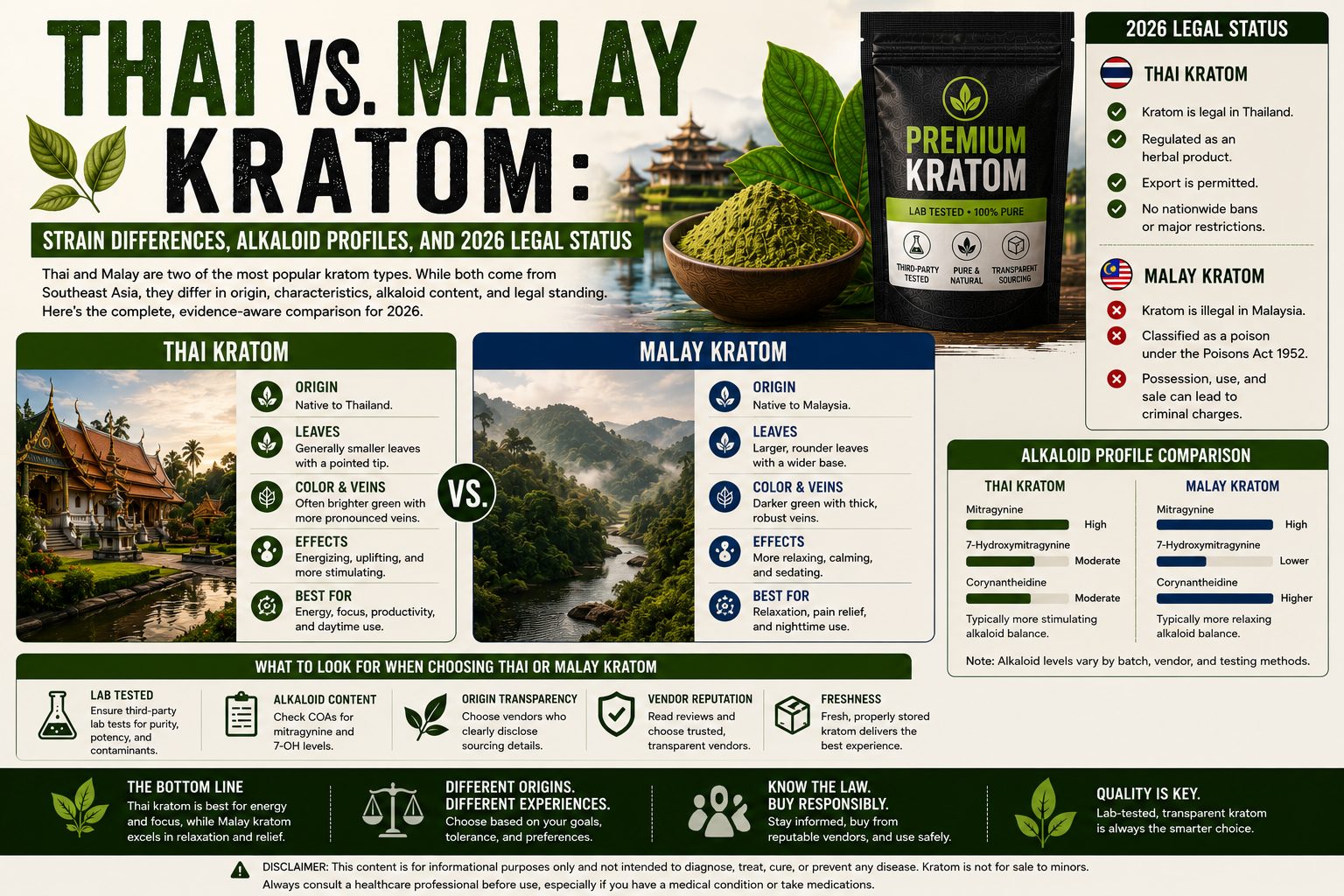
Kratom (Mitragyna speciosa) shoppers frequently ask the same question: what actually separates Thai vs Malay Kratom? The answer isn’t just marketing — it comes down to plant genetics, growing region, alkaloid chemistry, and a fast-changing regulatory landscape. This guide breaks down the real differences between these two popular strain origins, what the current research says, and what you need to know about kratom’s legal status heading into the second half of 2026.
Quick Overview: Thai Kratom vs. Malay Kratom
| Factor | Thai Kratom | Malay Kratom |
|---|---|---|
| Region | Southern, central, and northern Thailand | Peninsular Malaysia |
| Dominant alkaloid | Mitragynine (historically reported as a higher share of total alkaloids) | Mitragynine (lower reported share), with notable paynantheine content |
| Typical vein colors | Red, White, Green | Red, White, Green |
| Common user descriptions | Often marketed as more “energizing” or stimulating | Often marketed as smoother, longer-lasting, and more balanced |
| Growing conditions | Coastal/peninsular climate, high rainfall | Tropical lowland climate |
Origins and Growing Conditions
Kratom is native to Southeast Asia, and both Thailand and Malaysia have long histories of cultivating Mitragyna speciosa. Thai kratom trees traditionally grow in the southern provinces, though cultivation has since expanded to central and northern regions following the country’s 2021 kratom decriminalization. Researchers have found that alkaloid accumulation in Thai-grown kratom shifts noticeably by season and location, with mitragynine levels rising in the dry season and dropping during the rainy season, and calcium and magnesium levels in the soil also playing a measurable role in alkaloid production. This Thai vs Malay Kratom guide compares both categories using publicly available botanical information and laboratory testing.
Malay kratom, grown in Malaysia’s tropical lowlands, is associated with a different alkaloid balance. Distinct climate, soil composition, and harvesting practices between the two countries are the biological basis for the “strain” distinctions the kratom market has built around geography. When evaluating Thai vs Malay Kratom, consumers should review independent Certificates of Analysis before purchasing.
Alkaloid Profile: What the Research Actually Shows
Mitragynine is the primary active alkaloid in kratom, but the two origins are commonly described as differing in how much of it is present relative to other alkaloids. Older comparative analyses have reported mitragynine making up roughly two-thirds of total alkaloid content in Thai-origin plants, compared to a much smaller share in Malaysian-origin plants — with paynantheine, a secondary alkaloid, appearing at notably higher levels in some Malay-origin samples. Thai vs Malay Kratom remains one of the most searched regional comparisons among kratom consumers.
That said, newer research adds an important caveat: when scientists have tested finished commercial products labeled “red,” “green,” or “white” strain — rather than raw plant material traced to a specific farm — the cross-strain alkaloid differences are often much smaller or statistically insignificant. Several researchers now argue that a meaningful portion of the reported effect differences between kratom strains may be driven by marketing narratives, vendor branding, and expectation effects rather than verified chemical distinctions. Leaf maturity also matters: mature leaves (the type most commonly sold in the U.S. market) tend to carry higher levels of several minor alkaloids, like speciociliatine and 7-hydroxymitragynine, than young leaves do. A balanced Thai vs Malay Kratom comparison includes manufacturing standards, sourcing transparency, and quality-control procedures.
Bottom line: genetic and regional differences between Thai and Malay kratom are real at the plant level, but by the time kratom reaches store shelves, factors like harvest timing, drying method, blending, and vendor sourcing may influence the final product’s chemistry as much as geographic origin does.
Laboratory Testing & Transparency
When comparing Thai vs Malay Kratom, independent laboratory testing provides a more reliable basis for evaluation than regional names alone. Although Thai and Malay are widely recognized commercial classifications, product quality depends on cultivation practices, harvesting methods, post-harvest processing, manufacturing standards, storage conditions, and quality-control procedures. A comprehensive Thai vs Malay Kratom comparison should therefore prioritize objective laboratory documentation instead of promotional descriptions. Consumers should review current batch-specific Certificates of Analysis (COAs), verify independent laboratory testing, and compare measurable quality indicators including alkaloid analysis, heavy metal screening, microbial testing, and moisture content. Throughout this Thai vs Malay Kratom guide, laboratory transparency remains one of the strongest indicators of responsible manufacturing and informed purchasing decisions.
Vein Colors: Red, White, and Green
Both Thai and Malay kratom are sold in red, white, and green vein varieties, and vein color is generally tied to leaf maturity and drying/curing method rather than a separate botanical species:
- Red vein strains are typically harvested from more mature leaves and are the most widely sold color across both origins.
- White vein strains come from younger leaf growth and are frequently marketed for daytime use.
- Green vein strains fall between the two, both in harvest timing and in how vendors position them.
Popular named products like “Red Thai,” “Green Malay,” or “White Malay” combine an origin claim with a vein-color claim, but as noted above, independent lab testing doesn’t always confirm a large chemical gap between these labels once they reach the consumer market.
What Users Report — With a Caution
Anecdotal and vendor-driven descriptions commonly frame Thai strains as more stimulating and Malay strains as smoother or more sedating, but these characterizations are not well supported by controlled clinical research. Kratom’s overall pharmacology is complex and still poorly studied in humans, and individual response can vary widely based on the product, dose, tolerance, and other factors. Because of this uncertainty, this article won’t provide dosing or usage recommendations — if you’re considering kratom for a specific health concern, that conversation belongs with a licensed healthcare provider. Readers researching Thai vs Malay Kratom should verify that laboratory reports are current and batch specific.
Manufacturing Standards and Quality Assurance
Manufacturing quality is another important factor when evaluating Thai vs Malay Kratom. Drying procedures, sanitation protocols, packaging methods, storage conditions, and quality-control systems all influence overall product consistency. Consumers comparing Thai vs Malay Kratom should prioritize vendors that publish current batch-specific Certificates of Analysis, explain their laboratory testing procedures, and maintain documented manufacturing standards. Independent laboratory verification allows readers to compare measurable quality indicators using objective evidence instead of promotional claims. Understanding Thai vs Malay Kratom requires examining objective quality indicators instead of relying only on commercial classifications.
Vendor Transparency
Vendor transparency plays a major role in every Thai vs Malay Kratom comparison. Companies that openly publish Certificates of Analysis, explain their sourcing practices, identify independent laboratories, and describe their quality-control systems provide consumers with greater confidence. Readers researching Thai vs Malay Kratom should compare how consistently vendors provide this information before making purchasing decisions. Transparent documentation supports objective comparisons while encouraging responsible manufacturing throughout the botanical products industry. This Thai vs Malay Kratom comparison encourages consumers to prioritize laboratory transparency over promotional claims.
Making an Evidence-Based Comparison
A complete Thai vs Malay Kratom comparison combines laboratory testing, manufacturing standards, sourcing transparency, and independent editorial research into a single evaluation. Rather than choosing products solely because of regional names, consumers should compare batch-specific laboratory reports, quality-control procedures, vendor documentation, and publicly available educational resources. This Thai vs Malay Kratom guide emphasizes objective information supported by independently verified quality indicators rather than promotional claims, helping readers make informed purchasing decisions. Before choosing between Thai vs Malay Kratom, consumers should compare vendor documentation and independent testing practices.
Kratom Legal Status: July 2026 Update
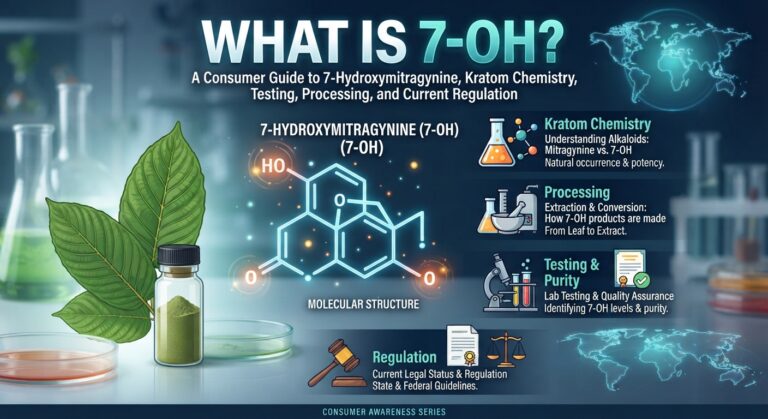
Kratom’s regulatory picture has shifted meaningfully in the past year, and it’s worth understanding the difference between natural kratom leaf and concentrated 7-hydroxymitragynine (7-OH) products, since they are being treated very differently by regulators.
- Natural kratom leaf (powders, capsules, and traditional leaf products) remains unscheduled under the federal Controlled Substances Act as of mid-2026. The DEA labeled mitragynine and 7-hydroxymitragynine as “Drugs of Concern” in January 2025 — an administrative designation, not a scheduling action.
- Concentrated 7-OH products — the high-potency shots, gummies, and tablets sold in some gas stations and smoke shops — are being treated as a separate issue. The FDA recommended in July 2025 that the DEA schedule concentrated 7-OH, and on July 1, 2026, the DEA filed formal Notices of Intent to temporarily place high-concentration 7-OH and related analogues into Schedule I. Following publication in the Federal Register and a required 30-day waiting period, the earliest this temporary order could take effect is early August 2026.
- State law varies widely. Roughly eight U.S. states currently ban kratom and/or 7-OH outright (recent additions include Tennessee and Kansas, effective July 1, 2026), while 30-plus states have adopted Kratom Consumer Protection Act (KCPA)-style regulations that permit sales under quality and labeling standards. Other states restrict extracts or high-concentration 7-OH specifically without banning whole-leaf kratom.
- Outside the U.S., legal status also varies: Thailand decriminalized kratom in 2021 after decades of prohibition, while Malaysia continues to restrict recreational sale and use domestically even as it remains a major kratom-growing region for export.
Because this is an active regulatory area, always check your state’s current statute and any recent federal rulemaking before purchasing, shipping, or possessing kratom or 7-OH products.
More Comparison Articles
- Red Kratom vs Green Kratom
- White Kratom vs Green Kratom
- Gold Kratom vs Yellow Kratom
- Horn Kratom vs Elephant Kratom
- Bali vs Maeng Da Kratom
- Borneo vs Sumatra Kratom
- Kapuas vs Riau Kratom
- White Malay vs Green Malay
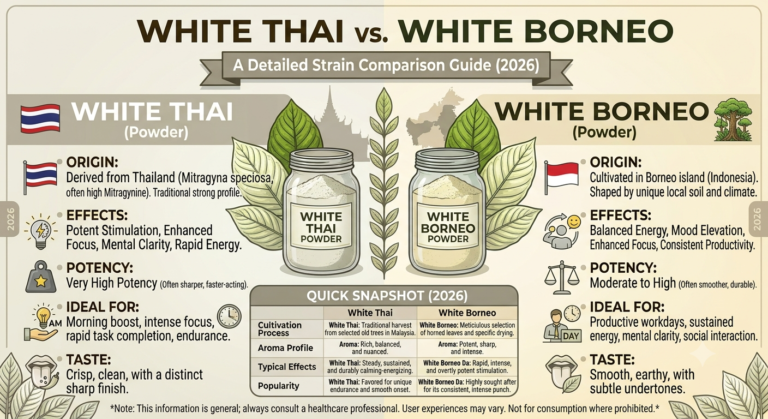
- White Thai vs White Borneo
- Green Malay vs Green Maeng Da
- Red Bali vs Red Borneo
- Red Bali vs Red Maeng Da
How to Evaluate Thai and Malay Kratom Products
Given that vendor labeling doesn’t always reflect verified lab differences, a few practical evaluation points matter more than strain name alone:
- Third-party lab testing — look for Certificates of Analysis (COAs) confirming mitragynine content, 7-OH concentration, and screening for heavy metals, salmonella, and other contaminants.
- 7-OH transparency — reputable vendors now commonly disclose 7-OH levels in parts per million (ppm), particularly given the current regulatory scrutiny on concentrated 7-OH.
- Sourcing and harvest date — since alkaloid content shifts seasonally, freshness and harvest transparency matter as much as the country of origin.
- American Kratom Association (AKA) or GMP certification — an indicator that a vendor follows consistent manufacturing and quality standards.
Regional Naming and Botanical Classification
Understanding Thai vs Malay Kratom requires looking beyond commercial names and focusing on documented production practices. Regional classifications are widely used within the marketplace, but they do not independently verify product quality or manufacturing consistency. A balanced Thai vs Malay Kratom comparison should examine sourcing information, harvesting techniques, processing methods, and quality-control standards supported by independent laboratory documentation. Consumers researching Thai vs Malay Kratom should compare objective evidence rather than relying solely on product descriptions or marketing language.
Frequently Asked Questions
Is Thai kratom stronger than Malay kratom? Older lab analyses of raw plant material have reported a higher proportion of mitragynine in Thai-origin kratom, but newer testing of finished commercial products often shows much smaller differences. “Strength” also depends heavily on the specific product, batch, and vendor, not just country of origin.
Are Thai and Malay kratom the same plant? Yes. Both come from the same species, Mitragyna speciosa. The differences are regional and agricultural (climate, soil, and cultivation practices), not differences in species.
Is kratom legal in 2026? Natural kratom leaf is not federally scheduled in the U.S. as of mid-2026, though it is banned in a handful of states and regulated in many others. Concentrated 7-OH products are under active DEA scheduling review, with a possible temporary Schedule I order as early as August 2026. Always check current state and federal rules before buying.
What’s the difference between kratom and 7-OH products? 7-hydroxymitragynine occurs naturally in kratom leaf, but only in trace amounts. The products currently drawing regulatory attention are synthetically concentrated or chemically enhanced to contain far higher 7-OH levels than naturally occurring kratom leaf, which produces stronger opioid-like effects and has prompted separate legal scrutiny. A comprehensive Thai vs Malay Kratom evaluation includes alkaloid analysis, heavy metal screening, microbial testing, and moisture analysis.
Readers interested in learning more about the topics discussed in this Thai vs Malay Kratom comparison can explore educational resources published by the American Society for Testing and Materials (ASTM International), the U.S. Food and Drug Administration (FDA), the National Institutes of Health (NIH), the American Herbal Products Association (AHPA), and MedlinePlus. These organizations provide educational information on laboratory testing, botanical products, manufacturing quality, scientific research, consumer safety, and Certificates of Analysis (COAs), helping readers evaluate products using objective evidence rather than marketing claims.
The Bottom Line
Thai and Malay kratom share the same botanical origin but differ in traditional growing regions, historical alkaloid ratios, and market positioning. Modern lab testing suggests the practical differences between finished Thai and Malay products may be smaller than vendor marketing implies, making third-party lab verification and transparent sourcing more useful buying criteria than strain name alone. With regulatory change accelerating in 2026 — especially around concentrated 7-OH — staying current on your state’s laws is just as important as understanding the product itself. Overall, Thai vs Malay Kratom should be evaluated through laboratory transparency, documented manufacturing standards, and independent editorial research.