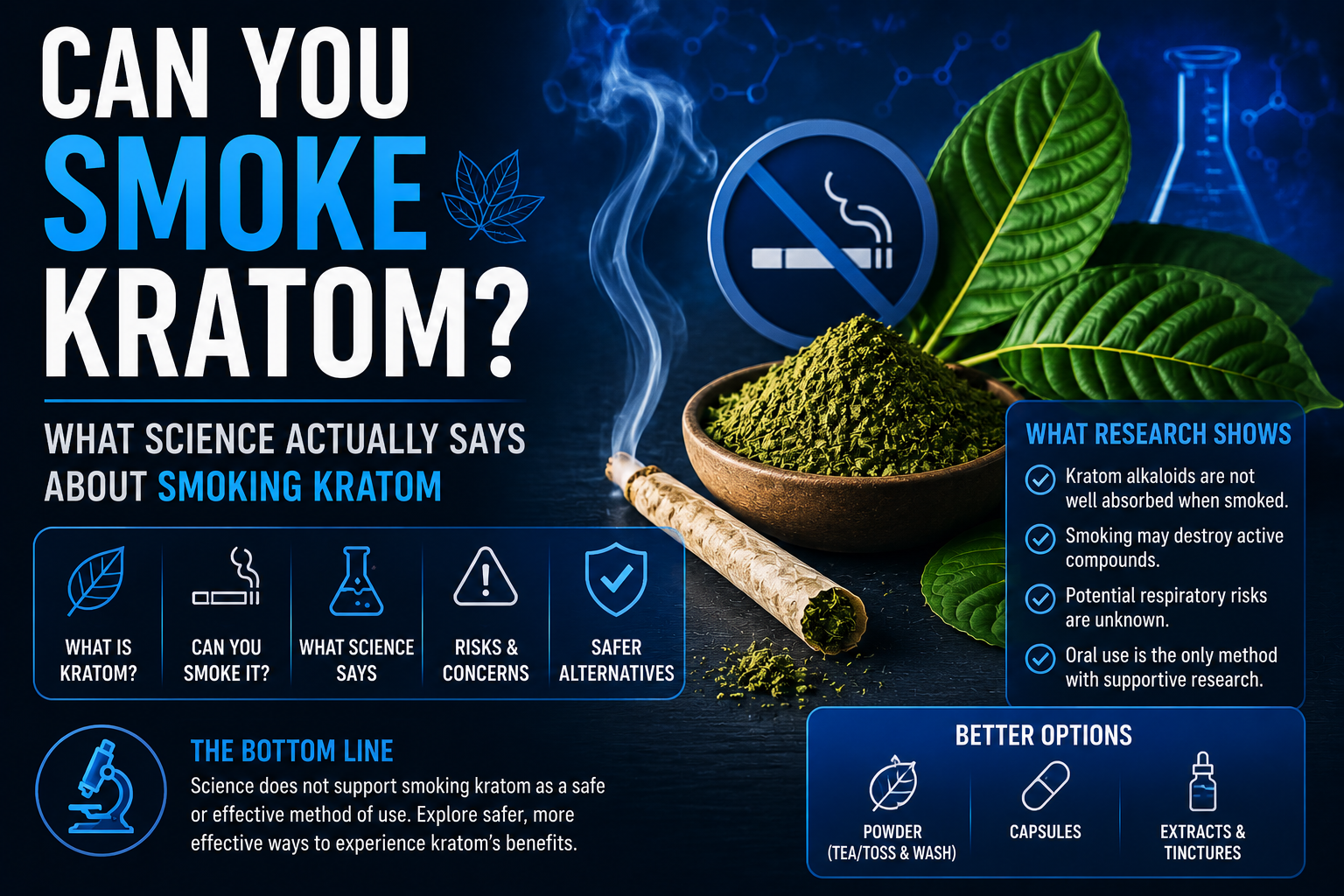
Can you smoke kratom? Kratom plant material can physically be burned, but there is little reliable human research establishing smoking as an effective, predictable or safe way to use kratom. Most scientific literature on Mitragyna speciosa involves oral preparations, dried leaf powder, tea, extracts or isolated alkaloids—not inhaled smoke. Burning plant material also creates smoke and combustion products that introduce respiratory risks unrelated to kratom’s alkaloids themselves.
That distinction matters.
The question is not simply whether kratom leaves or powder will burn. Many plant materials will. The more useful questions are whether inhalation reliably delivers kratom’s principal alkaloids, whether heat changes those compounds, what happens to them during combustion, and whether smoking introduces additional health risks.
Current evidence leaves major gaps in all four areas.
For that reason, Kratom Verdict does not recommend treating smoking as an established kratom administration method or assuming that claims about faster effects are scientifically demonstrated.
Can You Smoke Kratom? The Short Answer
If by can you smoke kratom you mean “can dried kratom plant material physically be burned?” the answer is yes.
If you mean “has smoking kratom been scientifically established as an effective and reasonably characterized route of administration?” the answer is no.
The available scientific literature overwhelmingly focuses on oral exposure.
Published research describes traditional consumption through chewing fresh leaves or preparing beverages from the leaves. Modern clinical research has similarly evaluated oral dried-leaf preparations and extracts rather than smoked kratom.
There is not a comparable body of controlled human research establishing:
- How much mitragynine survives combustion
- How efficiently mitragynine enters the bloodstream through smoke
- The pharmacokinetics of smoked kratom
- A validated inhaled dose
- The respiratory effects of kratom smoke
- How combustion changes minor kratom alkaloids
- Whether smoking meaningfully changes 7-hydroxymitragynine exposure
- The long-term pulmonary consequences of repeated kratom smoke exposure
That absence of evidence should not be mistaken for proof that smoking is harmless.
It means the route is poorly characterized.
Why Do People Ask Whether You Can Smoke Kratom?
The question usually arises because consumers associate smoking with rapid delivery of compounds from other plants.
That comparison can be misleading.
Different plant compounds have different:
- Chemical structures
- Boiling points
- Thermal stability
- Bioavailability
- Absorption characteristics
- Metabolism
- Distribution
A compound being pharmacologically active when swallowed does not establish that burning it is an efficient way to deliver it.
Kratom’s principal alkaloid, mitragynine, has primarily been investigated through oral and laboratory routes.
So when someone asks can you smoke kratom, comparisons with tobacco, cannabis or other smoked materials cannot substitute for kratom-specific evidence.
Buying Option
How Is Kratom Traditionally Consumed?
Understanding traditional use provides useful context.
Kratom is the common name for Mitragyna speciosa, a tropical tree native to Southeast Asia.
Scientific reviews describe traditional consumption primarily through chewing fresh leaves and preparing kratom beverages or decoctions.
Modern commercial products include:
- Dried leaf powder
- Capsules
- Tea products
- Extracts
- Liquid preparations
- Concentrated products
A comprehensive 2020 scientific review in Pain and Therapy describes common consumption through leaf decoctions or tea and ground powder.
Smoking is not the administration route around which the modern clinical evidence base has been built.
That is important because traditional use is sometimes invoked online to justify claims about unusual consumption methods.
Historical use and experimentally established safety are different standards—but in this case even the historical record does not provide strong justification for treating smoking as the conventional kratom route.
What Happens When Kratom Is Burned?
This is where the evidence becomes much thinner.
Combustion exposes plant material to high temperatures and creates a complex mixture of gases and particles.
The original chemical composition of a botanical powder cannot simply be assumed to remain unchanged after burning.
Heat can:
- Degrade compounds
- Transform compounds
- Produce new thermal-decomposition products
- Destroy some constituents
- Change the ratios of compounds ultimately inhaled
Exactly what happens to the full kratom alkaloid profile under realistic smoking conditions has not been adequately established in human clinical research.
Therefore, answering can you smoke kratom with “yes, and it works the same way” would go beyond the evidence.
We do not have good evidence showing that it works the same way.
What Is Mitragynine?
Mitragynine is the predominant alkaloid commonly associated with kratom.
Kratom contains dozens of alkaloids, although much scientific attention has focused on:
- Mitragynine
- 7-hydroxymitragynine
- Speciogynine
- Speciociliatine
- Paynantheine
Scientific pharmacology research shows that kratom is considerably more complicated than simply being a plant containing one active ingredient.
A 2022 pharmacological review describes more than 45 isolated kratom alkaloids and discusses the opioid-receptor pharmacology of mitragynine and 7-hydroxymitragynine.
Mitragynine interacts with μ-opioid receptors, while other receptor systems may also contribute to kratom’s overall pharmacology.
This does not make kratom equivalent to conventional opioids, nor does it establish therapeutic effectiveness.
It does mean that changing the delivery route could theoretically alter pharmacokinetics and effects—which is another reason an unstudied inhalation route should not be assumed equivalent to oral consumption.
Does Mitragynine Survive Smoking?
There is not enough high-quality human evidence to give consumers a reliable quantitative answer.
You may encounter websites claiming that a specific percentage of mitragynine is “destroyed” by heat or that a particular temperature preserves the alkaloids.
Such precise claims require direct analytical evidence.
Without validated studies replicating realistic smoking conditions and measuring the resulting aerosol, smoke chemistry and human exposure, those numbers should be treated cautiously.
This is an important Kratom Verdict principle:
Scientific-looking precision is not the same thing as scientific evidence.
If a website answers can you smoke kratom with exact temperatures, absorption percentages or smoking-equivalent doses without citing appropriate analytical research, readers should ask where those numbers came from.
Smoking and Oral Consumption Are Pharmacologically Different
Route of administration can substantially affect a drug’s pharmacokinetics.
Oral compounds must pass through the gastrointestinal tract and may undergo intestinal and hepatic metabolism.
Inhaled substances can follow a different absorption pathway.
That means you cannot take data from an oral kratom study and automatically apply it to inhalation.
For example, a systematic review of mitragynine pharmacokinetics described mitragynine as a lipophilic weak base and reviewed oral absorption, distribution, metabolism and elimination.
Those data help scientists understand oral mitragynine.
They do not establish the pharmacokinetics of smoked kratom.
Therefore, statements that smoking necessarily produces a particular onset, intensity or duration are not well supported without route-specific research.
Does Smoking Kratom Make It Work Faster?
This claim is frequently repeated but poorly demonstrated.
It may sound plausible because inhalation provides rapid systemic delivery for some substances.
But a plausible mechanism is not the same thing as evidence that smoking kratom efficiently delivers intact mitragynine.
To establish that scientifically, researchers would need to characterize factors such as:
- Alkaloid stability during heating
- Alkaloid concentration in smoke or aerosol
- Pulmonary absorption
- Blood concentrations after inhalation
- Time to maximum plasma concentration
- Resulting metabolites
- Physiological and subjective effects
- Respiratory adverse effects
Without such data, answering can you smoke kratom for faster effects with a confident yes would be speculation.
Is Smoking Kratom More Potent?
There is no reliable basis for claiming that smoking ordinary kratom leaf makes it more potent.
“Potency” itself can mean several different things.
It might refer to:
- Alkaloid concentration
- Blood concentration
- Subjective effect
- Receptor activity
- Speed of onset
Those are not interchangeable.
Burning a botanical material does not inherently increase the concentration of its active compounds.
Combustion may instead destroy or transform some components while creating additional smoke constituents.
Kratom Verdict therefore considers claims that smoked kratom is automatically “stronger” unsupported unless backed by route-specific analytical and clinical evidence.
Is Smoking Kratom Safer Than Taking It Orally?
There is no evidence establishing smoking kratom as the safer route.
In fact, smoking adds a separate exposure that oral use does not: combustion smoke entering the respiratory system.
Smoke from burned organic material contains fine particles and chemical products generated by combustion.
This does not mean that every type of plant smoke has an identical toxicological profile.
It does mean that inhaling combustion products should not be described as harmless simply because the starting material is botanical.
“Natural” does not mean “safe to inhale.”
The question can you smoke kratom safely therefore cannot currently be answered with a scientifically supported assurance of safety.
The Lung Problem: Kratom Smoke Has Not Been Adequately Studied
One of the biggest gaps in the discussion is pulmonary research.
For a smoking route to be responsibly characterized, researchers would ideally evaluate:
- Airway irritation
- Fine-particle exposure
- Inflammatory effects
- Lung-function changes
- Combustion chemistry
- Chronic respiratory exposure
- Cardiovascular consequences of smoke exposure
- Interactions with pre-existing respiratory conditions
There is not a substantial controlled human evidence base addressing these questions specifically for smoked kratom.
That means there is no scientifically validated basis for declaring repeated kratom smoking safe for the lungs.
This uncertainty is especially relevant for people with asthma, chronic obstructive pulmonary disease, cardiovascular disease or other conditions where smoke exposure may be concerning.
Can You Smoke Kratom Powder?
Kratom powder is finely milled botanical material intended in many commercial contexts for oral products.
The fact that powder can burn does not establish that inhaling its smoke is an effective administration method.
Fine powder also creates practical respiratory concerns even before combustion because airborne botanical particles can be inhaled accidentally.
More importantly, published human pharmacokinetic research does not provide a validated framework for smoking commercial kratom powder.
So while can you smoke kratom powder may sound like a simple product question, scientifically it raises unresolved questions about both combustion chemistry and pulmonary exposure.
Can You Smoke Kratom Leaves?
Dried plant leaves can physically combust.
But again, physical combustibility is not the relevant scientific standard.
The key question is whether inhalation produces a predictable and acceptably characterized exposure to kratom alkaloids.
Current research does not establish that.
Traditional Southeast Asian consumption has much stronger documentation for chewing fresh leaves and preparing beverages than for smoking.
Therefore, the existence of whole dried leaves should not be interpreted as evidence that smoking them is a validated use method.
Can Kratom Be Vaped?
Vaping and smoking are not the same process.
Smoking involves combustion.
Vaporization generally attempts to heat a material without full combustion.
However, that distinction does not establish that vaping kratom is safe or effective.
There is insufficient controlled human research defining:
- Appropriate kratom formulations for inhalation
- Alkaloid stability in vaping conditions
- Aerosol composition
- Pulmonary absorption
- Lung toxicity
- Reliable pharmacokinetics
- Long-term respiratory effects
Consumers should therefore be cautious with products or instructions claiming that kratom vaping is scientifically established.
The absence of smoke does not automatically establish the safety of an inhaled aerosol.
Can Kratom Extract Be Smoked?
Extracts introduce another layer of uncertainty.
A kratom extract may contain substantially different concentrations and ratios of alkaloids compared with ordinary dried leaf.
Modern products also vary greatly in formulation.
An extract intended for oral consumption should not automatically be assumed suitable for heating or inhalation.
Inactive ingredients, solvents, flavorings, carriers and other formulation components may behave differently when heated.
This is particularly important because a product being safe enough for one route does not establish safety through another.
Therefore, the answer to can you smoke kratom extract is not simply a question of whether the extract burns.
There is inadequate evidence to establish inhalation as a safe or predictable route for commercial kratom extracts.
Buying Option
7-OH Products Are a Separate Issue
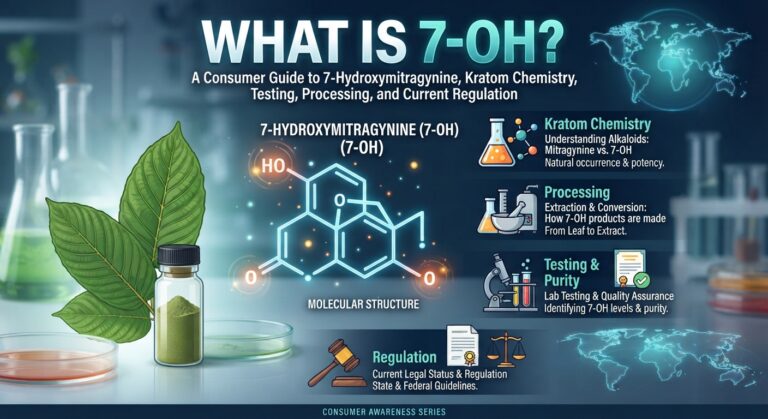
The modern kratom marketplace has changed considerably with the emergence of concentrated 7-hydroxymitragynine products.
7-hydroxymitragynine, commonly called 7-OH, occurs naturally in kratom in trace quantities, but commercial products containing added or enhanced concentrations have attracted significant regulatory concern.
The FDA recommends consumers avoid products containing added or enhanced 7-OH and describes them as potent opioid products that have not been proven safe or effective.
In July 2026, FDA reported that the Drug Enforcement Administration had announced the start of a temporary scheduling process involving 7-OH above a proposed threshold and three synthetic kratom-related compounds.
These concentrated products should not be treated as interchangeable with traditional kratom leaf.
That distinction applies whether someone is asking can you smoke kratom, swallow it or use another route.
The product’s actual composition matters.
Does Smoking Avoid Kratom’s Metabolism?
This is another oversimplified claim sometimes found online.
Mitragynine undergoes metabolism in the body, including conversion through metabolic pathways involving CYP enzymes.
Research indicates that conversion of mitragynine to 7-hydroxymitragynine contributes to some of mitragynine’s pharmacological effects.
Changing administration route could alter pharmacokinetic processes, but it does not mean metabolism simply disappears.
A substance entering the bloodstream remains subject to distribution and metabolic processes.
Without controlled inhalation studies, predicting exactly how smoking would alter mitragynine metabolism is speculative.
What Does Current Kratom Pharmacology Actually Establish?
The strongest evidence concerns the plant’s alkaloids and oral or experimentally controlled administration—not smoking.
Research establishes that:
- Kratom contains numerous alkaloids.
- Mitragynine is a major kratom alkaloid.
- Mitragynine has pharmacological activity at μ-opioid receptors.
- 7-hydroxymitragynine has important opioid-receptor activity.
- Mitragynine undergoes metabolism in the body.
- Kratom pharmacology involves more than a single receptor pathway.
- Product composition and exposure patterns can affect risk.
Research does not currently establish a validated smoking protocol or demonstrate that inhaled kratom is safer, more efficient or more predictable than oral preparations.
That difference between what is known and what is assumed is central to answering can you smoke kratom responsibly.
Kratom Is Not an FDA-Approved Treatment
The FDA’s current position also deserves context.
FDA states that there are no legally marketed prescription or over-the-counter drug products containing kratom or its known alkaloids.
The agency has raised concerns about serious adverse events associated with kratom and continues to evaluate kratom-related products.
That does not mean every reported adverse event proves kratom alone caused the outcome. Product composition, co-use of other substances and individual circumstances can complicate causality.
But it does mean kratom should not be presented as an FDA-approved treatment or as risk-free.
Changing the route from oral use to smoking does not change that regulatory or medical reality.
Why Anecdotal Reports Are Not Enough
Online forums may contain accounts from people claiming they smoked kratom.
Those reports can tell us that people have experimented with the route.
They cannot reliably establish:
- Dose delivered
- Alkaloid concentration
- Bioavailability
- Product purity
- Blood concentration
- Respiratory safety
- Long-term risk
Anecdotal experience is particularly weak evidence when combustion chemistry is involved.
Two people could smoke different products sold under the same kratom strain name and receive chemically different exposures.
That is why Kratom Verdict separates anecdotal reports from controlled evidence.
What About Mixing Kratom With Other Substances?
Combining psychoactive substances can increase uncertainty and risk.
Kratom contains pharmacologically active compounds and may interact with other drugs through pharmacodynamic or pharmacokinetic mechanisms.
A 2024 clinical pharmacology review discusses potential drug-drug interactions and emphasizes concerns associated with escalating use and polysubstance exposure.
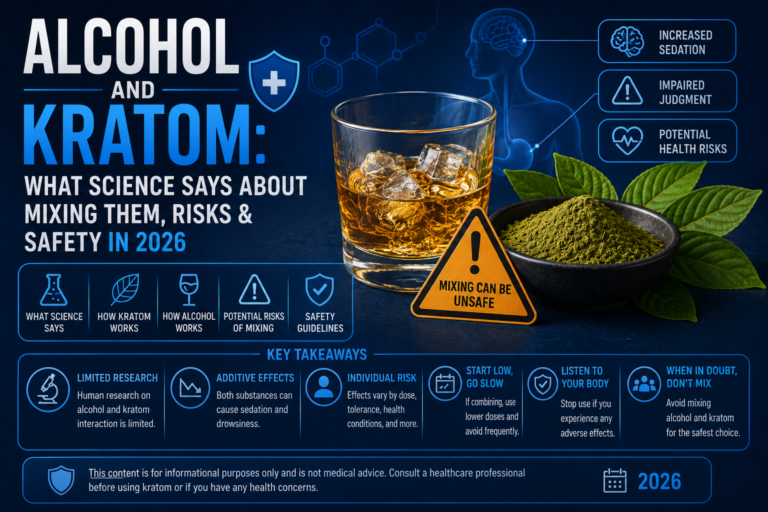
Smoking kratom alongside tobacco, cannabis or another substance creates an additional layer of complexity because effects cannot necessarily be attributed to one component.
The lack of research becomes even more significant when multiple substances are involved.
Anyone experiencing severe symptoms after kratom or polysubstance exposure should seek appropriate medical or emergency assistance rather than relying on online advice.
Who Should Be Especially Cautious About Inhaling Plant Smoke?
Because the respiratory effects of kratom smoke are poorly characterized, people with conditions that make smoke exposure particularly concerning should not assume that kratom smoke is benign.
That includes people with:
- Asthma
- Chronic lung disease
- Significant cardiovascular disease
- Known sensitivity to smoke or airborne particles
Pregnancy also warrants special caution around kratom generally. FDA has reported neonatal abstinence syndrome associated with kratom exposure during pregnancy, although individual cases and co-exposures require careful interpretation.
Anyone who is pregnant, nursing, taking prescription medication or managing a significant medical condition should discuss kratom-related questions with an appropriately qualified healthcare professional.
Evidence Strength: What Do We Actually Know?
| Question | Evidence strength | Kratom Verdict assessment |
|---|---|---|
| Does kratom contain mitragynine? | Strong | Well established |
| Is mitragynine pharmacologically active? | Strong | Well established |
| Is oral mitragynine absorbed? | Strong | Demonstrated in human research |
| Is kratom traditionally consumed orally? | Strong | Well documented |
| Can dried kratom physically burn? | Obvious physical property | Yes, but this says little about pharmacology |
| Does smoking efficiently deliver mitragynine? | Weak/insufficient | Not established |
| What percentage survives combustion? | Insufficient | Reliable universal figure unavailable |
| Is smoking kratom safer than oral use? | Insufficient | Not established |
| Is kratom smoke safe for lungs? | Insufficient | Not established |
| Does smoking produce faster effects? | Insufficient direct evidence | Cannot be reliably claimed |
| Is vaping kratom safe? | Insufficient | Not established |
| Are concentrated 7-OH products equivalent to leaf? | No | They require separate consideration |
This table captures the central problem with can you smoke kratom searches: there is a large gap between what can physically be done and what has been scientifically validated.
Common Myths About Smoking Kratom
Myth 1: “If a plant is natural, its smoke is natural and therefore safe.”
False reasoning.
Combustion changes plant material and creates smoke. Safety must be evaluated based on exposure, not whether the starting material grew naturally.
Myth 2: “Smoking always makes a botanical stronger.”
Not established.
Route of administration affects pharmacokinetics differently for different compounds. Heat can also degrade or transform chemicals.
Myth 3: “Smoking bypasses all metabolism.”
Incorrect.
Changing the route of administration can alter first-pass exposure, but compounds in systemic circulation can still undergo metabolism.
Myth 4: “If people online say it works, science has proven it.”
Anecdotes can generate research questions, but they do not establish pharmacokinetics, safety or efficacy.
Myth 5: “Kratom smoke has been studied as extensively as oral kratom.”
It has not.
The human evidence base primarily concerns oral preparations and measured kratom alkaloids.
What Should Consumers Take Away?
When evaluating can you smoke kratom, separate four questions:
Can the material burn?
Yes.
Does burning guarantee useful delivery of mitragynine?
No.
Has smoking been adequately studied in humans?
No.
Has smoking been established as safe?
No.
That framework prevents a physical possibility from being confused with a medically or scientifically supported practice.
Frequently Asked Questions
Can you smoke kratom?
Dried kratom plant material can physically burn, but smoking has not been established through controlled human research as a safe, predictable or well-characterized method of kratom administration. Most scientific evidence concerns oral preparations.
Can you smoke kratom powder?
Powder can combust, but there is inadequate research establishing how efficiently its alkaloids are delivered through smoke or what respiratory risks result. Commercial powder should not be assumed suitable for inhalation merely because it burns.
Can you smoke kratom leaves?
Dried leaves can burn, but traditional and scientific documentation focuses much more heavily on chewing leaves and preparing oral beverages. There is insufficient evidence establishing smoking leaves as a safe or predictable route.
Does smoking kratom make it stronger?
There is no good clinical evidence demonstrating that smoking ordinary kratom makes it more potent. Combustion may alter or destroy chemical constituents, and route-specific human pharmacokinetic data are lacking.
Does smoking kratom work faster?
There is insufficient direct evidence to establish a reliable onset time for smoked kratom. General assumptions about inhaled substances cannot replace kratom-specific research.
Can kratom be vaped instead?
Vaping avoids conventional combustion but creates different questions concerning aerosol chemistry, formulation and lung exposure. Controlled evidence establishing the safety and effectiveness of vaping kratom is inadequate.
Does heat destroy mitragynine?
Heat can alter chemical compounds, but precise claims about how much mitragynine survives realistic smoking conditions require appropriate analytical evidence. Reliable human smoking data are currently insufficient for a universal percentage.
Is smoking kratom bad for your lungs?
The pulmonary effects of kratom smoke specifically have not been adequately characterized. However, smoking introduces combustion particles and chemicals into the respiratory tract, so it should not be assumed harmless.
Is smoking kratom safer than taking kratom powder?
There is no evidence establishing smoking as safer. It adds respiratory exposure while remaining poorly studied as a kratom delivery route.
Are 7-OH products the same as kratom leaf?
No. FDA specifically distinguishes products containing added or enhanced 7-OH from the trace 7-OH naturally occurring in kratom. Concentrated 7-OH products raise separate pharmacological and regulatory concerns.
Kratom Verdict: Final Assessment
So, can you smoke kratom?
In the narrow physical sense, dried kratom plant material can be burned.
But that is not the answer consumers actually need.
The scientifically important question is whether smoking provides a safe, effective and predictable method of delivering kratom alkaloids.
Current evidence does not establish that.
Most human kratom research has examined oral exposure. Researchers have studied mitragynine pharmacology, metabolism, pharmacokinetics and the behavior of other kratom alkaloids, but there is no comparable clinical evidence base defining smoked kratom.
That leaves major unanswered questions about combustion.
We do not have sufficiently strong human evidence establishing how much mitragynine survives realistic smoking conditions, how efficiently it is absorbed through the lungs, how inhalation alters its pharmacokinetics, what combustion byproducts are produced or what repeated kratom-smoke exposure does to respiratory health.
Claims that smoking is automatically faster, stronger or more efficient therefore go beyond what current evidence can reliably demonstrate.
There is another practical issue: smoking introduces combustion exposure that does not exist when botanical material is consumed orally.
The fact that a plant is natural does not make its smoke harmless.
Consumers should also distinguish ordinary kratom leaf from modern concentrated 7-OH products. FDA has specifically warned about added or enhanced 7-OH products, and federal regulatory activity involving concentrated 7-OH intensified in 2026.
Kratom Verdict’s assessment is therefore straightforward:
When readers ask can you smoke kratom, the evidence supports a distinction between physical possibility and scientifically validated use.
Yes, the plant material can burn.
No, current evidence does not establish smoking kratom as a safe, predictable or well-researched route of administration.
Until better route-specific research exists, confident claims about smoking efficiency, potency, precise temperatures, exact alkaloid survival or guaranteed effects should be treated skeptically.
Kratom Verdict investigates the details consumers should check before making decisions in the kratom market. In this case, one of the most important details is also one of the simplest:
Being able to burn something does not establish that inhaling it is a good way to use it.
Sources & References
1. U.S. Food and Drug Administration (FDA) — FDA and Kratom
Federal information concerning kratom, FDA’s regulatory position, safety concerns, adverse-event information and current scientific work.
Source: FDA — FDA and Kratom
2. U.S. Food and Drug Administration — Hiding in Plain Sight: 7-OH Products (Updated July 13, 2026)
Current FDA information concerning concentrated 7-OH products and the July 2026 federal regulatory developments involving 7-OH above a proposed threshold and synthetic kratom-related compounds.
Source: FDA — Hiding in Plain Sight: 7-OH Products
3. U.S. Food and Drug Administration — Products Containing 7-OH Can Cause Serious Harm
FDA consumer guidance explaining the distinction between trace naturally occurring 7-OH in kratom and products containing added or enhanced concentrations.
Source: FDA — Products Containing 7-OH Can Cause Serious Harm
4. Hiranita T et al. — In Vitro and In Vivo Pharmacology of Kratom (2022)
Scientific review examining the pharmacological activity of kratom, mitragynine and 7-hydroxymitragynine, including opioid-receptor activity and experimental pharmacology.
Source: PubMed — PMID 35341571
5. Ya K et al. — Pharmacokinetics of Mitragynine, a Major Analgesic Alkaloid in Kratom (Mitragyna speciosa): A Systematic Review (2019)
Systematic review examining available pharmacokinetic evidence concerning mitragynine, including absorption, distribution, metabolism and elimination.
Source: PubMed — PMID 31100603
6. Eastlack SC, Cornett EM, Kaye AD — Kratom—Pharmacology, Clinical Implications, and Outlook: A Comprehensive Review (2020)
Review describing kratom’s traditional and contemporary use, including common oral preparations such as leaf decoctions, tea and ground powder, alongside pharmacological and safety considerations.
Source: PubMed — PMID 31994019
7. Hill R et al. — The Respiratory Depressant Effects of Mitragynine Are Limited by Its Conversion to 7-OH Mitragynine (2022)
Preclinical research investigating mitragynine metabolism, 7-hydroxymitragynine and respiratory effects in an animal model. The findings should not be treated as direct evidence about smoked kratom in humans.
Source: PubMed — PMID 35297034
8. Henningfield JE et al. — An Update on the Clinical Pharmacology of Kratom: Uses, Abuse Potential and Future Considerations (2024)
Review examining kratom pharmacology, pharmacokinetics, potential drug interactions, adverse effects, tolerance, dependence and kratom use disorder.
Source: PubMed — PMID 38217374
9. U.S. Food and Drug Administration — Import Alert 54-15: Mitragyna speciosa or Kratom (Updated August 17, 2026)
Current FDA import-alert information identifying kratom products in multiple forms, including capsules, whole leaves, processed leaves, extracts, powdered leaves and bulk liquids.
Source: FDA — Import Alert 54-15
Related Kratom Verdict Guides
Expand your knowledge of Best Kratom Brands for Pain Relief through our independent educational guides covering botanical science, laboratory testing, Certificates of Analysis, transparency standards, and vendor evaluation.
Kratom Fundamentals
- What Is Kratom? (2026): The Complete Beginner’s Guide
- Kratom Buying Guide (2026)
- Kratom Safety & Side Effects (2026)
- Kratom Legality Guide (2026)
Laboratory & Transparency
- Kratom Alkaloids Explained
- Kratom Lab Testing Explained
- Third-Party Lab Testing Explained
- How to Read a Kratom Certificate of Analysis (COA)
- How to Verify a Kratom COA
- AKA GMP Certification Explained