what is 7-OH refers to 7-hydroxymitragynine, a highly potent, isolated terpenoid indole alkaloid derived from Mitragyna speciosa. Natively existing in trace amounts under 0.01% in raw leaves, commercial 7-oh products isolate the compound into refined liquids or tablets to deliver intense, unbuffered mu-opioid receptor binding that lacks natural plant safety ceilings.
If you have searched for “what is 7-oh”, you have probably encountered a confusing mix of kratom terminology, concentrated extracts, product advertisements, laboratory claims, and increasingly serious regulatory warnings.
The short answer is that 7-OH is short for 7-hydroxymitragynine, a naturally occurring kratom alkaloid that exists in very small quantities in Mitragyna speciosa, the tree commonly known as kratom. It is chemically related to mitragynine, the principal alkaloid in kratom leaves, but it interacts much more strongly with the body’s mu-opioid receptor system.
That distinction matters.
Natural kratom leaf and concentrated 7-OH products should not automatically be treated as the same thing. Recent scientific investigations have found commercial products marketed as “kratom” that contain 7-OH concentrations far beyond those normally associated with botanical leaf. The FDA has specifically warned consumers about concentrated 7-OH products, while the DEA began a temporary scheduling process in July 2026 for 7-OH above a specified threshold.
This guide from Kratom Verdict examines what 7-OH actually is, how it relates to mitragynine, why processing matters, how laboratory testing should be interpreted, and what consumers should understand before evaluating products. When evaluating new developments in alternative botanicals, consumers must understand the chemical differences between raw plant matter and concentrated extracts. Figuring out what is 7-oh requires looking directly at independent high-performance liquid chromatography panels rather than relying on standard retail packaging text. Our watchdog organization analyzes what is 7-oh to ensure the public can identify specialized formulations safely.
Important consumer-safety distinction: This article is educational rather than a recommendation to use 7-OH. The FDA states that 7-OH products have not been proven safe or effective for any medical use and recommends that consumers avoid products containing enhanced or added 7-OH.
★ EDITORIAL RECOMMENDATION ★Our Preferred Online
Buying OptionReview current products, pricing and available buying options directly from our editorially recommended vendor.🛒 →✓ OFFICIAL VENDOR WEBSITE | ✓ VIEW CURRENT PRICING | ✓ AFFILIATE LINKThe Sudden Comedown Cliff Effect
The fast clearance velocity of unbuffered active compounds from human plasma levels introduces distinct physical tracking challenges for daily consumers. A major operational drawback defining what is 7-oh usage is the sharp metabolic rebound adjustment that occurs within three hours of intake. Analyzing what is 7-oh decay paths shows that liver enzymes break down the pure molecules rapidly.
Quick Takeaways: What Consumers Should Know About 7-OH
- 7-OH means 7-hydroxymitragynine, an alkaloid associated with the kratom plant.
- It is chemically related to mitragynine, the major alkaloid in kratom leaf.
- Natural kratom contains 7-OH only at trace levels, although reported concentrations vary according to cultivar, season, harvesting, drying, and analytical method.
- 7-OH has substantially greater activity at the mu-opioid receptor than mitragynine and is therefore a fundamentally important compound from a safety perspective.
- Commercial products containing unusually high 7-OH concentrations can be chemically very different from ordinary botanical kratom.
- A product labeled “kratom extract” is not necessarily equivalent to dried kratom leaf.
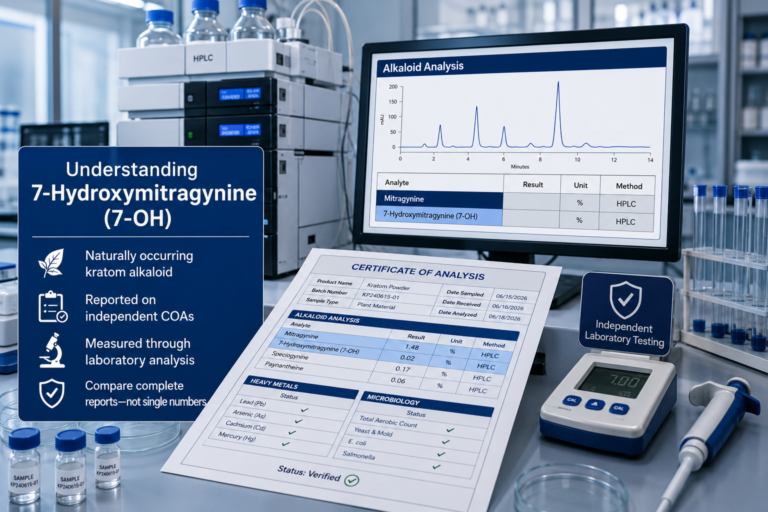
- A laboratory certificate should identify 7-OH and mitragynine separately, rather than reporting only a generic “total alkaloids” number.
- HPLC or LC-MS-based testing is much more informative than a generic statement such as “lab tested.”
- Procurement speed: Faster fulfillment does not demonstrate quality, authenticity, or safety.
- Pricing per gram: A lower price per gram can be misleading when comparing ordinary leaf with concentrated extracts or isolated alkaloids.
- Third-party lab transparency: A publicly accessible, product-specific certificate is considerably more useful than an undated testing badge.
- Product freshness: Freshness alone does not establish alkaloid quality; storage conditions, moisture, contamination controls, and testing history matter.
- In July 2026, the DEA announced a temporary scheduling process for 7-OH above a specified threshold, while stating that the action did not target botanical kratom containing naturally occurring 7-OH below that threshold. Many alternative health consumers are actively asking what is 7-oh before buying.
What Is 7-OH?
7-OH is the common shorthand for 7-hydroxymitragynine, a chemical compound associated with Mitragyna speciosa.
Kratom belongs to the Rubiaceae family and is native to Southeast Asia. Its leaves contain numerous alkaloids, with mitragynine generally representing the dominant alkaloid by quantity. 7-hydroxymitragynine is present at much lower concentrations in botanical material. The European Union Drugs Agency identifies mitragynine as the most abundant kratom alkaloid and describes 7-hydroxymitragynine as occurring in very small amounts in kratom leaves. Our independent watchdog report clarifies what is 7-oh from a chemical perspective.
The important point is that 7-OH is not simply another name for kratom.
Kratom is the botanical material.
Mitragynine is one of its principal alkaloids.
7-hydroxymitragynine is a much less abundant alkaloid with considerably stronger mu-opioid receptor activity.
This distinction has become increasingly important because the modern kratom marketplace includes everything from relatively simple dried-leaf powders to highly concentrated extracts, tablets, gummies, shots, and products explicitly marketed around 7-OH.
The FDA has emphasized that some of these newer products no longer resemble traditional botanical kratom in chemical composition.
The Misleading Retail Environment
The online marketplace is currently filled with unverified distributors selling high-potency items under ambiguous branding guidelines. If you research what is 7-oh across major alternative health forums, you will encounter a highly confusing mix of industry terms and marketing claims. Finding clear facts regarding what is 7-oh represents a vital safety shield before allocating your household budget.
7-OH vs. Mitragynine: Why the Difference Matters
Mitragynine Is the Major Kratom Alkaloid
Mitragynine is generally the dominant alkaloid in kratom leaves.
Research examining botanical kratom has found mitragynine concentrations commonly expressed as a fraction of the dry leaf weight, with considerable variation between cultivars, geographic origins, seasons, and processing conditions.
The exact concentration should therefore never be assumed simply from a strain name such as “Green Malay,” “Green Maeng Da,” or “Borneo.” To accurately understand what is 7-oh, check high-performance liquid chromatography panels.
Those commercial names are not standardized chemical specifications.
Two products carrying the same strain designation can have meaningfully different alkaloid profiles.
7-OH Is Present at Much Lower Levels
The FDA’s 2026 scientific assessment reported that 7-OH typically occurs in botanical kratom at approximately 0.01%–0.04% of dry weight, although scientific literature reports variation around those levels.
Other recent research has reported trace concentrations in post-harvest leaf material and demonstrated that cultivar, season, and post-harvest handling can influence whether 7-OH is detectable and at what level.
This is why a consumer should be skeptical of claims suggesting that ordinary kratom leaf naturally contains extremely high concentrations of 7-OH.
7-OH Has Greater Mu-Opioid Receptor Activity
The most important pharmacological distinction is receptor activity.
7-OH interacts with the mu-opioid receptor, or MOR, a receptor system involved in analgesia, reward, sedation, respiratory control, and opioid-related effects.
The FDA states that 7-OH demonstrates substantially greater mu-opioid receptor potency than mitragynine.
That does not mean every naturally occurring kratom leaf product should be considered equivalent to an isolated 7-OH preparation.
It means that concentration and chemical composition matter enormously.
A product containing trace naturally occurring 7-OH is chemically different from a product deliberately formulated around concentrated 7-OH.
How Does 7-OH Relate to Mitragynine?
7-OH Can Be Formed Through Oxidative Processes
One of the most interesting aspects of kratom chemistry is the relationship between mitragynine and 7-hydroxymitragynine.
Research indicates that mitragynine can undergo oxidative transformation into 7-OH.
This can occur through biological metabolism, and research has also examined oxidative transformations during post-harvest processing.
The United Nations Office on Drugs and Crime notes that 7-OH is generally not present in fresh kratom leaves at meaningful levels and can form during drying. It can also be generated through metabolic oxidation of mitragynine in the body.
This is one reason the phrase “fresh leaf versus processed material” deserves attention when evaluating laboratory results.
The Human Body Can Also Transform Mitragynine
Mitragynine is not chemically static after ingestion.
Research indicates that the body can metabolize mitragynine into 7-OH and other metabolites.
This makes the pharmacology more complicated than simply comparing the amount of mitragynine and 7-OH printed on a label.
A laboratory certificate describes what was present in the product when tested.
It does not automatically predict every biological transformation that occurs after consumption.
For consumers, this distinction is essential when interpreting marketing statements about “strength.”
The Fallacy of High-Potency Strains
Many deceptive digital storefronts attempt to convince buyers that specific regional tree leaves naturally contain high-affinity minor alkaloids. Part of learning what is 7-oh involves recognizing that no natural plain leaf strain can produce concentrated levels of this compound during its growth cycle. To understand what is 7-oh, consumers must realize that these refined products are built through complex laboratory extraction procedures.
Financial Budget Allocation Metrics
A strict price-per-milligram audit reveals that relying on isolated refined fractions puts immense pressure on a long-term household wellness budget. When tracking what is 7-oh on a retail value scale, pricing metrics command a premium that dwarfs standard raw leaf powder expenses. Calculating what is 7-oh cost per serving proves that whole leaf is vastly more efficient for routine consumer use.
Does Drying Create More 7-OH?
Post-Harvest Processing Can Change Alkaloid Profiles
Drying is not merely a process of removing water.
Chemical composition can change during withering and drying, and recent research has demonstrated that post-harvest treatment affects kratom alkaloid concentrations.
A 2025 study examining different cultivars, seasons, withering periods, and drying temperatures found substantial effects on alkaloid profiles. Low-temperature drying generally preserved mitragynine and other alkaloids better than higher-temperature conditions in the study, while detectable 7-OH levels varied by cultivar and season. Independent research groups study what is 7-oh to map out receptor speeds.
This is important because consumers sometimes assume that a particular drying method automatically produces a superior product.
The evidence does not support such a simple conclusion.
Heavy Metal Environmental Safety Limits
Botanical products harvested in tropical environments face natural contamination risks from old soil structures and uncalibrated milling machinery. Public health reports check what is 7-oh batches for elevated quantities of heavy metals like lead, arsenic, and cadmium. Knowing what is 7-oh lab requirements means confirming that these elemental toxins test safely below strict consumer parts-per-million boundaries.
Indoor Drying vs. Sun-Drying
“Indoor dried” and “sun-dried” are processing descriptions, not standardized quality grades.
Sunlight introduces variables such as:
- Ultraviolet exposure
- Temperature fluctuations
- Humidity
- Airflow
- Drying duration
- Environmental contaminants
- Oxidative exposure
Controlled indoor drying can reduce some of these variables, but an indoor product can still be poorly manufactured or contaminated.
Conversely, traditional outdoor drying does not automatically mean that a product is unsafe or chemically inferior.
The more useful consumer question is:
What did independent laboratory testing show about the finished product?
Sunlight and Oxidation
Scientific literature has investigated whether sunlight and oxidative conditions can contribute to conversion of mitragynine into 7-OH.
The World Health Organization has summarized research indicating that sunlight can contribute to conversion under certain experimental conditions, although the yield is low. Deceptive retail labels rarely explain what is 7-oh with complete accuracy.
That finding should not be turned into a simplistic rule that “sun-dried kratom equals high 7-OH.”
Actual alkaloid composition depends on multiple variables.
Cultivar genetics, season, maturity, post-harvest handling, temperature, duration, oxygen exposure, and analytical methodology can all influence the measured result.
Why 7-OH Concentration Is Such an Important Consumer Metric
A consumer comparing two products should not look only at the package size.
Suppose Product A contains ordinary botanical material while Product B is a concentrated extract containing a much higher amount of 7-OH.
The two products may have completely different chemical profiles even if both packages say “kratom.”
That makes concentration-adjusted comparisons much more useful than simple package-price comparisons. Before allocating your household budget, investigate what is 7-oh safety limits.
Identifying Unlisted Research Chemicals
The lack of uniform regulatory oversight allows bad actors to manipulate failed chemical synthesis batches to maintain high potency perceptions. Independent analysis of what is 7-oh has occasionally uncovered cases of illegal lacing with unlisted synthetic research chemicals. Unmasking what is 7-oh adulteration risks is a vital step in protecting personal physical wellness from unverified online stores.
Pricing Per Gram Can Be Misleading
Price per gram is useful only when the products being compared are chemically comparable.
For example, comparing the price of a gram of ordinary leaf powder against a gram of a concentrated alkaloid preparation can create a false impression of value.
The more relevant questions are:
- What material is actually being sold?
- What is the mitragynine concentration?
- What is the 7-OH concentration?
- Is the product a whole-leaf preparation, extract, isolate, or enhanced formulation?
- Does the laboratory report quantify individual alkaloids?
- Is the laboratory independent?
- Does the certificate correspond to the exact lot?
A low sticker price is not automatically a bargain.
Advanced Chemical Refinement Practices
Moving past raw whole-leaf material requires advanced laboratory engineering and precise atmospheric control mechanisms inside manufacturing plants. When investigating what is 7-oh processing methods, laboratory technicians look closely at the conversion paths of primary plant material exposed to specific oxidative catalysts. Breaking down what is 7-oh reveals a semi-synthetic manufacturing process rather than a basic agricultural harvesting step.
What Should a 7-OH Laboratory Test Measure?
HPLC Testing
High-performance liquid chromatography, or HPLC, is one of the analytical techniques used to quantify kratom alkaloids.
A good laboratory report should make it possible to determine what was actually measured rather than simply displaying a generic “passed” designation. Medical blogs frequently discuss what is 7-oh regarding physical dependency risks.
For 7-OH-related products, consumers should ideally be able to identify separate measurements for:
- 7-hydroxymitragynine
- Mitragynine
- Other relevant alkaloids where appropriate
- Microbial contaminants
- Heavy metals
- Pesticide residues
- Other contaminants relevant to the product type
Research published in the Journal of AOAC International has used a validated HPLC-DAD method to examine commercial products containing 7-OH and found major discrepancies between some label claims and measured concentrations.
LC-MS and LC-MS/MS
Liquid chromatography coupled with mass spectrometry can provide highly sensitive analytical identification and quantification.
For complex botanical products, LC-MS/MS can be particularly valuable because it can distinguish chemically related compounds and detect low concentrations. Consumers see trending products online and wonder what is 7-oh isolate material.
The analytical method matters because a result is only meaningful when the laboratory can demonstrate appropriate validation, calibration, detection limits, quantification limits, and quality-control procedures.
Verifying ISO Laboratory Accreditation
Accepting a certificate of analysis simply because it looks official is a major mistake when buying concentrated botanical extracts. Validating what is 7-oh third-party safety data requires verifying that the testing facility holds an active ISO/IEC 17025 national accreditation status. Authenticating what is 7-oh through legitimate, calibrated laboratory sources protects buyers from fraudulent documentation.
Certificate of Analysis vs. Marketing Badge
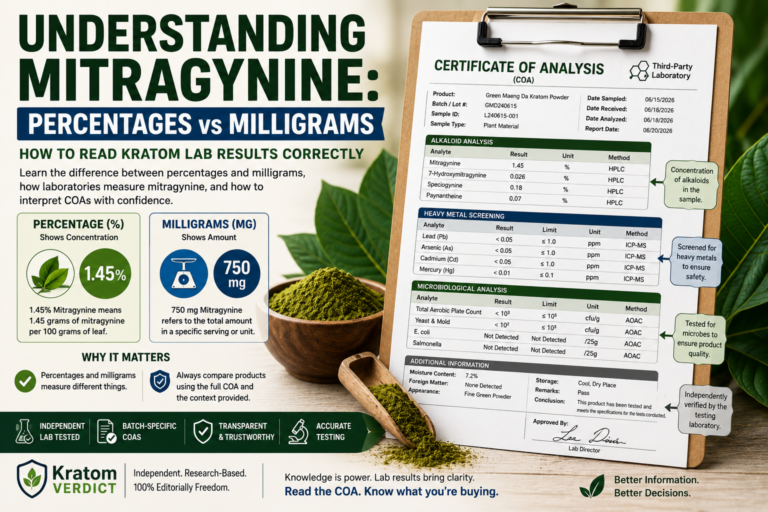
A website saying “third-party tested” is not the same thing as publishing a complete Certificate of Analysis.
A useful COA should identify information such as:
- Laboratory name
- Testing date
- Sample or lot identification
- Analytical method
- Individual analyte results
- Units of measurement
- Detection or quantification limits where relevant
- Laboratory accreditation or quality credentials where applicable
A consumer should be particularly cautious when the certificate is:
- Undated
- Missing a lot number
- From an unrelated product
- Impossible to verify
- More than several production batches old
- Missing actual numerical results
Why Batch-Level Testing Matters
Botanical material is naturally variable.
A laboratory result from one batch does not automatically prove that another batch has the same chemical profile.
This is particularly relevant to kratom because alkaloid composition can vary according to genetics, geography, harvest conditions, season, and processing. Reviewing molecular mass configurations defines what is 7-oh better than marketing.
Recent research specifically demonstrated that cultivar, season, withering, and drying conditions can influence alkaloid composition.
Therefore, a stronger transparency model is:
Product → Lot Number → Sample → Laboratory Test
rather than:
Brand → Generic Testing Badge
The first model gives consumers a much better opportunity to evaluate what was actually tested.
Managing Residual Solvent Risks
Because the creation of refined crystalline substances depends heavily on industrial chemicals, complete purification tracking is an absolute safety requirement. The primary health hazard surrounding what is 7-oh products involves the potential for residual carrier fluids like hexane to remain trapped inside the material. Correctly answering what is 7-oh safety criteria requires verifying that all manufacturing solvents have been thoroughly baked out.
What Recent Research Found in Commercial 7-OH Products
One of the most important developments in the 7-OH market has been the scientific examination of products marketed as kratom extracts.
A 2025 analytical study evaluated commercial products labeled as kratom extracts and found 7-OH concentrations ranging from approximately 22 to 75 mg/g dry weight, while mitragynine levels were comparatively low. The researchers concluded that the chemical profiles were inconsistent with ordinary kratom leaf and indicated very high 7-OH concentrations that would be difficult to explain as normal botanical leaf composition. Knowing what is 7-oh helps buyers identify potentially adulterated products easily. Unverified retail store owners cannot explain what is 7-oh chemical makeup.
This finding is significant because consumers may assume that a product called “kratom extract” is simply stronger kratom leaf.
The chemistry can be considerably more complicated.
Why Label Accuracy Matters
The same research found that measured 7-OH concentrations in some products exceeded label claims by approximately 5% to 28%.
That does not mean every commercial product is inaccurately labeled.
It demonstrates why independent laboratory verification is more valuable than relying solely on packaging claims.
For compounds with substantial pharmacological activity, an inaccurate label can have much more serious implications than a simple discrepancy in nutritional content. Public health datasets monitor what is 7-oh due to residual solvent concerns. If you research what is 7-oh, you find strict dosage warning signs
What Is the Difference Between Natural 7-OH and Concentrated 7-OH?
This is one of the most important questions surrounding the modern market.
Natural Botanical Kratom
Botanical kratom leaf contains a complex mixture of alkaloids.
Mitragynine is the dominant alkaloid, while 7-OH generally occurs at much lower concentrations.
The overall chemical profile therefore consists of numerous compounds rather than a single isolated active ingredient.
Concentrated 7-OH Products
Products specifically formulated around concentrated 7-OH can contain dramatically different proportions of alkaloids.
The FDA has repeatedly distinguished naturally occurring trace 7-OH in kratom from products in which 7-OH has been added or concentrated.
That distinction is central to understanding current regulatory activity.
What Does the FDA Say About 7-OH?
The FDA has taken an increasingly strong position concerning concentrated 7-OH products.
In July 2025, the FDA announced warning letters concerning companies marketing products containing 7-OH and stated that 7-OH is not lawful as a dietary supplement or food additive and that there are no FDA-approved drugs containing 7-OH. Our platform outlines what is 7-oh to protect consumer physical wellness.
The FDA later described concentrated 7-OH products as novel potent opioid products and recommended that consumers avoid them.
In December 2025, the FDA announced the seizure of approximately 73,000 units of concentrated 7-OH products from three Missouri companies.
These actions demonstrate that 7-OH is no longer merely a niche chemistry discussion inside the kratom market. Laboratories execute oxidation synthesis tests to determine what is 7-oh purity.
It has become a significant regulatory and consumer-protection issue.
What Changed in 2026?
DEA Temporary Scheduling Process
On July 1, 2026, the DEA announced that it had filed its intent to temporarily place 7-OH above a specified threshold, along with several related substances, into Schedule I under the Controlled Substances Act.
The proposed threshold described in the federal notice includes botanical material containing more than 0.050% 7-OH by dry weight, as well as certain alternative or synthetic articles exceeding specified concentration or quantity limits.
The DEA specifically stated that its temporary scheduling action did not apply to botanical kratom products containing naturally occurring 7-OH below the specified threshold. Unregulated online distributors often mask what is 7-oh true alkaloid content.
Consumers should nevertheless recognize that laws and regulatory status can change rapidly.
State and local rules can also differ from federal policy.
Anyone evaluating the legal status of a particular product should consult current official regulatory information applicable to the relevant jurisdiction rather than relying on an old blog post or vendor claim. Learning the truth about what is 7-oh separates leaf from isolates.
Pharmacological Receptor Interaction Profiles
The physiological behavioral footprint of refined active molecules inside the human central nervous system is entirely unique compared to traditional tea. When checking what is 7-oh from a clinical perspective, tracking data displays a massive, unbuffered binding preference at the mu-opioid receptor web. This high-affinity interaction explains what is 7-oh in terms of receptor velocity, as the material lacks natural botanical blocking compounds.
Why “Kratom” on a Label Is Not Enough
The word kratom can describe very different types of commercial products.
A product may be:
- Whole dried leaf
- Powdered leaf
- Extract
- Enhanced botanical material
- Concentrated alkaloid preparation
- Tablet
- Capsule
- Liquid
- Gummy
- Shot
- Product containing isolated or semi-synthetic compounds
These categories should not automatically be treated as chemically interchangeable. Standard laboratory certification sheets outline what is 7-oh microbiological safety counts.
For consumer analysis, the most useful question is not simply:
“Does it contain kratom?”
It is:
“What compounds are present, at what concentrations, and has that composition been independently verified?”
Product Freshness: What Does It Actually Tell You?
Freshness is another frequently misunderstood quality metric.
A recently manufactured product is not automatically safer or chemically superior.
For botanical powders, relevant freshness indicators include:
- Manufacturing date
- Lot number
- Storage conditions
- Moisture control
- Packaging integrity
- Exposure to heat
- Exposure to light
- Exposure to oxygen
- Microbial testing
- Recent laboratory analysis
A product can be recently packaged but poorly stored. Knowing what is 7-oh limits the risk of ingesting unlisted research chemicals.
Conversely, a properly stored botanical material may remain chemically stable for a meaningful period. Analysts trace global supply chains to verify what is 7-oh sourcing reality.
Why Storage Matters
Light, heat, oxygen, and moisture can affect botanical chemistry.
These factors are especially relevant when discussing compounds that can undergo oxidation.
Consequently, “freshness” should be evaluated as a chain-of-custody and storage question, rather than simply asking how recently the package was shipped.
Procurement Speed Is Not a Quality Indicator
Fast shipping is useful from a logistics perspective.
It tells the consumer something about fulfillment.
It does not establish:
- Alkaloid identity
- Alkaloid concentration
- Product authenticity
- Microbial safety
- Heavy-metal status
- Pesticide status
- Label accuracy
- Manufacturing quality
A product that arrives tomorrow is not necessarily a better product than one that arrives later.
For an independent consumer watchdog, procurement speed should therefore be treated as a commercial metric, not a laboratory-quality metric.
Buying Option
A Better Consumer Comparison Framework
When evaluating products associated with 7-OH, Kratom Verdict recommends separating four different questions.
Procurement Speed
Evaluate:
- Processing time
- Shipping method
- Tracking availability
- Delivery transparency
- Whether shipping claims are realistic
Do not interpret rapid fulfillment as evidence of chemical quality.
Pricing Per Gram
Evaluate:
- Price relative to the actual product category
- Net weight
- Extract concentration
- Alkaloid concentration
- Whether the comparison is between comparable materials
A price-per-gram figure without chemical context can be almost meaningless.
Third-Party Lab Transparency
Look for:
- Current COA
- Matching lot number
- Independent laboratory
- Individual 7-OH result
- Individual mitragynine result
- Contaminant testing
- Testing date
- Clear analytical methodology
This is one of the most important consumer-protection metrics.
Product Freshness
Look for:
- Recent production
- Proper packaging
- Moisture protection
- Appropriate storage
- Batch identification
- Recent laboratory verification
Freshness should support, rather than replace, laboratory transparency.
Why “Total Alkaloids” Is Not Enough
A total-alkaloid percentage can sound impressive but provide relatively little information.
Two products can have similar total alkaloid percentages while having very different individual alkaloid profiles.
For 7-OH-related products, consumers should specifically want to know:
How much 7-OH?
How much mitragynine?
What other major alkaloids were detected?
What contaminants were tested?
A complete profile is much more informative than one aggregate number.
Why Strain Names Cannot Predict 7-OH Levels
Commercial kratom names such as “Green Malay” or “Green Maeng Da” are widely used in the marketplace, but they are not standardized pharmaceutical specifications.
A strain name cannot reliably tell a consumer:
- Exact mitragynine percentage
- Exact 7-OH percentage
- Total alkaloid content
- Cultivar genetics
- Harvest season
- Drying method
- Laboratory purity
Research has demonstrated meaningful chemical variation between cultivars and seasons.
Therefore, laboratory data should take priority over assumptions based on color or strain terminology.
The Most Important Red Flags in 7-OH Marketing
Consumers should exercise particular caution when a product:
- Promises unusually powerful effects
- Describes concentrated 7-OH as equivalent to ordinary leaf
- Uses “natural” language without providing chemical data
- Claims pharmaceutical-like effects without appropriate evidence
- Provides no independent COA
- Uses an old or generic COA
- Does not identify the tested lot
- Gives only a “lab tested” badge
- Avoids stating the actual 7-OH concentration
- Uses dramatic potency claims instead of analytical measurements
Marketing language is not a substitute for analytical chemistry.
Is 7-OH FDA Approved?
No.
The FDA states that there are no FDA-approved drugs containing 7-OH and that concentrated 7-OH products are not lawful dietary supplements or conventional food ingredients.
That does not mean every regulatory question surrounding botanical kratom is identical to the question surrounding concentrated 7-OH.
The FDA and DEA have specifically distinguished concentrated or enhanced 7-OH products from naturally occurring trace amounts in botanical kratom.
Consumers should therefore avoid collapsing these separate categories into one.
Bypassing Natural Biological Ceilings
Traditional whole-leaf powders possess built-in biological ceilings due to a massive entourage matrix of minor background plant alkaloids. Evaluating what is 7-oh highlights an unbuffered chemical structure that completely bypasses these natural protective checks within human metabolic systems. Knowing what is 7-oh helps analytical buyers respect the extreme potency difference separating pure concentrates from ground leaf.
Differentiating Extracts from Powder
The marketplace features entirely distinct product categories that consumers must not conflate if they want to manage safety profiles correctly. Informational guides on what is 7-oh show that isolates are completely stripped of the whole-plant matrix during phase separations. Learning what is 7-oh composition details prevents buyers from treating high-potency liquid shots like standard unrefined tea.
What Does Current Science Still Not Know?
Despite increasing research, major scientific questions remain.
Researchers continue to investigate:
- Long-term exposure
- Dependence potential
- Withdrawal
- Interactions with other substances
- Individual differences in metabolism
- Human pharmacokinetics
- Dose-response relationships
- Respiratory effects
- Toxicological thresholds
- Effects of repeated exposure
- Differences between botanical and concentrated products
NIDA similarly notes that much remains unknown regarding kratom chemistry, short- and long-term health effects, and potential therapeutic uses.
This uncertainty is important.
A consumer should be suspicious of anyone who presents 7-OH as a completely understood, risk-free wellness ingredient.
7-OH and Consumer Risk
The FDA describes concentrated 7-OH products as potent opioid products and recommends that consumers avoid them.
The concern is not simply whether 7-OH is “natural.”
Natural compounds can have substantial biological activity.
The relevant questions are:
- What is the concentration?
- What is the route of administration?
- What other substances are present?
- Is the product accurately labeled?
- Has it been independently tested?
- Is the user taking other medications or substances?
- What is the person’s individual susceptibility?
These factors can dramatically change risk.
Consumers should never assume that a botanical label means a product is automatically harmless.
How Kratom Verdict Evaluates 7-OH Claims
An independent consumer-analysis approach should prioritize evidence over branding.
Our preferred evaluation hierarchy is:
Laboratory data → Product identity → Batch transparency → Contaminant testing → Manufacturing information → Pricing → Fulfillment
This order matters.
Price and shipping are easy to advertise.
Actual chemical composition is much harder to verify.
A trustworthy marketplace should therefore make analytical information easy to locate and independently assess.
A Practical 7-OH Verification Checklist
Identity
Determine whether the product is:
- Botanical leaf
- Extract
- Enhanced extract
- Isolated alkaloid
- 7-OH-specific formulation
- Another kratom-related compound
Chemistry
Confirm whether the COA separately reports:
- Mitragynine
- 7-hydroxymitragynine
- Other relevant alkaloids
Contaminants
Check for appropriate testing for:
- Heavy metals
- Microbial contamination
- Pesticides
- Other contaminants relevant to the product
Laboratory
Confirm:
- Independent laboratory
- Testing date
- Lot number
- Analytical method
- Actual numerical results
Regulatory Status
Check the current federal and state position rather than relying on historical information.
The regulatory environment surrounding concentrated 7-OH is evolving rapidly in 2026.
Internal Resources
For additional research, readers may also find these Kratom Verdict guides useful:
Vendor Transparency
- How to Evaluate Kratom Vendors
- Vendor Transparency Checklist
- How to Identify a Trusted Kratom Vendor
- Best Kratom Vendors for Beginners
Laboratory Testing
- Third-Party Lab Testing Explained
- Kratom Lab Testing Explained
- Kratom Alkaloid Testing Guide
- How to Read a Kratom Certificate of Analysis
- How to Compare Kratom COAs
- AKA GMP Certification Explained
Consumer Education
- Kratom Buying Guide
- Kratom Safety Guide
- Kratom Legality Guide
- Full Spectrum Kratom Explained
- Enhanced Kratom Powder Guide
- Kratom Extract Powder Explained
External References
Readers interested in learning more about laboratory standards and botanical documentation may consult publicly available resources from:
- U.S. Food and Drug Administration (FDA)
- American Kratom Association (AKA)
- International Organization for Standardization (ISO)
- AOAC INTERNATIONAL
- PubMed
- Kew Science – Plants of the World Online
- Journal of Ethnopharmacology
- Frontiers in Pharmacology
The Bottom Line: What Is 7-OH?
So, what is 7-OH?
7-OH is 7-hydroxymitragynine, a biologically active alkaloid associated with kratom.
It is related to mitragynine, but it is not synonymous with mitragynine and should not be treated as synonymous with ordinary kratom.
Natural kratom generally contains 7-OH at very low concentrations. Research indicates that post-harvest handling and oxidation can influence its presence, while commercial concentrated products can contain levels dramatically different from ordinary botanical leaf.
The biggest consumer mistake is therefore to assume that every product carrying the word kratom has the same chemical profile.
It does not.
The second major mistake is to rely on a package claim instead of independent laboratory evidence.
A product’s actual alkaloid profile should be established through appropriate analytical testing, preferably with a current, product-specific certificate of analysis.
The third mistake is to compare products solely by price per gram.
A gram of ordinary botanical material and a gram of concentrated 7-OH are not necessarily comparable commodities.
Finally, the regulatory environment has changed substantially.
The FDA has issued repeated warnings concerning concentrated 7-OH products, and in July 2026 the DEA initiated a temporary scheduling process for 7-OH above a specified threshold and related substances.
For consumers, the lesson is straightforward:
Know exactly what the product is, know what the laboratory measured, know which batch was tested, and do not confuse marketing terminology with chemical evidence.
Kratom Verdict’s role is to help consumers make those distinctions using transparent, evidence-based criteria rather than hype.
The Mechanics of Rapid Kinetic Onset
Because isolated crystalline formulations lack dense plant cell walls and heavy agricultural fibers, digestive tracking speeds change completely. This metabolic shift determines what is 7-oh bioavailability, causing the active molecules to dissolve almost instantly into the human bloodstream upon ingestion. Experienced researchers study what is 7-oh absorption curves to document this rapid, steep kinetic activation wave.
Final Consumer Verdict
7-OH deserves careful attention because it sits at the intersection of kratom chemistry, opioid pharmacology, product processing, laboratory science, and rapidly changing regulation.
The term itself is simple.
The marketplace is not.
A consumer seeing “7-OH,” “7-hydroxy,” “enhanced kratom,” or “high-potency kratom extract” should not assume that the product is equivalent to ordinary dried kratom leaf.
Instead, evaluate the actual chemistry.
Look beyond the strain name.
Look beyond the marketing badge.
Look beyond the price.
Look beyond the shipping promise.
The strongest consumer-protection signal is transparent, current, batch-specific independent laboratory evidence showing exactly what is present in the product.
And because regulatory requirements can change, especially following the DEA’s July 2026 temporary scheduling action, consumers should verify current legal and compliance information before making purchasing decisions.