Reviewed by Kratom Verdict Editorial Team
Last Updated: July 2026
Estimated Reading Time: 18–22 minutes
Guide Type: Independent Editorial Educational Guide
Research Basis: Publicly available scientific literature, laboratory testing methodologies, publicly available regulatory resources, and independent editorial research.
Editorial Note
Few topics in the kratom industry create more confusion than 7-Hydroxymitragynine, often abbreviated as 7-OH.
Some companies advertise it as the most important alkaloid in kratom.
Others claim consumers should avoid it entirely.
Social media discussions frequently describe 7-OH using terms such as:
- Extra Strength
- Maximum Potency
- Premium Alkaloids
- High 7-OH Formula
- Enhanced Extract
Unfortunately, these conversations often ignore the underlying laboratory science.
Most buyers never learn:
- What 7-Hydroxymitragynine actually is.
- How laboratories measure it.
- Why it appears in Certificates of Analysis.
- Why naturally occurring leaf differs from highly concentrated products.
- How regulatory agencies currently view concentrated 7-OH products.
Understanding these concepts helps consumers interpret laboratory reports objectively instead of relying on marketing claims or internet speculation.
This guide explains the science behind 7-Hydroxymitragynine, how independent laboratories report it, and how buyers should evaluate COAs using evidence rather than advertising.
What Is 7-Hydroxymitragynine?
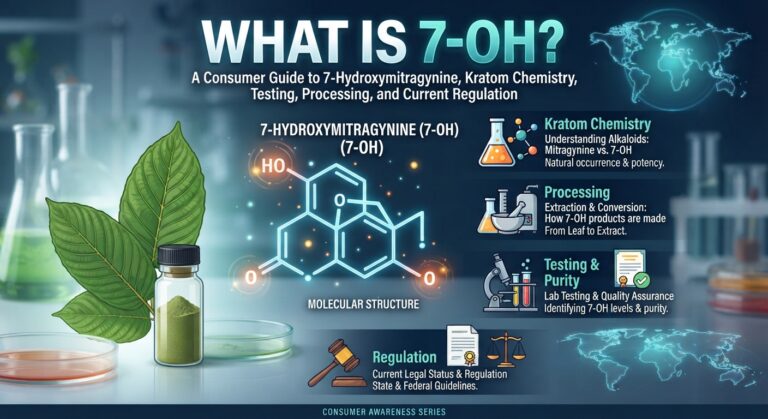
7-Hydroxymitragynine is one of the naturally occurring alkaloids identified in Mitragyna speciosa leaves.
Unlike mitragynine, which is generally present in much larger quantities, naturally occurring 7-OH is typically detected in considerably smaller amounts in traditional kratom leaf.
Independent laboratories commonly include 7-Hydroxymitragynine as part of routine alkaloid analysis because it provides additional information regarding the chemical composition of the tested sample.
Its presence on a Certificate of Analysis does not, by itself, indicate that a product is higher quality or lower quality.
Instead, it represents one measurement among many included within a comprehensive laboratory report.
Why Buyers Hear So Much About 7-OH
Interest in 7-Hydroxymitragynine has increased significantly over recent years.
Several factors contributed to this increased attention:
- Growth of concentrated extract products.
- Expansion of specialty formulations.
- Greater public discussion regarding alkaloid concentrations.
- Increased scientific research.
- Greater regulatory interest in concentrated alkaloid products.
As a result, consumers now encounter the term “7-OH” far more frequently than they did only a few years ago.
However, increased discussion has also resulted in greater misunderstanding.
Mitragynine vs. 7-Hydroxymitragynine
Although these alkaloids are related, they should not be considered interchangeable.
| Mitragynine | 7-Hydroxymitragynine |
|---|---|
| Primary naturally occurring alkaloid | Naturally occurring minor alkaloid |
| Usually present in greater concentration | Usually present in much lower concentration in traditional leaf |
| Frequently reported as % or mg/g | Often reported at much lower analytical values |
| Common focus of laboratory reports | Increasingly evaluated in extract products |
Understanding this distinction helps buyers interpret Certificates of Analysis more accurately.
Why Laboratories Measure 7-OH
Independent laboratories include 7-Hydroxymitragynine testing for several important reasons.
It helps document:
- Alkaloid profile
- Product characterization
- Batch consistency
- Manufacturing transparency
- Laboratory completeness
The value should always be interpreted alongside the remainder of the Certificate of Analysis rather than in isolation.
How Laboratories Report 7-Hydroxymitragynine
Depending on the laboratory, 7-OH may appear as:
- Percentage (%)
- mg/g
- mg per serving
- Below Limit of Quantification (LOQ)
- Not Detected (ND)
Each reporting method communicates different information.
Understanding these laboratory terms prevents unnecessary confusion.
Understanding “Not Detected”
Many buyers incorrectly assume that “Not Detected” indicates poor quality.
It does not.
“Not Detected” simply means the laboratory did not detect measurable quantities above its analytical detection limit under the testing conditions used.
This finding should always be interpreted within the context of the laboratory’s analytical methods and reporting limits.
Understanding “Below LOQ”
Some Certificates of Analysis report:
Below LOQ
LOQ stands for Limit of Quantification.
This means that although extremely small amounts may be present, the concentration remains below the laboratory’s validated level for accurate numerical measurement.
This differs from a product receiving a measured numerical value.
Understanding this distinction is important when comparing laboratory reports from different testing facilities.
How Laboratories Measure 7-Hydroxymitragynine
Professional analytical laboratories use highly sensitive scientific instruments capable of detecting extremely small quantities of botanical compounds.
Among the most common analytical methods are:
- High-Performance Liquid Chromatography (HPLC)
- Liquid Chromatography–Mass Spectrometry (LC-MS/MS)
- Ultra High-Performance Liquid Chromatography (UHPLC)
These analytical methods allow laboratories to identify and quantify individual alkaloids contained within the tested sample.
Professional laboratory reports often identify both:
- Mitragynine
- 7-Hydroxymitragynine
using validated analytical procedures.
Why Different Laboratories Report Different Numbers
Consumers occasionally compare Certificates of Analysis from different laboratories and notice different numerical values.
This does not automatically indicate that one laboratory is incorrect.
Differences may occur because laboratories use:
- Different reporting units
- Different validated methods
- Different detection limits
- Different software
- Different reporting formats
The important consideration is whether the laboratory clearly explains its methodology.
Understanding Natural Leaf vs. Concentrated Products
One of the most important distinctions buyers should understand is the difference between:
Traditional Botanical Leaf
Traditional kratom leaf naturally contains a variety of alkaloids.
Within ordinary leaf products, 7-Hydroxymitragynine is generally reported in much smaller quantities than mitragynine.
Concentrated Products
Extract products undergo additional manufacturing processes.
Some concentrated formulations may report substantially higher alkaloid concentrations than traditional leaf products.
Because of this difference, concentrated extracts should never be compared directly with ordinary powdered leaf using laboratory numbers alone.
Different product categories require different interpretation.
Why Concentrated Products Require Greater Transparency
As product concentration increases, transparency becomes even more important.
Responsible manufacturers should clearly provide:
✔ Batch-specific Certificates of Analysis
✔ Product identification
✔ Alkaloid analysis
✔ Serving information
✔ Product labeling
✔ Batch traceability
✔ Laboratory information
Additional processing should always be accompanied by additional documentation.
Why Regulatory Agencies Have Increased Their Attention
Recent years have seen increased discussion among regulators regarding concentrated alkaloid products.
Much of this attention has focused on products specifically marketed around elevated 7-Hydroxymitragynine concentrations rather than traditional botanical leaf.
This distinction is important.
Traditional powdered leaf and highly concentrated specialty products represent different product categories and should not automatically be discussed as though they present identical manufacturing considerations.
Responsible buyers should therefore carefully examine:
- Product labeling
- Laboratory reports
- Product identification
- Batch documentation
before comparing concentrated products.
Can Higher 7-OH Automatically Mean Better Quality?
No.
This represents one of the industry’s most common misconceptions.
Higher reported concentrations do not automatically indicate:
- Better manufacturing
- Better cultivation
- Better laboratory testing
- Better contaminant screening
- Better product consistency
Laboratory concentration represents only one analytical measurement.
Responsible purchasing decisions should evaluate the complete Certificate of Analysis rather than focusing on a single alkaloid.
Why Complete COAs Matter
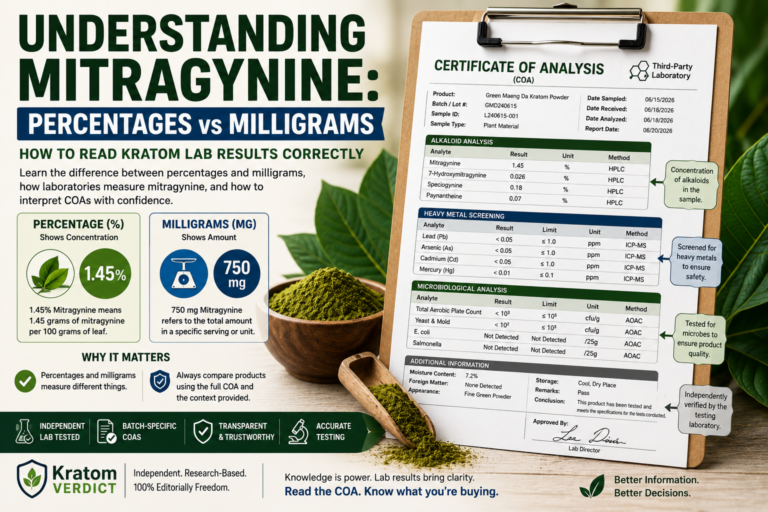
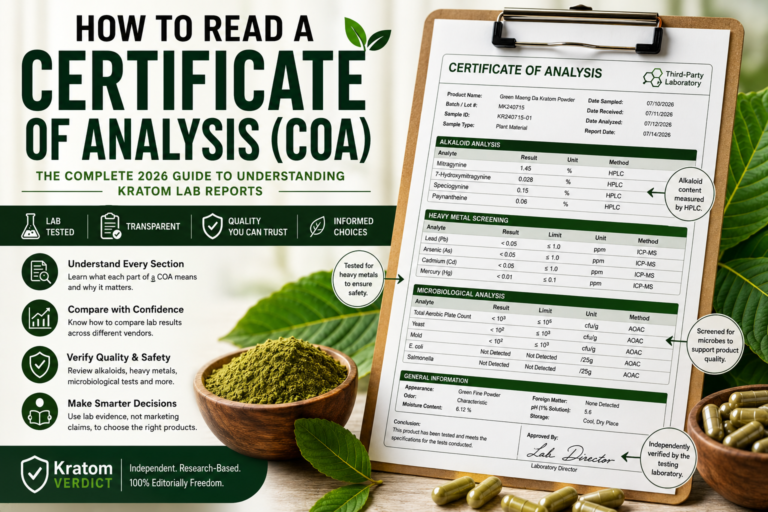
An excellent Certificate of Analysis contains considerably more than alkaloid measurements.
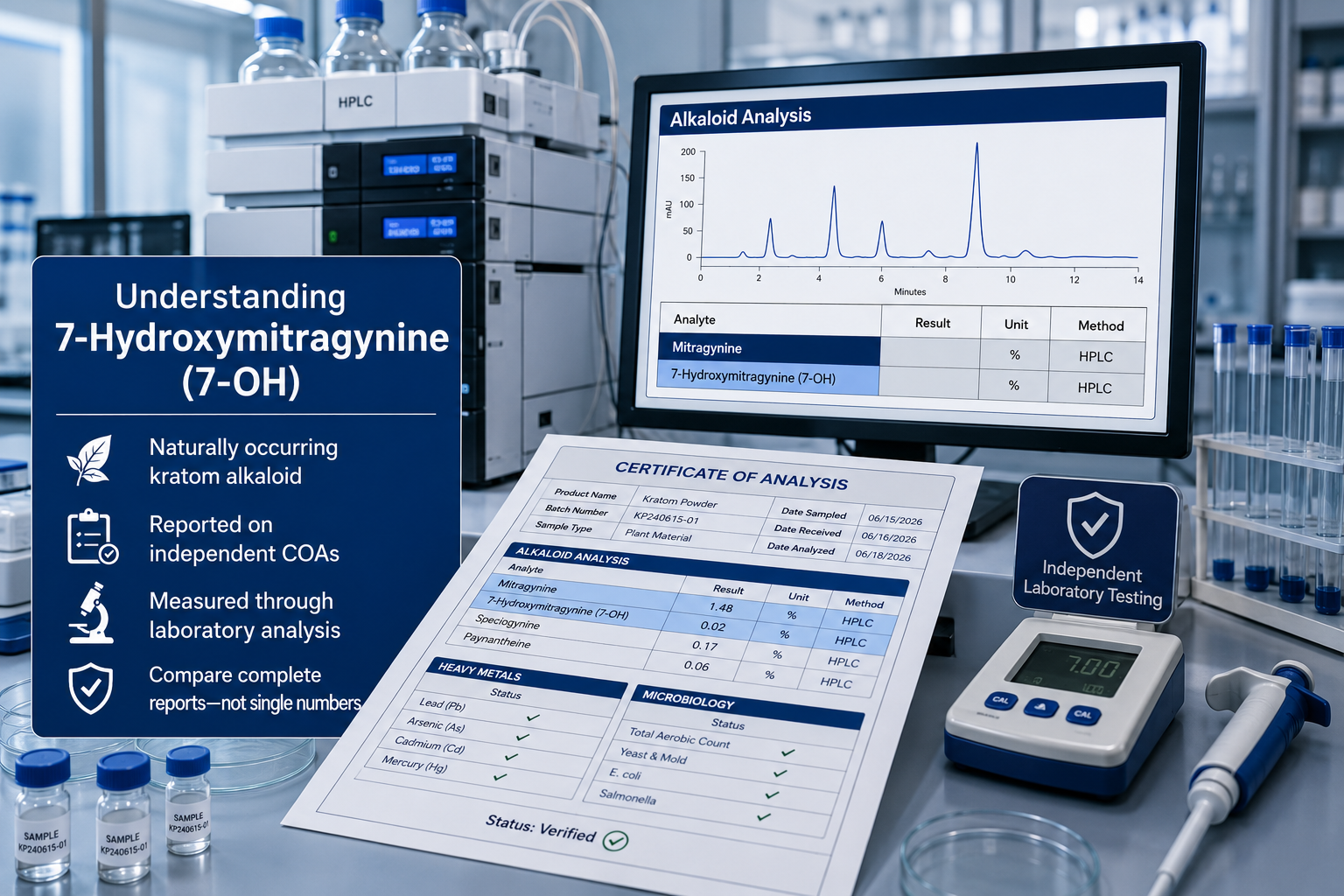
Professional reports generally include:
- Product identification
- Batch number
- Laboratory identity
- Test date
- Mitragynine
- 7-Hydroxymitragynine
- Heavy metal screening
- Microbiological analysis
- Analytical methods
- Laboratory authorization
The strongest companies publish complete reports instead of highlighting only favorable numbers.
Understanding Detection Limits
Professional laboratory reports frequently include:
LOD
Limit of Detection
The smallest quantity the laboratory can reliably detect.
LOQ
Limit of Quantification
The smallest quantity the laboratory can accurately measure with validated precision.
Understanding these terms helps buyers interpret:
- Not Detected (ND)
- Below LOQ
- Measured concentrations
without misunderstanding laboratory terminology.
Common Reporting Formats
Professional laboratories may report 7-Hydroxymitragynine using several formats.
| Reporting Format | Meaning |
|---|---|
| Percentage (%) | Concentration by weight |
| mg/g | Milligrams per gram |
| mg per serving | Quantity within one serving |
| ND | Not Detected above laboratory limit |
| Below LOQ | Present below validated measurement threshold |
Recognizing these reporting formats greatly improves laboratory interpretation.
Common Buyer Mistakes
Our editorial investigation identified several recurring misunderstandings.
Assuming higher numbers always indicate better products
Higher concentration does not automatically indicate better manufacturing.
Comparing extracts with traditional leaf
These products require different evaluation methods.
Ignoring contaminant testing
Heavy metals and microbiological screening remain equally important.
Looking only at one alkaloid
The complete laboratory report should always be reviewed.
Ignoring batch numbers
Batch identification remains essential for product traceability.
Why Companies Sometimes Highlight 7-OH in Marketing
Marketing departments naturally emphasize numbers that appear impressive.
Examples include:
- Enhanced Formula
- High 7-OH
- Maximum Alkaloids
- Premium Extract
These phrases may attract attention.
However, responsible buyers should continue evaluating:
- Complete Certificates of Analysis
- Heavy metal screening
- Microbiology
- Product traceability
- Manufacturing transparency
Documentation consistently provides stronger evidence than advertising.
What Experienced Buyers Examine First
Experienced consumers rarely begin with the 7-Hydroxymitragynine value.
Instead, they typically review:
- Product identification
- Batch number
- Laboratory identity
- Test date
- Heavy metals
- Microbiological testing
- Mitragynine
- 7-Hydroxymitragynine
- Analytical methods
- Laboratory authorization
This approach evaluates the entire scientific report instead of focusing on one analytical result.
Transparency Matters More Than Alkaloid Marketing
The strongest companies do not rely exclusively on promoting individual alkaloids.
Instead, they consistently publish:
- Batch-specific laboratory reports
- Manufacturing information
- Responsible labeling
- Product traceability
- Educational resources
Transparency—not marketing—remains the strongest indicator of editorial confidence.
How Buyers Should Evaluate 7-Hydroxymitragynine on a COA
The presence of a 7-Hydroxymitragynine value on a Certificate of Analysis should never be interpreted without context.
Instead, buyers should follow a structured evaluation process.
Step 1 — Identify the Product Type
Determine whether the product is:
- Traditional leaf powder
- Capsules
- Extract powder
- Liquid extract
- Tablets
- Gummies
Different product categories naturally require different laboratory interpretation.
Step 2 — Verify the Reporting Units
Determine whether the laboratory reports 7-OH as:
- Percentage (%)
- mg/g
- mg per serving
- Not Detected (ND)
- Below LOQ
Products should only be compared after confirming identical reporting units.
Step 3 — Confirm the Batch Number
The batch number printed on the package should match the Certificate of Analysis.
Matching batch identification significantly improves confidence that the laboratory report belongs to the purchased product.
Step 4 — Examine the Entire Laboratory Report
Do not focus exclusively on 7-Hydroxymitragynine.
Responsible buyers should also review:
- Product identification
- Mitragynine
- Heavy metals
- Microbiological testing
- Laboratory information
- Test date
- Analytical methods
The complete Certificate of Analysis provides considerably more information than a single alkaloid value.
Step 5 — Evaluate Company Transparency
Finally, examine whether the company provides:
- Batch-specific COAs
- Manufacturing information
- Responsible product labeling
- Customer support
- Educational resources
Transparency should always outweigh marketing claims.
Understanding Traditional Leaf vs. Specialty Products
One of the most important concepts for buyers is recognizing that not all kratom products belong to the same category.
Traditional botanical leaf products and highly processed specialty formulations should never be compared using identical evaluation criteria.
Responsible manufacturers clearly identify:
- Product type
- Product concentration
- Laboratory documentation
- Batch traceability
- Product labeling
This distinction helps consumers compare products more accurately while reducing confusion.
Why Complete Documentation Matters
A single alkaloid value provides only limited information.
Professional Certificates of Analysis should also include:
✔ Product identification
✔ Batch number
✔ Laboratory identity
✔ Test date
✔ Mitragynine
✔ Heavy metal screening
✔ Microbiological testing
✔ Analytical methods
✔ Laboratory authorization
When all of these elements are present, buyers can evaluate products with significantly greater confidence.
Understanding Marketing Claims
Consumers frequently encounter advertising phrases such as:
- Maximum 7-OH
- Elite Formula
- Ultimate Extract
- Premium Alkaloids
- Strongest Available
These statements may attract attention, but they provide very little scientific information.
Responsible purchasing decisions should instead focus on:
- Certificates of Analysis
- Product traceability
- Laboratory transparency
- Manufacturing documentation
- Responsible labeling
Objective evidence consistently provides stronger consumer protection than marketing language.
Frequently Asked Questions
Is 7-Hydroxymitragynine naturally found in kratom?
Yes.
7-Hydroxymitragynine is a naturally occurring alkaloid found in Mitragyna speciosa leaves.
However, naturally occurring concentrations in traditional leaf products are generally much lower than mitragynine.
Why do some Certificates of Analysis report “Not Detected”?
“Not Detected” means the laboratory did not identify measurable quantities above its validated detection limit.
It should not automatically be interpreted as indicating poor quality.
Understanding laboratory detection limits is important when reviewing COAs.
What does “Below LOQ” mean?
LOQ stands for Limit of Quantification.
This indicates that extremely small amounts may be present but remain below the laboratory’s validated threshold for accurate numerical measurement.
Should buyers compare products using only the 7-OH value?
No.
Responsible evaluation should always include:
- Product identification
- Mitragynine
- Heavy metals
- Microbiological testing
- Batch traceability
- Manufacturing transparency
The complete Certificate of Analysis provides a far more comprehensive assessment than one alkaloid measurement.
Why do extract products receive greater attention?
Extract products involve additional manufacturing processes compared with traditional leaf powder.
As a result, they generally require:
- More detailed laboratory documentation
- Clearer product labeling
- Better serving information
- Stronger manufacturing transparency
Additional processing increases the importance of objective documentation.
What should buyers verify before purchasing?
Responsible buyers should independently verify:
- Batch-specific Certificates of Analysis
- Laboratory identity
- Product labeling
- Batch numbers
- Heavy metal testing
- Microbiological screening
- Manufacturing transparency
These factors provide significantly greater confidence than marketing claims alone.
Final Editorial Verdict
Understanding 7-Hydroxymitragynine allows buyers to interpret laboratory reports more accurately while avoiding many of the misconceptions commonly found online.
The most important lesson is that 7-OH should never be evaluated in isolation.
Instead, it should be interpreted alongside:
- Mitragynine
- Heavy metal analysis
- Microbiological testing
- Product identification
- Laboratory methodology
- Batch traceability
- Manufacturing transparency
The strongest manufacturers consistently publish complete Certificates of Analysis, clearly identify product batches, explain laboratory terminology, and provide responsible educational resources that help consumers understand what laboratory values actually mean.
Consumers who learn how to evaluate the complete scientific record—not simply one alkaloid value—are considerably better prepared to compare products using objective evidence rather than marketing claims.
The Kratom Verdict Editorial Principles
Every technical guide published by Kratom Verdict follows the same independent editorial methodology.
Science Before Marketing
Scientific evidence always outweighs promotional language.
Complete Laboratory Reports Matter
Responsible purchasing decisions require evaluating the entire Certificate of Analysis rather than focusing on a single laboratory value.
Transparency Builds Confidence
Companies publishing complete documentation receive greater editorial confidence than companies relying primarily on advertising.
Education Protects Consumers
Helping buyers understand laboratory reports contributes to better long-term purchasing decisions than emphasizing product promotion.
Independent Verification
Whenever possible, buyers should independently verify:
- Certificates of Analysis
- Batch numbers
- Laboratory identity
- Product labeling
- Analytical methods
Independent verification remains one of the strongest consumer protections available when evaluating botanical products.
Final Recommendation
Consumers should approach 7-Hydroxymitragynine as one component of a much larger laboratory picture.
Instead of asking whether a product contains “high” or “low” 7-OH, responsible buyers should ask:
- Is the Certificate of Analysis complete?
- Can the laboratory report be verified?
- Does the batch number match?
- Were heavy metals and microbiological contaminants tested?
- Does the manufacturer provide transparent documentation?
Answering those questions provides a much stronger foundation for evaluating product quality than relying on isolated alkaloid values or marketing terminology.
Understanding how 7-Hydroxymitragynine fits within the complete Certificate of Analysis enables buyers to interpret laboratory reports with greater confidence while making more informed purchasing decisions.
Sources
- U.S. Food and Drug Administration (FDA) — Public guidance regarding kratom, botanical products, and concentrated alkaloid formulations.
- American Kratom Association (AKA) — Good Manufacturing Practices (GMP) Standards Program.
- ISO/IEC 17025 — General requirements for the competence of testing and calibration laboratories.
- National Center for Biotechnology Information (NCBI/PubMed) — Peer-reviewed analytical chemistry and Mitragyna speciosa research.
- AOAC International — Analytical testing methodology references.
- Publicly available Certificates of Analysis (COAs) reviewed during independent editorial research.
Editorial Disclosure
Kratom Verdict is an independent editorial publication. This guide evaluates publicly available scientific literature, laboratory documentation, and regulatory information using a consistent editorial methodology. Affiliate relationships, where applicable, do not influence editorial conclusions.
Medical & Legal Disclaimer
This guide is intended for educational and informational purposes only. Kratom is not approved by the U.S. Food and Drug Administration for the diagnosis, treatment, cure, or prevention of any disease. References to laboratory findings describe analytical measurements only and should not be interpreted as evidence of safety, effectiveness, or therapeutic benefit. Readers should review current laws applicable to their jurisdiction, examine batch-specific Certificates of Analysis, and consult qualified healthcare professionals before considering kratom or related botanical products.