- Written By Distinguished Professor Christopher R. McCurdy
- Reviewed by Kratom Verdict Editorial Team
- Last Updated: July 2026
- Estimated Reading Time: 17 Minutes
- Review Type: Independent Editorial Brand Review
Research Basis: Publicly available laboratory documentation, ISO/IEC 17025 laboratory standards, Certificates of Analysis (COAs), FDA educational publications, analytical chemistry references, and Kratom Verdict’s documentation-first editorial methodology.
Editorial Notice
Learning How to Read a Certificate of Analysis is one of the most valuable skills consumers can develop before purchasing botanical products. A Certificate of Analysis (COA) provides laboratory documentation that allows buyers to review objective information instead of relying solely on marketing claims.
This guide explains How to Read a Certificate of Analysis using a documentation-first approach. Rather than recommending products or vendors, this guide teaches readers how to interpret laboratory reports, understand batch identification, recognize analytical methods, evaluate Certificates of Analysis (COAs), and identify documentation that supports transparency.
Throughout this guide, How to Read a Certificate of Analysis will be explained step by step using publicly available laboratory standards and consumer education principles. This guide does not provide medical advice or evaluate therapeutic claims. Instead, it focuses on helping consumers understand laboratory documentation before making purchasing decisions.
Research Snapshot
| Category | Editorial Assessment |
|---|---|
| Guide Type | Consumer Education |
| Primary Focus | Certificate of Analysis Interpretation |
| Laboratory Standards | Reviewed |
| Analytical Methods | Reviewed |
| Batch Documentation | Reviewed |
| Transparency | Reviewed |
| Consumer Education | Reviewed |
| Editorial Method | Documentation-First |
Executive Summary
Understanding How to Read a Certificate of Analysis helps consumers evaluate botanical products using scientific documentation rather than promotional language. While many vendors advertise “third-party tested” products, consumers often do not know what laboratory reports actually contain or how to interpret them.
A Certificate of Analysis (COA) typically includes information such as laboratory identification, sample identification, batch numbers, analytical methods, testing dates, and laboratory findings. Learning How to Read a Certificate of Analysis allows consumers to determine whether documentation appears complete, current, and traceable.
Throughout this guide, readers will learn:
- What a Certificate of Analysis is
- Why COAs matter
- How to verify batch numbers
- How to identify laboratory information
- How to understand analytical methods
- How to recognize complete documentation
- How to compare COAs between vendors
- Common mistakes consumers make when reviewing laboratory reports
By the end of this guide, readers will understand How to Read a Certificate of Analysis using the same documentation-first methodology employed throughout Kratom Verdict.
What Is a Certificate of Analysis?
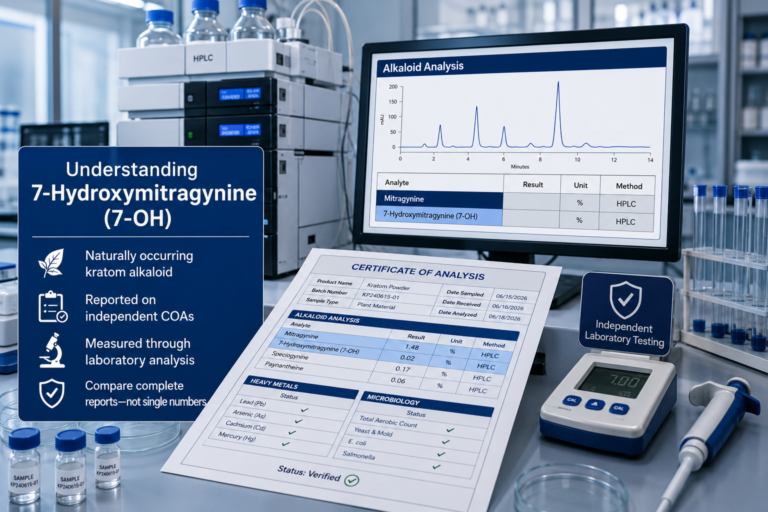
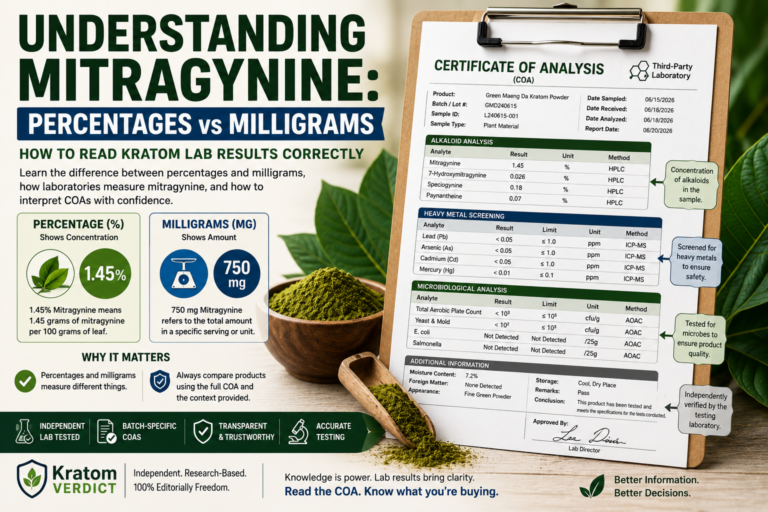
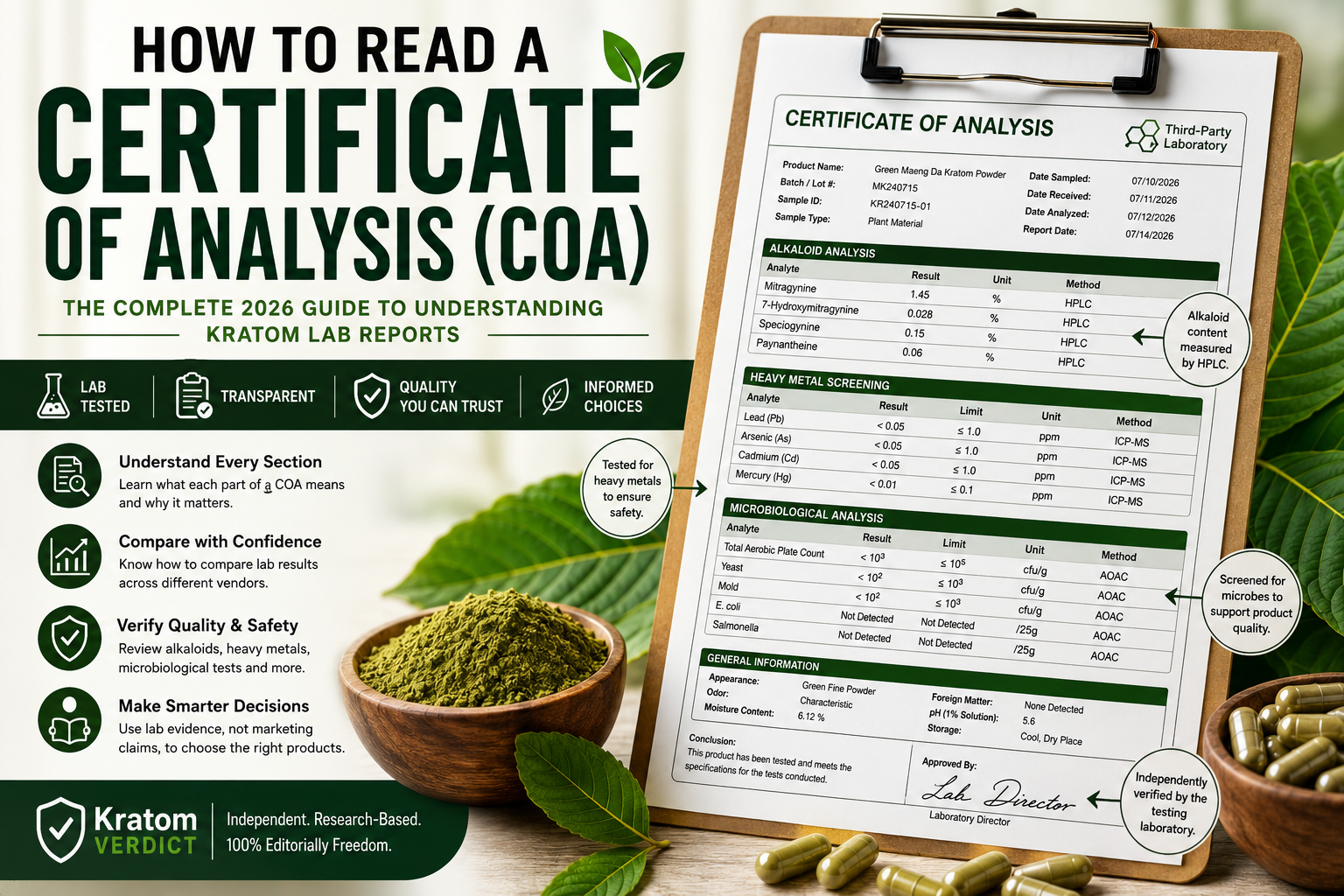
A Certificate of Analysis (COA) is a laboratory document prepared after analytical testing has been performed on a representative sample of a product. The purpose of a COA is to document laboratory findings and provide information that consumers or businesses can review before purchasing or distributing a product.
Understanding How to Read a Certificate of Analysis begins with recognizing that a COA is not simply a marketing document. Instead, it serves as a scientific record containing information about the tested sample, laboratory procedures, and documented analytical results.
A properly prepared COA commonly contains:
- Laboratory name
- Sample identification
- Batch number
- Lot number
- Date received
- Date analyzed
- Testing methodology
- Analytical findings
- Report identification number
- Laboratory authorization
Consumers should always compare these details with product packaging whenever possible.
Why COAs Matter
Learning How to Read a Certificate of Analysis is important because laboratory documentation allows consumers to evaluate transparency objectively.
A current batch-specific COA helps consumers:
- Confirm that testing was performed
- Verify batch identification
- Identify the testing laboratory
- Review testing dates
- Understand analytical methods
- Compare documentation across vendors
Rather than accepting marketing statements at face value, consumers can use Certificates of Analysis to make better-informed purchasing decisions.
Key Sections of Every COA
Although laboratory report formats vary, most Certificates of Analysis contain several core sections.
These include:
Laboratory Information
Identifies the laboratory responsible for performing the analysis.
Sample Identification
Describes the material submitted for testing.
Batch Number
Connects the laboratory report with the finished product.
Lot Number
Provides additional production identification.
Testing Dates
Shows when analysis was performed.
Analytical Methods
Documents the laboratory procedures used.
Results Section
Contains the reported analytical findings.
Laboratory Approval
Shows that the report has been authorized by the testing laboratory.
Understanding these sections is essential when learning How to Read a Certificate of Analysis.
Batch Numbers
Batch numbers are one of the most important elements of any Certificate of Analysis.
Consumers should verify that:
- The batch number on the COA matches the product packaging.
- The report appears current rather than outdated.
- The documentation corresponds to the product being purchased.
A batch-specific COA generally provides greater transparency than a generic laboratory report.
Laboratory Identification
A transparent Certificate of Analysis should clearly identify the laboratory performing the analysis.
Laboratory information often includes:
- Laboratory name
- Address
- Contact information
- Report number
- Authorization details
Consumers should be cautious when laboratory identification is incomplete or unavailable.
Kratom Verdict Documentation Methodology
At Kratom Verdict, Certificates of Analysis are evaluated using a consistent documentation-first framework.
Evaluation categories include:
- Laboratory identification
- Batch traceability
- Sample identification
- Testing dates
- Analytical methodology
- Documentation completeness
- Transparency
- Consumer accessibility
Applying the same evaluation criteria across multiple vendors allows consumers to compare documentation objectively rather than relying on advertising claims.
How to Read a Certificate of Analysis (COA): Understanding Laboratory Reports, Testing Methods & Product Transparency
Why Every Consumer Should Understand a COA
Learning How to Read a Certificate of Analysis is one of the most valuable skills for anyone purchasing botanical products. A Certificate of Analysis (COA) provides scientific documentation that helps consumers evaluate transparency rather than relying solely on advertising claims such as “premium quality,” “lab tested,” or “third-party tested.”
At Kratom Verdict, every vendor is evaluated using the same documentation-first methodology. Understanding How to Read a Certificate of Analysis allows consumers to compare laboratory documentation objectively across multiple companies using measurable evidence instead of promotional language.
A properly prepared COA should connect laboratory testing directly to the product being sold through batch numbers, sample identification, testing dates, analytical methods, and laboratory authorization.
Understanding Laboratory Information
The first section consumers should review when learning How to Read a Certificate of Analysis is laboratory identification.
A professional COA generally identifies:
- Laboratory name
- Laboratory address
- Contact information
- Laboratory report number
- Accreditation information (when applicable)
Clear laboratory identification improves transparency because consumers know which organization performed the analysis.
If laboratory information is missing or incomplete, consumers should carefully evaluate the documentation before relying on the report.
Sample Identification
Sample identification describes the material submitted for laboratory analysis.
Consumers learning How to Read a Certificate of Analysis should determine whether the sample description clearly identifies:
- Product type
- Sample description
- Sample identification number
- Internal tracking number
- Customer identification (when applicable)
Complete sample identification helps establish traceability between laboratory documentation and finished products.
Batch Numbers
Batch numbers represent one of the most important elements of any Certificate of Analysis.
Consumers should verify:
- The batch number on the COA matches the batch printed on product packaging.
- The batch appears current.
- The report corresponds to the specific product being purchased.
Learning How to Read a Certificate of Analysis includes understanding that batch-specific documentation provides significantly greater transparency than generic laboratory reports.
Lot Numbers
Many Certificates of Analysis also include lot numbers.
Although lot numbers and batch numbers are sometimes used interchangeably, some manufacturers distinguish them internally.
Consumers should confirm that:
- Lot numbers appear consistent.
- Product documentation matches laboratory documentation.
- Manufacturing records appear traceable.
Complete production identification strengthens transparency.
Dates on a Certificate of Analysis
Consumers often overlook the importance of laboratory dates.
A typical COA may contain:
- Sample received date
- Sample preparation date
- Analysis date
- Report issue date
Learning How to Read a Certificate of Analysis includes verifying that documentation appears reasonably current rather than several years old.
Current laboratory reports generally provide greater confidence than outdated documentation.
Analytical Methods
One of the most valuable sections of a COA explains how laboratory testing was performed.
Consumers commonly encounter methods including:
HPLC (High-Performance Liquid Chromatography)
Frequently used for alkaloid analysis.
UPLC (Ultra-Performance Liquid Chromatography)
Provides high-resolution compound separation.
LC-MS (Liquid Chromatography–Mass Spectrometry)
Allows enhanced compound identification.
ICP-MS (Inductively Coupled Plasma Mass Spectrometry)
Often used for elemental analysis.
Understanding these analytical methods helps consumers better interpret laboratory reports.
Laboratory Results
The analytical results section contains the actual laboratory findings.
Depending on the testing performed, reports may include:
- Alkaloid analysis
- Botanical identification
- Heavy metal analysis
- Microbiological testing
- Additional analytical information
Consumers should remember that laboratory reports document the analyzed sample rather than making marketing claims.
Understanding Units of Measurement
Consumers researching How to Read a Certificate of Analysis frequently encounter scientific units such as:
- Percentage (%)
- Parts per million (ppm)
- Milligrams per gram (mg/g)
- Micrograms per gram (µg/g)
These measurements help laboratories communicate analytical findings consistently.
Learning basic scientific units improves a consumer’s ability to compare laboratory reports across vendors.
Pass / Fail Information
Some laboratory reports include pass/fail designations.
Consumers should understand that pass/fail statements depend upon:
- Testing scope
- Laboratory criteria
- Customer specifications
- Analytical procedures
Pass/fail information should always be interpreted alongside the complete laboratory documentation.
Laboratory Authorization
Professional Certificates of Analysis generally conclude with laboratory authorization.
This section may include:
- Authorized laboratory signature
- Laboratory representative
- Electronic authorization
- Report approval statement
Authorization indicates that the report has completed the laboratory review process.
Independent Third-Party Testing
Consumers frequently encounter the phrase “third-party tested.”
Learning How to Read a Certificate of Analysis means determining whether the documentation actually supports this statement.
Consumers should verify:
- Independent laboratory identification
- Batch-specific testing
- Current documentation
- Complete laboratory reports
- Clearly documented analytical methods
The phrase “third-party tested” has significantly greater value when accompanied by publicly available documentation.
Common Documentation Mistakes
Consumers reviewing Certificates of Analysis should recognize several common documentation issues.
Examples include:
- Missing laboratory name
- Missing batch number
- Generic COAs
- Undated reports
- Missing analytical methods
- Limited sample identification
- Incomplete laboratory authorization
One documentation issue alone does not necessarily invalidate a report. However, multiple omissions reduce transparency.
Kratom Verdict Insight
The strongest Certificates of Analysis clearly identify the laboratory, include current batch-specific documentation, explain analytical methods, provide complete sample identification, document testing dates, and allow consumers to verify that laboratory reports correspond directly to the products they purchase.
Editorial Summary
At this stage, readers should have a solid understanding of How to Read a Certificate of Analysis by examining laboratory identification, sample documentation, batch numbers, lot numbers, testing dates, analytical methods, laboratory findings, units of measurement, and report authorization. These elements form the foundation of laboratory transparency and help consumers compare vendors objectively using scientific documentation rather than advertising claims.
Independent Third-Party Laboratory Testing
Understanding How to Read a Certificate of Analysis ultimately means understanding how laboratory documentation supports product transparency. Independent third-party laboratory testing allows consumers to evaluate objective information before making purchasing decisions instead of relying solely on advertising statements such as “premium quality,” “lab tested,” or “third-party tested.”
Throughout this guide, How to Read a Certificate of Analysis has focused on documentation rather than marketing. At Kratom Verdict, every vendor is evaluated using the same documentation-first methodology, ensuring that Certificates of Analysis (COAs), laboratory reports, manufacturing information, and quality-control documentation receive consistent evaluation across every review.
Independent laboratories operate separately from manufacturers and analyze representative samples using documented scientific procedures. While laboratory testing alone cannot evaluate every aspect of manufacturing quality, it remains one of the strongest indicators of transparency when combined with batch traceability, supplier qualification, manufacturing documentation, and quality-control systems.
Consumers who understand How to Read a Certificate of Analysis are better equipped to compare vendors objectively using publicly available evidence rather than promotional language.
ISO/IEC 17025 Laboratory Accreditation
Many botanical companies use laboratories accredited under ISO/IEC 17025, the internationally recognized standard for testing and calibration laboratories.
When learning How to Read a Certificate of Analysis, consumers should understand that ISO/IEC 17025 accreditation indicates that a laboratory maintains documented quality-management systems covering areas such as:
- Equipment calibration
- Method validation
- Personnel competency
- Sample handling
- Chain of custody
- Quality assurance
- Documentation management
- Internal audits
- Record retention
- Corrective actions
Although accreditation does not certify a product or vendor, it provides additional confidence regarding laboratory competence and testing procedures.
Understanding Common Analytical Methods
Consumers reviewing Certificates of Analysis frequently encounter several analytical techniques.
High-Performance Liquid Chromatography (HPLC)
Commonly used for botanical alkaloid analysis and compound separation.
Ultra-Performance Liquid Chromatography (UPLC)
Provides enhanced analytical resolution and faster compound separation.
Liquid Chromatography–Mass Spectrometry (LC-MS)
Used for advanced compound identification and confirmation.
Inductively Coupled Plasma Mass Spectrometry (ICP-MS)
Often used for elemental analysis within broader laboratory quality-control programs.
Understanding these methods helps consumers interpret laboratory reports with greater confidence when learning How to Read a Certificate of Analysis.
Complete COA Interpretation Checklist
When reviewing a Certificate of Analysis, consumers should confirm that the document contains:
✅ Laboratory name
✅ Laboratory contact information
✅ Sample identification
✅ Batch number
✅ Lot number
✅ Date received
✅ Date analyzed
✅ Report issue date
✅ Analytical methodology
✅ Laboratory findings
✅ Laboratory authorization
✅ Report identification number
A complete COA containing these elements generally provides greater transparency than incomplete documentation.
Questions Every Consumer Should Ask
Before relying on any laboratory report, ask:
- Does the batch number match the product?
- Is the report current?
- Is the testing laboratory clearly identified?
- Are analytical methods listed?
- Does the COA include complete sample information?
- Is laboratory authorization present?
- Is the report easy to verify?
- Does the company publish current batch-specific documentation?
These questions help consumers evaluate transparency more effectively.
Common COA Red Flags
Consumers should be cautious when encountering:
- Missing laboratory names
- Missing batch numbers
- Undated Certificates of Analysis
- Generic laboratory reports used for multiple products
- Missing analytical methods
- Missing sample identification
- Missing laboratory authorization
- Reports that cannot be connected to the purchased product
A single issue does not necessarily invalidate a report. However, multiple documentation gaps reduce the amount of independently verifiable information available.
Comparing COAs Between Vendors
Understanding How to Read a Certificate of Analysis also makes vendor comparison easier.
Consumers should compare:
| Evaluation Category | What to Review |
|---|---|
| Laboratory Identification | Clearly named laboratory |
| Batch Traceability | Matching batch numbers |
| Sample Information | Complete identification |
| Testing Dates | Current documentation |
| Analytical Methods | Documented procedures |
| Report Completeness | Full laboratory report |
| Authorization | Laboratory approval |
| Consumer Accessibility | Easy public access |
Using identical evaluation criteria helps consumers compare vendors objectively.
Internal Resources
For additional research, readers may also find these Kratom Verdict guides useful:
Vendor Transparency
- How to Evaluate Kratom Vendors
- Vendor Transparency Checklist
- How to Identify a Trusted Kratom Vendor
- Best Kratom Vendors for Beginners
Laboratory Testing
- Third-Party Lab Testing Explained
- Kratom Lab Testing Explained
- Kratom Alkaloid Testing Guide
- How to Read a Kratom Certificate of Analysis
- How to Compare Kratom COAs
- AKA GMP Certification Explained
Consumer Education
- Kratom Buying Guide
- Kratom Safety Guide
- Kratom Legality Guide
- Full Spectrum Kratom Explained
- Enhanced Kratom Powder Guide
- Kratom Extract Powder Explained
External References
Readers interested in learning more about laboratory standards and botanical documentation may consult publicly available resources from:
- U.S. Food and Drug Administration (FDA)
- American Kratom Association (AKA)
- International Organization for Standardization (ISO)
- AOAC INTERNATIONAL
- PubMed
- Kew Science – Plants of the World Online
- Journal of Ethnopharmacology
- Frontiers in Pharmacology
Kratom Verdict COA Evaluation Framework
| Documentation Category | Importance |
|---|---|
| Laboratory Identification | ⭐⭐⭐⭐⭐ |
| Batch Traceability | ⭐⭐⭐⭐⭐ |
| Certificate Completeness | ⭐⭐⭐⭐⭐ |
| Analytical Methods | ⭐⭐⭐⭐⭐ |
| Sample Identification | ⭐⭐⭐⭐ |
| Testing Dates | ⭐⭐⭐⭐ |
| Laboratory Authorization | ⭐⭐⭐⭐ |
| Consumer Accessibility | ⭐⭐⭐⭐ |
| Documentation Transparency | ⭐⭐⭐⭐⭐ |
Final Editorial Conclusion
Learning How to Read a Certificate of Analysis empowers consumers to evaluate botanical products using objective laboratory documentation instead of marketing claims. A well-prepared COA should include clear laboratory identification, batch-specific traceability, sample information, testing dates, analytical methods, laboratory findings, and authorization. When these elements are present and can be independently verified, they contribute to a higher level of transparency.
At Kratom Verdict, every vendor is assessed using the same documentation-first editorial methodology to ensure fairness, consistency, and independence. By applying the framework presented throughout this guide, readers can confidently interpret Certificates of Analysis, compare laboratory documentation across vendors, and make more informed purchasing decisions based on publicly available evidence rather than promotional language. This approach reflects Kratom Verdict’s commitment to consumer education, transparency, and evidence-based editorial standards.