Reviewed by Kratom Verdict Editorial Team
Last Updated: July 2026
Estimated Reading Time: 16 minutes
Guide Type: Independent Editorial Strain Guide
Research Basis: Publicly available botanical information, third-party laboratory transparency, publicly available regulatory resources, scientific literature, and independent editorial research.
Heavy metals and alkaloid potency tend to get most of the attention when people talk about lab testing, but microbial contamination is arguably the most acute, fast-acting safety risk in the entire testing panel. Heavy metal exposure is a slow, cumulative concern. A live Salmonella infection from a contaminated batch of powder can put someone in the hospital within days.
Microbial testing is the section of a Certificate of Analysis that screens for exactly that kind of risk — bacteria, yeast, and mold that can grow on raw botanical materials, dietary supplements, and other consumer products during growing, harvesting, drying, processing, and storage. This guide explains what microbial testing actually measures, which organisms and thresholds matter most, how the testing methodology works, and how to read a microbial panel on a real Certificate of Analysis with genuine understanding rather than just trusting a “PASS” stamp.
Why Microbial Contamination Happens
Any raw agricultural or botanical material — kratom leaf, herbal powders, dried spices, plant-based supplement ingredients — comes from an environment where microorganisms are simply part of the natural landscape. Contamination risk typically enters at one of several points:
Growing conditions. Warm, humid climates, which describe the native growing regions for many botanical products including kratom, provide favorable conditions for microbial proliferation well before harvest even begins.
Harvesting and handling. Manual harvesting, transport, and initial processing introduce exposure to soil, water, and human contact, all of which can carry bacteria, yeast, or mold spores.
Drying and storage. Incomplete drying leaves residual moisture that supports microbial growth, and improper storage conditions afterward — excess humidity, inconsistent temperature, exposure to pests — can allow existing contamination to multiply well after the product has left the farm.
Processing and packaging. Grinding, encapsulating, and packaging introduce additional contact points where contamination can be introduced or, if hygiene practices are poor, actively spread.
None of this makes microbial risk unique to any one product category. It’s a universal consideration across herbs, spices, teas, and other natural health products. What varies is how seriously a given manufacturer takes testing and quality control at each of these stages.
The Organisms a Complete Microbial Panel Should Cover
A genuinely thorough microbial testing panel goes well beyond a single generic “microbial count” and breaks results out by specific organism category.
Total Aerobic Microbial Count (TAMC)
This measures the total number of aerobic (oxygen-requiring) bacteria present in a sample, expressed in colony-forming units per gram (CFU/g). It’s a general indicator of overall microbial load rather than a test for any single pathogen. Typical specification limits for oral dietary supplement products commonly fall in the range of 1,000 to 100,000 CFU/g depending on the specific compendial standard and product category being applied.
Total Yeast and Mold Count (TYMC)
This tracks the combined presence of yeast and mold organisms, also expressed in CFU/g. Elevated yeast and mold levels aren’t just an aesthetic or spoilage issue — they can be associated with respiratory irritation, allergic reactions, and in some cases the production of mycotoxins, which is why many labs test mycotoxins as a related, separate panel. Typical acceptance limits for TYMC in oral products are commonly set lower than TAMC limits, often in the range of 100 to 10,000 CFU/g depending on the applicable standard.
Coliforms and Enterobacteriaceae
Coliforms are a broader family of gram-negative bacteria whose presence can indicate sanitation failures during processing, even when a more dangerous specific pathogen isn’t detected. Enterobacteriaceae, a related bacterial family, is tested for similar reasons — elevated levels can signal fecal contamination or unsanitary handling conditions even in the absence of a confirmed Salmonella or E. coli result. These indicator organisms matter because they can flag a hygiene problem before it escalates into detection of an actual pathogen.
Escherichia coli (E. coli)
E. coli testing checks specifically for this bacterium, which in certain strains can cause serious gastrointestinal illness. Reputable testing standards generally require the complete absence of E. coli in a defined sample size — commonly expressed as “absence in 1 gram” for oral products — rather than simply a low count. A COA reporting E. coli at “<10 CFU/g” is providing a quantitative sensitivity threshold; ideally, the result itself should read as fully absent or not detected.
Salmonella species
This is one of the single most important results on any microbial panel, and for good reason. Salmonella contamination has been directly linked to real, documented illness outbreaks tied to kratom products, and it remains one of the clearest, most acute safety risks in botanical product testing. Standard testing protocols require absence of Salmonella in a defined sample size, commonly 10 grams or more for oral products, and any positive detection should be treated as an automatic disqualifier — not a borderline result to weigh against other factors.
Staphylococcus aureus
Some testing protocols also screen for Staph aureus, particularly relevant depending on the specific product category and route of exposure, with absence typically required in a defined sample size for applicable products.
Pseudomonas aeruginosa and Candida albicans
These organisms are more commonly required for topical products or those applied to mucous membranes, though some oral product testing protocols include them as well depending on the specific compendial standard being followed.
The Regulatory Framework Behind Microbial Limits
Microbial testing for dietary supplements and botanical products in the United States is most commonly governed by two complementary chapters of the United States Pharmacopeia:
USP Chapter <61> covers enumeration testing — meaning it defines the methodology for counting total aerobic microbial load and total yeast and mold count in a sample.
USP Chapter <62> covers testing for specified, named organisms — meaning it defines the methodology for confirming the absence (or presence) of specific pathogens like Salmonella, E. coli, and Staphylococcus aureus.
These two chapters work together, and it’s worth understanding that they are not interchangeable. A laboratory or manufacturer that only performs TAMC and TYMC enumeration testing under USP <61> — without also conducting the specified organism testing required under USP <62> — can produce a Certificate of Analysis showing passing microbial counts while having no actual data at all on whether Salmonella, E. coli, or other named pathogens are present. This is a documented, recurring gap in the industry, and it’s exactly the kind of detail a shopper needs to check for directly rather than assuming a “microbial: passed” line covers everything it sounds like it covers.
The broader specification these tests are measured against is typically USP Chapter <2023>, “Microbiological Attributes of Nonsterile Nutritional and Dietary Supplements,” which lays out the overall acceptance criteria framework tying enumeration and specified-organism testing together for the supplement category specifically.
It’s also worth noting that method validation matters here just as much as it does for chemical testing. A microbial test method needs to demonstrate adequate recovery of challenge organisms even in the presence of the specific product formulation being tested — some botanical materials can inherently inhibit microbial growth in ways that interfere with accurate detection if the method hasn’t been properly validated for that specific product matrix.
Why Aqueous and Non-Aqueous Products Are Treated Differently
Water activity plays a significant role in microbial risk, which is why testing standards commonly apply meaningfully different — often roughly tenfold — lower microbial limits to aqueous preparations (liquids, tinctures, certain beverages) compared to non-aqueous forms like dried powders or capsules. Water-based environments simply support microbial proliferation far more readily than dry powder does, so a limit appropriate for a dry leaf product would be far too permissive if applied directly to a liquid extract or beverage.
How Microbial Testing Actually Works in the Lab
Sample preparation and enrichment. For specified organism testing (like Salmonella or E. coli detection), samples typically undergo a pre-enrichment step in a non-selective growth broth, allowing any low-level, stressed, or sub-lethally damaged organisms present in the sample the opportunity to recover and multiply to detectable levels before further testing.
Selective media culturing. Following enrichment, samples are cultured on selective and differential growth media designed to encourage the growth of target organisms while suppressing others, making specific pathogens easier to identify and confirm.
Confirmatory testing. Suspected positive results are typically followed by additional confirmatory biochemical or molecular testing to verify the identity of any detected organism before it’s reported on a final Certificate of Analysis.
Enumeration methods. For general microbial counts (TAMC, TYMC), standard plate count methodology or membrane filtration techniques are used to physically count colony-forming units, giving a quantifiable measure of total microbial load rather than a simple presence/absence result.
Reputable testing reports will typically cite the specific named method used for each organism tested — referencing the applicable USP chapter, an equivalent international pharmacopeial standard, or a recognized method like those published by international standards bodies — which is a meaningful signal that the lab is following validated, industry-recognized procedures rather than an informal in-house process.
Real-World Stakes: Why This Testing Category Matters So Much
Microbial contamination in kratom and other botanical supplement products isn’t a theoretical risk confined to academic papers — it has produced real, documented enforcement actions and product recalls. Regulatory history includes a case in which a kratom manufacturer received a mandatory recall order specifically over Salmonella contamination after declining to pursue a voluntary recall, marking a notable escalation in enforcement for the category. More recent industry monitoring has also tracked kratom product recalls tied to potential Salmonella contamination across multiple product lines.
These aren’t isolated incidents from years past — they reflect an ongoing pattern in a market where testing isn’t universally mandated, and where products distributed through less regulated retail channels have consistently shown a higher documented rate of contamination risk than those from vendors committed to routine, comprehensive lab testing. This history is exactly why microbial testing, and specifically the presence of a genuine Salmonella and E. coli screen, has become treated as a non-negotiable baseline expectation for any credible kratom vendor.
How to Read a Microbial Panel on a Real COA
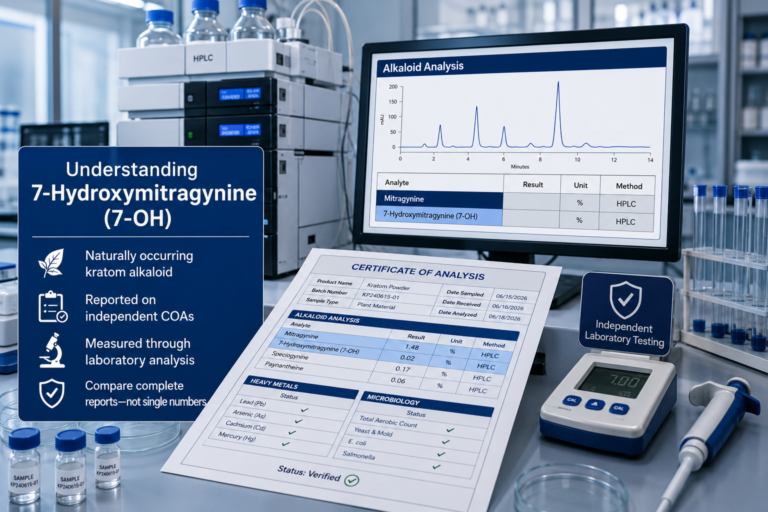
Check for individual organism results, not just a summary line. A COA that simply states “Microbiological: Passed” gives you far less information than one that breaks out TAMC, TYMC, coliforms, E. coli, and Salmonella as separate line items with actual values.
Confirm Salmonella and E. coli are both explicitly tested and reported as absent. These two results matter more than any other line on a microbial panel. If either is missing from the report entirely, that’s a meaningful gap, not a minor omission.
Look at the numeric CFU/g values, not just pass/fail labels. A result reported as “<10 CFU/g” or a specific numeric count gives you something to actually compare against a stated specification limit; a bare “pass” does not.
Check which specification the results are measured against. Look for a reference to USP <61>/<62>, USP <2023>, an equivalent national pharmacopeial standard, or a specific state regulatory framework — this tells you the lab is applying a recognized, defined acceptance criterion rather than an arbitrary internal judgment call.
Confirm the testing method is named. References to standard culturing techniques, confirmatory biochemical testing, or accredited method citations signal a rigorous process; a report with no stated methodology at all is harder to trust.
Match the product type to the appropriate limit. Remember that aqueous products (liquids, beverages, tinctures) should be held to meaningfully stricter microbial limits than dry powders or capsules, given how much more readily microorganisms proliferate in a water-based environment.
Treat any positive pathogen detection as an automatic disqualifier. Unlike heavy metals, where risk is dose-dependent and somewhat gradated, microbial pathogen contamination — particularly Salmonella — doesn’t have a “mild” acceptable version. A positive result should end the conversation about that specific batch, regardless of how strong the rest of the COA looks.
A Quick Glossary of Microbial Testing Terms
- CFU/g (Colony-Forming Units per Gram): A measurement of the number of viable, culturable microorganisms present in a solid sample.
- TAMC (Total Aerobic Microbial Count): The total count of aerobic bacteria in a sample, used as a general indicator of overall microbial load.
- TYMC (Total Yeast and Mold Count): The total combined count of yeast and mold organisms in a sample.
- Coliforms / Enterobacteriaceae: Indicator bacterial families whose elevated presence can signal broader sanitation or contamination issues.
- USP <61> / <62> / <2023>: United States Pharmacopeia chapters defining enumeration testing, specified organism testing, and overall microbiological acceptance criteria for dietary supplements, respectively.
- Pre-enrichment: A sample preparation step using non-selective growth broth to allow low-level or stressed organisms to recover before testing.
- Selective media: Specialized growth media formulated to encourage target organism growth while suppressing others, aiding pathogen identification.
- Bioburden: The overall level of microorganisms present in a raw material or finished product prior to any sterilization or treatment step.
- Water activity: A measure of the free moisture available in a product to support microbial growth, central to why aqueous and non-aqueous products are held to different limits.
Frequently Asked Questions
What’s the difference between a general microbial count and pathogen-specific testing? A general microbial count (TAMC/TYMC under USP <61>) tells you the overall population size of bacteria, yeast, and mold in a sample, but says nothing about whether any specific dangerous organism, like Salmonella, is present. Pathogen-specific testing (under USP <62>) is a separate process specifically designed to detect or confirm the absence of named organisms of concern. A complete microbial panel needs both.
Is a “Microbiological: Passed” statement on a COA good enough? Not on its own. That statement doesn’t tell you which organisms were actually tested, what the numeric results were, or what specification they were measured against. A trustworthy COA breaks out individual results — TAMC, TYMC, coliforms, E. coli, Salmonella — rather than summarizing everything into a single pass/fail line.
Why is Salmonella testing considered so critical for kratom specifically? Salmonella contamination has been directly linked to documented illness outbreaks and regulatory enforcement actions involving kratom products, including cases significant enough to prompt mandatory recall orders. That history has made explicit, reliable Salmonella testing one of the clearest non-negotiable baseline expectations across the kratom industry.
Do liquid kratom products need different microbial testing than powders? Yes. Because water-based products support microbial proliferation more readily than dry powder, aqueous preparations are typically held to meaningfully stricter microbial limits — often around ten times lower — than non-aqueous forms like capsules or dried leaf.
Can a product with a high general microbial count still be safe? General microbial counts (TAMC/TYMC) reflect overall bioburden and are compared against defined acceptance limits appropriate to the product category — a result within the specified limit for that dosage form is generally considered acceptable. The much more serious concern is a positive detection of a specific pathogen like Salmonella or E. coli, which should be treated as disqualifying regardless of how the general counts look.
Final Takeaway
Microbial testing is, in a very real sense, the safety-critical center of any Certificate of Analysis. Heavy metals and alkaloid content matter enormously for long-term safety and product integrity, but a contaminated batch carrying live Salmonella or E. coli poses an immediate, acute health risk that no other section of a COA can offset. Understanding the difference between general enumeration testing and specified pathogen testing, knowing which organisms actually need to show as absent rather than just “low,” and refusing to accept a summarized pass/fail line in place of real numbers are the concrete skills that turn a COA from a trust-me marketing document into something you can genuinely evaluate. In a product category where testing still isn’t universally mandated, that skill is one of the most meaningful forms of protection a consumer has.