Reviewed by Kratom Verdict Editorial Team
Last Updated: July 2026
Estimated Reading Time: 16 minutes
Guide Type: Independent Editorial Strain Guide
Research Basis: Publicly available botanical information, third-party laboratory transparency, publicly available regulatory resources, scientific literature, and independent editorial research.
When people talk about kratom lab testing, the conversation usually goes straight to alkaloid potency, heavy metals, and microbial contamination. Pesticide residue testing tends to get mentioned almost as an afterthought — a fourth panel tacked onto the end of a Certificate of Analysis, if it’s tested at all. That’s a problem, because kratom is an agricultural crop, grown at commercial scale across farms in Southeast Asia, and like any agricultural crop, it can carry residues from the chemicals used to protect it during cultivation.
This guide breaks down what pesticide testing for kratom actually involves, which chemical classes matter most, how the analytical methods work, what a legitimate pesticide panel should look like on a COA, and why this test category deserves far more attention from consumers than it typically gets.
Why Pesticide Residue Testing Matters for Kratom
Mitragyna speciosa, the tree kratom leaf is harvested from, is grown commercially across Indonesia, Thailand, Malaysia, and other Southeast Asian regions where kratom is native. Like any large-scale agricultural operation, kratom farming can involve the use of pesticides, herbicides, and fungicides to protect crops from insects, weeds, and fungal disease, particularly given that kratom grows in warm, humid climates that are also favorable to pest pressure.
The specific growing practices used at any given farm vary enormously — some operations use minimal or no chemical treatment, while others may apply commercial agricultural pesticides at rates and with products not necessarily intended for a crop destined for human consumption. Because kratom typically travels through a long, multi-step supply chain — grown on a farm, harvested, dried, shipped internationally, processed, and packaged — there’s substantial room for pesticide exposure to occur at multiple points before a product ever reaches a consumer, and equally substantial room for that exposure to go completely undocumented if no one along that chain is actually testing for it.
Unlike heavy metals, which arrive from soil and water largely outside anyone’s direct control, pesticide residue is a variable that traces back to specific, addressable agricultural decisions. That makes pesticide testing not just a safety screen, but effectively an audit of a vendor’s sourcing practices and how carefully they’ve vetted the farms supplying their raw material.
What Pesticide Testing Actually Screens For
A pesticide residue panel checks for the presence and concentration of specific agricultural chemical compounds in a finished product, comparing detected levels against established Maximum Residue Limits (MRLs) — the highest concentration of a given pesticide legally permitted in a specific commodity.
Categories of compounds commonly included in a comprehensive pesticide panel include:
Organophosphates — a broad class of insecticides historically among the most widely used in agriculture worldwide, some of which carry meaningful neurotoxicity concerns at elevated exposure levels.
Organochlorines — an older class of pesticides, some of which (like certain legacy compounds) persist in the environment for extended periods and can bioaccumulate, making them a concern even when current-use application has declined.
Carbamates — a class of insecticides with a mechanism of action similar to organophosphates, commonly included in multi-residue screening panels.
Pyrethroids — a widely used modern insecticide class, generally considered to have a more favorable safety profile than older chemical classes but still subject to residue limits.
Neonicotinoids — a newer class of systemic insecticides that has drawn increasing regulatory and environmental scrutiny, and one increasingly included in expanded multi-residue testing panels.
Fungicides and herbicides — depending on the specific testing panel a lab offers, residues from fungal disease control and weed management chemicals may also be included.
A truly comprehensive kratom pesticide panel can screen for anywhere from several dozen to several hundred individual compounds simultaneously, which is only realistically achievable with modern multi-residue analytical methods rather than older single-compound testing approaches.
How Pesticide Residue Testing Actually Works
QuEChERS extraction. Most modern multi-residue pesticide testing begins with a sample preparation technique known as QuEChERS — an acronym for Quick, Easy, Cheap, Effective, Rugged, and Safe. This method extracts a broad range of pesticide compounds from a plant material sample using a simplified, standardized process, making it possible to screen for dozens or even hundreds of different pesticides from a single prepared sample rather than running separate extractions for each compound.
LC-MS/MS (Liquid Chromatography–Tandem Mass Spectrometry). This is one of the primary analytical instruments used to detect and quantify pesticide residues once a sample has been prepared. It separates individual compounds within a sample and then uses two stages of mass spectrometry to both identify each compound and measure its precise concentration, offering high sensitivity and the ability to distinguish between chemically similar compounds.
GC-MS (Gas Chromatography–Mass Spectrometry). For certain classes of pesticides, particularly some organochlorines and other more volatile compounds, gas chromatography paired with mass spectrometry is used instead of or alongside LC-MS/MS, since different chemical properties are better suited to different separation techniques.
Method validation. A rigorous pesticide testing method needs documented validation covering its linearity range, accuracy, precision, limit of detection (LOD), and limit of quantification (LOQ) — meaning the lab has confirmed the method reliably detects and accurately quantifies each target compound at the concentrations that actually matter for safety evaluation, following recognized guidance frameworks used internationally for this kind of validation work.
Understanding Maximum Residue Limits (MRLs)
A pesticide test result is only meaningful in the context of an actual limit. Maximum Residue Limits are typically set by food safety regulatory bodies and represent the highest concentration of a specific pesticide legally permitted in a specific commodity, generally set well below levels expected to pose a health risk even with regular, long-term consumption.
Here’s an important nuance specific to a product like kratom: MRLs are most extensively developed for common food crops — fruits, vegetables, grains, tea, coffee — because those are the commodities international trade and food safety frameworks have prioritized for decades. Kratom, as a botanical product occupying a much newer and less formally regulated space, often doesn’t have its own dedicated, universally recognized MRL framework the way something like tea or coffee does.
In practice, this means testing labs and regulatory frameworks addressing kratom often apply MRLs borrowed from closely related commodity categories — frequently tea, given its similarly leaf-based, dried, steeped consumption pattern — as the most reasonable available benchmark until kratom-specific limits are more broadly established. This is worth understanding as a shopper: a pesticide panel that states results are compared against “food commodity MRLs” or “tea MRL equivalents” is applying a reasonable proxy standard, not a dedicated kratom-specific one, simply because a fully mature, kratom-specific regulatory framework doesn’t yet exist everywhere.
State-level frameworks that have adopted a version of the Kratom Consumer Protection Act have begun to formalize specific pesticide testing requirements directly into kratom product registration and labeling law, which is gradually pushing the industry toward more kratom-specific standards over time.
Why Some Vendors Skip Pesticide Testing Entirely
Given everything above, it’s worth being direct about an uncomfortable reality: pesticide testing is one of the panels most commonly omitted from a kratom Certificate of Analysis, even among vendors who reliably test for heavy metals, alkaloid content, and microbial contamination.
There are a few practical reasons for this. Multi-residue pesticide panels are analytically more complex and often more expensive to run than the other core test categories, particularly for a comprehensive screen covering dozens of compounds. Because pesticide contamination in kratom hasn’t generated the same level of high-profile regulatory attention as, say, the FDA’s heavy metals surveillance findings or documented Salmonella outbreaks, there’s been less external market pressure pushing every vendor to include it as a baseline expectation. The result is that a “complete” COA in this industry has, in practice, often meant alkaloids, heavy metals, and microbial testing — with pesticide screening treated as an optional fourth panel rather than a core requirement.
That’s changing, gradually, as more vendors adopt AKA GMP program standards and as state-level KCPA frameworks explicitly require pesticide testing as part of product registration. But as a shopper, it’s worth actively checking for this panel rather than assuming it’s automatically included just because a vendor advertises comprehensive lab testing.
What a Legitimate Pesticide Panel Should Include on a COA
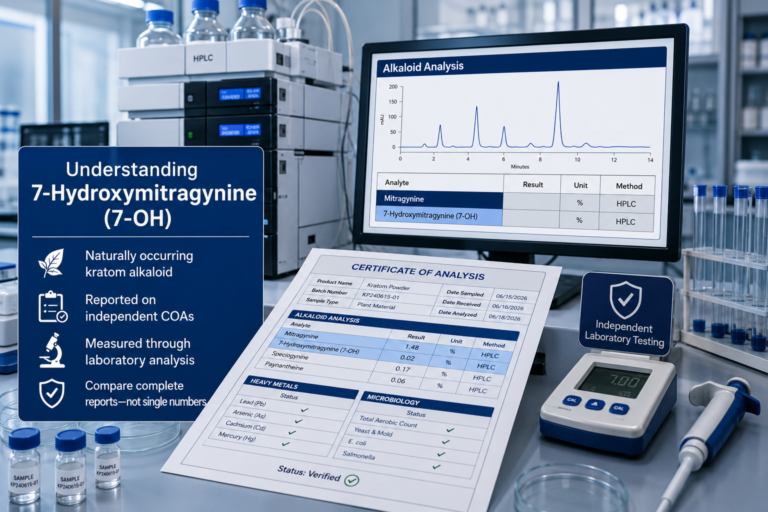
A named, comprehensive list of tested compounds — or at minimum, the number of compounds screened. A panel that states “200+ pesticide compounds screened via LC-MS/MS” tells you far more than one that vaguely states “pesticide testing: passed” with no further detail.
Individual results for detected compounds, not just an overall pass/fail. If any pesticide is detected, even below the relevant MRL, a thorough report will show the specific compound and concentration rather than folding it into a blanket pass.
The specific MRL framework used for comparison. Look for a stated reference — whether that’s a food commodity standard, a tea-equivalent MRL, or an emerging kratom-specific state regulatory limit — so you understand what the “pass” result is actually being measured against.
The analytical method named. LC-MS/MS and GC-MS are the recognized, sensitive methods appropriate for this kind of multi-residue screening; a report with no stated methodology offers far less confidence.
Testing conducted on the finished product, not just raw material. Since processing, extraction, and manufacturing can concentrate or dilute pesticide residues found in raw leaf, testing the actual finished product a consumer will use is more meaningful than testing only unprocessed material earlier in the supply chain.
A defined limit of detection and limit of quantification. As with heavy metals testing, a result showing every single compound at exactly “0.00” with no stated detection limit is a signal worth scrutinizing rather than an automatic reassurance.
How to Evaluate a Vendor’s Pesticide Testing Practices
Ask directly whether pesticide testing is part of standard batch testing, not just occasional spot-checks. A vendor who tests every batch for pesticide residues as a routine part of their release process is demonstrating a meaningfully different commitment than one who tested a single sample once and never repeated it.
Look for evidence of farm-level sourcing vetting, not just finished-product testing. Vendors that work directly with known farms using documented, verifiable growing practices are addressing the pesticide risk further upstream, which reduces the odds of ever encountering a problematic result at the finished-product testing stage in the first place.
Check whether pesticide testing is mentioned at all on the product’s published COA. If a vendor’s website discusses pesticide screening in general marketing language but the actual Certificate of Analysis for your specific batch doesn’t include a pesticide panel, that’s a meaningful gap between marketing claims and documented testing.
Consider the product type. Extraction and concentration processes can sometimes reduce certain types of residue relative to raw leaf material, though this isn’t guaranteed across all pesticide classes or extraction methods, which is one more reason finished-product testing matters more than raw-material testing alone.
A Note on the Broader Kratom Regulatory Landscape
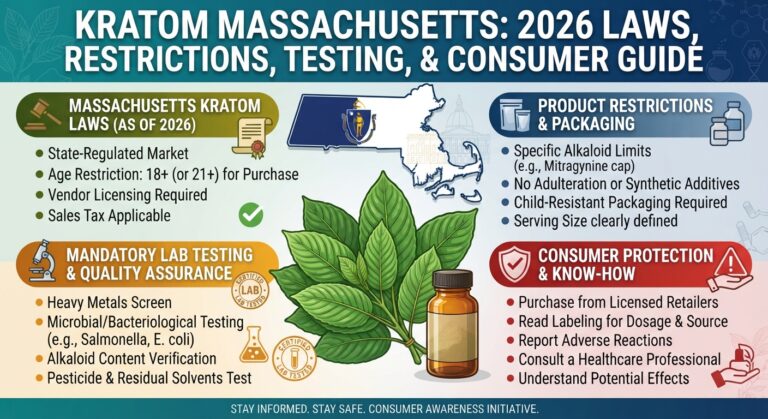
Pesticide testing sits within a kratom regulatory environment that continues to shift. As of mid-2026, kratom’s legal status varies considerably from state to state, and federal regulatory attention has increasingly focused on concentrated and synthesized 7-hydroxymitragynine products specifically, rather than natural whole-leaf kratom. Separately, states that have adopted Kratom Consumer Protection Act frameworks have moved to formalize testing requirements — including pesticide residue screening alongside heavy metals and microbial testing — directly into product registration and labeling law.
This evolving landscape means pesticide testing requirements, and the specific limits products are measured against, may look meaningfully different depending on which state a vendor is registered in and which testing standards they voluntarily choose to follow beyond what’s legally required. That variability is one more reason it’s worth checking a specific vendor’s actual COA rather than assuming industry-wide consistency on this particular panel.
A Quick Glossary of Pesticide Testing Terms
- MRL (Maximum Residue Limit): The highest concentration of a specific pesticide legally permitted in a given commodity, set by food safety regulatory frameworks.
- QuEChERS: A standardized sample preparation and extraction technique (Quick, Easy, Cheap, Effective, Rugged, Safe) widely used for multi-residue pesticide testing.
- LC-MS/MS (Liquid Chromatography–Tandem Mass Spectrometry): A highly sensitive analytical method used to identify and quantify pesticide residues in complex sample matrices.
- GC-MS (Gas Chromatography–Mass Spectrometry): An analytical method commonly used for volatile or semi-volatile pesticide compounds.
- LOD / LOQ (Limit of Detection / Limit of Quantification): The lowest concentration of a compound a test method can reliably detect (LOD) or accurately measure (LOQ).
- Organophosphates, organochlorines, carbamates, pyrethroids, neonicotinoids: The major chemical classes of insecticides commonly included in multi-residue pesticide screening panels.
- Method validation: The documented process of confirming a testing method’s accuracy, precision, and sensitivity before it’s applied to real product samples.
Frequently Asked Questions
Is pesticide contamination a bigger risk in kratom than heavy metals or microbial contamination? Not necessarily bigger, but it’s a distinct risk category that traces back to specific agricultural practices rather than passive environmental absorption or post-harvest handling. It deserves the same level of scrutiny as the other core panels, even though it’s historically received less consumer attention and is more frequently omitted from testing altogether.
Why doesn’t kratom have its own dedicated pesticide residue limits? Kratom is a relatively newer botanical product in terms of formal international regulatory attention compared to long-established food commodities like tea, coffee, or produce, which already have extensive MRL frameworks. In the absence of kratom-specific limits, labs and emerging state regulations often apply the closest reasonable proxy standard, commonly tea-equivalent MRLs, until more kratom-specific frameworks are developed.
Does extraction reduce pesticide residue in kratom products? It can, depending on the specific extraction method and the chemical properties of the pesticide involved, but this isn’t guaranteed or consistent across every compound class. Finished-product testing remains the only reliable way to confirm actual residue levels in what you’re consuming, rather than assuming extraction automatically resolves the issue.
How many different pesticides should a thorough kratom test panel screen for? There’s no single universal number, but comprehensive multi-residue panels using modern LC-MS/MS and GC-MS methods can realistically screen for anywhere from several dozen to several hundred individual compounds in a single test. A panel testing for only a handful of specific pesticides is considerably less thorough than one leveraging a broad multi-residue screening method.
What should I do if a vendor’s COA doesn’t include pesticide testing at all? Treat it as a real gap rather than a minor omission, particularly for non-extract leaf products where raw agricultural exposure risk is highest. It’s reasonable to ask the vendor directly whether pesticide testing is part of their standard protocol, and to weigh a consistent lack of pesticide screening against other vendors who do include it as part of a complete testing panel.
Final Takeaway
Pesticide residue testing is the quietly overlooked fourth pillar of kratom lab testing, sitting alongside alkaloid potency, heavy metals, and microbial screening as one of the core categories a truly comprehensive Certificate of Analysis should address. Because kratom is fundamentally an agricultural product moving through a long international supply chain, and because dedicated kratom-specific residue limits are still an emerging rather than mature regulatory area, this is a panel that rewards genuine scrutiny rather than passive trust in a vendor’s general “lab tested” marketing language. Checking for a named, methodologically sound pesticide panel — and treating its absence as a real gap rather than a forgivable oversight — is one more concrete step toward turning a COA from a reassuring badge into a document you can actually evaluate.