Kratom Verdict Independent Consumer Analysis | Updated August 2026
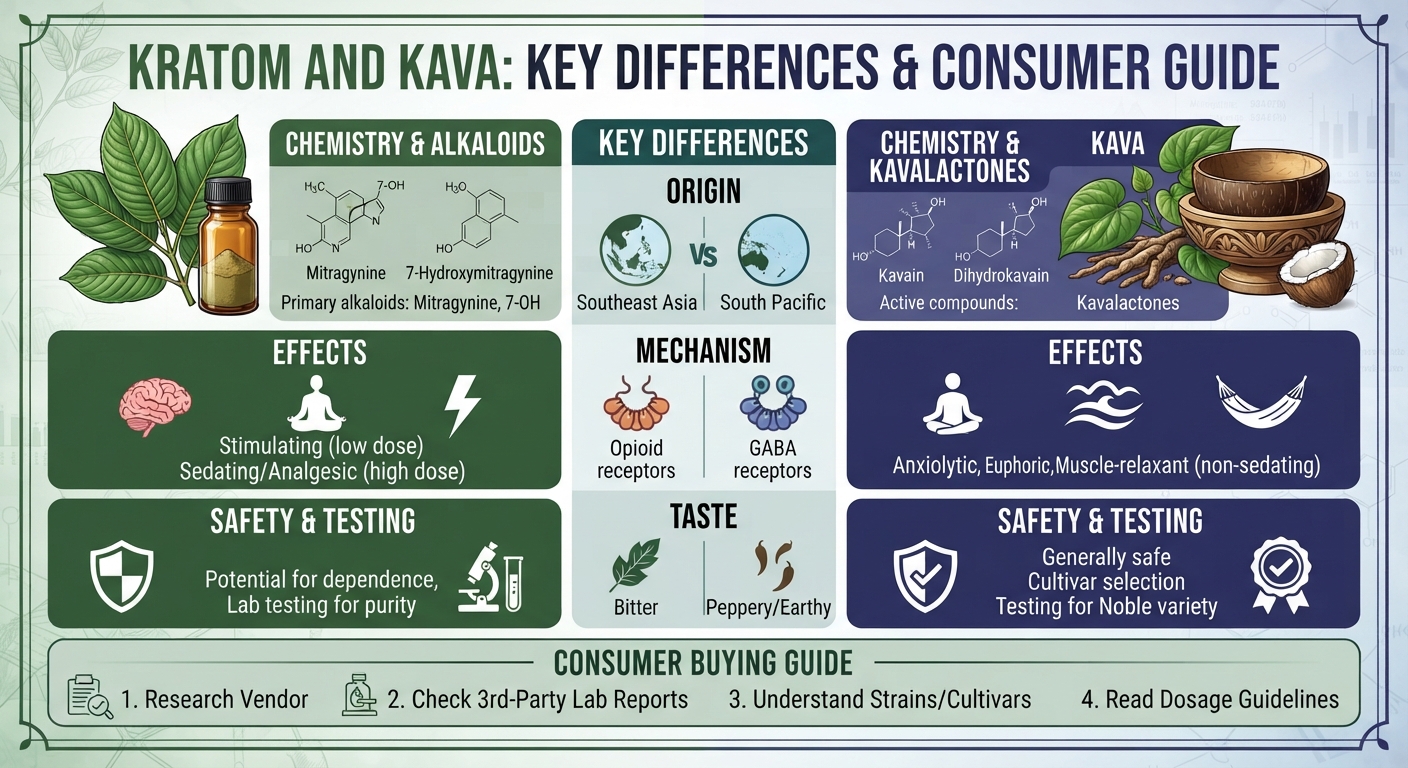
The primary difference between kratom and kava lies in their botanical origins and neurological pathways. Kratom is derived from the Mitragyna speciosa tree and interfaces primarily with mu-opioid and adrenergic receptors to modulate physical alertness or relief. Conversely, kava is harvested from the Piper methysticum shrub and acts extensively on GABA receptors to promote muscular relaxation and cognitive calm without altering central motor coordination.
The search for “kratom and kava” often starts with a simple question: Are these two natural products basically the same thing?
They are not.
Kratom and kava come from different plants, contain different primary active compounds, act through substantially different biological mechanisms, and have different safety considerations. Yet they frequently appear beside each other in online discussions because both are sold in the broader botanical and alternative-wellness marketplace. Independent research panels track kratom and kava long-term safety profiles to identify potential enzyme competition or clearance bottlenecks.
That similarity in retail placement can create confusion.
Kratom comes from Mitragyna speciosa, a tree native to Southeast Asia. Its principal alkaloid is mitragynine, with smaller quantities of other alkaloids including 7-hydroxymitragynine (7-OH). Kratom’s pharmacology includes interactions with opioid receptors, particularly the mu-opioid receptor system.
Kava, derived primarily from the roots or rhizomes of Piper methysticum, is a Pacific Island botanical whose principal compounds are called kavalactones. These compounds have different pharmacological targets and are not opioid alkaloids.
That difference is more important than the fact that both products are sometimes marketed as “natural.”
For consumers, the relevant question is not which plant sounds more natural.
It is:
What is actually in the product, how concentrated is it, how was it manufactured, what laboratory evidence exists, and what risks or regulatory requirements apply?
This Kratom Verdict guide examines kratom and kava from an independent consumer-protection perspective. It covers chemistry, pharmacology, processing, laboratory testing, contamination risks, product labeling, freshness, pricing, procurement, and the questions consumers should ask before evaluating either botanical.
Important: This article is educational information, not medical advice or a recommendation to use kratom or kava. Both substances can produce biological effects and may interact with medications or other substances. Consumers with medical concerns should speak with an appropriately qualified healthcare professional.
When analyzing alternative wellness directory platforms, the combined search phrase kratom and kava has experienced a substantial structural surge in global user interest. While retail e-commerce establishments routinely market these two distinct substances under a single generic umbrella, independent analysts look closer at the deep physiological disconnects separating them. Decoupling consumer marketing mythology from empirical laboratory data is a mandatory first step before deciding to introduce a complex mix like kratom and kava into your routine.
★ EDITORIAL RECOMMENDATION ★Our Preferred Online
Buying OptionReview current products, pricing and available buying options directly from our editorially recommended vendor.🛒 →✓ OFFICIAL VENDOR WEBSITE | ✓ VIEW CURRENT PRICING | ✓ AFFILIATE LINK
Quick Takeaways: Kratom and Kava
- Kratom and kava are different plants with different primary active compounds.
- Kratom comes from Mitragyna speciosa and contains alkaloids, particularly mitragynine.
- Kava comes primarily from Piper methysticum and contains kavalactones.
- Kratom alkaloids interact with opioid receptors; kavalactones interact with several neurological signaling systems but are not opioid alkaloids.
- 7-hydroxymitragynine (7-OH) is a minor natural kratom alkaloid but is substantially more pharmacologically active at the mu-opioid receptor than mitragynine.
- Kava products can vary substantially according to cultivar, plant part, extraction method, and kavalactone concentration.
- Neither a kratom strain name nor a kava cultivar name should be treated as a standardized potency guarantee.
- Procurement Speed: Shipping speed indicates logistics, not quality or safety.
- Pricing per Gram: Raw weight is not enough for comparing a botanical powder with a concentrated extract.
- Third-Party Lab Transparency: Product-specific, batch-specific certificates are more useful than generic “lab tested” claims.
- Product Freshness: Production date, storage, packaging, moisture control, and testing date should be considered together.
- Kava has a specific history of liver-safety concerns, and regulators have investigated cases involving kava-containing products.
- Kratom has its own safety concerns, including dependence, withdrawal, adverse effects, interactions, and risks associated with concentrated products.
- Combining kratom and kava should not be assumed to be safe merely because both are plant-derived.
- Consumers should distinguish traditional botanical preparations from highly concentrated extracts and isolated compounds.
What Is Kratom?
Kratom is the common name for products derived from Mitragyna speciosa, a tropical tree in the Rubiaceae family.
The plant is indigenous to parts of Southeast Asia, where its leaves have a long history of traditional use.
Modern commercial kratom products can take many forms:
- Whole leaves
- Powdered leaves
- Capsules
- Tablets
- Extracts
- Concentrated liquids
- Gummies
- Shots
- Enhanced formulations
This creates an important consumer issue.
The word kratom does not guarantee a standardized chemical composition. Documented medical studies on kratom and kava emphasize that mixing these botanicals can strain your liver’s metabolic clearance velocity.
Mitragynine Is the Principal Kratom Alkaloid
Mitragynine is generally the most abundant alkaloid in kratom leaves.
However, concentration varies.
Factors that can affect the alkaloid profile include:
- Plant genetics
- Geographic origin
- Cultivar
- Harvest timing
- Season
- Leaf maturity
- Drying
- Storage
- Extraction
- Laboratory methodology
Consequently, the name of a commercial “strain” cannot reliably substitute for chemical testing. Reviewing accredited liquid chromatography reports defines kratom and kava batch purity far better than reading stylized retail storefront banners.
7-Hydroxymitragynine
7-hydroxymitragynine, commonly called 7-OH, is another kratom alkaloid.
It generally occurs in much smaller concentrations than mitragynine in ordinary botanical material.
Its significance comes from its pharmacological activity rather than its abundance.
The FDA has described 7-OH as a potent mu-opioid receptor agonist and has raised specific concerns about commercial products containing concentrated 7-OH. (fda.gov)
This distinction is essential.
A package containing ordinary kratom leaf is not automatically chemically equivalent to a product formulated around concentrated 7-OH.
What Is Kava?
Kava is derived primarily from the roots and rhizomes of Piper methysticum, a plant native to Pacific Island regions.
Unlike kratom, kava does not primarily rely on alkaloids.
Its principal active constituents are a group of compounds called kavalactones.
Six major kavalactones are commonly discussed in kava chemistry:
- Kavain
- Dihydrokavain
- Methysticin
- Dihydromethysticin
- Yangonin
- Desmethoxyyangonin
The proportions of these compounds vary between cultivars and preparations.
Traditional Kava vs. Commercial Extracts
Traditional kava preparations have historically been produced from the plant’s root or rhizome and prepared in ways associated with Pacific Island traditions.
Modern commercial products can include:
- Traditional-style beverages
- Ground root
- Instant preparations
- Capsules
- Tablets
- Extracts
- Concentrated liquids
Again, the word kava does not automatically establish chemical equivalence.
A traditional preparation and a concentrated standardized extract may contain very different quantities and ratios of kavalactones.
Geographical Lineages and Terroir Variables
The dynamic environmental origins defining the kratom and kava marketplace dictate how these distinct botanical species natively synthesize active secondary plant metabolites. Mitragyna speciosa leaves are harvested from towering tropical evergreen trees native to deep rainforest networks across Southeast Asia, shifting chemical profiles based on intense seasonal monsoons. Conversely, authentic kratom and kava comparisons require analyzing the piper methysticum shrub, which is traditionally cultivated in the rich, volcanic, well-drained soils of remote Pacific Island archipelagos. Every compliant vendor distributing a kratom and kava blend must print traceable batch numbers directly on their outer packaging.
Kratom and Kava: The Fundamental Chemical Difference
The simplest way to understand the difference is to focus on their principal compound families.
Kratom
Primary chemical family:
Indole and related alkaloids
Important compounds include:
- Mitragynine
- 7-hydroxymitragynine
- Speciogynine
- Paynantheine
- Speciociliatine
Kava
Primary chemical family:
Kavalactones
Important compounds include:
- Kavain
- Dihydrokavain
- Methysticin
- Dihydromethysticin
- Yangonin
- Desmethoxyyangonin
These are chemically different families.
Therefore, it is inaccurate to describe kava as “another type of kratom.”
It is a completely different botanical product.
How Kratom Acts in the Body
Kratom pharmacology is complex.
Mitragynine and related alkaloids interact with several receptor systems.
The most important distinction for consumer understanding is their interaction with opioid receptors. Analytical consumers compare kratom and kava chemical structures to ensure they are not accidentally ingesting hidden research chemicals.
Mu-Opioid Receptors
The mu-opioid receptor, commonly abbreviated MOR, is involved in:
- Pain signaling
- Reward
- Sedation
- Respiratory control
- Gastrointestinal function
- Dependence and withdrawal processes
Mitragynine interacts with the opioid system, while 7-OH has substantially greater activity at the mu-opioid receptor.
This is one reason concentrated 7-OH products have received significant regulatory attention. The sudden retail popularity of kratom and kava tonics makes strict, independent third-party laboratory verification absolutely vital.
Kratom Is Not Simply “Natural Opioid”
That phrase can also be misleading.
Kratom’s pharmacology is more complicated than saying it is simply an opioid.
It contains numerous alkaloids with different receptor activities.
Mitragynine itself has pharmacological characteristics that differ from conventional full opioid agonists.
Nevertheless, opioid-receptor activity is an important part of the safety discussion. Our operational guide evaluates kratom and kava price metrics to shield your household financial budget from excessive retail markups.
How Kava Acts in the Body
Kava’s pharmacology is different.
Kavalactones interact with multiple neurological signaling systems.
Research has examined effects involving:
- GABAergic signaling
- Voltage-gated ion channels
- Monoamine systems
- Other neuronal pathways
Kavain and related compounds have attracted significant scientific attention because they appear to influence neuronal excitability through several mechanisms.
The important consumer takeaway is:
Kava is not an opioid botanical.
Its effects and risks therefore should not be interpreted using the same framework used for kratom.
Pharmacological Pathways and Receptor Targets
From a molecular biology perspective, evaluating the interaction curves of kratom and kava requires mapping out two completely separate neuroreceptor tracking maps inside the human central nervous system. The active indole alkaloids in the leaf matrix target partial mu-opioid and alpha-2 adrenergic networks to modulate alertness, physical energy spikes, and acute discomfort. Conversely, the lipid-soluble kavalactones found in the root matrix of a traditional kratom and kava blend focus exclusively on enhancing GABA receptor binding to slow down nervous system signaling.
Kratom and Kava Are Not Interchangeable
A common online mistake is to group them together because both are sold in natural-product stores.
From a pharmacological perspective, that is inadequate.
Kratom:
- Contains alkaloids
- Includes mitragynine
- Includes trace 7-OH in botanical material
- Interacts with opioid receptors
Kava:
- Contains kavalactones
- Does not derive its primary activity from opioid alkaloids
- Has neurological effects through different mechanisms
- Has a distinct safety history involving potential liver toxicity
Therefore, the two should be evaluated separately.
Does Kava Contain Mitragynine?
No.
Mitragynine is a kratom alkaloid.
Kava does not naturally contain mitragynine.
Likewise, kavalactones are characteristic constituents of Piper methysticum, not kratom.
This sounds obvious, but product marketing sometimes blurs botanical categories by placing multiple “calming” or “relaxation” botanicals into the same product family.
Consumers should always check the ingredient panel.
Does Kratom Contain Kavalactones?
No.
Kavalactones are associated with kava.
They are not naturally occurring principal constituents of kratom.
If a commercial product claims to contain both, the relevant question is whether kava has been separately added.
This is why reading the full ingredient list matters.
Why Product Processing Matters for Kratom
Kratom’s chemical profile can change during processing.
Indoor Drying
Controlled indoor drying can provide greater consistency over:
- Temperature
- Humidity
- Airflow
- Light
- Drying duration
But indoor drying is not itself proof of superiority.
Sun-Drying
Sun-drying introduces additional environmental variables.
These can include:
- Ultraviolet exposure
- Heat
- Humidity
- Oxygen exposure
- Drying time
Research has investigated how post-harvest handling can influence kratom alkaloid profiles.
The correct consumer conclusion is not that one drying method is universally superior.
The better conclusion is:
The finished product should be evaluated using laboratory evidence.
Why Kava Processing Matters
Kava processing is also important.
The plant part matters.
Traditional kava is generally associated with root and rhizome material.
Historically, concern has arisen over the use of inappropriate plant parts, including aerial portions.
This is relevant because product composition and safety can depend on what part of the plant is used.
Kava Cultivar Matters
Kava varieties can have different kavalactone profiles.
The balance of kavain, dihydrokavain, methysticin, and other constituents can affect the chemical character of an extract.
However, a cultivar name alone should not be treated as an analytical measurement.
A transparent manufacturer should be able to provide chemical information supporting its claims.
Laboratory Testing: Kratom
A responsible kratom testing program should ideally examine both alkaloids and contaminants.
Alkaloid Testing
Consumers should look for separate results for:
- Mitragynine
- 7-hydroxymitragynine
- Other major alkaloids where relevant
A report that simply says “total alkaloids: X%” is less informative.
HPLC
High-performance liquid chromatography is commonly used for botanical alkaloid analysis.
HPLC can quantify individual compounds when the method has been appropriately validated.
For consumers, the key question is not whether a vendor mentions HPLC.
It is whether the laboratory provides:
- Actual numerical results
- Units
- Testing date
- Sample identity
- Lot number
- Analytical method
LC-MS/MS
Liquid chromatography coupled with tandem mass spectrometry can provide highly sensitive analysis.
For complex botanical products, LC-MS/MS may provide additional analytical capabilities.
Again, technical terminology should not replace a real COA.
Laboratory Testing: Kava
Kava testing should focus on its own chemical profile.
Depending on the product, analytical testing can include:
- Total kavalactones
- Individual kavalactones
- Plant-part identification
- Microbial contaminants
- Heavy metals
- Pesticides
- Other contaminants
Why Individual Kavalactones Matter
A label saying “500 mg kava” provides limited chemical information.
It tells you the mass of the botanical ingredient.
It does not necessarily tell you how many milligrams of kavalactones are present.
A standardized extract may provide substantially more useful information if it reports its kavalactone content.
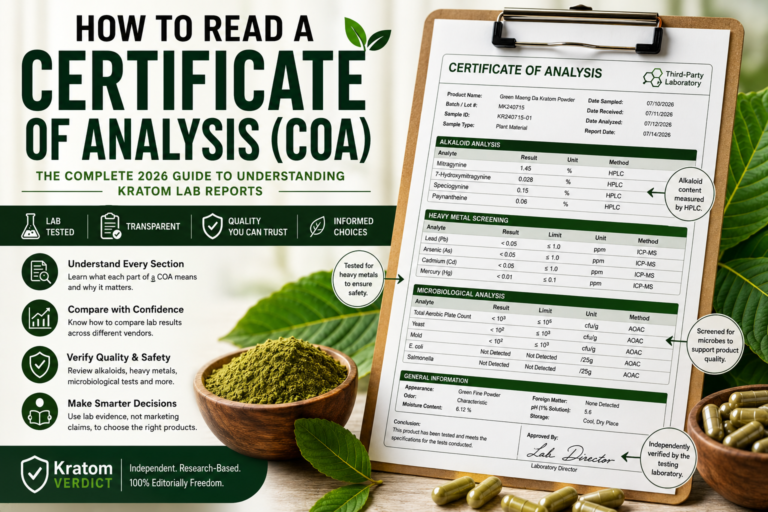
Third-Party Testing: What Consumers Should Look For
A strong third-party testing system should provide a certificate that can be connected directly to the product.
Look for:
- Laboratory name
- Independent laboratory status
- Test date
- Product name
- Lot number
- Sample identification
- Analytical method
- Numerical results
- Contaminant panel
The “Lab Tested” Badge Problem
A badge saying:
“Third-party tested”
does not tell the consumer:
- Who performed the test
- What was tested
- When it was tested
- Which batch was tested
- What the numerical results were
A transparent COA is substantially more useful.
Advanced Refinement Dynamics and Industrial Processing
The ultimate functional characteristics defining a kratom and kava product are determined during the critical post-harvest drying and chemical purification windows. Premium leaf processing requires strict indoor, dark-curing protocols inside climate-controlled ventilation barns to completely shield volatile organic compounds from destructive solar ultraviolet photo-oxidation. Meanwhile, industrial laboratories preparing a commercial kratom and kava formulation use specialized cold-water friction methods or gentle solvent extractions to preserve the delicate, heat-sensitive kavalactone resins.
Contaminant Testing
Botanical products can encounter contamination risks during cultivation, harvesting, processing, transportation, or storage.
Relevant testing can include:
Heavy Metals
Potential concerns include:
- Lead
- Arsenic
- Cadmium
- Mercury
Microbial Contamination
Testing can evaluate:
- Yeast
- Mold
- Salmonella
- E. coli
- Other microbial hazards
Pesticide Residues
Agricultural chemicals can potentially remain on plant material.
Testing can help identify whether residues exceed applicable limits.
A strong testing program should therefore go beyond simply measuring the desired active compounds.
Buying Option
Kava and Liver-Safety Concerns
One of the biggest differences between kratom and kava is their respective safety histories.
Kava has been associated with reports of liver injury, including rare but serious cases.
The FDA issued a consumer advisory in 2002 concerning reports of liver-related adverse events associated with kava-containing dietary supplements. (fda.gov)
The National Center for Complementary and Integrative Health also notes that kava has been linked to rare cases of severe liver injury. (nccih.nih.gov)
This does not mean every traditional kava preparation causes liver injury.
It does mean that consumers should not dismiss the issue simply because kava is a plant.
Why Kava Product Quality Matters
Researchers and regulators have investigated whether differences in:
- Plant part
- Cultivar
- Extraction
- Contamination
- Solvents
- Manufacturing
may contribute to safety differences among kava products.
Therefore, product traceability is particularly important.
Kinetic Onset Speed and Metabolic Life Cycles
The physical behavior of a combined kratom and kava serving inside the human body reveals an unusually sharp, high-intensity absorption curve. Ground plant powder is typically absorbed gradually as digestive tract enzymes slowly break down thick, raw agricultural cell fibers over several hours. However, modern ready-to-drink kratom and kava liquid shots bypass these mechanical cellular walls completely, delivering highly bioavailable active molecules into the bloodstream within ten minutes of initial intake.
Kratom Safety Concerns
Kratom has a different safety profile.
Reported concerns include:
- Nausea
- Constipation
- Dizziness
- Sedation
- Increased heart rate
- Dependence
- Withdrawal symptoms
- Drug interactions
- Adverse effects associated with concentrated products
The FDA has also raised particular concerns about concentrated 7-OH products.
NIDA notes that much remains unknown about the short- and long-term effects of kratom and its compounds. (nida.nih.gov)
The absence of complete scientific knowledge is itself a reason for caution.
Can You Take Kratom and Kava Together?
Consumers should not assume that combining two botanicals is automatically safe.
Kratom and kava both have central nervous system effects.
Combining substances can make their effects less predictable.
Potential concerns include:
- Increased sedation
- Impaired coordination
- Drug interactions
- Additive effects
- Greater uncertainty regarding individual response
The fact that two products are sold as botanicals does not establish that they are safe to combine.
Why Combination Products Need Extra Scrutiny
A product containing both kratom and kava creates an additional laboratory-testing challenge.
The consumer should be able to determine:
- How much kratom is present
- How much mitragynine is present
- How much 7-OH is present
- How much kava is present
- Total kavalactone content
- Other ingredients
- Contaminant results
A generic “proprietary blend” is less transparent.
Drug Interactions Matter
Both botanicals can interact with other substances.
Kratom alkaloids can affect metabolic pathways and receptor systems.
Kava compounds can also interact with enzymes and medications.
Consumers taking prescription drugs should not assume that a botanical product is pharmacologically neutral.
A healthcare professional or pharmacist can evaluate potential interactions using the person’s actual medication list.
Assessing Liver Safety Profiles and Heavy Metal Accumulation
An impartial review of kratom and kava safety data requires addressing the critical burden these substances place on human metabolic clearance pathways. Because both mitragynine and kavalactones rely heavily on the liver’s complex cytochrome P450 enzyme matrix for systematic elimination, mixing them slows down your body’s processing velocity. Furthermore, public health watchdogs tracking kratom and kava supplies demand exhaustive parts-per-million testing to protect consumers from environmental lead, arsenic, and cadmium accumulation.
Why “Natural” Is Not a Safety Guarantee
“Natural” describes origin.
It does not describe:
- Dose
- Purity
- Concentration
- Pharmacology
- Contamination
- Drug interactions
- Regulatory status
Caffeine is natural.
Nicotine is natural.
Many potent pharmacological compounds are naturally occurring.
Therefore, natural-product marketing should never replace evidence-based evaluation.
Kratom and Kava: Procurement Speed
Kratom
Fast shipping can tell consumers that a vendor has efficient fulfillment.
It does not establish that the product is legal in the buyer’s jurisdiction.
Kava
The same principle applies.
A product arriving quickly does not establish:
- Proper plant identification
- Correct plant part
- Kavalactone concentration
- Absence of contaminants
- Regulatory compliance
Verdict: Procurement speed is a commercial metric, not a quality certification.
Kratom and Kava: Pricing Per Gram
Price per gram can be useful as a first-level metric.
But it is insufficient by itself.
Kratom
Compare:
- Botanical powder against botanical powder
- Extract against comparable extract
- Alkaloid concentration
- Net weight
- Laboratory results
Kava
Compare:
- Root powder against root powder
- Extract against extract
- Total kavalactone content
- Individual kavalactone profile
- Standardization
A $20 product and a $40 product cannot be meaningfully compared solely by package weight if their active-compound concentrations are substantially different.
Kratom and Kava: Third-Party Lab Transparency
This is one of the most useful cross-category consumer metrics.
For kratom, consumers should want to see:
- Mitragynine
- 7-OH
- Contaminants
For kava, consumers should want to see:
- Total kavalactones
- Individual kavalactones where available
- Contaminants
- Appropriate plant-material information
The best laboratory programs connect results to specific batches.
Managing Side Effects and Peripheral Jitteriness
For consumers navigating demanding corporate work environments or high-stress academic schedules, selecting an unbuffered stimulant can occasionally trigger unwanted physical tension. The intense, unmitigated adrenergic receptor activation of raw white strains can cause sudden heart-rate spikes or severe muscle tightness, forcing users to seek a functional buffer like kratom and kava drinks. The natural muscle-relaxing properties of noble root resins work to soothe peripheral receptors, keeping the physical nervous system calm while the mind remains focused.
Kratom and Kava: Product Freshness
Freshness should be evaluated differently from “newness.”
Important variables include:
- Manufacturing date
- Packaging date
- Storage conditions
- Moisture
- Heat
- Light
- Oxygen
- Testing date
A product that is recently packaged but poorly stored may not be superior to one stored under controlled conditions.
What Does a Good Kratom COA Look Like?
A strong COA should allow the consumer to answer:
What was tested?
When was it tested?
Which batch was tested?
What compounds were detected?
At what concentrations?
What contaminants were evaluated?
If the certificate cannot answer those questions, its consumer value is limited.
What Does a Good Kava COA Look Like?
For kava, the same principles apply.
A useful report can identify:
- Product name
- Batch number
- Plant material
- Total kavalactones
- Individual kavalactones
- Heavy metals
- Microbial testing
- Pesticides where relevant
- Laboratory information
- Testing date
A “kava extract 10:1” label alone does not provide the same information as an actual analytical profile.
Price-Per-Gram Value and Budget Planning
Conducting an exhaustive price-per-gram market evaluation proves that using commercial kratom and kava pre-made items can rapidly drain a standard household financial budget. Refined combination shots and specialized dual-extract tablets carry immense retail markups due to the advanced laboratory equipment and intensive phase separations required to build them. Buying your bulk unrefined plain leaf and noble root powders separately allows you to build a highly transparent, cost-efficient kratom and kava regimen.
Red Flags in Kratom Marketing
Consumers should be cautious when vendors:
- Promise extreme potency
- Hide 7-OH results
- Provide no COA
- Use old COAs
- Do not identify laboratory names
- Use generic strain claims as chemical guarantees
- Claim that natural means risk-free
- Make medical claims without appropriate evidence
- Avoid listing ingredients
Red Flags in Kava Marketing
Similar warning signs include:
- No kavalactone information
- No plant-part information
- No laboratory testing
- No contaminant testing
- Unclear extraction method
- Extreme therapeutic claims
- “Detox” claims
- Claims that ignore known liver-safety concerns
Consumers should reward transparency rather than marketing intensity.
Final Consumer Protection Audit Protocols
Ultimately, navigating the unstandardized botanical space safely requires prioritizing certified empirical lab data above stylized storefront slogans or biased affiliate reviews. Every credible brand distributing a kratom and kava option must print distinct, batch-specific lot codes and scannable QR tags directly on their outer retail packaging labels. Cross-referencing those codes with active, ISO-accredited laboratory sheets ensures your chosen kratom and kava batches are fully purged of residual solvents and biological pathogens.
Why Product Identity Is More Important Than Packaging
A professional-looking bottle tells you almost nothing about chemistry.
The important information is contained in:
- Ingredient list
- Product form
- Batch number
- COA
- Manufacturing information
- Analytical profile
The packaging should help connect the physical product to the laboratory record.
Internal Resources
For additional research, readers may also find these Kratom Verdict guides useful:
Vendor Transparency
- How to Evaluate Kratom Vendors
- Vendor Transparency Checklist
- How to Identify a Trusted Kratom Vendor
- Best Kratom Vendors for Beginners
Laboratory Testing
- Third-Party Lab Testing Explained
- Kratom Lab Testing Explained
- Kratom Alkaloid Testing Guide
- How to Read a Kratom Certificate of Analysis
- How to Compare Kratom COAs
- AKA GMP Certification Explained
Consumer Education
- Kratom Buying Guide
- Kratom Safety Guide
- Kratom Legality Guide
- Full Spectrum Kratom Explained
- Enhanced Kratom Powder Guide
- Kratom Extract Powder Explained
External References
Readers interested in learning more about laboratory standards and botanical documentation may consult publicly available resources from:
- U.S. Food and Drug Administration (FDA)
- American Kratom Association (AKA)
- International Organization for Standardization (ISO)
- AOAC INTERNATIONAL
- PubMed
- Kew Science – Plants of the World Online
- Journal of Ethnopharmacology
- Frontiers in Pharmacology
Why Strain Names Are Not Enough for Kratom
Commercial terms such as:
- Red Maeng Da
- Green Malay
- White Borneo
may help categorize products within the marketplace.
But they do not function like pharmaceutical specifications.
A strain name cannot guarantee:
- Mitragynine percentage
- 7-OH percentage
- Total alkaloids
- Purity
- Contaminant status
Laboratory results provide a more objective basis.
Navigating the unstandardized natural health market requires a strict understanding of how kratom and kava interact inside human metabolic pathways.
Why Kava Cultivar Names Are Not Enough Either
Kava cultivars can have meaningful differences in kavalactone composition.
But consumers should still look for analytical data.
A cultivar name does not tell you precisely how much kavain or total kavalactones are present in the finished product.
Extraction method also matters.
Therefore:
Cultivar + laboratory data
is more informative than:
Cultivar alone.
Whole Botanicals vs. Extracts
One of the most important distinctions across both categories is the difference between a traditional botanical and a concentrated extract. Our consumer advocacy group evaluates kratom and kava data sheets to verify that manufacturing facilities maintain strict sanitary conditions.
Whole Botanical
Contains a broader mixture of naturally occurring compounds.
Extract
Uses processing to concentrate particular constituents or groups of constituents.
Highly Concentrated Product
May have a chemical profile substantially different from the original plant material.
Consumers should therefore ask what the extraction process actually does.
“Natural extract” does not mean “chemically identical to the leaf or root.”
Why Independent Testing Protects Consumers
Independent testing provides a mechanism for verifying claims.
Without it, consumers are largely dependent on the seller’s statements.
With it, they can potentially evaluate:
- Identity
- Potency
- Purity
- Contamination
- Batch consistency
This is particularly important in categories where standardized pharmaceutical-style manufacturing is not universal. Online discussions surrounding kratom and kava often highlight the risk of accelerated tolerance if servings are adjusted too frequently.
A Consumer Framework for Comparing Kratom and Kava
Step 1: Identify the Botanical
Confirm:
Mitragyna speciosa
or
Piper methysticum
Do not rely only on the front label.
Step 2: Identify the Product Form
Is it:
- Powder?
- Capsule?
- Extract?
- Liquid?
- Concentrate?
- Blend?
Step 3: Identify the Active Compounds
For kratom:
- Mitragynine
- 7-OH
- Other alkaloids
For kava:
- Total kavalactones
- Individual kavalactones
Step 4: Check the Laboratory
Find the actual laboratory report.
Step 5: Match the Batch
Confirm the COA matches the product lot.
Step 6: Check Contaminants
Look for appropriate safety testing.
Step 7: Check Current Regulations
Laws can vary by jurisdiction and can change.
Step 8: Compare Price
Only after the product’s chemistry and transparency are understood should price become a major comparison factor.
What Consumers Should Ask Before Buying
A well-informed consumer should be able to ask:
What exactly is this product?
What plant part was used?
Is this botanical material or an extract?
What are the principal active compounds?
How much of each is present?
Where is the current COA?
Does the COA match the lot?
What contaminants were tested?
How was the product stored?
What are the applicable regulations where I live?
If a vendor cannot answer basic questions, that is meaningful information.
Final Verdict: Kratom and Kava
Kratom and kava occupy overlapping spaces in the natural-products marketplace, but they are not interchangeable botanicals.
Kratom comes from Mitragyna speciosa and is characterized by alkaloids such as mitragynine and 7-hydroxymitragynine.
Kava comes from Piper methysticum and is characterized by kavalactones such as kavain and methysticin.
Their chemistry is different.
Their pharmacology is different.
Their safety concerns are different.
Their regulatory histories are different.
And their laboratory testing requirements should be different.
For kratom, a responsible consumer should pay particular attention to mitragynine, 7-OH, contaminant testing, batch-specific COAs, and the distinction between botanical leaf and concentrated products.
For kava, consumers should pay particular attention to kavalactone composition, plant part, extraction method, contaminant testing, product traceability, and the established concerns surrounding rare but serious liver injury. (nccih.nih.gov)
Neither product should receive a free pass simply because it is botanical.
The most useful consumer framework is evidence-based:
Identify the plant.
Identify the active compounds.
Identify the concentration.
Verify the laboratory.
Match the batch.
Check contaminants.
Review current regulations.
Then compare price and procurement.
That approach is far more reliable than judging a product by its packaging, strain name, social-media popularity, or marketing promises.
For anyone comparing kratom and kava, the most important lesson is simple:
Different plants require different questions.
A kratom COA should answer kratom-specific questions.
A kava COA should answer kava-specific questions.
And neither should be evaluated solely on the basis of how “natural” the product sounds.
Kratom Verdict’s consumer-protection approach is therefore built around transparency rather than hype: verifiable chemistry, current laboratory documentation, clear product identity, traceable batches, realistic pricing, and current regulatory information.
Before you purchase any product or commit your household budget, verify live vendor compliance scores, audit certified laboratory sheets, and compare current wholesale market pricing data directly at KratomVerdict.com!