Kratom Verdict Independent Consumer Analysis | Updated August 2026
Liquid kratom shots are highly concentrated liquid botanical formulations built by isolating active indole alkaloids using water, ethanol, or CO2 extraction methods. Unlike raw plain leaf powder, these concentrated shots bypass natural plant cell wall fibers to deliver an unbuffered, rapid kinetic onset that interfaces heavily with central nervous system receptors, requiring advanced consumer safety and laboratory sheet auditing.
The term “kratom shots” has become increasingly common in the botanical-products marketplace.
Unlike traditional kratom powder, which is typically sold as dried and ground leaf, kratom shots are generally small-volume liquid products designed to deliver concentrated kratom constituents in a convenient format. They can appear in bottles resembling energy shots, wellness beverages, or other compact liquid supplements. Tracking kratom shots data helps online buyers avoid overpriced options, making a review of commercial kratom shots value essential.
That convenience creates an important consumer question:
What is actually inside the bottle?
A small bottle can contain substantially more concentrated botanical material or alkaloids than its physical size suggests. Some products may be based on kratom extracts, while others may contain additional concentrated compounds. Products marketed around 7-hydroxymitragynine, or 7-OH, require particular scrutiny because 7-OH has significantly greater mu-opioid receptor activity than mitragynine.
The modern kratom-shot category therefore cannot be evaluated using the same criteria consumers might use for ordinary leaf powder. If you research kratom shots manufacturing methods, you must check how different kratom shots brands execute chemical solvent purges.
A package saying “kratom” does not tell you:
- The amount of kratom extract
- The concentration of mitragynine
- The concentration of 7-OH
- Whether the product contains other active ingredients
- Whether the product is batch tested
- Whether the laboratory results are current
- Whether the product contains contaminants
- Whether the product complies with applicable regulations
This Kratom Verdict analysis approaches kratom shots from an independent consumer-protection perspective. The objective is not to promote a particular brand or product, but to explain what consumers should understand about chemistry, extraction, laboratory testing, pricing, freshness, labeling, and regulatory considerations.
Important: This article is educational and does not recommend consuming kratom shots. Kratom and concentrated kratom-derived products can produce significant biological effects, can interact with medications or other substances, and may be subject to changing state and federal regulations. Consumers should verify current laws and consult an appropriately qualified healthcare professional regarding individual health questions. The rapid popularity of kratom shots introduces new consumer risks for anyone purchasing unverified kratom shots at local gas stations.
★ EDITORIAL RECOMMENDATION ★Our Preferred Online
Buying OptionReview current products, pricing and available buying options directly from our editorially recommended vendor.🛒 →✓ OFFICIAL VENDOR WEBSITE | ✓ VIEW CURRENT PRICING | ✓ AFFILIATE LINK
Quick Takeaways: What Consumers Should Know About Kratom Shots
- Kratom shots are generally concentrated liquid kratom products, rather than ordinary dried-leaf powder suspended in water.
- The actual chemical composition varies substantially between products.
- A small bottle does not necessarily mean a low amount of active compounds.
- Mitragynine is the principal alkaloid associated with traditional kratom leaf.
- 7-hydroxymitragynine (7-OH) is a much less abundant natural kratom alkaloid but has substantially greater activity at the mu-opioid receptor than mitragynine.
- Some commercial products marketed as kratom extracts have been found to contain 7-OH concentrations far beyond what would be expected in ordinary botanical leaf.
- Procurement Speed: Fast shipping is a logistics metric and does not demonstrate product quality or legal compliance.
- Pricing per Gram: Comparing the price of a liquid shot with dry powder solely by package weight can be misleading because concentration and extraction change the economics.
- Third-Party Lab Transparency: A current, lot-specific COA is much more valuable than a generic “lab tested” statement.
- Product Freshness: Manufacturing date, storage conditions, packaging integrity, and laboratory testing date should be evaluated together.
- Consumers should distinguish botanical kratom, extracts, enhanced products, and concentrated alkaloid products.
- Product labels should identify ingredients and ideally provide enough information to understand the actual chemical composition.
- Concentrated 7-OH products have attracted significant attention from U.S. regulators.
- A consumer should never assume that a product is safe or lawful merely because it is sold online or appears in a retail store.
What Are Kratom Shots?
Kratom shots are small-volume liquid products containing kratom-derived material.
The word “shot” generally describes the format rather than a standardized chemical composition.
That distinction is important.
There is no universal formulation that defines every kratom shot.
One product might contain:
- A water-based kratom preparation
- A concentrated botanical extract
- An extract standardized to alkaloids
- A combination of kratom compounds
- Other botanical ingredients
- Flavoring agents
- Sweeteners
- Preservatives
- Other active ingredients
Another product carrying the same broad category name may have a completely different chemical profile.
Why the Bottle Size Can Be Misleading
Traditional kratom powder is often purchased by weight.
A liquid shot is typically sold by volume.
That makes direct comparison difficult.
A 30-mL bottle and a 500-gram bag of powder are not comparable simply because both are labeled “kratom.”
The consumer needs to know what amount of active material is contained within the liquid.
Extract vs. Leaf
Traditional kratom leaf contains a broad mixture of alkaloids.
An extract uses processing to concentrate constituents from the original plant material.
This can dramatically change the ratio between:
- Plant material
- Mitragynine
- 7-OH
- Other alkaloids
- Non-alkaloid constituents
Therefore, a kratom shot should generally be evaluated as an extract-style product unless the manufacturer provides evidence demonstrating otherwise. Our independent kratom shots report breaks down why specific kratom shots formulas deliver a rapid, unbuffered receptor activation spike.
What Is Actually in a Kratom Shot?
The answer depends entirely on the formulation.
A transparent label should ideally tell consumers:
- Total liquid volume
- Amount of kratom-derived material or extract
- Relevant alkaloid concentrations
- Other active ingredients
- Inactive ingredients
- Batch information
The most useful information is quantitative.
For example, a label stating:
“Proprietary kratom blend”
provides very little chemical information.
A more transparent product might provide:
- Mitragynine concentration
- 7-OH concentration
- Total extract amount
- Laboratory testing information
Why Proprietary Blends Create Problems
A proprietary blend can legally or commercially group multiple ingredients under a single total quantity.
That can make it difficult to determine how much of each active component is present.
For consumers evaluating concentrated products, this reduces transparency.
The more pharmacologically active a product is, the more important precise labeling becomes.
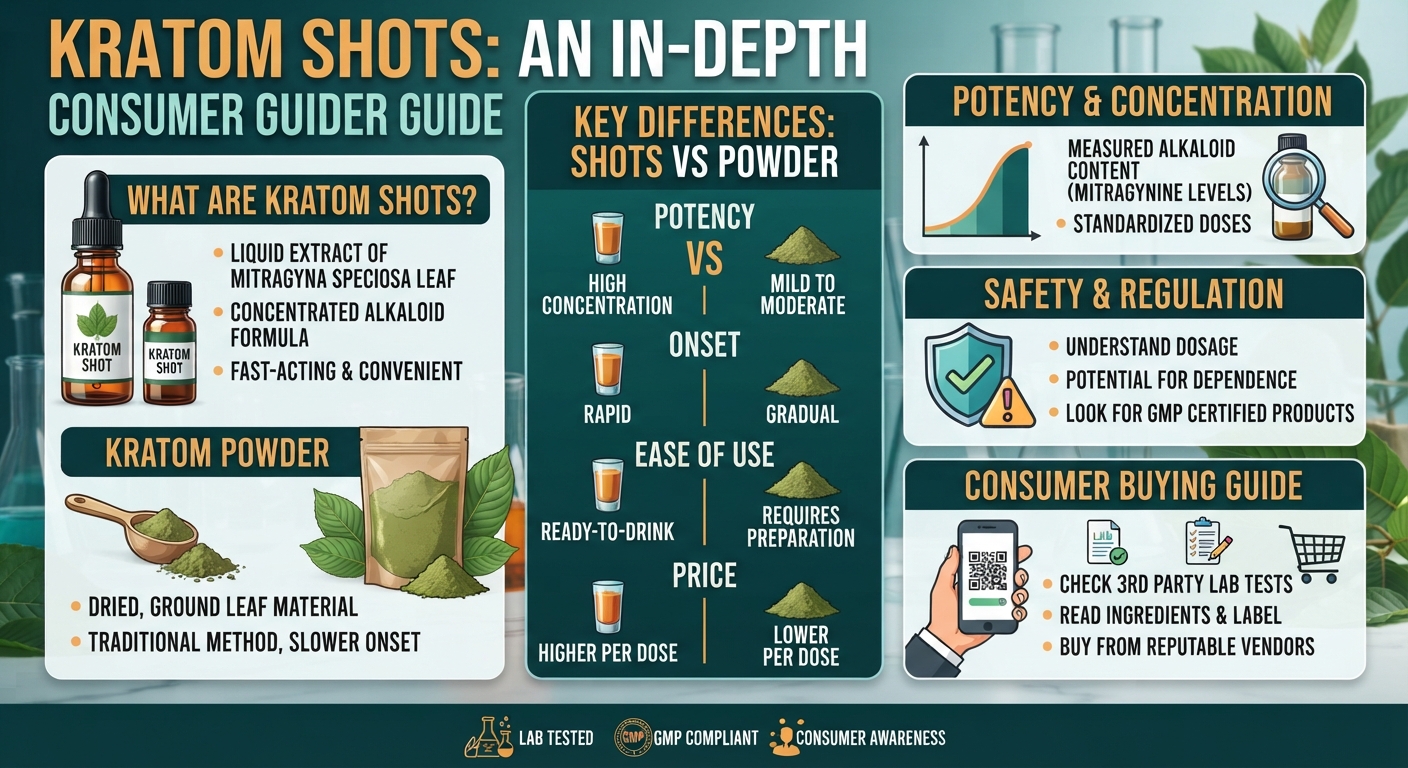
Kratom Shots vs. Traditional Kratom Powder
Traditional Powder
Kratom powder generally consists of dried and ground leaf.
Its chemistry depends on:
- Plant genetics
- Cultivar
- Geography
- Harvest season
- Leaf maturity
- Drying
- Storage
- Testing
Mitragynine is generally the dominant alkaloid.
7-OH occurs at much lower concentrations in ordinary botanical material.
Kratom Shots
Shots typically use some form of liquid preparation or extract.
Extraction can concentrate certain compounds.
That means the resulting product can have a chemical profile substantially different from the starting leaf.
This is one of the most important distinctions consumers should understand.
Why Mitragynine Matters
Mitragynine is the principal alkaloid in many kratom products.
It belongs to the indole-alkaloid family and contributes substantially to kratom’s pharmacological activity.
However, mitragynine concentration varies naturally.
A product’s strain name cannot guarantee an exact percentage.
What Changes Mitragynine Concentration?
Potential variables include:
- Genetics
- Cultivar
- Geographic origin
- Harvest timing
- Season
- Drying method
- Storage
- Extraction method
- Laboratory methodology
Consequently, two products marketed under similar strain names can produce different analytical results.
This is why batch-specific testing is more informative than relying on strain terminology.
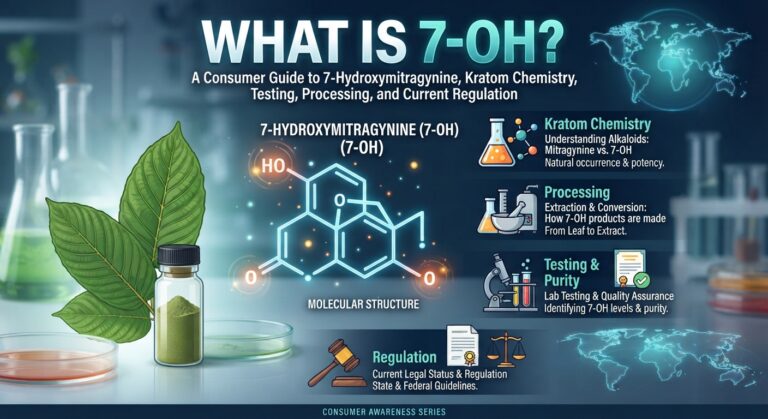
What Is 7-OH?
7-OH is short for 7-hydroxymitragynine.
It is a naturally occurring kratom alkaloid, but it normally occurs at much lower concentrations than mitragynine in botanical leaf.
Its significance comes from its strong pharmacological activity.
The FDA has described 7-OH as a potent mu-opioid receptor agonist and has specifically warned consumers about products containing concentrated 7-OH. (fda.gov)
Why 7-OH Changes the Consumer Analysis
A product containing trace naturally occurring 7-OH is not chemically equivalent to one deliberately formulated to contain concentrated 7-OH.
This distinction is particularly important for kratom shots because liquid extraction and concentration can produce products that are chemically very different from traditional leaf. Digital stores stock kratom shots from multiple extract processors, allowing consumers to compare various kratom shots milligram limits easily.
How Kratom Extraction Works Conceptually
Extraction is the process of transferring desired compounds from plant material into another medium.
The precise manufacturing process varies.
A commercial manufacturer may use:
- Water
- Alcohol
- Other extraction solvents
- Filtration
- Concentration
- Evaporation
- Standardization
- Blending
The consumer does not necessarily need proprietary manufacturing details. To understand kratom shots safety benchmarks, verify how these concentrated kratom shots batches are screened for residual industrial solvents.
But they should know whether the final product is:
Botanical material
or
Concentrated extract
or
Concentrated individual alkaloids.
Those are materially different categories.
Indoor Drying vs. Sun-Drying
Processing starts before extraction.
Indoor Drying
Indoor drying allows manufacturers or suppliers to control variables such as:
- Temperature
- Humidity
- Airflow
- Light
- Drying duration
Controlled conditions can improve consistency.
But “indoor dried” is not a guarantee of purity or potency.
Sun-Drying
Sun-drying introduces variables such as:
- UV exposure
- Heat
- Humidity
- Oxygen
- Drying time
Research has examined the impact of post-harvest conditions on kratom alkaloids.
The correct consumer conclusion is not that one drying method automatically produces a superior product. Independent labs auditing kratom shots purity demand scannable lot codes to ensure all retail kratom shots match recent laboratory certification sheets.
Instead:
The finished batch should be evaluated through appropriate laboratory testing.
Can Processing Change 7-OH Levels?
Yes, processing can influence kratom chemistry.
Scientific research has investigated oxidative conversion involving mitragynine and 7-OH.
Post-harvest conditions can affect alkaloid profiles.
Recent research examining different kratom cultivars, seasons, withering periods, and drying temperatures found significant variation in alkaloid composition and demonstrated that processing conditions can influence measured constituents. (pmc.ncbi.nlm.nih.gov)
However, consumers should avoid simplistic claims such as:
“Sun-drying creates extremely high 7-OH.”
Actual concentrations depend on multiple factors.
Why Concentration Is More Important With Shots
A powder product may contain a relatively dilute concentration of plant material. Analytical reviews of kratom shots bioavailability outline the severe tolerance risks facing buyers who utilize kratom shots too frequently.
An extract shot can concentrate constituents into a small volume.
That changes the importance of labeling.
A consumer may look at:
30 mL
and assume the product contains relatively little material.
Volume alone tells you almost nothing.
The meaningful questions are:
- How much extract?
- What alkaloid concentration?
- How much mitragynine?
- How much 7-OH?
- What other ingredients?
- What does the laboratory report?
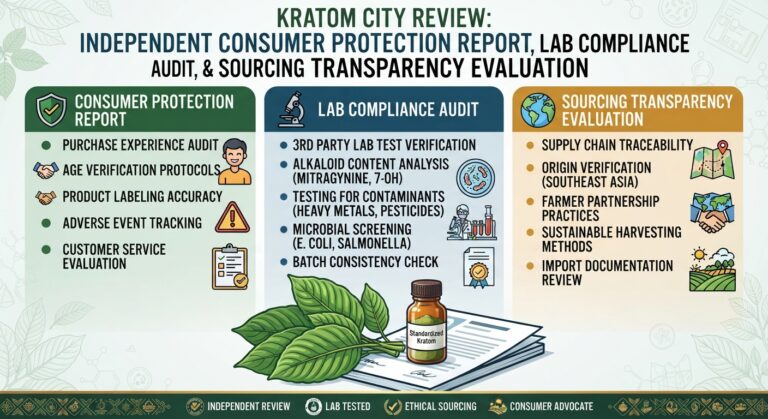
Laboratory Testing for Kratom Shots
Liquid products present specific analytical challenges.
A good laboratory should be capable of accurately measuring relevant alkaloids in the product matrix. Selecting your next kratom shots purchase requires checking if those particular kratom shots utilize clean, food-grade CO2 extraction pathways.
HPLC
High-performance liquid chromatography can be used to quantify kratom alkaloids.
A strong analytical report should ideally identify:
- Mitragynine
- 7-OH
- Other relevant alkaloids
- Units of measurement
- Detection or quantification limits
- Testing method
- Sample identification
The laboratory should also have appropriate quality controls.
LC-MS/MS
Liquid chromatography combined with tandem mass spectrometry can provide highly sensitive analytical measurements.
For concentrated products, sensitive methods can be particularly important because concentrations may differ dramatically from ordinary leaf.
Again, the presence of the words “LC-MS” on a marketing page is not enough.
The actual results matter.
Why a COA Matters
A Certificate of Analysis, or COA, provides analytical evidence about a specific sample.
A strong COA should contain:
- Product name
- Lot number
- Sample number
- Laboratory name
- Testing date
- Analytical method
- Numerical results
- Units
- Relevant contaminant results
The most important feature is traceability.
The consumer should be able to connect:
Bottle → Lot → Laboratory Report
Generic COAs Are Weak Evidence
A vendor may publish one certificate for a product category.
But if the current bottle comes from a different batch, the older report may not represent the material being sold.
Batch-specific testing is therefore considerably more useful.
Buying Option
What Should a Kratom Shot Be Tested For?
A comprehensive testing program can include several categories.
Alkaloids
At minimum, consumers interested in chemical transparency should look for:
- Mitragynine
- 7-hydroxymitragynine
Additional alkaloids can provide further context.
Heavy Metals
Testing may include:
- Lead
- Arsenic
- Cadmium
- Mercury
Microbial Contamination
Testing may include:
- Salmonella
- E. coli
- Yeast
- Mold
- Other pathogens
Pesticides
Agricultural residue testing can help identify unwanted pesticide contamination.
Other Contaminants
The appropriate testing panel depends on the manufacturing process and product type.
Why “Lab Tested” Is Not Enough
Consider two product claims:
Product A: “Third-party tested.”
Product B: Publishes a current lot-specific COA showing alkaloids, contaminants, laboratory identity, test date, and analytical methodology.
Product B gives the consumer substantially more information.
This is the difference between a claim of testing and evidence of testing.
What Does “Potency” Mean for a Kratom Shot?
Potency can refer to several different concepts.
It might mean:
- Amount of kratom extract
- Mitragynine concentration
- 7-OH concentration
- Total alkaloid concentration
- Manufacturer-defined extract ratio
These are not interchangeable.
Extract Ratio Is Not the Same as Alkaloid Concentration
A product labeled “20:1 extract” does not automatically tell you the concentration of mitragynine or 7-OH.
Extract ratios describe the relationship between starting botanical material and extract under a particular manufacturing framework.
They do not necessarily provide a standardized pharmacological measurement.
A consumer should therefore prioritize actual alkaloid results when available.
Why Small Bottles Can Contain Concentrated Products
A shot’s physical size is not a useful proxy for chemical strength.
Extraction can reduce a large amount of plant material into a much smaller liquid volume.
That is the basic reason concentrated products can fit into small containers.
Therefore, comparing:
“One bottle vs. one scoop of powder”
without analytical data is not meaningful.
Kratom Shots and Duration
Consumers sometimes search for how long kratom shots last.
There is no single scientifically reliable duration applicable to every product or individual.
Duration can depend on:
- Product composition
- Alkaloid concentration
- Route of administration
- Individual metabolism
- Food intake
- Other substances
- Tolerance
- Frequency of use
More concentrated products may also produce different exposure patterns than traditional leaf.
A vendor’s claimed “X-hour duration” should therefore not be treated as a laboratory measurement.
Why Duration Claims Are Often Marketing Claims
A statement such as:
“Lasts all day”
is not a standardized pharmacokinetic measurement.
A scientifically meaningful duration claim would require controlled research specifying:
- Compound concentration
- Dose
- Population
- Measurement method
- Pharmacokinetic endpoint
- Time course
Most consumer-product marketing does not meet that standard.
Therefore, Kratom Verdict recommends treating duration claims as anecdotal unless supported by credible evidence.
Kratom Shots and the Risk of Overconcentration
Concentrated products create a basic consumer problem:
The margin for misunderstanding the label can become smaller.
If a consumer does not know how much active material is present, a small bottle can make it difficult to judge exposure.
This is one reason precise labeling and independent testing are so important.
Why 7-OH-Specific Products Deserve Additional Scrutiny
The FDA has specifically warned consumers about concentrated 7-OH products.
The agency states that products containing 7-OH can cause serious harm and recommends avoiding products containing added or enhanced 7-OH. (fda.gov)
This is an important distinction from ordinary botanical kratom.
A consumer should therefore ask whether a kratom shot contains:
- Naturally occurring trace 7-OH
- Concentrated 7-OH
- Added 7-OH
- Another enhanced alkaloid formulation
If the label does not make this clear, transparency is limited.
Current Regulatory Attention on 7-OH
The federal regulatory environment surrounding concentrated 7-OH has changed substantially.
In July 2026, the DEA announced a temporary scheduling process involving 7-OH above a specified threshold and related substances. The agency specifically stated that the action did not apply to botanical kratom containing naturally occurring 7-OH below the stated threshold. (dea.gov)
This illustrates why consumers should not assume that:
“Kratom” = “7-OH concentrate.”
They are not necessarily the same category.
It also demonstrates why old articles about kratom legality can quickly become outdated.
Kratom Shots and Product Labeling
A transparent product label should ideally identify:
- Product name
- Net volume
- Ingredients
- Kratom source or extract
- Active compounds where applicable
- Batch number
- Manufacturer
- Contact information
- Relevant warnings
- Storage information
A label should not force the consumer to guess what is inside the bottle.
Proprietary Blends
Proprietary formulas can make comparison more difficult.
If a shot simply states:
“Proprietary kratom extract blend”
without specifying relevant alkaloid concentrations, consumers cannot easily compare it with another product.
Kratom Shots and Contamination
Liquid products can introduce additional manufacturing considerations.
Potential concerns include:
- Microbial contamination
- Heavy metals originating from plant material
- Solvent residues
- Manufacturing contamination
- Packaging-related contamination
- Water-quality issues
- Preservative problems
The exact risks depend on the formulation.
This is why comprehensive testing should consider the entire manufacturing process.
Shelf Life and Freshness
Kratom shots may have different stability considerations from dry powder.
Liquid products can be more sensitive to:
- Microbial growth
- Temperature
- Light
- Oxidation
- Packaging integrity
Preservatives may be used, but consumers should not assume preservation without checking the ingredient list.
What Should Consumers Check?
Look for:
- Manufacturing date
- Expiration or best-before date
- Storage instructions
- Lot number
- Packaging integrity
- Current COA
A damaged bottle or improperly stored product deserves additional caution.
Refrigeration Claims
Some liquid products may recommend refrigeration after opening.
That recommendation can be formulation-specific.
Consumers should follow the manufacturer’s storage instructions rather than assuming every shot should or should not be refrigerated.
Storage requirements should be stated clearly on the label.
Procurement Speed: Consumer Metric #1
Procurement speed measures how quickly a vendor processes and delivers a product.
For kratom shots, it can be useful for evaluating logistics.
But it does not establish:
- Potency
- Purity
- Safety
- Laboratory quality
- Legal compliance
A fast shipment is not evidence of a better product.
This is especially important when regulations differ across states or are changing.
Pricing Per Gram: Consumer Metric #2
Price per gram is particularly problematic for liquid shots.
A shot is normally sold by volume.
The product may contain concentrated extract.
Therefore, “cost per gram” may not even be the most appropriate unit unless the manufacturer discloses the mass and concentration of the relevant material.
Better Questions
Instead of asking only:
“How much does this bottle cost?”
ask:
- What is the net volume?
- What is the extract concentration?
- What is the mitragynine concentration?
- What is the 7-OH concentration?
- What laboratory verified the results?
- What is the cost relative to comparable products?
That produces a much more meaningful comparison.
Third-Party Lab Transparency: Consumer Metric #3
This is arguably the strongest quality metric.
Look for:
- Current COA
- Matching lot number
- Independent laboratory
- Actual numerical results
- Alkaloid profile
- Contaminant panel
- Test date
A product with excellent laboratory transparency gives consumers substantially more information than one relying on marketing claims.
Product Freshness: Consumer Metric #4
For a liquid shot, freshness should be considered alongside:
- Manufacturing date
- Expiration date
- Storage conditions
- Packaging
- Opened/unopened status
- Laboratory testing date
A recently manufactured bottle is not automatically safe.
Likewise, a product being close to its manufacturing date does not establish legal compliance.
How to Compare Two Kratom Shots
A useful consumer comparison can follow this sequence.
Step 1: Compare Ingredients
Look at the full ingredient panel.
Step 2: Compare Alkaloids
Check whether both products disclose:
- Mitragynine
- 7-OH
Step 3: Compare Concentration
Determine whether the reported concentrations are comparable.
Step 4: Compare Laboratory Reports
Check laboratory identity, date, lot number, and methods.
Step 5: Compare Contaminant Testing
Do not stop with alkaloids.
Step 6: Compare Storage Requirements
Especially important for liquid products.
Step 7: Compare Price
Only after the chemical profile is understood.
Red Flags When Shopping for Kratom Shots
Consumers should exercise caution when a product:
- Uses dramatic potency claims
- Does not disclose alkaloid concentrations
- Uses a proprietary blend without meaningful quantities
- Has no accessible COA
- Provides a generic COA
- Uses an unrelated batch number
- Does not identify the laboratory
- Makes medical claims
- Claims “100% safe”
- Claims that natural means risk-free
- Specifically emphasizes concentrated 7-OH without transparent testing
- Provides no storage information
The more concentrated the product, the more important these red flags become.
Why Vendor Reputation Alone Is Not Enough
A vendor can have:
- Excellent reviews
- Attractive packaging
- Strong social-media presence
- Fast shipping
- Many years in business
and still provide inadequate analytical transparency.
Reputation is useful.
It is not a substitute for current laboratory evidence.
The strongest consumer model combines:
Reputation + Testing + Traceability + Regulatory Transparency.
What About Customer Reviews?
Reviews can help evaluate:
- Shipping
- Packaging
- Customer service
- Product consistency
- General purchasing experience
They are much less useful for determining:
- Actual mitragynine concentration
- Actual 7-OH concentration
- Heavy-metal status
- Microbial safety
- Laboratory validity
A customer cannot reliably determine alkaloid concentration by taste or subjective experience.
Why Taste and Color Are Poor Quality Tests
Kratom shots can vary in:
- Color
- Flavor
- Bitterness
- Thickness
- Aroma
None of these characteristics reliably establishes chemical potency.
A darker product is not automatically stronger.
A more bitter product is not automatically purer.
A thicker liquid is not automatically more concentrated.
Laboratory analysis remains the appropriate tool.
Kratom Shots and Drug Interactions
Kratom alkaloids can interact with biological pathways involved in drug metabolism.
The risk can be particularly important for people taking prescription medications or other psychoactive substances.
Consumers should not assume that a small bottle means a small pharmacological effect.
Anyone taking medication should discuss potential interactions with a qualified clinician or pharmacist.
Kratom Shots and Alcohol
Combining kratom products with alcohol can increase uncertainty and may increase sedation or impairment.
The safest consumer-protection position is to avoid assuming that two individually familiar substances are safe when combined.
The same principle applies to:
- Sedatives
- Opioids
- Sleep medications
- Other psychoactive substances
Kratom Shots and Other Concentrated Botanicals
The modern marketplace increasingly combines multiple botanical extracts into small-volume products.
This makes the ingredient panel especially important.
A product containing kratom plus other sedating botanicals can have a different risk profile from a product containing kratom alone.
Consumers should therefore evaluate the entire formulation, not just the word “kratom.”
Why “Natural Energy Shot” Language Can Be Misleading
Some products may be marketed with wellness language that makes them sound like ordinary beverages.
But the presence of botanical extracts does not make a product nutritionally or pharmacologically equivalent to an energy drink.
Consumers should check:
- Active ingredients
- Extract concentration
- Alkaloid content
- Caffeine
- Other stimulants
- Sedating ingredients
- Regulatory warnings
Marketing category and chemical category are not necessarily the same.
A Practical Kratom Shot Verification Checklist
Product Identity
- Confirm the product is actually a kratom-derived formulation.
- Identify whether it is botanical, extract-based, or enhanced.
- Read the complete ingredient list.
- Check net volume.
Alkaloid Transparency
- Look for mitragynine results.
- Look for 7-OH results.
- Determine whether other alkaloids are reported.
- Avoid relying only on extract-ratio claims.
Laboratory Verification
- Find the current COA.
- Verify the laboratory.
- Check the testing date.
- Match the lot number.
- Review actual numerical results.
Contaminant Testing
- Heavy metals
- Microbial testing
- Pesticides where applicable
- Other process-specific contaminants
Freshness
- Manufacturing date
- Expiration date
- Storage instructions
- Packaging integrity
Regulatory Review
- Check the current law where you live.
- Do not rely on an old shipping list.
- Treat online checkout availability as a commercial feature, not legal authorization.
Internal Resources
For additional research, readers may also find these Kratom Verdict guides useful:
Vendor Transparency
- How to Evaluate Kratom Vendors
- Vendor Transparency Checklist
- How to Identify a Trusted Kratom Vendor
- Best Kratom Vendors for Beginners
Laboratory Testing
- Third-Party Lab Testing Explained
- Kratom Lab Testing Explained
- Kratom Alkaloid Testing Guide
- How to Read a Kratom Certificate of Analysis
- How to Compare Kratom COAs
- AKA GMP Certification Explained
Consumer Education
- Kratom Buying Guide
- Kratom Safety Guide
- Kratom Legality Guide
- Full Spectrum Kratom Explained
- Enhanced Kratom Powder Guide
- Kratom Extract Powder Explained
External References
Readers interested in learning more about laboratory standards and botanical documentation may consult publicly available resources from:
- U.S. Food and Drug Administration (FDA)
- American Kratom Association (AKA)
- International Organization for Standardization (ISO)
- AOAC INTERNATIONAL
- PubMed
- Kew Science – Plants of the World Online
- Journal of Ethnopharmacology
- Frontiers in Pharmacology
What Makes a Kratom Shot More Transparent?
A consumer-friendly product should make it easy to determine:
What is in the bottle?
How concentrated is it?
Who tested it?
When was it tested?
Which batch was tested?
What contaminants were checked?
How should it be stored?
If those answers are difficult to find, the product deserves additional scrutiny.
The Difference Between Transparency and Marketing
Marketing says:
“Premium.”
Laboratory data says:
“Mitragynine: X mg/mL.”
Marketing says:
“Ultra-strength.”
Laboratory data says:
“7-OH: X mg/mL.”
Marketing says:
“Pure.”
Laboratory data says:
“Heavy metals: results shown.”
This distinction captures the core philosophy of consumer protection.
Claims are useful.
Evidence is better.
The Broader Regulatory Picture
The regulatory environment surrounding kratom and kratom-derived compounds is evolving rapidly in the United States.
The FDA has taken enforcement action against companies marketing concentrated 7-OH products and has repeatedly warned consumers about the risks associated with concentrated 7-OH. (fda.gov)
The DEA also announced a temporary scheduling process in July 2026 involving 7-OH above a specified threshold and related substances. (dea.gov)
State laws can differ significantly.
That means a consumer should always check the current law applicable to the specific jurisdiction.
Why Kratom Shots Need More Consumer Due Diligence
A traditional bag of botanical powder is already a variable natural product.
A concentrated liquid adds additional variables:
- Extraction
- Concentration
- Solvent handling
- Liquid stability
- Preservation
- Packaging
- Alkaloid standardization
Therefore, the analytical burden should arguably be greater rather than smaller.
A manufacturer selling a concentrated liquid should be able to provide meaningful evidence about what has been manufactured.
Final Consumer Verdict on Kratom Shots
Kratom shots are not simply “kratom powder in a smaller bottle.”
They are generally concentrated liquid products whose chemistry can differ substantially from ordinary dried leaf.
That difference changes how consumers should evaluate them.
The first question should be:
What exactly is inside the bottle?
The second:
How much of the relevant active compounds are present?
The third:
Has an independent laboratory verified those numbers?
And the fourth:
Does the current product comply with applicable law?
For traditional kratom, mitragynine is generally the principal alkaloid, while 7-OH occurs at much lower natural concentrations.
For concentrated products, however, the alkaloid profile can be substantially different.
This is why a consumer should not assume that the word “kratom” tells the whole story.
A shot should ideally be evaluated through:
Product identity → Alkaloid profile → Laboratory verification → Contaminant testing → Batch traceability → Freshness → Regulatory status → Price
That order matters.
Price and shipping are easy to compare.
Chemical composition is not.
The most important consumer metric is therefore not how attractive the bottle looks or how quickly it arrives.
It is whether the manufacturer can provide verifiable evidence about what is actually inside it.
A strong COA should connect the product to a specific batch and provide numerical analytical results.
For consumers evaluating concentrated kratom products, special attention should be paid to mitragynine and 7-OH, because these compounds can differ dramatically between ordinary botanical material and concentrated formulations.
The rapidly changing regulatory environment makes this even more important.
The FDA has issued specific warnings about concentrated 7-OH products, while the DEA announced a temporary scheduling process in July 2026 concerning 7-OH above a specified threshold and related substances. (fda.gov)
Therefore, the responsible consumer approach is not to assume that every kratom shot is the same.
They are not.
Different manufacturers can use different source material, extraction techniques, concentrations, formulations, preservation systems, and testing programs.
Consumers should reward the products and companies that make those differences transparent.
The strongest purchasing decision is based on evidence rather than hype:
Know the ingredients.
Know the alkaloid concentrations.
Know the batch.
Know the laboratory.
Know the contaminant results.
Know the current legal environment.
Then compare the economics.
That is the foundation of responsible consumer research in the rapidly evolving kratom-shot marketplace.
Before you purchase any product or commit your household budget, verify live vendor compliance scores, audit certified laboratory sheets, and compare current wholesale market pricing data directly at KratomVerdict.com!