Reviewed by Kratom Verdict Editorial Team
Last Updated: July 2026
Estimated Reading Time: 16 minutes
Guide Type: Independent Editorial Strain Guide
Research Basis: Publicly available botanical information, third-party laboratory transparency, publicly available regulatory resources, scientific literature, and independent editorial research.
A kratom product’s label is often the very first — and sometimes the only — piece of information a buyer actually looks at before making a purchase. Yet most kratom labels pack a surprising amount of regulatory, safety, and quality information into a small amount of physical space, and very few shoppers know how to read all of it.
This matters more now than it used to. As of 2026, kratom regulation in the United States has shifted decisively away from a patchwork of vague state rules and toward increasingly specific, standardized labeling requirements, driven largely by the widespread adoption of the Kratom Consumer Protection Act (KCPA) across more than 20 states. That means a growing share of kratom labels are now legally required to disclose specific information — not just marketing copy — and knowing how to interpret it gives you a real, practical advantage as a consumer.
This guide walks through every major component you’ll find on a legitimate kratom product label, what each one actually means, which details are legally required versus optional, and the red flags that signal a label you shouldn’t trust.
Why Kratom Labels Look Different From State to State
Unlike many consumer products governed by a single federal labeling standard, kratom labeling requirements vary significantly depending on where a product is sold, because kratom itself remains unscheduled at the federal level while individual states have taken increasingly divergent regulatory paths.
As of mid-2026, the U.S. kratom legal landscape breaks down roughly into three categories: states that have adopted a KCPA framework (more than 20 states, including Utah, Florida, Georgia, Arizona, Nevada, Oregon, Colorado, Oklahoma, Kentucky, Mississippi, West Virginia, and Rhode Island, which became the first state ever to reverse a prior ban when it replaced its prohibition with a KCPA framework effective April 1, 2026); states with general legality but no formal KCPA-style labeling mandate; and states that have banned kratom or its alkaloids outright, treating mitragynine and 7-hydroxymitragynine as controlled substances.
This is exactly why two kratom products sitting side by side on a shelf, or two different vendor websites, can display noticeably different label formats. A product sold into a KCPA state is typically required to meet a much more specific, legally defined labeling standard than one sold in a state with no formal kratom-specific labeling law at all.
The Core Components of a Legitimate Kratom Label
1. Product Identity and Strain Name
Every label should clearly identify what the product actually is — the specific strain or blend name (Green Maeng Da, Red Bali, White Borneo, and so on), the product form (powder, capsules, extract, tincture), and the net weight or quantity contained.
2. Mitragynine and 7-Hydroxymitragynine Content
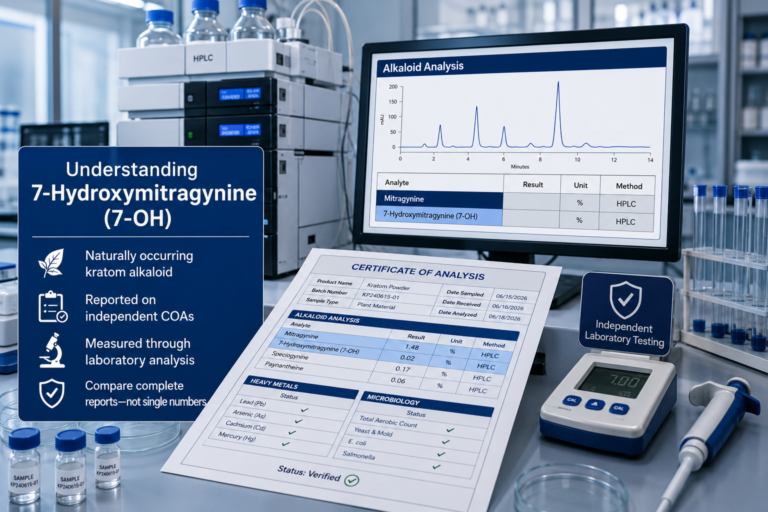
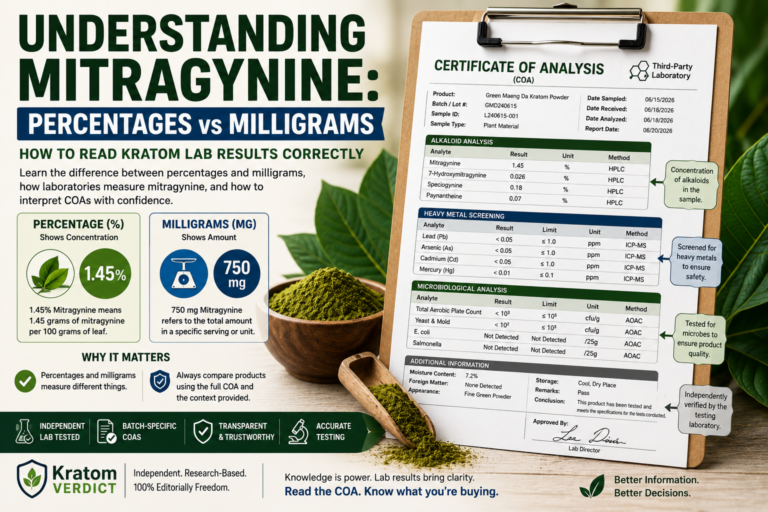
This is one of the most consequential label requirements to understand, and it’s become dramatically more specific under KCPA frameworks. Rather than a vague potency claim, compliant labels are increasingly required to state the actual measured amount of mitragynine and 7-hydroxymitragynine (commonly abbreviated 7-OH) present in the product.
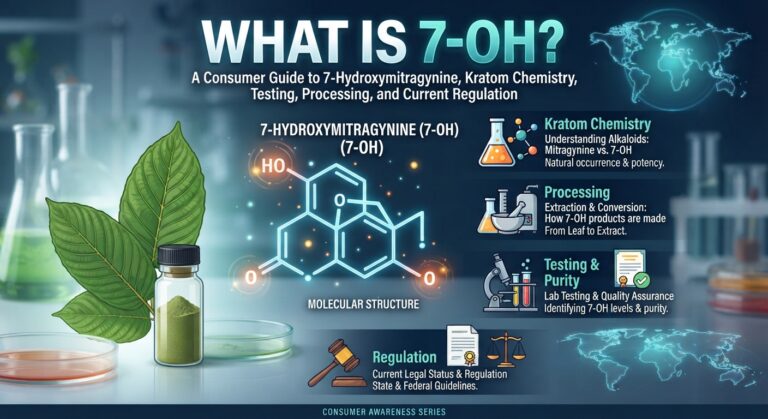
Some states have gone further still. Florida’s regulatory guidance, for instance, has directed manufacturers to disclose 7-OH concentration specifically in parts per million (ppm) on a dry weight basis, giving consumers a precise, standardized figure rather than a general marketing claim. This level of specificity matters because 7-OH is the alkaloid at the center of the most significant kratom regulatory attention in recent years — concentrated, artificially enhanced 7-OH products behave very differently from naturally occurring leaf, and transparent labeling is the primary tool regulators have chosen to distinguish between the two.
3. The 7-OH Concentration Cap
Under most KCPA frameworks, there’s a specific regulatory limit on how much 7-hydroxymitragynine a product can legally contain relative to its total alkaloid content — commonly capped at 2% of the total alkaloid fraction, though the precise figure and how it’s calculated varies somewhat by state (Georgia notably differs from the more common under-1%-of-total-alkaloid-fraction threshold used elsewhere). A compliant label should reflect a product that falls within this threshold, and products marketed as containing dramatically enhanced or isolated 7-OH — well above naturally occurring leaf levels — are exactly the category that’s drawn the most regulatory scrutiny and, in some jurisdictions, outright restriction.
4. Lot or Batch Number
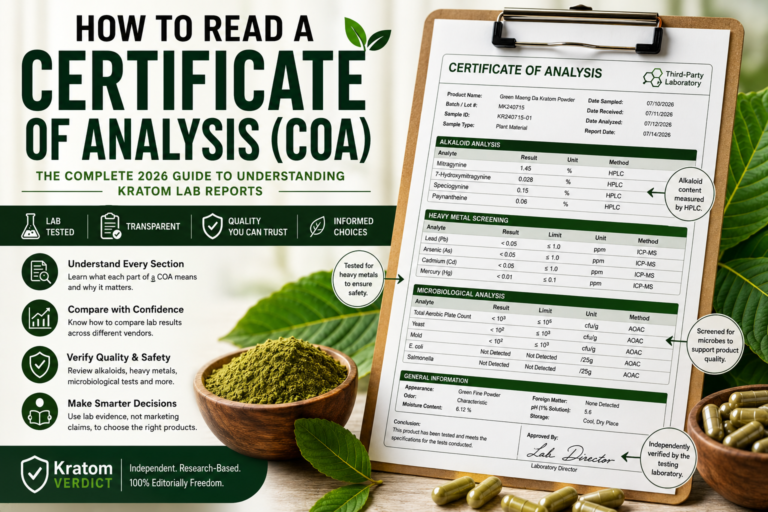
A legitimate kratom label includes a specific lot or batch identification number, and this number should match exactly the lot number referenced on the product’s Certificate of Analysis. This is the single detail that connects the physical product in your hand to the specific lab testing results that apply to it — without a matching lot number, there’s no real way to confirm that any published COA actually corresponds to what you’re holding.
5. Manufacturer, Packer, or Distributor Information
Regulatory frameworks typically require the name and physical business address of the company responsible for manufacturing, packing, or distributing the product. This isn’t just a formality — it’s the information you’d need to actually contact a company, verify its legitimacy, or pursue a concern if something went wrong with a product.
6. Country of Origin
Increasingly required under KCPA-style frameworks, country of origin labeling reflects where the raw kratom material was sourced. Given that the vast majority of the world’s kratom supply has historically come from Indonesia, and given that Indonesian export regulations changed substantially in October 2024 — including new sterilization requirements and minimum mitragynine concentration standards for exported material — country of origin has become a more meaningful data point than it might first appear, since it connects a finished product back to a specific, evolving regulatory and quality environment.
7. Age Restriction Statement
KCPA-compliant labels typically include a clear statement indicating the product is restricted to purchasers 21 and older (the age threshold most commonly adopted, though some frameworks reference 18). This isn’t just a suggestion — in KCPA states, it reflects an actual legal purchasing restriction that retailers are required to enforce.
8. The FDA Disclaimer Statement
Because kratom is not an FDA-approved dietary supplement or drug, compliant labels are generally required to include a statement along the lines of noting that the product has not been evaluated by the Food and Drug Administration and is not intended to diagnose, treat, cure, or prevent any disease. Related to this, labels are typically prohibited from making any specific therapeutic or medical claims unless the product has actually been registered with the FDA for that purpose — meaning a label claiming to “treat anxiety” or “cure pain” is very likely operating outside compliant labeling standards.
9. Serving Size and Usage Guidance
A responsible, compliant label should specify a suggested serving size, allowing a consumer to understand roughly how much of the product corresponds to the alkaloid content disclosed elsewhere on the label. Since alkaloid exposure and associated risk (for heavy metals, for instance) scale directly with how much product is actually consumed, this figure connects directly back to how you’d interpret the rest of the label and any associated COA.
10. Restrictions on Marketing Imagery
Some state frameworks specifically prohibit certain marketing tactics on kratom labels — for example, Utah’s regulatory framework explicitly bars any imagery resembling a cartoon or fictional character, a rule clearly designed to prevent packaging that could appeal to minors. A label using this kind of imagery in a KCPA state would be a direct compliance violation, not just a style choice.
What a Certificate of Analysis Reference on a Label Should Look Like
Increasingly, compliant kratom labels include a way to directly access the batch-specific Certificate of Analysis — commonly a QR code, a printed URL directing to a COA lookup page, or a lot number paired with instructions for requesting the document by email. The presence of this kind of direct verification pathway, rather than just a generic “lab tested” claim with no way to check it, is one of the clearest positive signals a label can offer.
How Testing Requirements Connect to What’s on the Label
It’s worth understanding that a compliant kratom label isn’t just a matter of good design — under KCPA frameworks, the label content is directly tied to underlying, mandatory lab testing. States that have adopted KCPA-style regulations generally require that the mitragynine and 7-OH figures printed on a label be independently verified through third-party testing from a laboratory holding, or actively working toward, ISO/IEC 17025:2017 accreditation. Some frameworks specifically allow labs to test kratom products before achieving full accreditation only if they’re following recognized minimum good laboratory practices (such as OECD Principles) while actively pursuing accreditation — a reasonable accommodation that still ties label claims back to a genuine testing standard rather than an arbitrary vendor assertion.
This means the label and the COA are meant to function as a connected pair: the label tells you what to expect, and the COA (accessible via the lot number) is what actually verifies it. A label making specific alkaloid claims with no accessible, lot-matched COA behind it is only telling half the story.
Red Flags on a Kratom Label
No lot or batch number at all. Without this, there’s no way to connect the product to any specific testing documentation, regardless of what else the label claims.
Vague or missing manufacturer information. A label with no identifiable company name and address, or one using only a brand name with no legal business identity behind it, offers no real accountability.
Specific medical or therapeutic claims. Language suggesting a product treats, cures, or prevents a specific health condition is a significant compliance red flag in virtually every regulatory framework covering kratom, and should raise real skepticism about the rest of the label’s accuracy.
No FDA disclaimer statement. The absence of this now-standard disclaimer, particularly on a product sold into a KCPA state, suggests the manufacturer either isn’t aware of or isn’t following basic compliance requirements.
Marketing imagery that could appeal to minors. Cartoon characters, imagery mimicking popular candy or snack branding, or similar design choices are both an ethical concern and, in many KCPA states, an explicit legal violation.
Alkaloid figures with no accessible COA. A label boldly printing specific mitragynine or 7-OH percentages with no lot number, QR code, or other pathway to independently verify those figures is asking you to trust a number with no way to check it.
7-OH content disproportionate to natural leaf levels. Naturally occurring 7-hydroxymitragynine typically represents a very small fraction of a plant’s total alkaloid content. A label indicating 7-OH levels well above the regulatory concentration cap common under KCPA frameworks — or a product explicitly marketed around dramatically enhanced 7-OH potency — is describing something meaningfully different from traditional leaf kratom, and is exactly the category that’s drawn the most serious recent regulatory and safety scrutiny.
Why Label Standards Have Tightened So Quickly
Kratom labeling requirements have moved fast in a short period, and understanding why helps make sense of the current landscape. Concerns about concentrated, artificially enhanced 7-OH products — sold as tablets, gummies, and drink shots at potency levels far beyond what natural leaf produces — became a central regulatory flashpoint in 2025 and 2026, prompting both state-level restrictions and a narrower federal action targeting synthesized 7-OH and related compounds specifically, while leaving natural, unenhanced whole-leaf kratom outside that federal action’s scope.
This has pushed KCPA-adopting states toward increasingly specific labeling requirements precisely so that consumers, retailers, and regulators can distinguish between traditional, naturally-occurring-potency kratom leaf and concentrated 7-OH isolate products at a glance, rather than relying on marketing language that could obscure the difference. Understanding this distinction is genuinely one of the most useful things a label-literate consumer can take away from all of this: the specific alkaloid percentages on a label aren’t just a technical detail, they’re the primary tool currently available for telling these two very different product categories apart.
A Quick Glossary of Kratom Label Terms
- KCPA (Kratom Consumer Protection Act): Model state legislation, adopted in some form by more than 20 states, establishing age limits, labeling standards, testing mandates, and adulteration bans for kratom products.
- Mitragynine: The primary alkaloid associated with kratom’s effects, and a core figure required on compliant labels.
- 7-Hydroxymitragynine (7-OH): A secondary alkaloid subject to specific concentration caps and disclosure requirements under most KCPA frameworks, due to its association with concentrated, enhanced products.
- Alkaloid fraction: The total measured alkaloid content of a product, against which 7-OH concentration caps (commonly around 2%) are typically calculated.
- Lot/batch number: A unique identifier tying a specific product unit back to its corresponding Certificate of Analysis.
- ppm (parts per million), dry weight basis: A standardized way some states require 7-OH concentration to be expressed on a label, based on the dried plant material’s weight.
- FDA disclaimer statement: The required label language noting the product hasn’t been evaluated by the FDA and isn’t intended to diagnose, treat, cure, or prevent disease.
Frequently Asked Questions
Is kratom labeling regulated the same way in every state? No. Labeling requirements vary considerably depending on whether a state has adopted a KCPA framework, has general legality with no specific labeling mandate, or bans kratom outright. More than 20 states currently follow some version of KCPA-style labeling standards, while others have no formal kratom-specific labeling law, and a smaller number classify kratom alkaloids as controlled substances entirely.
Why do some labels list 7-OH content so specifically now? Concentrated, artificially enhanced 7-hydroxymitragynine products have become the central focus of recent kratom regulatory action, both at the state level through KCPA concentration caps and through a narrower federal action targeting synthesized 7-OH specifically. Specific 7-OH labeling requirements exist largely to help distinguish traditional, naturally-potency leaf kratom from these more concentrated, more heavily regulated product categories.
What does it mean if a label has no lot number? It means there’s no reliable way to connect the specific product you’re holding to any lab testing documentation that might exist for that brand or product line. This is one of the clearest labeling red flags across the entire industry.
Does a kratom label with an FDA disclaimer mean the product is FDA-approved? No — it means the opposite. The disclaimer statement exists specifically to clarify that the FDA has not evaluated the product and that it isn’t intended to diagnose, treat, cure, or prevent any disease. Its presence reflects regulatory compliance, not FDA endorsement.
How can I verify that the alkaloid figures on a label are accurate? Look for a lot number, QR code, or other reference connecting the label to a specific, accessible Certificate of Analysis from an independent, ideally ISO/IEC 17025-accredited laboratory. A label making specific claims with no way to verify them against actual lab documentation should be treated with more caution than one offering a clear, direct verification path.
Final Takeaway
A kratom label is no longer just packaging — in a growing number of states, it’s a legally defined document required to disclose specific alkaloid content, batch identification, manufacturer accountability, and regulatory compliance statements, all tied back to underlying lab testing requirements. Understanding what each element actually means, why 7-OH disclosure specifically has become such a focal point, and which details signal a label you can trust versus one asking you to take marketing claims on faith gives you real, practical leverage as a kratom consumer. In a regulatory landscape that’s still actively evolving state by state, learning to read a label with this level of understanding is one of the most useful and durable skills a buyer can develop.