Reviewed by Kratom Verdict Editorial Team
Last Updated: July 2026
Estimated Reading Time: 18–22 minutes
Guide Type: Independent Editorial Educational Guide
Research Basis: Publicly available scientific literature, laboratory testing methodologies, publicly available regulatory resources, and independent editorial research.
Editorial Note
One of the most common mistakes made by kratom buyers is misunderstanding laboratory results.
Consumers frequently compare products using statements such as:
- “This product contains 2% mitragynine.”
- “This one has 18 mg of mitragynine.”
- “This extract contains 45 mg.”
- “This powder is stronger because the percentage is higher.”
These comparisons often mix percentages, milligrams, serving sizes, and package totals as though they measure the same thing.
They do not.
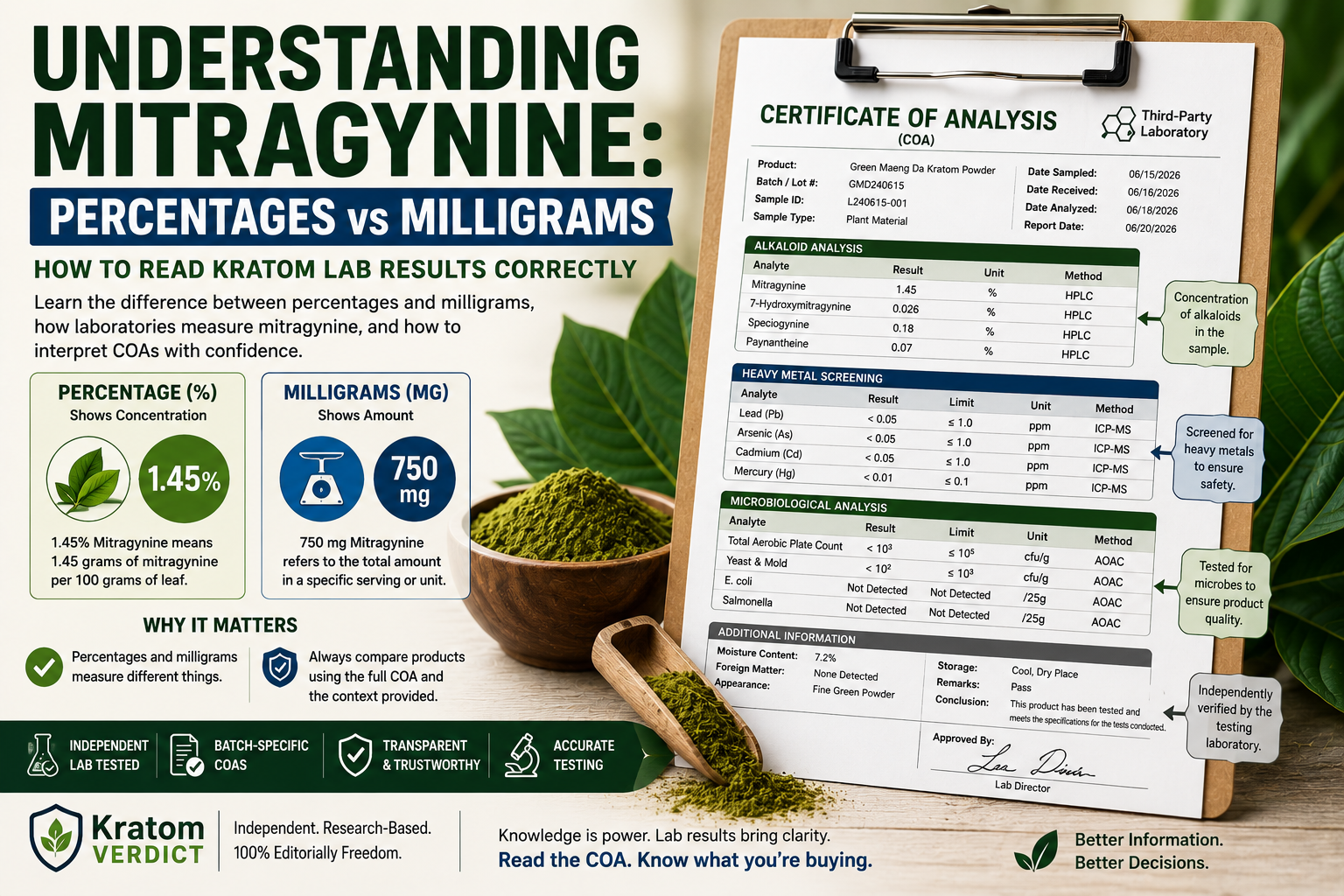
Understanding the difference between percentages and milligrams is one of the most valuable skills a buyer can learn when evaluating Certificates of Analysis (COAs).
This guide explains how laboratories report alkaloid concentrations, why different units are used, and how to compare products accurately using objective laboratory data instead of marketing claims.
Why This Topic Confuses So Many Buyers
Laboratories report mitragynine using several different measurement systems.
For example, a Certificate of Analysis may display:
- 1.45%
- 14.5 mg/g
- 725 mg per package
- 36 mg per serving
Each number may accurately describe the same product—but they answer different questions.
Without understanding the units, buyers often compare unrelated measurements and reach incorrect conclusions.
The purpose of this guide is to explain what each measurement actually means.
What Is Mitragynine?
Mitragynine is the primary naturally occurring alkaloid found in Mitragyna speciosa leaves.
Independent laboratories commonly measure mitragynine because it serves as one indicator of a product’s chemical composition.
However, laboratory reports measure concentration—they do not determine:
- Overall product quality
- Manufacturing standards
- Product safety
- Customer satisfaction
- Regulatory compliance
A complete product evaluation always includes contaminant testing, traceability, manufacturing transparency, and responsible labeling in addition to alkaloid analysis.
Why Laboratories Use Different Units
Different laboratories use different reporting formats depending on:
- Product type
- Testing method
- Customer requirements
- Laboratory software
- Report format
Common reporting units include:
- Percentage (%)
- Milligrams per gram (mg/g)
- Milligrams per serving (mg)
- Milligrams per package
- Parts per million (ppm) for contaminants
Each unit serves a different purpose.
Understanding which unit is being reported is considerably more important than comparing the numbers themselves.
Percentage (%) — The Most Common Measurement
Most Certificates of Analysis for traditional kratom powder report mitragynine as a percentage.
Example:
Mitragynine: 1.50%
This means that approximately 1.5% of the tested sample’s weight consisted of mitragynine at the time of laboratory analysis.
The percentage describes concentration—not the total amount contained in the package.
For example:
A 100-gram package containing 1.50% mitragynine contains far more total mitragynine than a 25-gram package with the same percentage.
The percentage remains identical.
The total quantity does not.
Milligrams Per Gram (mg/g)
Some laboratories prefer reporting alkaloids as:
15 mg/g
This means that each gram of the tested material contained approximately 15 milligrams of mitragynine.
For powdered leaf products, percentages and milligrams per gram can often be converted directly.
For example:
| Percentage | Approximate mg/g |
|---|---|
| 1.00% | 10 mg/g |
| 1.20% | 12 mg/g |
| 1.50% | 15 mg/g |
| 1.80% | 18 mg/g |
| 2.00% | 20 mg/g |
Understanding this relationship helps buyers compare reports from different laboratories.
Why Different Companies Report Different Numbers
Two companies may honestly report:
Vendor A:
1.70%
Vendor B:
17 mg/g
Although the numbers appear very different, they describe essentially the same concentration.
Without understanding unit conversions, buyers may incorrectly assume one product is significantly stronger than the other.
Milligrams Per Serving
Extract products often display:
45 mg Mitragynine per serving
This measurement differs completely from percentage.
Instead of describing concentration throughout the product, it describes the quantity contained within one serving as defined by the manufacturer.
Because serving sizes differ between products, buyers should avoid comparing milligrams per serving without first confirming serving size.
Milligrams Per Package
Some manufacturers also display:
900 mg Total Mitragynine
This number represents the approximate total amount of mitragynine contained within the entire package.
It does not indicate concentration.
A larger package naturally contains more total alkaloids than a smaller package with identical percentages.
Understanding the difference between total quantity and concentration prevents misleading comparisons.
Why Buyers Often Misinterpret Laboratory Reports
Several common misunderstandings occur repeatedly.
Many buyers compare:
- Percentages against serving amounts.
- Milligrams against percentages.
- Total package values against concentrations.
- Extracts against ordinary leaf powder.
These comparisons are scientifically inaccurate because they measure different characteristics.
Before comparing any laboratory reports, buyers should first confirm they are evaluating equivalent units.
Converting Percentages into Milligrams Per Gram
One of the simplest laboratory conversions involves percentages and milligrams per gram (mg/g).
Because one gram equals 1,000 milligrams:
1.00% = 10 mg/g
This relationship makes it relatively easy to compare reports using different measurement systems.
For example:
| Mitragynine (%) | Approximate mg/g |
|---|---|
| 0.80% | 8 mg/g |
| 1.00% | 10 mg/g |
| 1.20% | 12 mg/g |
| 1.40% | 14 mg/g |
| 1.60% | 16 mg/g |
| 1.80% | 18 mg/g |
| 2.00% | 20 mg/g |
Although the numbers appear different, both reporting methods describe the same concentration.
Understanding Milligrams Per Serving
Many extract manufacturers emphasize statements such as:
- 45 mg Mitragynine
- 80 mg Per Serving
- 120 mg Total Alkaloids
Without context, these numbers are difficult to interpret.
Milligrams per serving depend entirely on the serving size selected by the manufacturer.
For example:
Product A:
15 mg per serving
Serving size: 1 capsule
Product B:
30 mg per serving
Serving size: 2 capsules
The concentration per capsule may actually be identical.
Always verify serving size before comparing products.
Why Total Package Milligrams Can Be Misleading
Some companies advertise:
“1,200 mg Total Mitragynine”
At first glance, this appears impressive.
However, the total amount often reflects package size rather than concentration.
For example:
Package A
- 50 grams
- 2% Mitragynine
Package B
- 200 grams
- 2% Mitragynine
Package B naturally contains four times more total mitragynine simply because it contains four times more material.
The concentration remains identical.
Package totals should never be interpreted as indicators of higher quality.
Understanding Concentration vs Quantity
One of the most important concepts in laboratory interpretation is distinguishing between:
Concentration
How much mitragynine exists within a given amount of material.
Usually reported as:
- Percentage
- mg/g
Quantity
How much mitragynine exists within:
- One serving
- One capsule
- One bottle
- One package
Usually reported as:
- mg per serving
- mg per package
These measurements answer completely different questions.
Confusing them frequently leads to incorrect product comparisons.
Why Extract Products Require Different Calculations
Traditional powder generally contains naturally occurring alkaloid concentrations.
Extract products are manufactured differently.
Because extracts concentrate alkaloids, laboratory reports commonly display:
- mg per serving
- mg per capsule
- Product concentration ratios
- Total alkaloid content
Extracts therefore require considerably more careful interpretation than ordinary powdered leaf.
Comparing extract numbers directly with powder percentages is rarely appropriate.
Can Two Products Have the Same Percentage but Different Total Alkaloids?
Yes.
Consider two hypothetical products.
Product A
100-gram package
1.50% Mitragynine
Product B
250-gram package
1.50% Mitragynine
Both products have identical laboratory concentration.
However, Product B contains considerably more total mitragynine simply because it contains more botanical material.
This demonstrates why percentages and package totals should never be confused.
Why Laboratory Reports May Differ Between Companies
Consumers sometimes assume that different numbers indicate different testing quality.
In reality, laboratories often use different reporting formats.
One laboratory may report:
1.65%
Another may report:
16.5 mg/g
Another may report:
1650 mg/kg
All three may accurately describe the same concentration.
The reporting format differs—not necessarily the laboratory result.
Why Buyers Should Verify Units Before Comparing Products
Responsible buyers should always identify:
✔ Percentage (%)
✔ mg/g
✔ mg per serving
✔ mg per package
✔ Product size
Only after confirming identical units should meaningful comparisons begin.
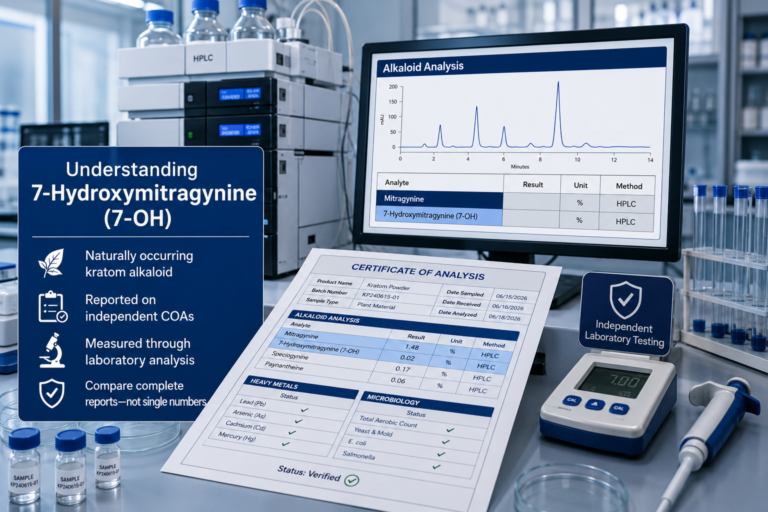
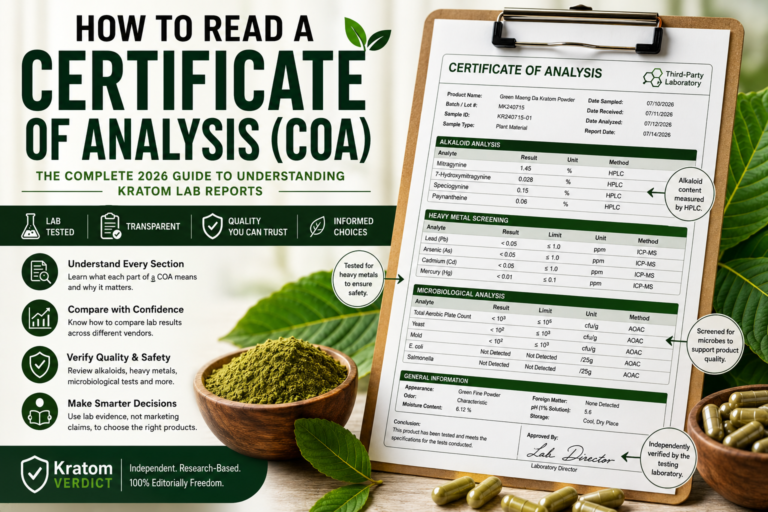
The Importance of Reading the Entire Certificate of Analysis
Many consumers immediately search for:
“Mitragynine”
Unfortunately, they often ignore the remainder of the laboratory report.
Responsible evaluation includes reviewing:
- Product identification
- Batch number
- Laboratory name
- Test date
- Heavy metals
- Microbiology
- Analytical methods
- Laboratory authorization
The mitragynine value represents only one section of the overall Certificate of Analysis.
Common Laboratory Reporting Formats
Professional laboratories commonly display mitragynine using one or more of the following formats.
| Reporting Format | What It Describes |
|---|---|
| Percentage (%) | Concentration by weight |
| mg/g | Milligrams per gram |
| mg per serving | Quantity within one serving |
| mg per package | Total quantity within package |
| mg/kg | Milligrams per kilogram |
| ppm | Primarily used for contaminants |
Recognizing these units significantly improves laboratory interpretation.
Why Marketing Sometimes Creates Confusion
Some advertisements selectively highlight whichever number appears largest.
Examples include:
“900 mg Mitragynine”
“2% Mitragynine”
“18 mg/g”
Although all three statements may be technically accurate, they describe different measurements.
Without understanding the units, consumers may incorrectly assume one product greatly exceeds another.
Responsible companies clearly explain what their numbers represent.
Does Higher Mitragynine Mean Better Kratom?
Not necessarily.
Higher mitragynine concentration does not automatically indicate:
- Better manufacturing
- Better cultivation
- Better laboratory practices
- Better customer support
- Better contaminant testing
A complete evaluation should also include:
- Heavy metal screening
- Microbiological analysis
- Product traceability
- Manufacturing transparency
- Responsible labeling
Laboratory concentration represents only one component of overall product quality.
Common Buyer Mistakes
During our editorial research, several mistakes appeared repeatedly.
Comparing percentage with mg per serving
These units measure different characteristics.
Ignoring serving size
Serving size greatly influences reported milligram values.
Comparing extracts with ordinary powder
These products require different evaluation methods.
Looking only at mitragynine
Heavy metals and microbiological testing remain equally important.
Ignoring package size
Larger packages naturally contain more total alkaloids even when concentrations remain identical.
What Experienced Buyers Examine First
Experienced consumers generally review laboratory reports in the following order:
- Product identification
- Batch number
- Laboratory information
- Test date
- Heavy metal analysis
- Microbiological screening
- Mitragynine concentration
- Analytical methods
- Laboratory authorization
Understanding the entire report provides significantly greater confidence than focusing on a single alkaloid value.
How to Compare Two Laboratory Reports Correctly
Comparing two Certificates of Analysis becomes much easier when buyers follow a consistent process.
Instead of immediately comparing the mitragynine value, review the reports in the following order.
Step 1 — Verify Product Type
Determine whether the product is:
- Traditional leaf powder
- Capsules
- Extract powder
- Liquid extract
- Gummies
- Tablets
Different product categories often use different reporting methods.
Step 2 — Confirm the Reporting Units
Identify whether the laboratory reports mitragynine as:
- Percentage (%)
- mg/g
- mg per serving
- mg per package
Products should only be compared after confirming equivalent units.
Step 3 — Verify the Batch Number
A Certificate of Analysis should correspond to the exact product batch being sold.
Matching batch numbers significantly improve confidence in the laboratory report.
Step 4 — Review More Than Alkaloids
Responsible buyers also evaluate:
- Heavy metal screening
- Microbiological analysis
- Product identification
- Laboratory information
- Test dates
Mitragynine represents only one section of a complete Certificate of Analysis.
Step 5 — Consider Package Size
A larger package naturally contains more total alkaloids than a smaller package with identical concentration.
Total quantity should never be confused with concentration.
Real-World Example
Imagine two companies advertise the following.
Vendor A
- 1.60% Mitragynine
- 100-gram package
Vendor B
- 16 mg/g Mitragynine
- 100-gram package
Many consumers assume these represent different products.
In reality, the reported concentration is essentially the same.
The laboratories simply used different reporting units.
Now consider another example.
Vendor C
- 2.00% Mitragynine
- 25-gram package
Vendor D
- 1.50% Mitragynine
- 250-gram package
Vendor C has the higher concentration.
Vendor D contains a greater total amount of mitragynine because the package is substantially larger.
Both statements can be true simultaneously.
Why Laboratory Transparency Matters More Than Numbers
Many companies advertise impressive alkaloid values.
However, the value itself means little without supporting documentation.
Responsible laboratory reports should clearly identify:
- Product name
- Batch number
- Laboratory identity
- Testing date
- Analytical methods
- Heavy metals
- Microbiological testing
- Laboratory authorization
Complete documentation provides far greater confidence than a single percentage printed on a website.
Why Responsible Companies Explain Their Numbers
Transparent manufacturers understand that laboratory values can be confusing.
The strongest companies often provide educational resources explaining:
- Percentage conversions
- Serving calculations
- Product concentrations
- Laboratory terminology
- Certificate of Analysis interpretation
Education represents another important indicator of overall transparency.
Understanding Laboratory Precision
Professional laboratories report analytical values within the limits of their validated testing methods.
Because botanical materials naturally vary, laboratory results should not be interpreted as permanent values.
Factors influencing analytical results may include:
- Agricultural variation
- Harvest timing
- Storage conditions
- Sample preparation
- Natural biological differences
Minor variation between production batches should generally be expected.
Responsible companies acknowledge this rather than claiming perfect consistency.
What Laboratory Results Cannot Tell You
Even the most comprehensive Certificate of Analysis cannot answer every question.
Laboratory reports do not directly evaluate:
- Company ethics
- Customer service
- Shipping quality
- Return procedures
- Manufacturing culture
- Long-term consistency across future batches
Those areas require additional editorial investigation beyond laboratory analysis.
Frequently Asked Questions
Is a higher mitragynine percentage always better?
No.
Higher concentration does not automatically indicate:
- Better manufacturing
- Better sourcing
- Better contaminant control
- Better transparency
A complete evaluation always includes laboratory documentation, product traceability, and manufacturing practices.
Why do some laboratories report percentages while others report milligrams?
Different laboratories use different reporting systems depending on their analytical methods, software, and reporting preferences.
Neither format is inherently superior.
The important consideration is understanding what each measurement represents.
Can two laboratory reports with different numbers describe the same product?
Yes.
For example:
1.50%
and
15 mg/g
describe essentially the same concentration.
Understanding unit conversions prevents incorrect comparisons.
Should buyers compare extracts and powder using the same numbers?
No.
Extracts often report:
- mg per serving
- Total alkaloids
- Concentration ratios
Traditional powder generally reports percentages or mg/g.
These product categories require different interpretation.
Why do package totals vary so much?
Package totals depend primarily on:
- Package size
- Product concentration
A larger package naturally contains more total mitragynine than a smaller package with identical concentration.
What should buyers examine first?
Responsible buyers generally review:
- Product identification
- Batch number
- Laboratory identity
- Heavy metals
- Microbiology
- Mitragynine concentration
- Analytical methods
Evaluating the complete report provides considerably greater confidence than focusing on a single value.
Final Editorial Verdict
Learning how to interpret mitragynine percentages and milligram values transforms the way consumers evaluate kratom products.
Instead of relying on advertising claims, buyers begin comparing products using objective laboratory evidence.
That shift significantly improves purchasing decisions.
The strongest companies consistently provide:
- Batch-specific Certificates of Analysis
- Clearly identified laboratory units
- Product traceability
- Manufacturing transparency
- Responsible educational resources
- Complete contaminant screening
Those characteristics matter considerably more than simply advertising the highest alkaloid percentage.
Understanding the difference between concentration, serving quantities, and total package values allows buyers to interpret laboratory reports with greater confidence while avoiding many of the most common mistakes seen throughout the marketplace.
The Kratom Verdict Editorial Principles
Every technical guide published by Kratom Verdict follows the same independent editorial methodology.
Science Before Marketing
Laboratory data should always outweigh promotional language.
Education Before Sales
Helping consumers understand laboratory reports provides greater long-term value than encouraging purchases based on advertising.
Documentation Before Assumptions
Objective laboratory reports provide considerably stronger evidence than unsupported marketing claims.
Transparency Builds Confidence
Companies publishing complete Certificates of Analysis, batch traceability, and manufacturing information receive greater editorial confidence.
Independent Verification
Whenever possible, buyers should independently verify:
- Certificates of Analysis
- Batch numbers
- Laboratory identity
- Product labeling
- Analytical methods
Independent verification remains one of the strongest consumer protections available when comparing kratom products.
Final Recommendation
Consumers should never compare kratom products using percentages or milligram values alone.
Instead, every Certificate of Analysis should be evaluated as a complete scientific document that includes:
- Product identification
- Batch traceability
- Laboratory testing
- Heavy metal analysis
- Microbiological screening
- Mitragynine concentration
- Analytical methods
Understanding how these measurements work together allows buyers to move beyond marketing claims and evaluate products using objective evidence.
That knowledge forms one of the strongest foundations for responsible purchasing and supports better-informed comparisons across vendors, product types, and laboratory reports.
Sources
- U.S. Food and Drug Administration (FDA) — Public guidance regarding kratom and botanical product safety.
- American Kratom Association (AKA) — Good Manufacturing Practices (GMP) Standards Program.
- ISO/IEC 17025 — General requirements for the competence of testing and calibration laboratories.
- National Center for Biotechnology Information (NCBI/PubMed) — Peer-reviewed analytical chemistry and Mitragyna speciosa research.
- AOAC International — Analytical testing methodology references.
- Publicly available Certificates of Analysis (COAs) reviewed during independent editorial research.
Editorial Disclosure
Kratom Verdict is an independent editorial publication. This guide is based on publicly available laboratory documentation and scientific references evaluated using a consistent editorial methodology. Affiliate relationships, where applicable, do not influence editorial conclusions.
Medical & Legal Disclaimer
This guide is intended for educational and informational purposes only. Kratom is not approved by the U.S. Food and Drug Administration for the diagnosis, treatment, cure, or prevention of any disease. Laboratory measurements discussed in this article describe analytical test results and should not be interpreted as evidence of safety, effectiveness, or therapeutic benefit. Readers should review current laws in their jurisdiction, examine batch-specific Certificates of Analysis, and consult qualified healthcare professionals before considering kratom or related botanical products.