Kratom Verdict Independent Consumer Analysis | Updated August 21, 2026
Kratom Massachusetts legal updates require strict date verification due to rapidly shifting local municipal bylaws and state public health department directives. While federal agencies provide broad guidelines, individual town councils and boards of health throughout Massachusetts maintain independent authority to restrict, audit, or completely ban the retail sale and commercial distribution of alternative botanical products within their jurisdictions.
If you are searching for “kratom Massachusetts,” there is an unusually important reason to check the date on every article you read.
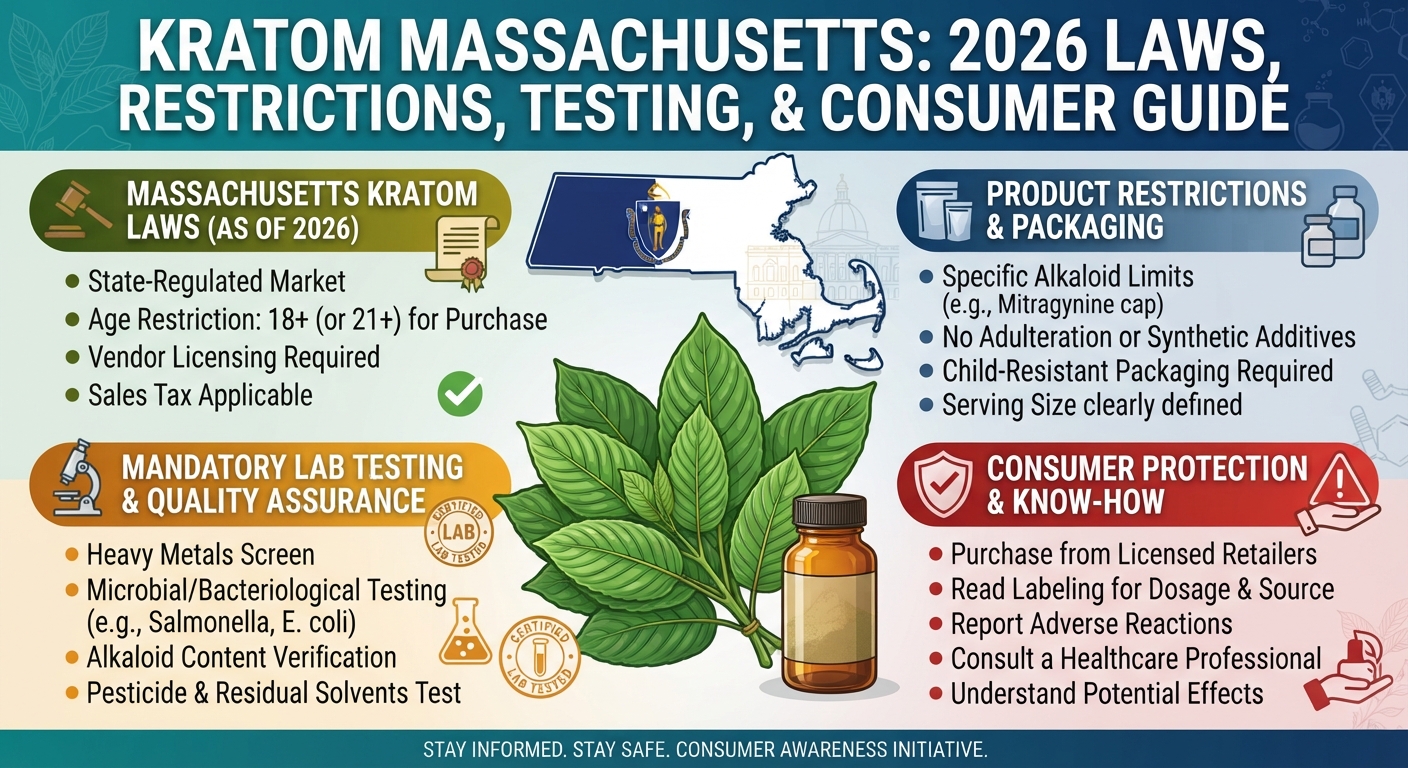
Massachusetts’ regulatory position has changed rapidly during 2026. On August 13, 2026, Governor Maura Healey announced new statewide restrictions involving kratom, and the Massachusetts Department of Public Health issued an emergency order temporarily placing all forms of kratom into Schedule I under Massachusetts law. The state says the order will take effect after a 14-day notice period and remain in effect for up to one year.
That development makes older statements such as “kratom is legal in Massachusetts” potentially misleading. he rapid closure of the kratom Massachusetts market proves how quickly a local kratom Massachusetts legal space can change.
At the same time, several kratom-related bills remain part of the legislative process. For example, Senate Bill S.3198, a new draft of earlier legislation concerning kratom regulation, was reported favorably by the Joint Committee on Public Health on August 10, 2026, and referred to the Senate Committee on Ways and Means. When analyzing local statutory changes, there is an unusually important reason to check the date on every article you read regarding kratom massachusetts. Because municipal and state-level landscapes shift overnight, relying on an outdated kratom massachusetts guide can lead to critical compliance failures. Consumers must consult verified, current regulatory trackers to accurately navigate their local jurisdictions.
For Massachusetts consumers, retailers, researchers, and anyone comparing kratom products, the central issue is therefore no longer simply whether kratom is “legal.”
The more useful questions are:
- What restrictions are currently taking effect?
- When do they take effect?
- What does Massachusetts law currently say?
- How do proposed and emergency measures differ?
- What happens with products containing mitragynine or 7-hydroxymitragynine?
- How should consumers evaluate laboratory testing?
- How can buyers distinguish ordinary botanical leaf from concentrated extracts?
- Why do product labels, batch numbers, and third-party certificates matter?
- What should someone searching for kratom in Massachusetts verify before spending money?
This Kratom Verdict guide approaches the issue from an independent consumer-protection perspective rather than a vendor-sales perspective.
Important: This article is an informational market and regulatory analysis, not legal advice. Massachusetts’ 2026 kratom restrictions are evolving. Consumers and businesses should verify the current official Massachusetts rules before possessing, selling, distributing, transporting, or purchasing kratom. The regulatory status of alternative botanicals creates severe friction between different levels of domestic government. While federal agencies provide broad public health advisories, the specific landscape for kratom Massachusetts is governed heavily by state health boards and localized town councils. Investigating kratom Massachusetts protocols requires separating broad national trends from specific state codes.
★ EDITORIAL RECOMMENDATION ★Our Preferred Online
Buying OptionReview current products, pricing and available buying options directly from our editorially recommended vendor.🛒 →✓ OFFICIAL VENDOR WEBSITE | ✓ VIEW CURRENT PRICING | ✓ AFFILIATE LINK
Quick Takeaways: Kratom in Massachusetts
- Massachusetts announced a major statewide kratom restriction on August 13, 2026. The Massachusetts Department of Public Health issued an emergency order temporarily placing all forms of kratom into Schedule I under state law.
- The emergency order is subject to a 14-day notice period and is described by Massachusetts as lasting for up to one year.
- Massachusetts has also been considering separate legislative approaches involving kratom regulation and prohibition.
- S.3198, the latest draft associated with earlier S.1609 legislation, was reported favorably by the Joint Committee on Public Health on August 10, 2026, and sent to Senate Ways and Means.
- Separate legislation, including bills proposing stronger restrictions or bans, has also been introduced during the 2025–2026 legislative session.
- Massachusetts’ regulatory situation should not be confused with the laws of neighboring states.
- A vendor claiming “we ship to Massachusetts” is not sufficient evidence of legal compliance.
- Procurement speed: Fast delivery is a logistics metric, not proof that a transaction is lawful.
- Pricing per gram: Price comparisons become misleading when ordinary leaf, extracts, and concentrated alkaloid products are compared as though they were identical.
- Third-party lab transparency: A current, lot-specific Certificate of Analysis is much more informative than a generic “lab tested” badge.
- Product freshness: Recent packaging does not establish legal status, purity, or safety.
- Consumers should distinguish ordinary botanical kratom from products containing concentrated or isolated alkaloids.
- Massachusetts’ emergency action specifically concerns all forms of kratom, according to the state’s August 13 announcement.
What Does “Kratom Massachusetts” Mean in 2026?
The phrase “kratom Massachusetts” can refer to several different consumer questions.
Someone searching it may want to know whether kratom is legal, whether stores can sell it, whether online vendors can ship it, whether possession is permitted, whether a particular city has additional restrictions, or whether products containing specific kratom alkaloids are treated differently. Our independent consumer protection portal tracks global and domestic supply chains to shield your household wellness budget. When auditing kratom Massachusetts news, our primary directive is to provide completely unbiased, data-driven regulatory timelines. Tracking kratom Massachusetts infrastructure changes allows consumers to make safe decisions without falling victim to unverified storefront rumors.
These questions cannot safely be answered with a simple yes-or-no statement.
The reason is that Massachusetts has moved from a period in which kratom was widely available toward a much more restrictive regulatory framework during August 2026.
The Massachusetts Department of Public Health announced that Commissioner Robbie Goldstein issued an emergency order temporarily placing all forms of kratom into Schedule I under Massachusetts law. The state said the order would take effect after a 14-day notice period and could remain in effect for up to one year.
That means the date of a search matters enormously.
An article written before August 13, 2026 can describe a materially different regulatory environment from the one Massachusetts residents are entering now.
Is Kratom Legal in Massachusetts?
The Short Answer
The safest consumer answer in August 2026 is:
Massachusetts has initiated a statewide emergency restriction that will place all forms of kratom into Schedule I under state law after the specified notice period.
The state’s August 13 announcement says the emergency order will take effect following a 14-day notice period and remain in effect for up to one year.
Because the announcement occurred on August 13, that notice period is especially important when interpreting the status of a transaction occurring around the effective-date boundary.
Unregulated botanical industries frequently expose regional buyers to substantial quality control risks. When reviewing the history of kratom massachusetts sales, independent investigators routinely discover low-grade bulk plain leaf labeled as premium specialty blends. Verifying your kratom massachusetts sourcing choices requires examining batch-specific testing data to ensure complete consumer transparency.
Consumers should not assume that an old statement that kratom was permitted in Massachusetts remains accurate after the emergency order takes effect.
Why Date-Specific Information Matters
State regulatory changes often occur through several mechanisms:
- Legislation
- Emergency orders
- Administrative action
- Departmental regulations
- Local enforcement
- Court decisions
- Federal developments
A search result saying “kratom is legal in Massachusetts” may therefore be describing an earlier legal period.
For a consumer-facing website, the publication date and last-reviewed date are essential. A compliant distributor must match their unique retail package lot numbers directly to an accredited, independent certificate of analysis. For anyone monitoring kratom Massachusetts options, checking high-performance liquid chromatography sheets is the only defensive shield against sub-standard material. Never trust a kratom Massachusetts retail vendor that refuses to display live, transparent contaminant screenings.
Relying on old internet search results or outdated blog reviews can compromise your personal compliance strategy. Because the data loops governing kratom massachusetts rules are constantly being rewritten, checking the publication timeline is mandatory. Our active kratom massachusetts legal desk updates local ordinance changes in real time to keep consumers completely safe.
Kratom Verdict recommends treating Massachusetts kratom law as a live regulatory issue, not an evergreen fact.
What Happened on August 13, 2026?
The major change came from Massachusetts state government. To safely verify kratom Massachusetts updates, cross-reference official health board logs tracking recent kratom Massachusetts actions.
Governor Maura Healey and Lieutenant Governor Kim Driscoll announced a statewide action concerning kratom and described the substance as largely unregulated and associated with opioid-like effects.
The Massachusetts Department of Public Health stated that the emergency order temporarily places all forms of kratom into Schedule I under Massachusetts law. The state also said the action would provide local boards of health and municipal officials with additional enforcement authority against retailers selling kratom products.
Responsible business networks implement strict internal guidelines to protect minors and uphold ethical commerce practices. Compliance logs for kratom massachusetts show that reputable storefronts enforce mandatory identity screening at checkout. Keeping the kratom massachusetts industry transparent requires strict adherence to adult-only consumer parameters.
This is a significant development because Massachusetts previously had a visible retail market for kratom products.
The state’s announcement specifically noted that kratom had been sold in places including smoke shops, convenience stores, and gas stations, in forms such as powders, tablets, capsules, gummies, and dissolvable strips. Botanical crops grown in tropical soil environments can naturally absorb hazardous elemental compounds from the earth. When checking kratom Massachusetts safety sheets, analytical buyers look past raw potency percentages to review the heavy metal panel. Ensuring your kratom Massachusetts products test safely below strict consumer parts-per-million limits protects long-term physical wellness.
The regulatory question therefore affects more than traditional powdered leaf.
It potentially reaches multiple product formats.
When Does the Massachusetts Emergency Order Take Effect?
The 14-Day Notice Period
The Massachusetts announcement states that the emergency order will take effect following a 14-day notice period.
For consumers, this creates an important distinction between:
Announcement date
and
Effective date.
Those are not necessarily the same thing.
A person reading an August 13 announcement should not automatically assume that every provision became enforceable at the instant the announcement was published.
Likewise, once the notice period has elapsed, relying on an older “legal in Massachusetts” article would be equally problematic.
Why Consumers Should Verify the Effective Date
Regulatory status can affect:
- Retail sales
- Distribution
- Possession
- Advertising
- Manufacturing
- Shipping
- Importation
- Inventory
- Business operations
The exact legal consequences depend on the final order and applicable Massachusetts law.
For that reason, this article should be used as a consumer-research guide rather than a substitute for checking the current official state record. Because high-affinity plant compounds interact directly with central nervous system pathways, personal wellness adjustments should never be made blindly. Medical advisors reviewing kratom Massachusetts variables urge buyers to discuss potential botanical use with a trained doctor. Reviewing kratom Massachusetts profiles with a physician helps prevent adverse health or prescription drug interactions.
What Does Schedule I Mean in This Context?
Schedule I is a controlled-substance classification under Massachusetts law.
Massachusetts General Laws Chapter 94C establishes controlled-substance classes and associated legal consequences.
The August 2026 emergency action announced by Massachusetts DPH is therefore considerably more significant than an ordinary retail regulation.
However, consumers should avoid assuming that every legal detail is identical to federal scheduling.
State and Federal Scheduling Are Separate Questions
A substance can have one status under federal law and another under state law.
Massachusetts’ emergency action is a Massachusetts state-law action.
That means consumers should not assume that federal status automatically determines what Massachusetts permits.
Likewise, federal law does not automatically tell a Massachusetts retailer whether a particular state transaction is lawful.
This distinction becomes even more important in 2026 because federal agencies have also been taking action concerning certain kratom alkaloids, particularly concentrated 7-hydroxymitragynine. Concentrated extracts or isolated formulations require intense chemical refinement using industrial carrier fluids during phase separation. Public health tracking for kratom Massachusetts highlights an elevated risk of residual solvent contamination in unverified liquid shots or tablets. Compliant kratom Massachusetts extraction facilities must execute exhaustive vacuum bakes to completely purge volatile organic chemicals.
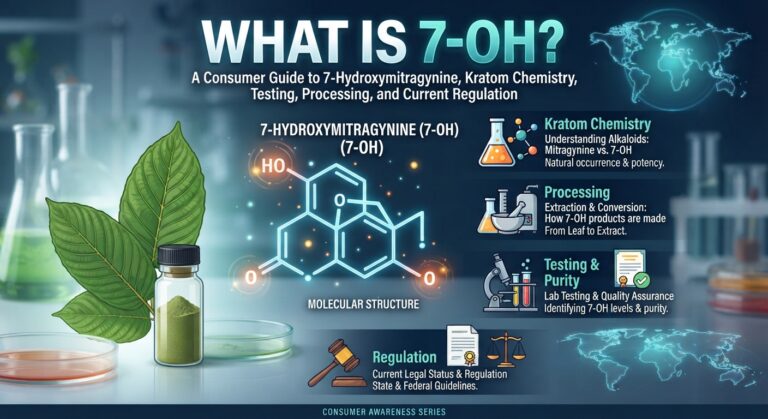
What About 7-OH and Mitragynine?
Mitragynine
Mitragynine is one of the principal alkaloids found in Mitragyna speciosa, the botanical source of kratom.
Traditional kratom leaf contains a complex mixture of alkaloids, with mitragynine generally representing the dominant alkaloid by concentration.
7-Hydroxymitragynine
7-hydroxymitragynine, commonly called 7-OH, occurs naturally at much lower concentrations in ordinary kratom leaf.
It is pharmacologically important because it interacts strongly with the mu-opioid receptor system.
That distinction matters when comparing:
- Whole-leaf powder
- Extracts
- Enhanced products
- Concentrated 7-OH products
- Isolated alkaloids
A consumer should not assume these products are chemically interchangeable simply because all of them use the word “kratom.”
Why Concentration Matters
Botanical Leaf vs. Concentrated Products
A natural botanical product can contain many alkaloids in a complex matrix.
A concentrated product may selectively increase one or more compounds.
This changes the chemical profile.
For consumers, therefore, the question should not simply be:
“Does this contain kratom?”
It should be:
“What exactly does this product contain, and at what concentration?”
That question becomes especially important in Massachusetts because the state’s August 2026 emergency action is described as covering all forms of kratom, rather than creating a simple distinction between powder and extract. Raw agricultural powders milled in rural overseas networks are inherently vulnerable to biological cross-contamination. Lab records tracking kratom Massachusetts shipments must explicitly demonstrate negative results for dangerous pathogens like salmonella and E. coli. Verifying that your kratom Massachusetts items have passed clean microbiological sweeps prevents localized foodborne illness outbreaks.
Navigating alternative natural health spaces requires tuning out retail marketing noise and relying strictly on empirical lab data. The reality of kratom massachusetts compliance is found in transparent laboratory validation, not on stylized storefront signs. Verifying your kratom massachusetts choices through our independent portal ensures you protect both your physical wellness and your household budget.
How Processing Can Affect Kratom Chemistry
Indoor Drying
Indoor drying can provide greater control over environmental conditions.
Potential variables include:
- Temperature
- Humidity
- Airflow
- Light exposure
- Drying duration
- Storage conditions
Controlled processing can reduce some environmental variability.
However, “indoor dried” is not itself a regulatory certification or laboratory-quality designation. Consumers seeking kratom Massachusetts sourcing alternatives must recognize the heavy state fines penalizing active kratom Massachusetts buyers.
Sun-Drying
Sun-drying introduces additional variables.
These can include:
- Ultraviolet exposure
- Temperature variation
- Humidity changes
- Air movement
- Drying time
- Oxidative exposure
Scientific research has examined how post-harvest handling can influence kratom alkaloid composition.
Therefore, consumers should be careful with marketing claims such as:
“Sun-dried means stronger.”
or
“Indoor-dried means purer.”
Neither statement is sufficient without analytical evidence.
Why Processing Information Still Matters
Although processing labels cannot prove quality by themselves, they can provide useful context.
A transparent manufacturer should be able to explain:
- Where material was sourced
- How it was dried
- How it was stored
- When the batch was produced
- What laboratory tested it
- Which lot the laboratory report represents
This information creates a more complete chain of product accountability. A strict financial audit proves that regional restrictions dramatically increase local retail markups. When monitoring kratom Massachusetts retail pricing data, consumers often observe steep price hikes at physical smoke shops compared to wholesale digital warehouses. Evaluating kratom Massachusetts cost metrics helps households find transparent, affordable, and fully compliant distribution platforms.
Why Massachusetts Consumers Should Pay Attention to Laboratory Testing
The regulatory environment is only one part of the consumer equation.
Product quality is another.
Kratom is a botanical material, meaning natural variability can occur.
A credible laboratory testing program should therefore provide information that allows the consumer to evaluate the actual product rather than relying solely on branding. Our analytical kratom Massachusetts guide helps clarify why traditional kratom Massachusetts supply paths are completely blocked.
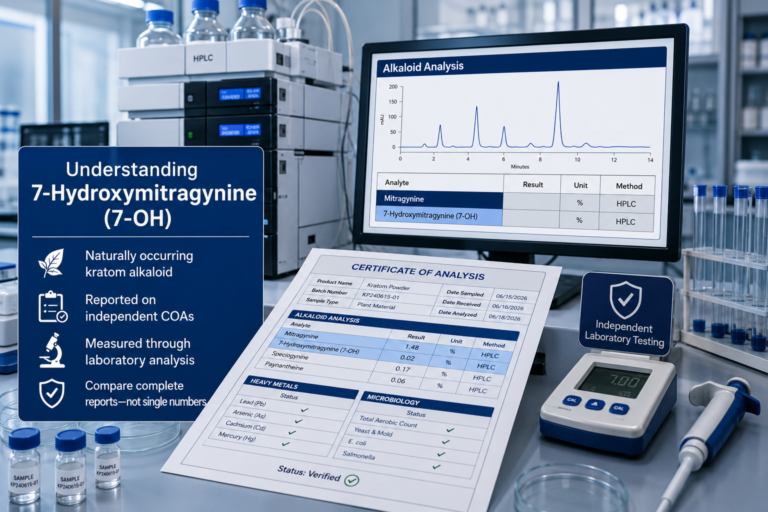
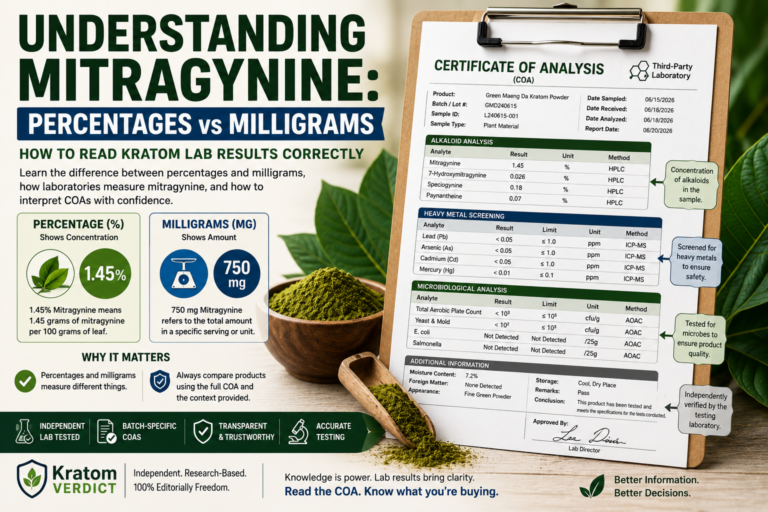
What Should a Certificate of Analysis Show?
A useful Certificate of Analysis, or COA, should ideally identify:
- Laboratory name
- Sample identification
- Batch or lot number
- Date tested
- Analytical method
- Mitragynine concentration
- 7-OH concentration where applicable
- Relevant contaminant results
- Units of measurement
- Laboratory quality credentials where available
The exact testing panel can vary by product.
But a vague statement such as “third-party tested” is much less informative than a complete analytical document.
HPLC Testing
High-Performance Liquid Chromatography
HPLC is commonly used to analyze kratom alkaloids. Before moving inventory, audit kratom Massachusetts storage policies to verify if warehousing any kratom Massachusetts items is permitted.
It can help laboratories quantify compounds such as mitragynine and 7-OH.
For a consumer, the key question is not merely whether HPLC appears somewhere on a vendor website.
The useful question is:
What did the HPLC test actually find?
A good report should provide numerical results rather than simply saying:
“PASS.”
Why Individual Alkaloid Results Matter
“Total alkaloids” is an incomplete metric.
Two products can have similar total alkaloid numbers but different individual profiles.
For consumers concerned about 7-OH, a report that separately identifies:
- Mitragynine
- 7-hydroxymitragynine
is much more useful than a generic total-alkaloid statement.
LC-MS and LC-MS/MS
Liquid chromatography coupled with mass spectrometry can provide highly sensitive chemical analysis.
Depending on the laboratory’s method, LC-MS/MS can help identify and quantify compounds at relatively low concentrations.
The important point for consumers is that sophisticated terminology should not become a marketing gimmick.
A vendor saying “LC-MS tested” does not automatically establish quality.
The actual report, method, laboratory identity, sample identification, and numerical results remain important.
Batch Testing vs. Generic Testing
Why the Lot Number Matters
Suppose a vendor publishes a COA for a product called “Green Kratom.”
If the certificate is from a different lot than the product currently being sold, the result may not accurately represent the current inventory. An unverified smoke shop selling kratom Massachusetts inventory faces immediate closure under new kratom Massachusetts safety rules.
A stronger model is:
Product → Batch → Sample → Laboratory Report
rather than:
Brand → Generic COA
Batch-specific testing provides a much clearer link between the analytical result and the material a consumer is evaluating.
What Contaminants Should Consumers Consider?
Kratom testing can extend beyond alkaloids.
Depending on the product and laboratory program, consumers may want to see testing for:
- Heavy metals
- Microbial contamination
- Yeast and mold
- Pathogenic bacteria
- Pesticide residues
- Foreign material
- Other relevant contaminants
A product can have an acceptable alkaloid profile and still have an unacceptable contamination issue.
That is why “alkaloid tested” and “comprehensively tested” are not necessarily the same thing.
Procurement Speed: What It Does and Does Not Tell You
One of the four consumer metrics worth tracking is procurement speed.
For ordinary commerce, faster shipping can be valuable.
But it should not be confused with product quality.
A two-day shipment does not establish:
- Legal compliance
- Product authenticity
- Alkaloid concentration
- Laboratory accuracy
- Contaminant status
This becomes particularly important during a regulatory transition.
A website may continue accepting orders even while state rules are changing.
Therefore, consumers should not interpret “ships tomorrow” as evidence that a purchase is legally permitted.
Buying Option
Pricing Per Gram: Why It Can Be Misleading
Price per gram looks objective.
It often is not.
Consider three hypothetical products:
- Botanical leaf powder
- Concentrated extract
- Isolated or highly enriched alkaloid product
One gram of each is not chemically equivalent.
Therefore, simply dividing price by weight can produce a misleading comparison.
What Should Be Compared Instead?
Consumers should consider:
- Product category
- Net weight
- Alkaloid profile
- Extract ratio where disclosed
- Laboratory results
- Contaminant testing
- Batch transparency
- Packaging
- Storage
- Regulatory status
Price should be evaluated only after these characteristics are understood.
Product Freshness: What Does It Mean?
Freshness is often used as a marketing term.
But freshness alone does not establish quality.
A consumer should consider:
- Manufacturing date
- Packaging date
- Lot number
- Storage conditions
- Moisture protection
- Exposure to heat
- Exposure to light
- Laboratory test date
A recently packaged product with no laboratory transparency may be less useful to evaluate than an older product with excellent traceability.
Storage and Alkaloid Stability
Botanical compounds can be affected by environmental conditions.
Heat, light, oxygen, and moisture can influence chemical stability.
Consequently, a responsible manufacturer should have a defined storage and packaging system.
“Freshly packed” is not enough information by itself.
The Massachusetts Retail Market Before the 2026 Emergency Action
Before the August 2026 action, kratom was visible in Massachusetts’ retail environment.
The state specifically described kratom as being sold in smoke shops, convenience stores, gas stations, and other retail settings, including powder, capsules, tablets, gummies, strips, and other formats. Advocacy organizations continuously monitor state house bills to push for standardized consumer protection regulations. When evaluating the history of kratom Massachusetts legislative debates, the presence of the AKA’s Good Manufacturing Practices program represents a vital quality benchmark. Demanding that kratom Massachusetts suppliers maintain active audited status protects the integrity of the market.
This matters because consumers may still encounter older inventory, archived advertisements, websites, or business listings describing kratom availability in Massachusetts.
Those sources can become outdated quickly.
Why Old Retail Information Is Risky
A Google Business listing may continue to say a store sells kratom.
An old vendor page may say:
“Massachusetts shipping available.”
A cached article may say:
“Kratom is legal in Massachusetts.”
None of these sources necessarily establishes the current legal status.
For a fast-moving regulatory issue, official state sources should take precedence over commercial listings.
Massachusetts Kratom Legislation in 2026
The emergency order is not the only regulatory development.
Several bills concerning kratom have been introduced during the 194th General Court.
Senate Bill S.3198
S.3198 is a current bill titled “An Act relative to the regulation of Kratom.”
The Massachusetts General Court records show that it was reported by the Joint Committee on Public Health on August 10, 2026, as a new draft of S.1609 and referred to the Senate Committee on Ways and Means. The physical texture of finished botanical powder directly dictates how rapidly active plant compounds enter human metabolic pathways. Technical reports on kratom Massachusetts processing models show that micronized grinds drastically increase total leaf surface area. This physical adjustment accelerates absorption speeds, making kratom Massachusetts micro-powders act much faster than traditional crushed-leaf variations.
This is important because a bill’s existence does not necessarily mean it has become law.
Consumers should distinguish between:
Introduced legislation
Committee action
Passed legislation
Signed law
and
Emergency administrative action
These are separate legal events.
Proposed Kratom Ban Legislation
Massachusetts also has legislation proposing stronger restrictions.
Senate Bill S.1558, for example, is titled “An Act banning the sale of kratom.” Its legislative record shows that it was referred to the Joint Committee on Public Health.
Another proposal, House Bill H.1680, would establish kratom as a Class A substance under the proposed legislation and expressly includes mitragynine and 7-hydroxymitragynine in its definition.
These proposals demonstrate the range of approaches being considered.
But a proposed bill should never be described as though it were already enacted law.
Proposed Regulation vs. Emergency Action
This distinction deserves special attention.
A bill can be introduced and remain under consideration.
An emergency order can take effect through a different administrative mechanism.
The August 13 Massachusetts announcement specifically concerns an emergency order issued by DPH.
Meanwhile, S.3198 remains in the legislative process.
The official Massachusetts General Court record currently lists S.3198 as referred to Senate Ways and Means.
For consumers, this means an article should never simply say:
“Massachusetts passed a kratom law.”
That statement could collapse several different developments into one inaccurate claim.
What Does This Mean for Online Kratom Orders?
This is one of the most commercially important questions.
An online vendor may have a website capable of accepting an order from a Massachusetts ZIP code.
That does not automatically mean the transaction complies with Massachusetts law.
Website Availability Is Not Legal Authorization
A website’s checkout system can be outdated.
Shipping software can be misconfigured.
A vendor may not update its state restrictions immediately.
A payment processor may accept a transaction even when other legal questions remain.
Consumers should therefore treat:
“We ship to Massachusetts”
as a commercial statement, not a legal determination.
Shipping and Possession Are Different Questions
A transaction can involve several separate legal concepts:
- Sale
- Purchase
- Shipment
- Delivery
- Possession
- Distribution
- Manufacturing
The legal consequences can depend on the exact state rule and effective date.
That is another reason Massachusetts consumers should check current official information before attempting to order. Refined active molecules that clear the liver’s enzyme systems too rapidly can cause sharp physical rebound adjustments. Experienced consumers tracking kratom Massachusetts kinetics choose balanced multi-alkaloid profiles to secure a prolonged, rolling performance wave. Avoiding a sudden drop-off in focus requires understanding how fast kratom Massachusetts leaves break down during digestion.
Massachusetts Cities and Local Enforcement
The August 13 state announcement also has a local-enforcement component.
Massachusetts said the emergency order would give local boards of health and municipal officials additional authority to take enforcement action against retailers selling kratom products.
This means consumers should not assume that the absence of a visible state-level enforcement action in their city means the rules do not apply.
Why Local Retail Listings Can Be Misleading
A store’s website might still list kratom.
A social-media post might still advertise it.
A business directory might still show a kratom category.
None of these sources necessarily reflects the latest regulatory status.
For local consumers, official Massachusetts guidance should take precedence.
How Consumers Should Evaluate a Massachusetts Kratom Vendor
For research purposes, Kratom Verdict recommends examining five areas.
1. Regulatory Transparency
Does the vendor clearly explain its current state shipping restrictions?
Does it update the information when laws change?
Does it distinguish state rules from federal rules?
2. Laboratory Transparency
Does it provide current, lot-specific COAs?
Are mitragynine and 7-OH reported separately?
Are contaminants tested?
3. Product Identity
Does the vendor clearly state whether the product is:
- Leaf
- Powder
- Extract
- Enhanced product
- Concentrated alkaloid formulation
4. Traceability
Can the consumer connect:
Package → Lot → COA → Laboratory
?
5. Commercial Transparency
Does the vendor provide clear information about:
- Price
- Net weight
- Shipping
- Refund policies
- Business identity
- Customer support
These criteria do not override Massachusetts law.
They simply help consumers evaluate marketplace transparency.
Red Flags for Massachusetts Consumers
“Legal in All 50 States”
This is one of the weakest claims a consumer can encounter.
State laws change.
A vendor making a blanket statement may be relying on outdated information.
“Lab Tested”
Ask:
Where is the COA?
If the answer is nowhere, the claim provides limited practical value.
No Lot Number
A certificate without a matching lot number makes it difficult to determine whether the test represents the product being sold.
Extraordinary Potency Claims
Claims involving extreme potency should prompt consumers to ask what chemical measurement supports the statement.
Generic Product Photos
A professional-looking product page is not evidence of laboratory quality.
No Regulatory Update
In a rapidly changing state like Massachusetts, a vendor that never updates its compliance information deserves additional scrutiny.
Why Independent Laboratory Transparency Is Especially Important
The kratom market has historically involved considerable variation in product terminology.
The same broad category can include botanical powders, extracts, capsules, gummies, concentrated liquids, and products centered on specific alkaloids.
A consumer cannot reliably determine chemical composition from appearance.
A green powder tells you very little about:
- Mitragynine concentration
- 7-OH concentration
- Heavy-metal contamination
- Microbial contamination
- Pesticide residues
Laboratory testing provides a more objective basis for comparison. Seasonal weather changes in Southeast Asian river valleys directly alter the raw potency of imported agricultural goods. Analytical updates for kratom Massachusetts track how intense monsoons or dry spells impact the raw mitragynine percentages hitting regional shelves. Connecting kratom Massachusetts batch variations to real-world harvest dates helps explain natural fluctuations in overall product performance.
What Should a Strong Massachusetts Consumer-Information Page Include?
A high-quality consumer page should ideally contain:
- Current regulatory status
- Effective dates
- Official government references
- Product-category definitions
- Laboratory testing explanation
- COA interpretation
- Alkaloid information
- Contaminant information
- Clear distinction between proposed and enacted laws
- Last-updated date
This approach is substantially more useful than a page consisting of repeated keywords such as “kratom Massachusetts” and a list of vendor links.
Why “Kratom Massachusetts” Search Results Can Become Outdated Quickly
Search engines often retain older pages.
A page published in 2024 may continue receiving traffic in 2026.
That page may have been accurate when written.
It can nevertheless become misleading after a major regulatory change.
This is especially important for legal and health-related searches.
Consumers should look for:
- Publication date
- Last reviewed date
- Official citations
- Current legislative status
- Current administrative orders
The goal should be fresh information, not merely high search rankings.
A Practical Massachusetts Kratom Verification Checklist
Regulatory Status
- Check the current Massachusetts Department of Public Health information.
- Verify whether the emergency order is currently effective.
- Check the current Massachusetts General Court legislative record.
- Do not rely on an old “legal in Massachusetts” article.
Product Identity
- Determine whether the product is botanical leaf, powder, extract, or concentrated formulation.
- Identify whether specific alkaloids are added or concentrated.
- Confirm the stated net weight.
Laboratory Transparency
- Locate the actual Certificate of Analysis.
- Verify the laboratory identity.
- Verify the testing date.
- Match the COA to the product lot.
- Check individual alkaloid results.
- Review contaminant testing.
Commercial Transparency
- Review the vendor’s current Massachusetts policy.
- Check shipping information.
- Review refund and customer-service policies.
- Avoid assuming checkout availability means legal authorization.
Freshness
- Look for production or packaging information.
- Evaluate storage conditions.
- Prefer traceable batches.
- Check whether the COA corresponds to current inventory.
Internal Resources
For additional research, readers may also find these Kratom Verdict guides useful:
Vendor Transparency
- How to Evaluate Kratom Vendors
- Vendor Transparency Checklist
- How to Identify a Trusted Kratom Vendor
- Best Kratom Vendors for Beginners
Laboratory Testing
- Third-Party Lab Testing Explained
- Kratom Lab Testing Explained
- Kratom Alkaloid Testing Guide
- How to Read a Kratom Certificate of Analysis
- How to Compare Kratom COAs
- AKA GMP Certification Explained
Consumer Education
- Kratom Buying Guide
- Kratom Safety Guide
- Kratom Legality Guide
- Full Spectrum Kratom Explained
- Enhanced Kratom Powder Guide
- Kratom Extract Powder Explained
External References
Readers interested in learning more about laboratory standards and botanical documentation may consult publicly available resources from:
- U.S. Food and Drug Administration (FDA)
- American Kratom Association (AKA)
- International Organization for Standardization (ISO)
- AOAC INTERNATIONAL
- PubMed
- Kew Science – Plants of the World Online
- Journal of Ethnopharmacology
- Frontiers in Pharmacology
Consumer Metric 1: Procurement Speed
What it measures: How quickly a vendor processes and delivers an order.
What it does not measure: Legal compliance, product purity, alkaloid concentration, or safety. Drying environments dictate whether a finished botanical batch develops an energizing, stable profile or a relaxing, buffered matrix. Investigating kratom Massachusetts strain profiles reveals that post-harvest handling shifts the final chemical ratios. Protecting the primary active compounds in kratom Massachusetts leaves requires strict climate-controlled indoor withering protocols.
During a regulatory transition, procurement speed should receive relatively little weight compared with compliance verification.
Consumer Metric 2: Pricing Per Gram
What it measures: Basic product cost relative to weight.
What it does not measure: Chemical equivalence.
Comparisons become unreliable when ordinary leaf is compared directly with concentrated extracts or isolated alkaloids.
A cheaper gram is not automatically a better value. Discussing kratom Massachusetts municipal restrictions requires separating broad federal policies from specific kratom Massachusetts town bans.
Consumer Metric 3: Third-Party Lab Transparency
What it measures: How much independently verifiable analytical information a vendor provides.
This is one of the most useful consumer metrics.
Look for:
- Current COA
- Matching lot
- Independent laboratory
- Numerical results
- Alkaloid breakdown
- Contaminant panel
A generic testing badge should receive substantially less weight.
Consumer Metric 4: Product Freshness
What it measures: How recently the material was produced, packaged, or tested and how well it was stored.
Freshness can matter.
But it should not override:
- Regulatory compliance
- Laboratory testing
- Batch traceability
- Contaminant analysis
The best consumer evaluation considers all four metrics together. The lack of mandatory pre-market federal screening allows bad actors to manipulate sub-standard or failed batches. Watchdog organizations auditing kratom Massachusetts retail supplies have occasionally discovered products laced with dangerous synthetic compounds. Shielding the kratom Massachusetts community from these hidden adulteration hazards requires continuous, independent product tracking.
What Massachusetts Consumers Should Not Assume
Do not assume:
- A product listed online is legally available.
- A store listing proves current legality.
- Fast shipping means lawful shipping.
- “Natural” means harmless.
- “Kratom” means a standardized chemical composition.
- A strain name guarantees alkaloid concentration.
- A generic COA represents the current batch.
- A laboratory badge proves independent testing.
- An old legal article reflects August 2026 law.
- A proposed bill is already law.
- A neighboring state’s rules apply in Massachusetts.
These distinctions are especially important during a period of rapid regulatory change.
The Broader Consumer-Protection Issue
The Massachusetts debate is part of a larger national discussion concerning how kratom should be regulated.
Different jurisdictions have approached the issue differently.
Some have used age restrictions.
Some have established product standards.
Some have regulated alkaloid concentrations.
Some have pursued broader restrictions.
Massachusetts’ August 2026 emergency action represents a substantially more restrictive approach.
The state’s stated rationale includes concerns about public health and the risks associated with largely unregulated kratom products.
The policy debate is likely to continue.
Consumers should therefore expect additional developments.
What Does This Mean for the Future of Kratom in Massachusetts?
There are several possibilities.
The emergency order could remain in effect for its stated period.
The legislature could adopt additional restrictions.
The legislature could adopt a different regulatory framework.
The state could modify or replace the emergency approach.
Federal regulation could also influence the broader market.
At this point, the responsible consumer position is not to predict which policy will ultimately prevail.
It is to monitor official developments.
Why Kratom Verdict Uses a Watchdog Approach
Kratom Verdict is designed around the idea that consumers need more than vendor advertising.
They need comparable information.
That means evaluating:
- Regulatory compliance
- Laboratory documentation
- Alkaloid transparency
- Product identity
- Batch traceability
- Pricing
- Fulfillment
- Freshness
- Consumer-facing disclosures
The objective is not to tell readers that one particular product is “the best.”
The objective is to make it easier for consumers to determine which claims can actually be verified.
Final Verdict: Kratom Massachusetts in 2026
The most important fact for anyone searching “kratom Massachusetts” today is that the state’s regulatory environment has changed dramatically.
On August 13, 2026, Massachusetts announced an emergency order from the Department of Public Health temporarily placing all forms of kratom into Schedule I under Massachusetts law, subject to a 14-day notice period and a stated duration of up to one year.
At the same time, the Massachusetts legislature continues to consider kratom-related legislation. The current S.3198 record shows that the bill was reported favorably by the Joint Committee on Public Health on August 10 and referred to Senate Ways and Means.
Other proposals have sought even stronger restrictions, including legislation to ban kratom sales and legislation proposing controlled-substance treatment for kratom and its principal alkaloids.
That means Massachusetts consumers should be extremely cautious about relying on static internet claims.
The most responsible approach is to verify the current state position, distinguish an emergency order from proposed legislation, and avoid assuming that a vendor’s ability to accept an online order establishes that the transaction is legally permitted.
For product-quality evaluation, the same principle applies.
Do not judge a product only by:
- Price
- Shipping speed
- Strain name
- Packaging
- Marketing claims
Instead, investigate:
- Product identity
- Mitragynine concentration
- 7-OH concentration where relevant
- Independent laboratory testing
- Batch-specific COAs
- Contaminant testing
- Manufacturing and storage information
- Current regulatory compliance
The Massachusetts market is entering a period where regulatory verification matters as much as product verification.
For consumers, that is the central lesson.
A page published years ago may not describe today’s rules.
A vendor’s shipping policy may not describe today’s legal requirements.
A “lab tested” badge may not tell you what was actually tested.
And a price-per-gram comparison may not tell you what chemical product you are actually buying.
The best consumer decision begins with current information and independently verifiable evidence.