Reviewed by Kratom Verdict Editorial Team
Last Updated: July 2026
Estimated Reading Time: 5 minutes
Guide Type: Independent Editorial Comparison Guide
Research Basis: Publicly available botanical literature, regional sourcing information, third-party laboratory documentation, publicly available regulatory resources, scientific literature, and independent editorial research.
Bali vs Maeng Da Kratom are two of the most searched kratom strain names, and they’re often presented as a straightforward head-to-head choice. In reality, both are trade names rather than scientifically defined varieties — and understanding that distinction matters more than memorizing which one is supposedly “stronger.”
This guide covers where each name comes from, how they’re typically processed, what’s actually known about their alkaloid content, and — just as important — why the label on the bag tells you less than a lot of marketing suggests.
Laboratory Testing & Transparency
When comparing Bali vs Maeng Da Kratom, independent laboratory testing provides a more reliable basis for evaluation than commercial product names alone. Although Bali and Maeng Da are among the most recognized names in today’s kratom marketplace, product quality ultimately depends on cultivation practices, harvesting methods, post-harvest processing, manufacturing standards, storage conditions, and quality-control procedures. A comprehensive Bali vs Maeng Da Kratom comparison should therefore prioritize objective laboratory documentation rather than promotional descriptions. Consumers should review current batch-specific Certificates of Analysis (COAs), verify independent laboratory testing, and compare measurable quality indicators including alkaloid analysis, heavy metal screening, microbial testing, and moisture content. Throughout this Bali vs Maeng Da Kratom guide, laboratory transparency remains one of the strongest indicators of responsible manufacturing and informed purchasing decisions.
The Importance of Independent Laboratory Reports
A reliable Bali vs Maeng Da Kratom comparison should include careful evaluation of independent laboratory reports before any purchasing decision is made. Batch-specific Certificates of Analysis provide valuable information about alkaloid analysis, heavy metal screening, microbial testing, moisture content, and laboratory identification. Consumers researching Bali vs Maeng Da Kratom should verify that every laboratory report matches the exact batch number shown on the product packaging and has been performed by an independent testing facility. Transparent laboratory documentation demonstrates a commitment to responsible manufacturing and allows consumers to compare objective quality indicators instead of relying solely on advertising claims. Throughout this guide, laboratory transparency remains one of the strongest indicators of product quality because independently verified information provides greater confidence than commercial branding or promotional language.
Where the Names Actually Come From
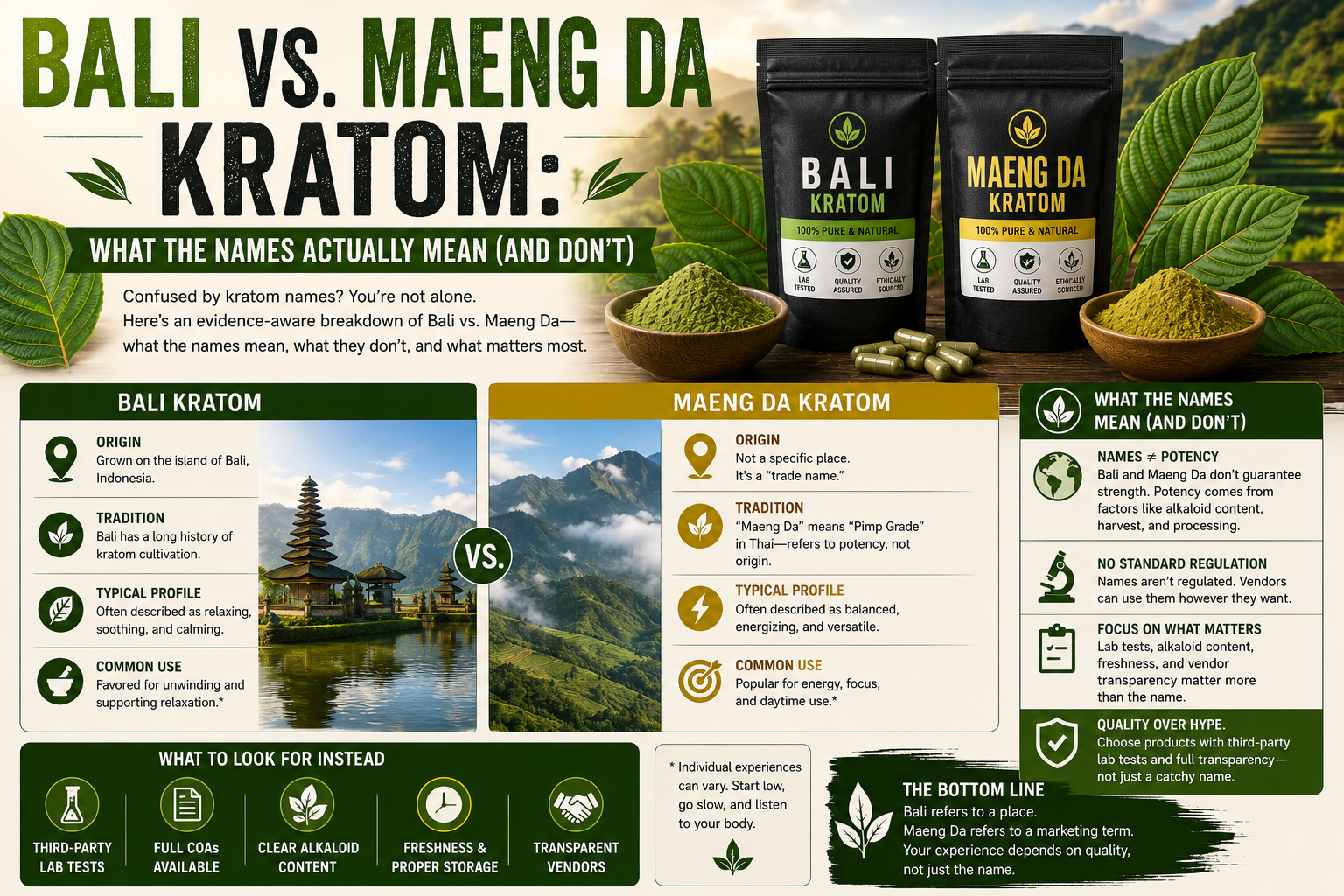
Bali doesn’t refer to a strain grown on the island of Bali. It’s a legacy trade name tied to the port through which Indonesian kratom was historically shipped to international buyers — most Bali-labeled kratom today is grown in Borneo (Kalimantan) and other parts of Indonesia. It’s one of the older, more established names in the commercial kratom market, associated with traditional shade-drying and fermentation processing.
Maeng Da originated in Thailand — the name is commonly translated as “pimp grade,” a reference to its reputation for potency rather than a botanical classification. Thai-origin Maeng Da is now largely unavailable due to Thailand’s domestic kratom regulations, so most Maeng Da sold today is grown in Indonesia using grafting and selective cultivation techniques originally developed to reproduce the characteristics of the original Thai variety.
Neither name is standardized or regulated. There’s no governing body that defines what qualifies as “Bali” or “Maeng Da” — vendors apply the label based on their own sourcing and processing conventions, which is a large part of why quality and consistency vary so much from one company to the next.
More research on comparison Category
- Red Kratom vs Green Kratom
- White Kratom vs Green Kratom
- Gold Kratom vs Yellow Kratom
- Horn Kratom vs Elephant Kratom
- Borneo vs Sumatra Kratom
- Thai vs Malay Kratom
- Kapuas vs Riau Kratom
- White Malay vs Green Malay
- White Thai vs White Borneo
- Green Malay vs Green Maeng Da
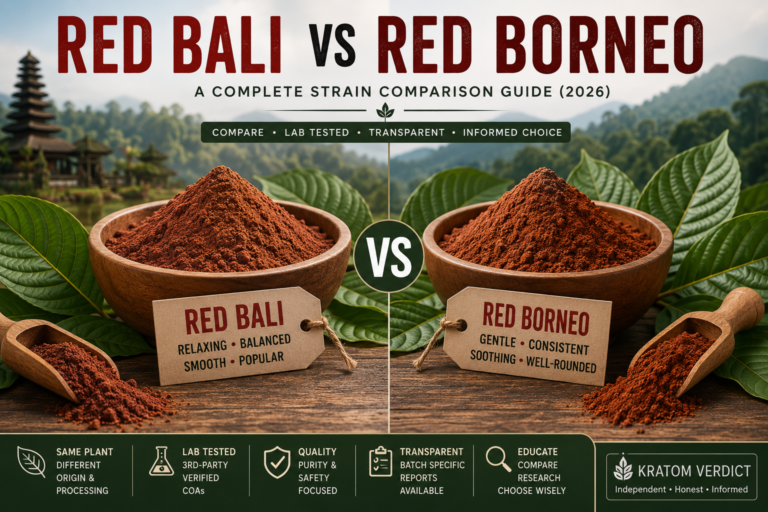
- Red Bali vs Red Borneo
- Red Bali vs Red Maeng Da
Commercial Names and Regional Classifications
Understanding Bali vs Maeng Da Kratom requires looking beyond familiar commercial names and examining documented production practices. While these names are widely used across the botanical marketplace, they do not independently determine product quality or consistency. A balanced Bali vs Maeng Da Kratom comparison should evaluate cultivation methods, harvesting techniques, processing standards, storage conditions, and vendor transparency. Consumers researching Bali vs Maeng Da Kratom should compare objective laboratory documentation and publicly available quality information before making purchasing decisions rather than relying solely on product names.
Manufacturing Consistency and Quality Assurance
Manufacturing consistency is another important consideration during a Bali vs Maeng Da Kratom evaluation. Every stage of production, including drying methods, sanitation procedures, storage conditions, packaging practices, and quality-control systems, contributes to the consistency of the finished product. A thorough Bali vs Maeng Da Kratom comparison should examine whether vendors openly explain these manufacturing procedures and consistently publish current Certificates of Analysis for each production batch. Consumers benefit from comparing documented manufacturing standards rather than assuming product quality based only on familiar commercial names. Vendors that prioritize transparency and independent laboratory verification generally make it easier for readers to evaluate objective quality indicators while supporting responsible manufacturing practices across the botanical products industry.
Alkaloid Profile: What’s Actually Documented vs. What’s Marketing
Both Bali and Maeng Da contain the same core alkaloids found throughout Mitragyna speciosa — primarily mitragynine and 7-hydroxymitragynine (7-OH), alongside dozens of minor alkaloids like speciogynine, paynantheine, and mitraphylline. The often-repeated claim that Maeng Da has a categorically higher alkaloid concentration than Bali is a common industry talking point, but it isn’t something you can rely on without a batch-specific lab result — actual alkaloid content depends heavily on soil, climate, harvest timing, and processing method, and it varies by batch even within the same “strain” from the same vendor.
What’s more consistently reported across vendors and lab data:
| Bali | Maeng Da | |
|---|---|---|
| Primary origin | Indonesia (Borneo/Kalimantan), traded historically via Bali | Originally Thailand; now mostly Indonesian cultivation using grafting techniques |
| Processing | Traditional shade-drying, often longer fermentation | Often more intensive processing aimed at preserving specific alkaloids |
| Vein colors available | Red, green, white | Red, green, white (occasionally yellow/gold as a fermented blend) |
| Market positioning | Marketed as a classic, accessible, moderate-profile strain | Marketed as a premium, higher-potency strain |
| Price point | Generally lower | Generally higher |
| Batch consistency | Varies by vendor | Varies by vendor |
The market positioning row is doing a lot of work in most comparison articles — “Bali is beginner-friendly,” “Maeng Da is more potent” — but these are reputational framings built up over years of marketing, not laboratory constants. Two bags labeled “Maeng Da” from two different vendors can have meaningfully different alkaloid profiles.
Vein Color Matters at Least as Much as Strain Name
Within both Bali and Maeng Da, the vein color (determined by leaf maturity and drying method) is often described by users as more relevant to the experience than the strain name itself:
- Red vein (Red Bali, Red Maeng Da): commonly associated with a slower onset and longer-lasting profile.
- Green vein (Green Bali, Green Maeng Da): commonly described as a middle-ground profile.
- White vein: commonly associated with a faster onset and shorter duration.
These are patterns reported by users and vendors, not clinically established effects — kratom’s alkaloid pharmacology isn’t well studied in controlled human trials, and the FDA has not evaluated or approved any of these products for any use.
Manufacturing Standards and Quality Assurance
Manufacturing quality plays an important role in every Bali vs Maeng Da Kratom comparison. Drying procedures, sanitation practices, packaging methods, storage environments, and quality-control systems all contribute to product consistency. Consumers comparing Bali vs Maeng Da Kratom should prioritize vendors that publish current batch-specific Certificates of Analysis, explain their laboratory testing procedures, and maintain documented manufacturing standards. Independent laboratory verification provides measurable quality indicators that allow products to be compared using objective evidence rather than marketing claims. When evaluating Bali vs Maeng Da Kratom, consumers should review independent Certificates of Analysis before purchasing.
Vendor Transparency
Vendor transparency is another essential factor when evaluating Bali vs Maeng Da Kratom. Companies that openly publish Certificates of Analysis, describe their sourcing practices, identify independent laboratories, and explain their quality-control procedures provide consumers with greater confidence. Readers researching Bali vs Maeng Da Kratom should compare how consistently vendors provide this information before making purchasing decisions. Transparent documentation supports objective comparisons while encouraging responsible manufacturing practices throughout the botanical products industry. This Bali vs Maeng Da Kratom guide compares both categories using publicly available botanical information and laboratory testing.
Why the Label Matters Less Than the Lab Report
Because “Bali” and “Maeng Da” are unregulated trade names, the single most useful piece of information for comparing two products isn’t the strain name — it’s the batch-specific Certificate of Analysis (COA). Before comparing a Bali product to a Maeng Da product, check that both have:
- A COA tied to the actual batch/lot number on the package
- Disclosed mitragynine and 7-OH percentages (not just “total alkaloids”)
- A full contaminant panel — heavy metals, microbials, pesticide/solvent residue
- Testing performed by an independent, accredited lab, not just in-house
Two products both labeled “Maeng Da” from different vendors are not guaranteed to be comparable. A well-tested Bali product from a transparent vendor is a more known quantity than an untested Maeng Da product from one that isn’t — regardless of which strain name is on the label. Bali vs Maeng Da Kratom remains one of the most searched comparisons among kratom consumers.
Understanding Product Classification
Understanding Bali vs Maeng Da Kratom begins with recognizing that commercial names are not standardized botanical classifications. While these names are commonly used throughout the marketplace, they often represent traditional marketing categories rather than scientifically defined plant varieties. A balanced Bali vs Maeng Da Kratom comparison should therefore focus on objective factors such as harvesting practices, post-harvest processing, manufacturing consistency, and independent quality verification. Consumers should evaluate publicly available Certificates of Analysis (COAs), laboratory documentation, and transparent sourcing information before making purchasing decisions. Reviewing measurable quality indicators provides a stronger basis for comparison than relying solely on commercial terminology. This evidence-based approach helps readers understand how manufacturers classify products while encouraging informed purchasing decisions supported by independent laboratory testing, responsible quality-control procedures, and transparent documentation rather than promotional descriptions alone.
Making an Evidence-Based Comparison
A complete Bali vs Maeng Da Kratom comparison combines laboratory testing, manufacturing standards, sourcing transparency, and independent editorial research into one objective evaluation. Rather than selecting products solely because of commercial names, consumers should compare batch-specific laboratory reports, quality-control procedures, vendor documentation, and publicly available educational resources. This Bali vs Maeng Da Kratom guide emphasizes objective information supported by independently verified quality indicators instead of promotional claims, helping readers make informed purchasing decisions.
Readers interested in learning more about the topics discussed in this Bali vs Maeng Da Kratom comparison can explore educational resources published by the National Institutes of Health (NIH), the AOAC INTERNATIONAL, the American Herbal Products Association (AHPA), the United States Pharmacopeia (USP), and the National Institute of Standards and Technology (NIST). These organizations provide publicly available information on laboratory testing, scientific research, manufacturing quality, analytical methods, Certificates of Analysis (COAs), and consumer education that help readers evaluate botanical products using objective evidence.
Making an Objective Purchasing Decision
Making an informed decision requires more than comparing commercial product names. An evidence-based Bali vs Maeng Da Kratom comparison should combine laboratory testing, manufacturing standards, vendor transparency, and publicly available educational resources into a single objective evaluation. Consumers researching Bali vs Maeng Da Kratom should review current Certificates of Analysis, quality-control procedures, sourcing documentation, and independent laboratory verification before selecting a product. This approach encourages readers to rely on measurable quality indicators rather than promotional claims or marketing language. By emphasizing objective documentation and transparent manufacturing practices, consumers can better understand how botanical products are evaluated for consistency, quality assurance, and consumer confidence while making purchasing decisions supported by independently verified information.
The Bottom Line
Bali and Maeng Da represent two different origins and processing traditions, not a simple “milder vs. stronger” binary. Bali carries a longstanding reputation as a classic, moderate, affordable option; Maeng Da carries a reputation for potency built through selective cultivation. But because neither name is standardized or regulated, that reputation is only a starting point — the batch-specific lab data is what actually tells you what’s in the package, whichever name is on the front of it.
This article is for informational purposes only and does not constitute medical advice. Kratom is not FDA-approved for any medical use, and its legal status varies by state and locality. Consult a healthcare provider and check your local laws before purchasing or using any kratom product.