Reviewed by Kratom Verdict Editorial Team
Last Updated: July 2026
Estimated Reading Time: 18–22 minutes
Guide Type: Independent Editorial Strain Guide
Research Basis: Publicly available botanical information, third-party laboratory transparency, publicly available regulatory resources, scientific literature, and independent editorial research.
Green Bali kratom has a reputation problem that has nothing to do with the strain itself. It’s one of the most searched kratom products online, which means it’s also one of the most counterfeited, mislabeled, and inconsistently sourced. A recent independent lab sweep of the market found that only 5 out of more than 50 tested kratom products actually met comprehensive quality standards — everything else fell short on potency accuracy, contamination limits, or labeling honesty.
This guide covers what Green Bali actually is, what the alkaloid numbers on a lab report mean, how to tell a legitimate vendor from a marketing page dressed up as one, and what to check before you buy.
Disclosure: This site earns commissions when you purchase through some vendor links below. That doesn’t change our evaluation criteria — we’re upfront about it because transparency is the whole point of this guide.
What Is Green Bali Kratom?
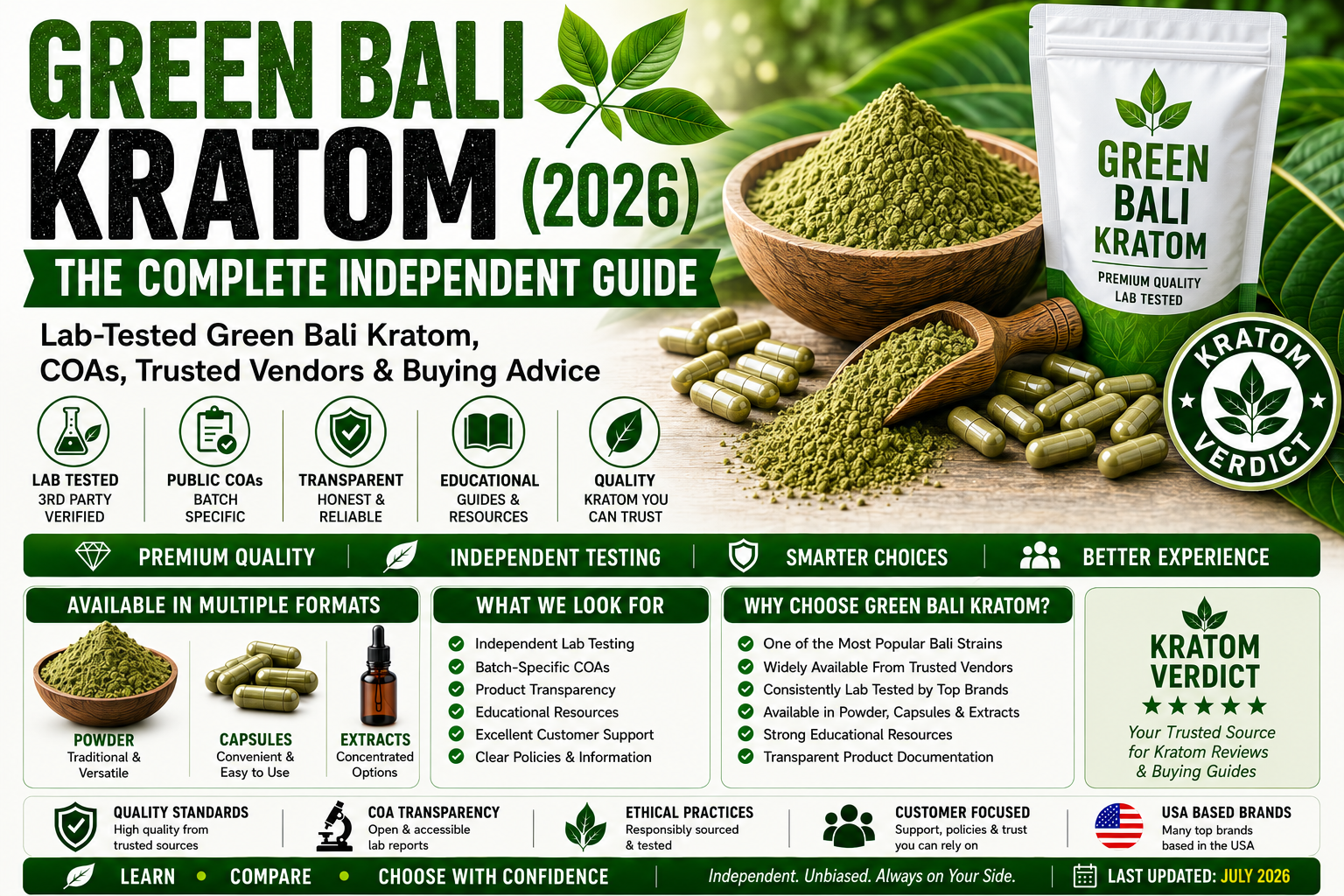
Green Bali kratom comes from Mitragyna speciosa trees grown in and around Bali, Indonesia, though “Bali” today functions more as a strain-processing designation than a strict geographic guarantee — much of what’s sold as Bali-origin kratom is actually grown across Indonesian growing regions and processed using techniques associated with the Bali strain profile.
The “green” refers to the vein color of the leaf at harvest, which affects the drying process and, ultimately, the alkaloid balance in the finished powder. Green-vein strains are generally positioned as a middle ground between the more energizing white veins and the more sedating red veins — and Green Bali in particular has built a reputation as one of the more balanced, “all-purpose” options in that category.
Alkaloid Profile: What the Numbers Actually Mean
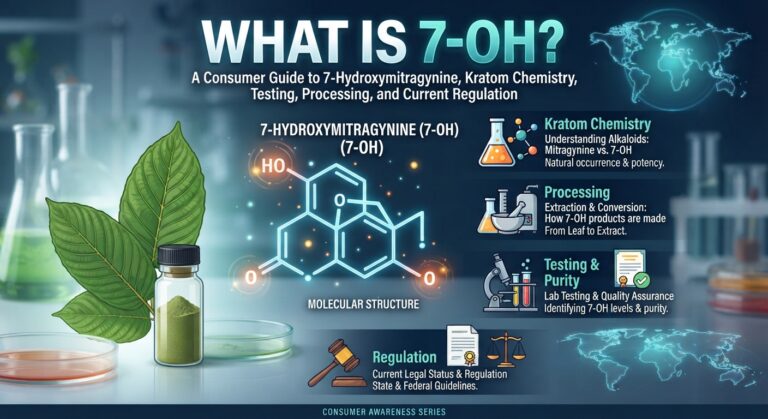
Kratom’s effects come primarily from two alkaloids: mitragynine and 7-hydroxymitragynine (7-OH). Understanding both is the difference between reading a lab report and just looking at a percentage.
- Mitragynine is the dominant alkaloid in kratom leaf and drives most of the strain’s characteristic effects. Independent testing generally shows Green Bali averaging around 1.4% mitragynine, though quality vendors report anywhere from roughly 1.2% (lower tier) to 1.9% (premium tier) depending on harvest and processing.
- 7-OH occurs naturally in kratom leaf only in trace amounts. In properly sourced Green Bali, that’s typically around 0.02% — nowhere near the concentrated levels found in the synthetic 7-OH shots and gummies currently facing DEA scheduling action (see our separate guide on that topic for the full regulatory picture).
A genuine Certificate of Analysis (COA) will show both figures, tested batch-by-batch, not as a one-time reference document reused across every shipment. If a vendor can’t produce a current, batch-specific COA, that’s a hard pass regardless of how the product is marketed.
What Users Report About Green Bali’s Effects
Because kratom is not FDA-evaluated for any medical use, no vendor or publisher can make a legitimate treatment claim — and you should be skeptical of any that do. What can be said accurately is that Green Bali is widely described by users and vendors as one of the more balanced strain profiles: neither as stimulating as white-vein strains nor as sedating as red-vein strains, which is part of why it’s frequently recommended to first-time buyers exploring green strains specifically.
As with any botanical product, individual response varies significantly based on body chemistry, tolerance, dose, and the specific batch’s alkaloid concentration. If you’re using kratom to manage a health condition, that’s a conversation to have with a doctor, not something to dose based on a blog post.
Green Bali vs. Other Bali Strains
| Strain | Typical Profile | Best Known For |
|---|---|---|
| Green Bali | Balanced, moderate mitragynine (~1.2–1.9%) | All-around use, beginner-friendly among green strains |
| Red Bali | Higher perceived sedation, popular for evening use | Relaxation-focused use |
| White Bali | More stimulating profile | Daytime energy and focus |
This kind of comparison table is exactly the sort of content Google’s quality raters look for in supplement/wellness content — it demonstrates the publisher actually understands the product category rather than just repackaging one vendor’s marketing copy.
Research more with Us
- What Is Kratom?
- Bali Kratom
- Red Bali Kratom
- White Bali Kratom
- Gold Bali Kratom
- Kratom Alkaloids Explained
- Kratom Lab Testing Explained
- How to Read a Kratom COA
- How to Verify a Kratom COA
- Kratom Buying Guide
- Kratom Safety & Side Effects
- Kratom Legality Guide
Why So Many Green Bali Products Fail Quality Testing
The kratom market has no federal product-safety regulation the way food or pharmaceuticals do. That gap gets exploited in a few consistent ways:
- Mislabeled strains — leaf sold as “Green Bali” that’s actually a blend or a different origin entirely
- Inflated potency claims — labels stating mitragynine percentages that don’t match independent lab results
- Contamination — heavy metals (particularly lead and nickel) and microbial contamination (salmonella, E. coli) from poor processing or storage
- Stale or reused COAs — a single lab report from months ago presented as current across every batch sold since
This is why the AKA GMP (Good Manufacturing Practice) certification program exists — vendors who complete it are audited against specific handling, testing, and labeling standards, and the list of certified vendors is publicly available through the American Kratom Association.
Vendor Evaluation Checklist
Before buying Green Bali kratom from any source, verify:
- A current, batch-specific COA showing mitragynine %, 7-OH %, and results for heavy metals and microbial screening
- AKA GMP certification status — check the AKA’s published vendor list directly rather than trusting a badge on the vendor’s own site
- Independent reviews outside the vendor’s own website (Trustpilot, Reddit’s r/kratom, BBB rating)
- Clear sourcing information — where the leaf is actually grown and processed
- A real return/satisfaction policy — reputable vendors stand behind batch consistency
- Reasonable pricing — prices dramatically below market average are a red flag for cut or substituted product, not a deal
Common Product Formats
Green Bali is sold across several formats, each with different practical tradeoffs:
- Powder — most common, most cost-effective, requires manual measuring
- Capsules — pre-measured convenience, slightly higher cost per gram
- Extracts/tinctures — concentrated, requires much smaller serving sizes and more careful dosing
- Enhanced or “boosted” powders — standard leaf spiked with extract to reach a higher stated mitragynine percentage; these should carry the same COA transparency as any other product
A Note on Dosing
We’re not going to give you a specific gram recommendation, and you should be wary of any site that hands you one with total confidence — individual tolerance, body weight, and batch potency all vary too much for a one-size-fits-all number to be responsible advice. The general principle experienced users and harm-reduction resources consistently point to is starting on the lower end of whatever range a reputable vendor lists for a given product, waiting to gauge the effect, and adjusting gradually rather than starting at a vendor’s “maximum recommended” serving. If you’re new to kratom entirely, talk to a healthcare provider first, particularly if you’re taking other medications — kratom has documented interactions with several drug classes.
Legal Status Check
Green Bali kratom’s legal status follows the same state-by-state patchwork as kratom generally. As of mid-2026, it remains legal at the federal level and in most U.S. states, with roughly nine states maintaining outright bans and 30+ operating under Kratom Consumer Protection Act frameworks requiring age verification and testing standards. Always confirm your specific state’s current law before ordering — a product that’s legal to ship from one state may not be legal to receive in another.
Readers interested in learning more about botanical science, plant identification, and independent research can consult publicly available resources from the Missouri Botanical Garden, Royal Botanic Gardens Kew, the USDA PLANTS Database, PubMed, and the National Center for Biotechnology Information (NCBI). These organizations provide educational information about plant taxonomy, botanical research, and scientific literature relevant to botanical products.
Frequently Asked Questions
Is Green Bali kratom stronger than other Bali strains? Not necessarily “stronger” — Green Bali is generally described as more balanced, while Red Bali is associated with stronger sedative effects and White Bali with stronger stimulating effects. Strength within any strain depends heavily on the specific batch’s mitragynine content.
What mitragynine percentage should I look for? Products testing below roughly 1.2% mitragynine are generally considered lower-grade, while anything above about 1.7% is considered premium tier. The number only matters if it’s independently verified by a current COA — a printed percentage with no accompanying lab report is not verification.
Is Green Bali kratom the same as 7-OH products? No. Green Bali is natural leaf kratom containing only trace, naturally occurring 7-OH (around 0.02%). This is a completely different product category from the concentrated 7-OH extracts, shots, and gummies currently facing federal scheduling action.
How do I know if a vendor’s lab results are legitimate? Look for a COA from a named, independent third-party lab (not an in-house lab), dated to the specific batch you’re purchasing, with a batch number that matches what’s printed on your product packaging. Many reputable vendors now post COAs via a QR code directly on the label.
Does AKA GMP certification guarantee quality? It’s the strongest publicly verifiable signal currently available in an unregulated market, but it’s not an absolute guarantee — always cross-check with the batch-specific COA for the product you’re actually buying, not just the vendor’s general certification status.
The Bottom Line
Green Bali’s reputation as a balanced, versatile strain is well-earned — but that reputation is exactly what makes it a magnet for vendors cutting corners on testing and sourcing. The strain itself isn’t the risk; an unverified vendor is. Before you buy, confirm a current batch-specific COA, check AKA GMP status directly through the American Kratom Association, and read reviews from sources the vendor doesn’t control.
This article is for informational purposes only and does not constitute medical advice. The FDA has not evaluated kratom for any medical use. Consult a healthcare provider before using kratom, particularly if you take other medications or have an existing health condition. Always verify kratom’s legal status in your state before purchasing.