Reviewed by: Kratom Verdict Editorial Team
Last Updated: July 2026
Estimated Reading Time: 11 Minutes
Review Type: Independent Editorial Buyer’s Guide
Research Basis: Publicly available company information, Certificates of Analysis (COAs), third-party laboratory testing policies, industry standards, consumer transparency practices, vendor documentation, and publicly available regulatory resources.
Disclaimer: This article is for informational purposes only and does not make efficacy claims. Kratom is not evaluated or approved by the FDA for treating any medical condition. Kratom is illegal or restricted in several U.S. states, municipalities, and countries — verify your local laws before purchasing. Consult a licensed healthcare provider before using any botanical supplement.
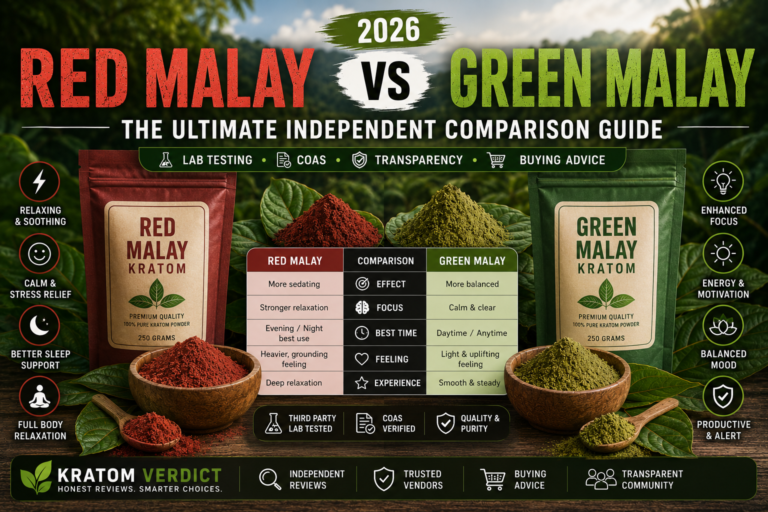
Red Kratom vs. Green Kratom is one of the most searched comparisons among kratom consumers. This guide explains the differences in botanical characteristics, commercial naming, laboratory testing, COAs, transparency, and buying considerations. Readers researching Red Kratom vs Green Kratom should compare laboratory testing, Certificates of Analysis (COAs), and vendor transparency rather than relying solely on marketing claims.
Introduction: Why Vein Color Is the First Classification Every Buyer Encounters
Walk into any kratom vendor’s product catalog and the first thing you’ll be asked to choose is a vein color — almost always red, white, or green. Of these three, Red and Green are the two most widely stocked and searched, and buyers new to the category are often left comparing product listings with no clear sense of what the color designation actually reflects.
This guide breaks down what “vein color” actually means botanically, how Red and Green vein kratom differ in terms of sourcing and processing, and — consistent with our approach across this series — how to evaluate vendor claims and product quality using verifiable, lab-based criteria rather than efficacy promises. No comparison in this article is framed around what either color “does,” since that’s not a claim any vendor or article can responsibly make. An objective Red Kratom vs Green Kratom comparison includes alkaloid testing, sourcing information, quality-control practices, and independent laboratory verification. Instead, this is a guide to understanding the classification system itself and applying sound due diligence when comparing products. Red Kratom vs Green Kratom remains one of the most frequently searched comparisons because both products originate from the same botanical species but differ in commercial processing methods and product characteristics.
What “Vein Color” Actually Refers To
Kratom leaves contain visible veins running through the leaf structure, and at the time of harvest, these veins present in different colors — red, white, or green — depending on the plant’s maturity, growing conditions, and genetic variety. This vein color is one of the primary classification systems used across the kratom industry, alongside separate classifications like leaf shape (as seen in specialty types like Horn or Elephant kratom) and regional origin (such as Bali, Borneo, or Maeng Da naming conventions). Understanding Red Kratom vs Green Kratom becomes easier when consumers evaluate harvesting practices, drying techniques, and batch-specific documentation instead of focusing only on product names.
It’s important to understand that vein color is generally believed to correlate with different processing methods and, according to industry sourcing claims, different alkaloid ratios — though the degree to which vein color alone determines final composition is influenced by many additional factors, including harvest timing, drying method, and regional growing conditions.
Red Vein Kratom: Overview
Red vein kratom is typically associated with fully matured leaves harvested later in the plant’s growth cycle. Vendors commonly describe red vein products as being processed using specific drying techniques — often involving longer fermentation or drying periods — that are said to influence the final alkaloid profile. Ultimately, Red Kratom vs. Green Kratom is a comparison of commercial classifications rather than different botanical species. This Red Kratom vs Green Kratom guide is intended to help readers understand the differences through publicly available botanical information, laboratory standards, and transparent editorial research.
Common Characteristics Attributed to Red Vein Kratom by Vendors
- Marketed as coming from more mature leaves
- Frequently associated with slower, extended drying or curing processes
- Often the most widely available vein color across vendor catalogs
- Commonly sourced from regions including Bali, Borneo, and Sumatra, according to vendor sourcing claims
Green Vein Kratom: Overview
Green vein kratom is generally positioned as occupying a middle point in the maturity spectrum — harvested at a stage between the very young leaves associated with white vein products and the fully mature leaves associated with red vein products. Processing methods for green vein kratom are often described as involving shorter drying times or different environmental exposure compared to red vein processing.
Common Characteristics Attributed to Green Vein Kratom by Vendors
- Marketed as harvested at a mid-maturity stage
- Often associated with moderate drying times relative to red and white vein processing
- Commonly sourced from regions including Indonesia and Malaysia, according to vendor sourcing claims
- Frequently marketed as a middle-ground option relative to red and white vein products in vendor descriptions
Red vs. Green Kratom: Side-by-Side Comparison
| Characteristic | Red Vein Kratom | Green Vein Kratom |
|---|---|---|
| Leaf maturity typically claimed | Fully matured leaves | Mid-maturity leaves |
| Common processing description | Longer drying/curing periods (per vendor claims) | Moderate drying periods (per vendor claims) |
| Market availability | Generally the most widely available vein color | Widely available, often second to red in catalog size |
| Common sourcing regions cited | Bali, Borneo, Sumatra | Indonesia broadly, Malaysia |
| Typical price positioning | Comparable to green vein in most catalogs | Comparable to red vein in most catalogs |
| Vein color visibility in raw leaf | Reddish coloring in the leaf’s central vein | Green coloring in the leaf’s central vein |
Why Vein Color Alone Doesn’t Tell the Whole Story
One of the most important things to understand as a buyer is that vein color is only one variable among several that influence a kratom product’s actual composition. Relying on vein color alone to compare products — without checking lab data — leaves out several other meaningful factors:
1. Regional Growing Conditions
Soil composition, climate, and altitude all affect a kratom tree’s chemical profile independent of vein color. A red vein product from one region may differ meaningfully from a red vein product sourced elsewhere.
2. Processing and Drying Methods
Even within the same vein color category, individual vendors may use different drying techniques — indoor vs. outdoor drying, varying humidity control, or different fermentation windows — all of which can influence the final product beyond what the vein color label alone indicates. Before purchasing, readers comparing Red Kratom vs. Green Kratom should review current laboratory reports and quality standards.
3. Harvest Timing
The exact point at which a leaf is harvested, even within a broadly defined maturity range, can vary from farm to farm, meaning two products labeled the same vein color may not have been harvested under identical conditions.
4. Batch-to-Batch Variability
Because kratom is an agricultural product, natural batch-to-batch variation exists regardless of vein color labeling — which is exactly why relying on a Certificate of Analysis (COA) for each specific batch is more informative than the vein color label alone.
How to Actually Compare Red and Green Vein Products as a Buyer
Rather than relying on vendor marketing descriptions of what each vein color represents, apply the same due-diligence framework used throughout this series:
Red Kratom vs. Green Kratom: What’s the Difference?
A COA will show the actual measured alkaloid content — including mitragynine and 7-hydroxymitragynine levels — for the specific batch you’re considering. This gives you concrete, comparable data rather than relying on generalized vein-color marketing claims. The purpose of this Red Kratom vs. Green Kratom guide is to explain the key differences using independent editorial research.
Compare Sourcing Region Disclosures
Ask or check whether the vendor discloses the specific growing region for each vein color product, rather than a generic “Indonesia” label. More detailed sourcing disclosure gives you more context for understanding potential differences between products. Understanding Red Kratom vs. Green Kratom requires looking beyond marketing claims and focusing on laboratory data, processing methods, and product transparency
Confirm Testing Covers More Than Alkaloid Content
As with any kratom purchase, verify that the COA includes heavy metal and microbial screening in addition to alkaloid content, since vein color has no bearing on contamination risk. Although both products come from the same species, Red Kratom vs. Green Kratom differs primarily because of harvesting, drying, and post-harvest processing techniques rather than different plant species
Dont forget to read
- White Kratom vs Green Kratom
- Gold Kratom vs Yellow Kratom
- Horn Kratom vs Elephant Kratom
- Bali vs Maeng Da Kratom
- Borneo vs Sumatra Kratom
- Thai vs Malay Kratom
- Kapuas vs Riau Kratom
Look at Processing Method Descriptions
Some vendors provide detailed descriptions of their drying and curing methods for each vein color product. More specific, verifiable process descriptions are a stronger transparency signal than generic marketing language. When evaluating Red Kratom vs. Green Kratom, consumers should prioritize vendors that publish current batch-specific Certificates of Analysis (COAs) from independent laboratories
Verify AKA GMP Status
A vendor’s overall AKA GMP Qualified status, verifiable through the American Kratom Association’s published list, reflects manufacturing hygiene and testing protocols across their full product line — including both red and green vein offerings.
Common Misconceptions About Vein Color Classifications
Misconception: Vein Color Is a Standardized, Regulated Classification
There’s no regulatory body standardizing what qualifies as “red” or “green” vein kratom across the industry. Classification relies on each vendor’s own harvesting and labeling practices, which is part of why batch-specific lab data is more informative than the vein color label alone. A thorough Red Kratom vs. Green Kratom comparison should include alkaloid testing, contaminant screening, and vendor transparency.
Misconception: All Red (or Green) Vein Products Are Chemically Identical
Because vein color reflects a broad harvesting and processing category rather than a precise chemical specification, two products labeled the same vein color from different vendors — or even different batches from the same vendor — can vary in actual composition. This is why checking COAs matters even when comparing products within the same vein-color category. A careful Red Kratom vs. Green Kratom comparison should always include third-party laboratory testing, transparent sourcing information, and clear product documentation instead of relying solely on strain names.
Misconception: Vein Color Determines Regional Origin
While certain regions are more commonly associated with certain vein color offerings in vendor catalogs, vein color itself is a harvesting and processing classification, not a geographic one. The same growing region can produce red, white, and green vein products depending on harvest timing and processing choices. Understanding Red Kratom vs. Green Kratom requires looking beyond marketing claims and examining sourcing and processing methods.
Questions to Ask When Comparing Red and Green Vein Products
- Can I see current, batch-specific COAs for both the red and green vein products I’m considering?
- What specific region is each product sourced from, and does the vendor disclose this in detail?
- What processing or drying method does the vendor use for each vein color, and how specifically is it described?
- Is the vendor AKA GMP Qualified, and can that be verified independently?
- Do the COAs include heavy metal and microbial testing in addition to alkaloid content?
- How does the pricing between the two vein colors compare, and does that align with typical market pricing for each?
A Buyer’s Checklist for Comparing Vein Color Products
- Batch-specific COAs available for each vein color product being compared
- COAs include alkaloid content, heavy metals, and microbial testing
- Testing lab named and independently verifiable (ISO 17025 accredited)
- Sourcing region disclosed in specific detail for each product
- Processing/drying method described with reasonable specificity
- AKA GMP Qualified status confirmed through the AKA’s own published list
- Labeling free of medical or efficacy claims
- Vendor restricts shipping to jurisdictions where kratom is banned
Readers interested in exploring the botanical science, laboratory quality standards, and regulatory information discussed in this Red Kratom vs Green Kratom guide can consult educational resources published by the National Center for Biotechnology Information (NCBI), the National Institutes of Health (NIH), the American Herbal Products Association (AHPA), the American Kratom Association (AKA), and the U.S. Pharmacopeia (USP). These organizations provide publicly available information on botanical research, manufacturing standards, laboratory testing, Certificates of Analysis (COAs), scientific literature, and consumer education.
Frequently Asked Questions
Is Red vein kratom a different plant species than Green vein kratom? No. Vein color is a harvesting and processing classification within the same Mitragyna speciosa species, not a distinction between different plant species or subspecies.
Why do vendors describe Red and Green vein kratom differently in terms of processing? Vendors commonly describe red vein products as undergoing longer drying or curing periods and green vein products as undergoing comparatively shorter processing, though exact methods vary by vendor and aren’t standardized across the industry. Ultimately, Red Kratom vs. Green Kratom is less about identifying a universally “better” option and more about understanding differences in processing, alkaloid testing, and vendor transparency.
Does vein color determine alkaloid content on its own? Vein color is one factor among several — including growing region, harvest timing, and processing method — that can influence a batch’s alkaloid profile. The only way to know the actual alkaloid content of a specific batch is to check its Certificate of Analysis. Is Red Kratom vs. Green Kratom a comparison of different plant species?
Are Red and Green vein kratom sourced from different countries? Both are commonly sourced from Indonesia and other Southeast Asian growing regions, according to vendor disclosures, though specific regional sourcing can vary by vendor and by batch, and should be verified through the vendor’s own disclosures rather than assumed.
Is one vein color considered more “beginner-friendly” than the other? Neither vein color classification is inherently more or less appropriate for someone new to kratom — that depends on individual circumstances and is a conversation better suited for a healthcare provider than a generalized comparison article.
How can I tell if a vendor’s vein color labeling is accurate? Vein color claims, like leaf-shape claims, rely heavily on vendor sourcing practices and honesty, since processed powder doesn’t retain visually identifiable vein color information. Checking a vendor’s overall transparency practices — COAs, sourcing disclosure, GMP status — provides more confidence than the label alone. Red Kratom vs. Green Kratom is one of the most commonly researched comparisons among kratom consumers.
Is Red Kratom vs. Green Kratom a comparison of different plant species?
No. Red Kratom vs. Green Kratom compares commercial color classifications that are generally associated with different harvesting and processing methods rather than separate botanical species
Should I expect Red and Green vein products to be priced differently? Pricing varies by vendor and by specific product line, but there’s no industry-wide rule dictating that one vein color should be priced higher than another. Comparing prices across several vendors offering the same classification is a more reliable approach than assuming price reflects a specific vein color’s relative quality.
Final Takeaways
Red and Green vein kratom represent two points along a broader harvesting and processing classification system used throughout the kratom industry, generally associated with different maturity stages and drying methods according to vendor descriptions. This Red Kratom vs. Green Kratom guide focuses on laboratory testing, transparency, and publicly available botanical information. To provide readers with balanced and transparent information, this comparison also references publicly available educational resources from recognized organizations involved in botanical research, public health, and quality standards. These resources offer additional information about botanical products, laboratory testing, Certificates of Analysis (COAs), manufacturing practices, and scientific literature. Readers who wish to explore the topic further can review the following sources: When evaluating Red Kratom vs. Green Kratom, consumers should compare batch-specific Certificates of Analysis (COAs). Because this classification system isn’t standardized or regulated, and because vein color itself can’t be independently verified once kratom is processed into powder, the most reliable way to compare Red and Green vein products isn’t through vendor marketing language — it’s through the same due-diligence framework that applies to any kratom purchase:
- Check batch-specific COAs for actual measured alkaloid content
- Confirm testing includes heavy metals and microbial screening
- Review sourcing region disclosures for both products
- Verify AKA GMP Qualified status independently
- Ask vendors directly about their specific processing methods
Approaching vein color comparisons this way shifts the conversation away from unverifiable marketing claims and toward the kind of concrete, checkable information that actually helps you understand what you’re purchasing.
This article is for informational purposes only and does not constitute medical advice. Kratom is not FDA-approved for the treatment, cure, or prevention of any disease. Consult a licensed healthcare professional before using any botanical supplement, particularly if you are pregnant, nursing, taking other medications, or managing a chronic health condition.