Reviewed by Kratom Verdict Editorial Team
Last Updated: July 2026
Estimated Reading Time: 5 minutes
Guide Type: Independent Editorial Comparison Guide
Research Basis: Publicly available botanical information, third-party laboratory transparency, publicly available regulatory resources, scientific literature, and independent editorial research.
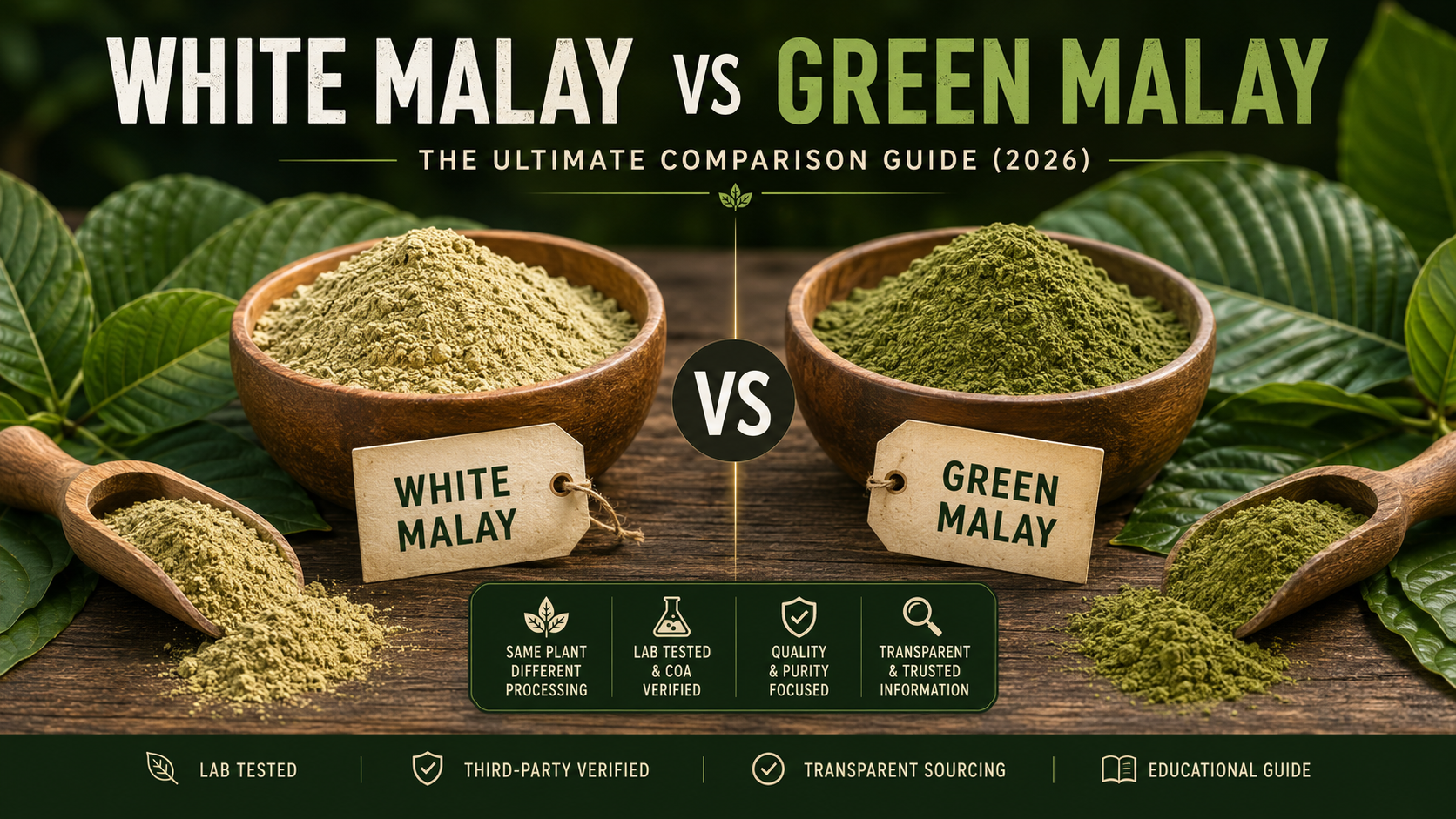
White Malay vs Green Malay is one of the most common comparisons among consumers seeking to understand how these two commercial varieties differ in processing, transparency, and product characteristics.
White Malay and Green Malay show up together constantly in “energy vs. balance” comparison posts, almost always without a single lab document backing the claim. This guide covers what actually distinguishes the two on a documentation level — not marketing language — and what to check before trusting either one.
What “Malay” Actually Refers To
“Malay” is a regional designation — kratom (Mitragyna speciosa) associated with cultivation in or near Malaysia, or marketed under that regional identity by Southeast Asian suppliers. Malay-labeled kratom has a market reputation for a milder, more gradual alkaloid profile compared to some Indonesian varieties, but that’s a general pattern, not a lab-enforced standard. Cultivation conditions, soil, and harvest timing affect the actual chemical makeup regardless of the regional label attached to it.
“White” and “Green” are separate from the regional claim — they describe vein color at harvest and the drying method applied afterward:
- White — harvested earlier, dried with minimal oxidation, generally marketed as the most “stimulating” or energizing profile in a vendor’s lineup
- Green — harvested at a middle maturity point, given a moderate drying process, generally marketed as a balance between white and red
“White Malay” and “Green Malay” therefore combine a regional claim with a processing claim — two separately unverified pieces of information stacked into one product name.
White Malay vs. Green Malay: What’s Actually Different
| Factor | White Malay | Green Malay |
|---|---|---|
| Harvest maturity (claimed) | Earliest | Mid-maturity |
| Oxidation/drying time (claimed) | Minimal | Moderate |
| Common marketing framing | “Energizing,” “stimulating” | “Balanced,” moderate effect |
| Verified by lab testing? | Only what a batch-specific COA confirms | Only what a batch-specific COA confirms |
| Regional consistency | Same “Malay” regional claim as Green | Same “Malay” regional claim as White |
The honest takeaway: the marketing framing differs, but the verification requirement is identical. Neither “white” nor “green” is a stand-in for a specific, guaranteed alkaloid ratio — only a batch-specific COA establishes that.
This White Malay vs Green Malay guide explains the differences using publicly available botanical information, laboratory testing, and Certificates of Analysis (COAs).
When comparing White Malay vs Green Malay, consumers should evaluate independent laboratory reports, sourcing information, and quality-control standards.
What a Real Certificate of Analysis (COA) Should Show
Whether you’re comparing White or Green Malay, any COA you’re shown should include:
| COA Element | What to Check |
|---|---|
| Batch/lot number | Matches the number printed on your product’s packaging |
| Testing lab name | Independently named, ISO/IEC 17025-accredited — verify separately |
| Test date | Recent relative to purchase, not reused across unrelated batches |
| Alkaloid content | Mitragynine percentage at minimum |
| Heavy metal screening | Lead, arsenic, cadmium, mercury |
| Microbial screening | Salmonella, E. coli, yeast/mold counts |
A vendor selling both White and Green Malay should be able to produce two distinct COAs — one per batch, per color. A single generic “Malay” report covering both is a documentation gap worth noting, not a substitute for batch-specific testing.
Before choosing between White Malay vs Green Malay, readers should compare vendor transparency, testing standards, and publicly available documentation. This White Malay vs Green Malay guide explains the differences using botanical information, laboratory transparency, and editorial analysis based on publicly available sources.
A detailed White Malay vs Green Malay comparison focuses on harvesting practices, drying methods, alkaloid testing, and vendor transparency rather than marketing claims. A comprehensive White Malay vs Green Malay guide should always consider laboratory testing, manufacturing quality standards, and reliable educational resources.
This White Malay vs Green Malay comparison is intended to help readers make informed purchasing decisions through objective editorial research and publicly available information. Before deciding between White Malay vs Green Malay, consumers should review vendor transparency, manufacturing standards, laboratory reports, and current quality-control information.
The Safety and Regulatory Context Both Varieties Share
This applies equally to White and Green Malay, and to kratom generally:
- The FDA has not approved kratom for any medical use and doesn’t recognize it as a safe dietary supplement. It has issued warnings about contamination risk (including past recalls) and dependency potential. When researching White Malay vs Green Malay, readers should compare publicly available quality documentation instead of relying only on product descriptions or marketing terminology.
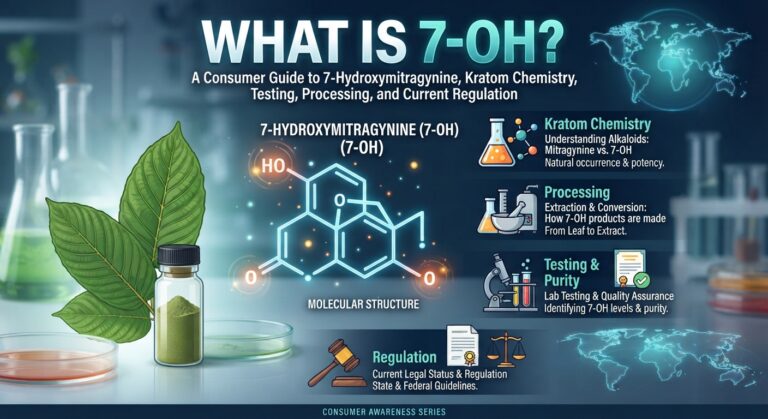
- Kratom’s active compounds, mitragynine and 7-hydroxymitragynine, act on opioid receptors — the same mechanism behind the stimulating effects some users report from white varieties, and the same mechanism behind documented dependency and withdrawal risks with regular use. A balanced White Malay vs Green Malay comparison should consider independent laboratory testing, batch-specific Certificates of Analysis (COAs), and transparent sourcing practices.
- Kratom’s legal status varies by state and country; confirm local law before ordering either variety.
- The American Kratom Association (AKA) GMP program is a voluntary industry standard, not government oversight — verify membership directly on the AKA’s site rather than a vendor’s claim.
- White Malay vs Green Malay is best evaluated by comparing current batch-specific laboratory reports rather than relying on product names alone.
If you’re choosing between White and Green Malay for a specific reason — energy, focus, mood, or otherwise — treat marketing claims as unverified, and talk to a healthcare provider if the underlying reason is a health concern rather than curiosity.
Also read these Comparisons
- White Kratom vs Green Kratom
- Gold Kratom vs Yellow Kratom
- Horn Kratom vs Elephant Kratom
- Bali vs Maeng Da Kratom
- Borneo vs Sumatra Kratom
- Thai vs Malay Kratom
- Kapuas vs Riau Kratom
How to Choose Between Them, Practically
Since neither name guarantees a specific effect, a more useful approach than “which is better” is:
- Check both COAs side by side if a vendor sells both — compare actual alkaloid percentages rather than color names.
- Start with the smallest available quantity of whichever you’re trying, since individual response varies and marketing descriptions are generalizations, not guarantees.
- Track your own experience against the specific batch, not the color name — the next batch, even from the same vendor, may test differently.
- Be skeptical of “energizing” claims specifically — stimulant-like effects are exactly the kind of subjective claim most prone to placebo effect and marketing exaggeration, and least likely to be quantified in a standard COA.
- Consumers researching White Malay vs Green Malay should review independent Certificates of Analysis (COAs) to better understand product transparency and quality-control practices.
Powder, Capsules, or Extract
- Powder is easiest to verify against a batch-specific COA for either variety.
- Capsules raise the same question for both colors: was testing done pre- or post-encapsulation?
- Extract versions of White or Green Malay carry the least standardized potency language industry-wide — scrutinize specific potency claims closely regardless of color.
Bottom Line
“White Malay” and “Green Malay” each combine a regional claim with a harvest/oxidation claim — neither independently verified by anyone outside a batch-specific lab report. The genuinely useful comparison isn’t white vs. green in the abstract; it’s the actual COA of the specific batch in front of you, checked against the steps above. This White Malay vs Green Malay comparison highlights the importance of sourcing, processing methods, and third-party laboratory verification. White Malay vs Green Malay is an important comparison for consumers who want to understand how processing methods and quality standards can influence commercial kratom products.
Sources for Further Reading
- U.S. Food and Drug Administration — public statements on kratom safety and regulatory status
- American Kratom Association — GMP program directory (industry self-regulation, not government oversight)
- Journal of Ethnopharmacology and Frontiers in Pharmacology — peer-reviewed research on Mitragyna speciosa alkaloids
- Kew Science, Plants of the World Online — botanical reference for Mitragyna speciosa
Readers interested in exploring the botanical science, laboratory quality standards, and regulatory information discussed in this White Malay vs Green Malay guide can consult educational resources published by the National Center for Biotechnology Information (NCBI), the National Institutes of Health (NIH), the American Herbal Products Association (AHPA), the American Kratom Association (AKA), and the U.S. Pharmacopeia (USP). These organizations provide publicly available information on botanical research, manufacturing standards, laboratory testing, Certificates of Analysis (COAs), scientific literature, and consumer education.
This article is for general educational purposes and isn’t medical advice. It doesn’t endorse or recommend the use of kratom, and doesn’t recommend specific vendors or brands.