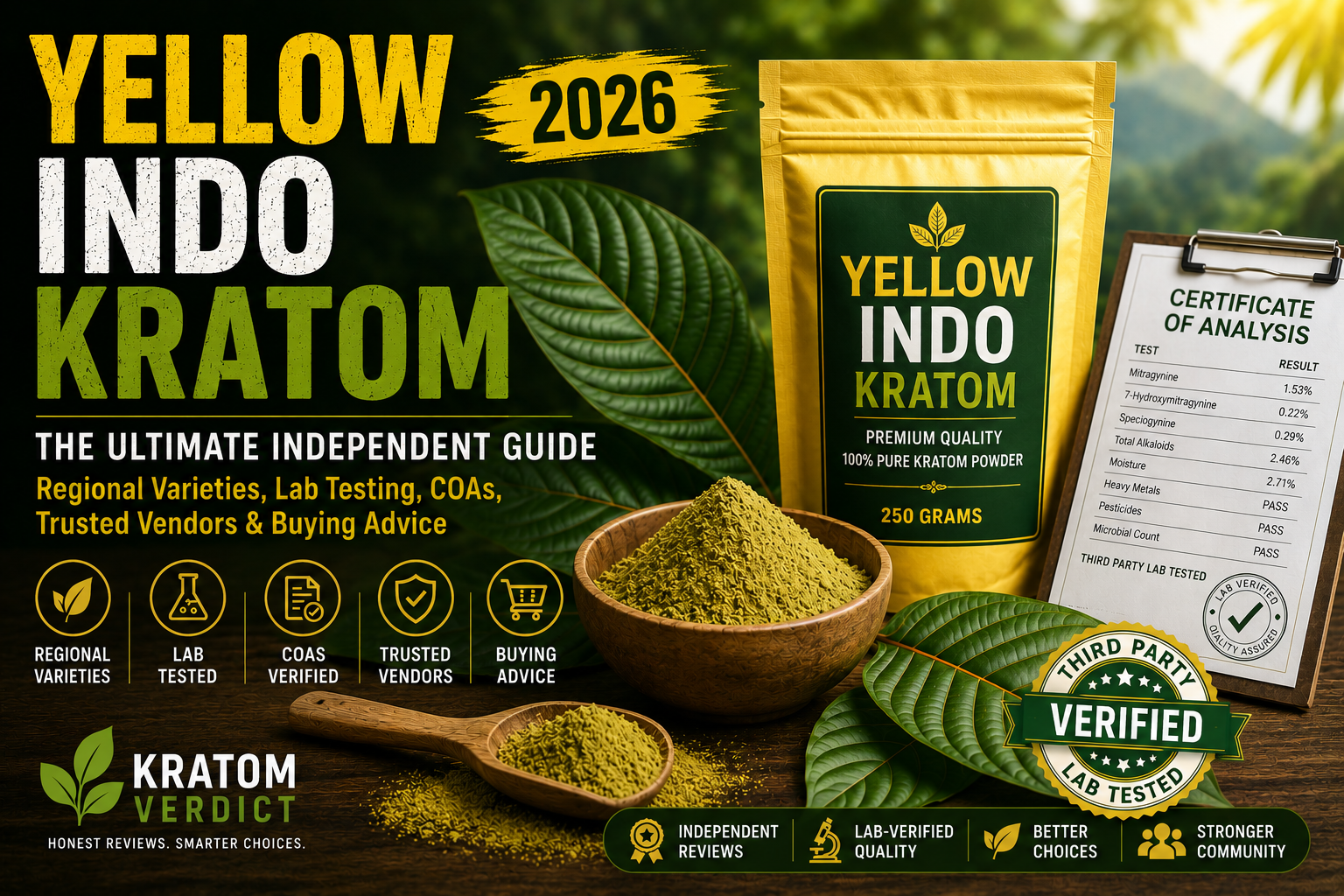
- Reviewed by Kratom Verdict Editorial Team
- Last Updated: July 2026
- Estimated Reading Time: 5 minutes
- Guide Type: Independent Editorial Strain Guide
- Research Basis: Publicly available botanical information, third-party laboratory transparency, publicly available regulatory resources, scientific literature, and independent editorial research.
Research Snapshot
| Category | Summary |
|---|---|
| Botanical Species | Mitragyna speciosa |
| Commercial Name | Yellow Indo Kratom |
| Geographic Association | Indonesia |
| Botanical Classification | Rubiaceae Family |
| Typical Product Forms | Powder, Capsules, Tea, Extracts |
| Independent Lab Testing | Recommended |
| COA Availability | Batch-specific when provided by vendors |
| ISO/IEC 17025 Testing | Preferred laboratory standard |
| Editorial Approach | Documentation-first, evidence-based |
| Legal Status | Varies by jurisdiction |
Table of Contents
- Executive Summary
- Historical Background
- Botanical Classification
- Geographic Distribution
- Cultivation & Harvesting
- Processing & Manufacturing
- Laboratory Science
- Certificate of Analysis (COA)
- Laboratory Review
- COA Red Flags
- Supply Chain Transparency
- Vendor Evaluation Framework
- References
- External Authority Resources
- Related Kratom Verdict Guides
- Kratom Verdict Transparency Scorecard
- Editorial Conclusion
Executive Summary
Yellow Indo Kratom is one of the most recognized commercial names in today’s kratom marketplace, yet it is also one of the most frequently misunderstood. Many consumers assume that the word “Yellow” refers to a naturally occurring kratom variety or a distinct botanical species. Current botanical research, however, does not support this interpretation. Instead, Yellow Indo Kratom is generally understood as a commercial designation used for products derived from Mitragyna speciosa that have undergone specific post-harvest processing or manufacturing techniques.
Unlike scientific botanical classifications, commercial names such as Yellow Indo Kratom are not regulated by international botanical organizations. Manufacturers may apply the designation to products processed using different drying, curing, blending, or finishing methods. As a result, two products marketed as Yellow Indo Kratom can differ in appearance, alkaloid composition, laboratory documentation, and manufacturing practices despite sharing the same commercial name.
This distinction is important because product names alone provide limited information about manufacturing quality or analytical composition. Independent laboratory testing, Certificates of Analysis (COAs), batch identification, and transparent production documentation offer a far more objective method for evaluating Yellow Indo Kratom than marketing descriptions alone. These documents allow consumers to review measurable analytical data instead of relying exclusively on advertising claims.
Throughout this guide, Yellow Indo Kratom is examined using Kratom Verdict’s documentation-first editorial approach. Rather than promoting commercial claims or unverified product comparisons, this article focuses on botanical science, Indonesian sourcing, cultivation practices, processing methods, laboratory analysis, quality-control procedures, Certificates of Analysis, and supply-chain transparency. Readers will gain a clearer understanding of how Yellow Indo Kratom fits within the broader Mitragyna speciosa marketplace while learning why documentation is more valuable than product names when evaluating transparency.
By the conclusion of this guide, readers will understand what Yellow Indo Kratom represents, how it differs from formal botanical classifications, why independent laboratory testing matters, how to interpret Certificates of Analysis, and what documentation should be reviewed before evaluating products marketed under this commercial designation.
1. Historical Background
The commercial history of Yellow Indo Kratom developed alongside the rapid expansion of Indonesia’s kratom export industry during the early twenty-first century. Long before international demand increased, indigenous communities throughout Indonesia harvested Mitragyna speciosa primarily for local use. Historical records describe the use of the plant itself rather than the extensive commercial naming systems commonly used in today’s global marketplace.
As international demand for kratom products grew, exporters and manufacturers introduced descriptive commercial categories to organize products for wholesalers, retailers, and consumers. During this period, names such as Green Indo, White Indo, Red Indo, Gold Indo, and Yellow Indo Kratom became increasingly common in international product catalogs. These designations helped differentiate products commercially but were not created through botanical taxonomy or scientific classification.
Unlike botanical species names, commercial labels have never been standardized across the kratom industry. One manufacturer may market a product as Yellow Indo Kratom based on a particular curing or drying process, while another manufacturer may apply the same name to a product prepared using a different production method. Because of these differences, commercial terminology alone cannot accurately describe manufacturing practices or laboratory composition.
Today, Yellow Indo Kratom remains a well-established commercial marketplace designation rather than a formally recognized botanical cultivar. Scientific literature continues to identify the underlying plant as Mitragyna speciosa, regardless of the commercial label assigned after harvesting and processing. Understanding this historical development helps readers recognize why independent documentation, laboratory analysis, and transparent manufacturing information have become increasingly important for evaluating products marketed as Yellow Indo Kratom.
2. Botanical Classification
Understanding the botanical classification of Yellow Indo Kratom is essential for distinguishing scientific facts from commercial terminology. Although Yellow Indo Kratom is widely recognized within the global kratom marketplace, it is not classified as a separate botanical species or officially recognized cultivar. Instead, Yellow Indo Kratom represents a commercial product designation derived from Mitragyna speciosa, a tropical tree belonging to the Rubiaceae family.
The Rubiaceae family contains more than 13,000 documented plant species worldwide, including economically important plants such as coffee (Coffea arabica). Within this botanical family, Mitragyna speciosa is the species associated with all commercially available kratom products, including Yellow Indo Kratom, Green Indo Kratom, White Indo Kratom, Red Indo Kratom, and Gold Indo Kratom. The commercial names describe marketplace categories rather than scientifically distinct plants.
The accepted botanical classification is shown below:
| Botanical Rank | Classification |
|---|---|
| Kingdom | Plantae |
| Division | Tracheophyta |
| Class | Magnoliopsida |
| Order | Gentianales |
| Family | Rubiaceae |
| Genus | Mitragyna |
| Species | Mitragyna speciosa |
This classification demonstrates that Yellow Indo Kratom shares the same botanical origin as every other commercially named kratom product. Differences between products are generally associated with harvesting schedules, post-harvest processing, manufacturing practices, regional sourcing, and quality-control procedures rather than differences in botanical taxonomy.
Commercial Name vs. Botanical Science
One of the most persistent misconceptions surrounding Yellow Indo Kratom is the belief that “Yellow” identifies a naturally occurring tree variety. Current scientific literature does not recognize Yellow, Gold, Red, Green, or White as separate botanical classifications. Instead, these names developed through commercial marketing and manufacturing practices designed to organize products within the international kratom trade.
Because naming conventions differ among manufacturers, the label Yellow Indo Kratom should not be interpreted as proof of a specific alkaloid profile, cultivation method, or manufacturing process. Batch-specific documentation—including Certificates of Analysis, laboratory reports, and production records—provides a much stronger basis for evaluating transparency than commercial names alone.
Understanding the distinction between botanical science and commercial terminology is one of the most important steps toward making informed decisions about Yellow Indo Kratom. Throughout the remainder of this guide, the focus remains on documented evidence, laboratory science, and transparent manufacturing information rather than promotional descriptions.
3. Geographic Distribution
The commercial identity of Yellow Indo Kratom is closely associated with Indonesia, one of the world’s leading producers and exporters of Mitragyna speciosa. Indonesia’s tropical climate, fertile river systems, abundant rainfall, and humid environmental conditions provide a suitable habitat for the cultivation and natural growth of the botanical species from which Yellow Indo Kratom is produced. While the commercial designation suggests Indonesian origin, regional sourcing may differ between manufacturers depending on their supply chains and production practices.
Most products marketed as Yellow Indo Kratom originate from Kalimantan, the Indonesian portion of the island of Borneo. Several provinces—including West Kalimantan, Central Kalimantan, East Kalimantan, and South Kalimantan—play important roles in supplying kratom to international markets. These regions contain extensive tropical forests and agricultural areas where Mitragyna speciosa naturally thrives under favorable climatic conditions.
Other Indonesian regions, including parts of Sumatra and neighboring islands, also contribute to commercial kratom production. However, the geographic origin of Yellow Indo Kratom alone should not be interpreted as an indicator of product quality. Environmental conditions, cultivation methods, processing techniques, laboratory testing, and manufacturing documentation collectively provide a more meaningful assessment of a specific batch than regional origin by itself.
Environmental Conditions
The natural habitat supporting Yellow Indo Kratom production is characterized by tropical environmental conditions that promote healthy tree growth throughout much of Indonesia. Mitragyna speciosa typically flourishes in environments with:
- Warm tropical temperatures throughout the year
- High annual rainfall
- Elevated humidity
- Fertile alluvial soils
- River floodplains
- Dense tropical vegetation
These environmental characteristics contribute to successful cultivation across multiple Indonesian provinces. Nevertheless, suitable growing conditions alone do not determine the characteristics of finished Yellow Indo Kratom products. Harvest timing, post-harvest processing, manufacturing consistency, and laboratory verification all influence the final commercial product.
Regional Variability
Consumers occasionally encounter claims suggesting that Yellow Indo Kratom sourced from one Indonesian province is inherently superior to material originating elsewhere. At present, scientific literature does not establish universally accepted evidence supporting such claims. While regional environmental differences certainly exist, the quality and documentation of individual production batches remain more informative than geographic origin alone.
Independent laboratory testing, Certificates of Analysis (COAs), transparent manufacturing practices, and documented quality-control procedures provide substantially stronger evidence than generalized regional marketing claims. For this reason, Kratom Verdict encourages readers to evaluate measurable documentation rather than relying exclusively on geographic descriptions.
4. Cultivation & Harvesting Practices
The production of Yellow Indo Kratom begins with the cultivation or collection of Mitragyna speciosa trees throughout Indonesia. Depending on the producer, raw botanical material may originate from cultivated plantations, managed agricultural operations, community-based farming systems, or naturally growing tree populations. Agricultural practices vary considerably between regions and producers, reflecting differences in local traditions, environmental conditions, and available infrastructure.
Tree maturity, seasonal weather patterns, and harvesting schedules all influence the production process for Yellow Indo Kratom. However, there are currently no internationally standardized harvesting protocols that define products marketed under this commercial name. Consequently, manufacturers may follow different harvesting practices while producing products sold under the same marketplace designation.
Harvesting generally involves carefully selecting mature leaves using manual collection techniques intended to preserve tree health and support continued production. After harvesting, leaves are transported for cleaning, inspection, drying, sorting, and subsequent manufacturing processes before entering commercial distribution.
Sustainable Production
As international demand for Yellow Indo Kratom continues to grow, sustainability has become an increasingly important consideration within the global supply chain. Responsible production practices may include:
- Selective leaf harvesting
- Preservation of mature trees
- Replanting initiatives
- Soil conservation measures
- Responsible land management
- Protection of surrounding ecosystems
- Safe working conditions
- Community-based agricultural practices
Although sustainability initiatives differ among producers, transparent documentation enables consumers to better understand the environmental commitments associated with individual manufacturers.
5. Processing & Manufacturing
Processing is one of the defining stages in the production of Yellow Indo Kratom. Unlike botanical classification, which remains consistent across Mitragyna speciosa, manufacturing techniques may vary significantly among producers. These differences help explain why products sold under the same commercial designation can display variations in color, texture, aroma, and laboratory documentation.
Following harvest, leaves typically move through several production stages before reaching consumers:
- Initial inspection
- Cleaning and foreign material removal
- Controlled drying
- Sorting
- Milling into powder
- Particle-size screening
- Batch identification
- Packaging
- Storage
- Distribution
Each stage contributes to production consistency and traceability when properly documented.
Drying & Curing
The commercial designation Yellow Indo Kratom is frequently associated with post-harvest drying or curing practices rather than botanical differences. Depending on the manufacturer, leaves may undergo combinations of shaded drying, indoor drying, controlled curing, or proprietary finishing techniques before final milling and packaging.
Because these manufacturing processes are not standardized throughout the industry, two products marketed as Yellow Indo Kratom may be processed differently while sharing the same commercial designation. For this reason, production documentation and laboratory analysis provide more reliable information than product names alone.
Manufacturing Quality Control
Professional manufacturers commonly implement quality-control procedures throughout the production of Yellow Indo Kratom to improve consistency and documentation. While quality systems vary between facilities, comprehensive production programs often include:
- Incoming material inspection
- Removal of foreign materials
- Moisture monitoring
- Controlled milling procedures
- Equipment sanitation
- Batch identification
- Production documentation
- Sample retention
- Final packaging inspection
Quality-control documentation provides additional transparency regarding how Yellow Indo Kratom is manufactured. Consumers should consider published quality procedures alongside laboratory reports and Certificates of Analysis when evaluating manufacturer transparency.
Batch Traceability
Modern quality-management systems increasingly emphasize batch traceability for Yellow Indo Kratom. Traceability allows manufacturers to connect finished products with production records, laboratory analyses, and quality-control documentation.
A traceable production system may include:
- Unique batch numbers
- Lot identification
- Production dates
- Laboratory sample identification
- Processing records
- Packaging records
- Distribution documentation
When these records are maintained and made available to consumers, they improve transparency and help distinguish documented manufacturing practices from unsupported marketing claims
6. Laboratory Science
As the global kratom industry has expanded, independent laboratory testing has become one of the most important methods for evaluating Yellow Indo Kratom products. While the commercial designation Yellow Indo Kratom may describe sourcing traditions or post-harvest processing methods, laboratory testing provides measurable analytical information about a specific production batch. Rather than relying on promotional descriptions, scientific analysis documents identifiable characteristics using standardized laboratory procedures.
A comprehensive laboratory testing program for Yellow Indo Kratom generally evaluates botanical identity, naturally occurring alkaloid composition, heavy metals, microbiological contamination, moisture content, and additional quality-control parameters. These analytical findings are typically summarized within a Certificate of Analysis (COA), allowing manufacturers, retailers, and consumers to review objective documentation for a particular production lot.
It is important to recognize that laboratory testing does not determine whether one Yellow Indo Kratom product is superior to another. Instead, testing documents measurable characteristics within the submitted sample using validated analytical methods. This documentation-first approach forms the foundation of Kratom Verdict’s editorial methodology.
Why Independent Laboratory Testing Matters
Independent laboratories operate separately from manufacturing facilities, helping improve transparency throughout the Yellow Indo Kratom supply chain. Because external laboratories follow documented analytical procedures, they provide objective information that can be independently reviewed rather than relying solely on commercial marketing.
A professional laboratory report for Yellow Indo Kratom may include:
- Botanical identity confirmation
- Alkaloid profile analysis
- Heavy-metal screening
- Microbiological testing
- Moisture determination
- Sample identification
- Batch verification
- Laboratory methodology
- Testing dates
- Authorized laboratory approval
When manufacturers publish complete laboratory reports for Yellow Indo Kratom, consumers gain access to measurable documentation that supports informed comparisons between production batches.
ISO/IEC 17025 Laboratory Accreditation
Many laboratories testing Yellow Indo Kratom operate under ISO/IEC 17025, the internationally recognized accreditation standard for testing and calibration laboratories. Although accreditation does not certify the quality of Yellow Indo Kratom itself, it demonstrates that the laboratory follows documented quality-management procedures covering analytical testing, instrument calibration, method validation, record management, and staff competency.
An ISO/IEC 17025 accredited laboratory typically maintains procedures involving:
- Instrument calibration
- Method validation
- Sample traceability
- Laboratory quality assurance
- Staff competency evaluation
- Internal auditing
- Documentation management
- Corrective action procedures
When evaluating Yellow Indo Kratom, accreditation should be considered together with the complete Certificate of Analysis and not interpreted as a guarantee of product quality.
High-Performance Liquid Chromatography (HPLC)
High-Performance Liquid Chromatography (HPLC) is one of the most commonly used analytical methods when testing Yellow Indo Kratom. HPLC separates naturally occurring compounds within botanical material, allowing laboratories to identify and quantify individual alkaloids present in the submitted sample.
A typical HPLC report for Yellow Indo Kratom may include:
| Alkaloid | Laboratory Purpose |
|---|---|
| Mitragynine | Primary alkaloid quantification |
| 7-Hydroxymitragynine | Secondary alkaloid analysis |
| Paynantheine | Botanical characterization |
| Speciogynine | Alkaloid profiling |
| Speciociliatine | Additional composition analysis |
These analytical values describe only the specific batch of Yellow Indo Kratom submitted for testing and should always be interpreted together with the complete laboratory report.
LC-MS & UPLC Analysis
Some laboratories analyzing Yellow Indo Kratom also employ Liquid Chromatography-Mass Spectrometry (LC-MS) or Ultra-Performance Liquid Chromatography (UPLC). These advanced analytical techniques provide enhanced sensitivity and improved compound separation for complex botanical materials.
Depending on laboratory objectives, LC-MS or UPLC may be used to:
- Confirm botanical identity
- Characterize alkaloid composition
- Improve analytical sensitivity
- Verify compound separation
- Support scientific research
The analytical methods used to evaluate Yellow Indo Kratom should always be clearly documented within the Certificate of Analysis.
ICP-MS Heavy Metal Screening
Because Yellow Indo Kratom is derived from an agricultural botanical source, laboratories commonly perform heavy-metal analysis using Inductively Coupled Plasma Mass Spectrometry (ICP-MS). This analytical method detects trace concentrations of elemental contaminants that cannot be identified visually.
Typical heavy-metal screening includes:
- Lead (Pb)
- Arsenic (As)
- Cadmium (Cd)
- Mercury (Hg)
Heavy-metal analysis contributes to the overall documentation of Yellow Indo Kratom and should always be reviewed alongside reporting limits, laboratory methods, and batch-specific results.
Microbiological Testing
Chemical analysis alone does not provide a complete evaluation of Yellow Indo Kratom documentation. Comprehensive laboratory programs frequently include microbiological testing to assess microbial contamination that cannot be observed visually.
Typical microbiological testing panels include:
| Test | Purpose |
|---|---|
| Total Aerobic Plate Count | General microbial population |
| Yeast Count | Yeast screening |
| Mold Count | Mold screening |
| Escherichia coli | Indicator organism testing |
| Salmonella spp. | Pathogen screening |
Microbiological analysis strengthens the documentation supporting production quality and manufacturing controls for Yellow Indo Kratom.
Moisture Analysis
Moisture analysis forms another important component of laboratory testing for Yellow Indo Kratom. Excess moisture may influence storage stability, packaging integrity, and long-term preservation of botanical material.
Validated laboratory procedures allow manufacturers to monitor moisture consistency across production batches. Moisture analysis should be considered alongside packaging quality, storage recommendations, transportation conditions, and other quality-control documentation.
7. Understanding the Certificate of Analysis (COA)
A Certificate of Analysis (COA) is one of the most valuable documents available when evaluating Yellow Indo Kratom. Rather than functioning as promotional material, a COA provides laboratory documentation describing analytical procedures performed on a specific production batch.
A professional COA for Yellow Indo Kratom commonly includes:
- Laboratory name
- Laboratory accreditation
- Sample identification
- Batch number
- Lot number
- Date received
- Date analyzed
- Report issue date
- Analytical methods
- Laboratory findings
- Authorized approval
Reviewing the complete COA enables consumers to compare documentation between manufacturers using objective laboratory information rather than advertising claims.
8. Real COA Walkthrough
When reviewing a COA for Yellow Indo Kratom, consumers should confirm that the report clearly identifies the tested batch and explains the analytical methods used during laboratory evaluation.
Before relying on a laboratory report, verify that:
- The batch number matches the purchased product.
- The testing laboratory is clearly identified.
- Analytical methods are disclosed.
- Testing dates are included.
- The report appears complete and unaltered.
- The COA corresponds to the specific Yellow Indo Kratom batch offered for sale.
9. COA Red Flags
Consumers evaluating Yellow Indo Kratom should exercise additional caution if they encounter documentation containing any of the following issues:
- Missing batch number
- No laboratory identification
- Missing testing dates
- No analytical methodology
- Incomplete or edited reports
- Generic COAs reused across multiple products
- Missing laboratory authorization
- Reports that cannot be independently verified
These issues do not automatically indicate a problem with the product itself, but they reduce transparency and warrant further due diligence.
10. Supply Chain Transparency
Supply-chain transparency has become increasingly important throughout the Yellow Indo Kratom industry. Manufacturers that openly publish sourcing information, production practices, laboratory documentation, and quality-control procedures provide consumers with greater confidence in their documentation standards.
Transparent suppliers commonly provide:
- Batch-specific COAs
- Independent laboratory reports
- Manufacturing documentation
- Quality-control procedures
- Storage recommendations
- Product traceability information
11. Vendor Evaluation Framework
When comparing vendors selling Yellow Indo Kratom, measurable documentation generally provides more reliable information than marketing language.
A documentation-first evaluation should consider:
✓ Independent laboratory testing
✓ Batch-specific Certificates of Analysis
✓ ISO/IEC 17025 laboratory accreditation
✓ Heavy-metal screening
✓ Microbiological testing
✓ Manufacturing transparency
✓ Batch traceability
✓ Accurate labeling
✓ Published quality-control procedures
✓ Responsive customer support regarding documentation
Rather than focusing on promotional claims, this framework encourages readers to evaluate Yellow Indo Kratom using objective laboratory evidence and transparent manufacturing information.
12. References
Peer-Reviewed Scientific Literature
- Singh D, Narayanan S, Vicknasingam B. Traditional and Non-Traditional Uses of Mitragynine (Kratom): A Survey of the Literature.
- Prozialeck WC, Jivan JK, Andurkar SV. Pharmacology of Kratom: An Emerging Botanical Agent.
- Kruegel AC, Grundmann O. The Medicinal Chemistry and Neuropharmacology of Kratom.
- Hassan Z, Muzaimi M, Navaratnam V, et al. From Kratom to Mitragynine and Its Derivatives.
- Cinosi E, Martinotti G, Simonato P, et al. Following “The Roots” of Kratom.
Botanical References
- Mitragyna speciosa botanical classification
- Rubiaceae family references
- Indonesian botanical publications
- Tropical forestry and agricultural literature
Laboratory References
- ISO/IEC 17025 Testing & Calibration Laboratories
- High-Performance Liquid Chromatography (HPLC)
- Liquid Chromatography–Mass Spectrometry (LC-MS)
- Ultra-Performance Liquid Chromatography (UPLC)
- ICP-MS Heavy Metal Analysis
- Standard Microbiological Laboratory Procedures
13. External Authority Resources
Readers who wish to learn more about Yellow Indo Kratom, botanical science, laboratory testing, Certificates of Analysis, and current regulatory developments are encouraged to review the following authoritative resources.
Government & Regulatory Resources
Industry Standards
Botanical References
Kew Science – Plants of the World Online
Scientific Literature
Laboratory Standards
International Organization for Standardization (ISO)
14. Related Kratom Verdict Guides (Internal Links)
Expand your knowledge of Yellow Indo Kratom through our independent educational guides covering botanical science, laboratory testing, Certificates of Analysis, transparency standards, and vendor evaluation.
Kratom Fundamentals
- What Is Kratom? (2026): The Complete Beginner’s Guide
- Kratom Buying Guide (2026)
- Kratom Safety & Side Effects (2026)
- Kratom Legality Guide (2026)
Laboratory & Transparency
- Kratom Alkaloids Explained
- Kratom Lab Testing Explained
- Third-Party Lab Testing Explained
- How to Read a Kratom Certificate of Analysis (COA)
- How to Verify a Kratom COA
- AKA GMP Certification Explained
Related Indo Kratom Guides
Related Comparison Guides
- Gold Kratom vs. Yellow Kratom
- White Kratom vs. Green Kratom
- Bali vs. Maeng Da Kratom
- Borneo vs. Sumatra Kratom
- Thai vs. Malay Kratom
Vendor Transparency Guides
- How to Identify a Trusted Kratom Vendor
- How to Evaluate Kratom Vendors
- Best Kratom Vendors for Beginners
- Full Spectrum Kratom Explained
- Kratom Extract Powder Explained
- Enhanced Kratom Powder Guide
15. Kratom Verdict Transparency Scorecard
| Transparency Category | Status |
|---|---|
| Botanical Classification Explained | ✅ |
| Commercial Naming Explained | ✅ |
| Geographic Origin Covered | ✅ |
| Cultivation & Harvesting Explained | ✅ |
| Processing & Manufacturing Explained | ✅ |
| Independent Laboratory Testing | ✅ |
| ISO/IEC 17025 Standards | ✅ |
| HPLC Analysis Explained | ✅ |
| LC-MS & UPLC Covered | ✅ |
| ICP-MS Heavy Metal Testing | ✅ |
| Microbiological Testing | ✅ |
| Moisture Analysis | ✅ |
| Certificate of Analysis (COA) | ✅ |
| Real COA Walkthrough | ✅ |
| COA Red Flags | ✅ |
| Supply Chain Transparency | ✅ |
| Vendor Evaluation Framework | ✅ |
| Scientific References Included | ✅ |
| External Authority Resources | ✅ |
| Internal Educational Resources | ✅ |
| Independent Editorial Review | ✅ |
Overall Transparency Rating
★★★★★ 5/5 – Comprehensive Documentation-First Educational Guide
Editorial Note
This transparency scorecard evaluates the educational completeness of this guide. It is not an endorsement or quality rating of any individual Yellow Indo Kratom product, manufacturer, importer, retailer, or vendor. Consumers should evaluate products using batch-specific Certificates of Analysis (COAs), independent laboratory testing, manufacturing transparency, and documented quality-control procedures whenever such information is available.
16. Editorial Conclusion
Yellow Indo Kratom remains one of the most widely recognized commercial designations within the international kratom marketplace, yet it is frequently misunderstood because commercial terminology is often mistaken for botanical classification. Throughout this guide, Yellow Indo Kratom has been examined from a documentation-first perspective, emphasizing botanical science, Indonesian sourcing, cultivation practices, manufacturing methods, laboratory testing, Certificates of Analysis (COAs), and supply-chain transparency rather than promotional claims.
Scientific literature consistently recognizes Mitragyna speciosa as the botanical species from which Yellow Indo Kratom is derived. The commercial term “Yellow” generally reflects post-harvest processing, curing, blending, or manufacturing practices instead of identifying a separate botanical variety. Since these production methods can differ among manufacturers, products sold under the same commercial designation may vary in appearance, analytical documentation, and manufacturing procedures.
Independent laboratory testing remains one of the most valuable resources for evaluating Yellow Indo Kratom. Batch-specific Certificates of Analysis, ISO/IEC 17025-accredited laboratories, HPLC alkaloid analysis, ICP-MS heavy-metal screening, microbiological testing, and transparent manufacturing documentation provide measurable information that is considerably more informative than marketing descriptions alone. Consumers should review complete laboratory reports, verify batch identification, and compare documented quality-control procedures whenever these resources are available.
As botanical research, laboratory methodologies, regulatory guidance, and industry transparency continue to evolve, documentation will remain an essential component of responsible product evaluation. Readers are encouraged to consult authoritative scientific literature, government resources, and recognized laboratory standards while recognizing that commercial product names alone cannot substitute for independently verifiable evidence.
At Kratom Verdict, our editorial mission is to publish independent, evidence-based educational resources that prioritize transparency, scientific accuracy, and consumer education. Every guide is developed to help readers understand botanical classification, laboratory science, Certificates of Analysis, regulatory developments, and supply-chain documentation so they can evaluate Yellow Indo Kratom and related products using objective information rather than unsupported marketing claims.