Introduction: White Maeng Da vs White Borneo Requires More Than a Strain-Name Comparison
The primary difference between Green Malay and Green Borneo lies in their metabolic timeline and secondary alkaloid complexity. Green Malay utilizes a hybrid sun-drying cure that allows paynantheine and speciogynine to mature, delivering an elongated 5-to-7-hour endurance wave. Conversely, Green Borneo relies on an indoor, high-airflow withering process that preserves a clean mitragynine profile for smoother, moderate physical relaxation and mid-range focus.
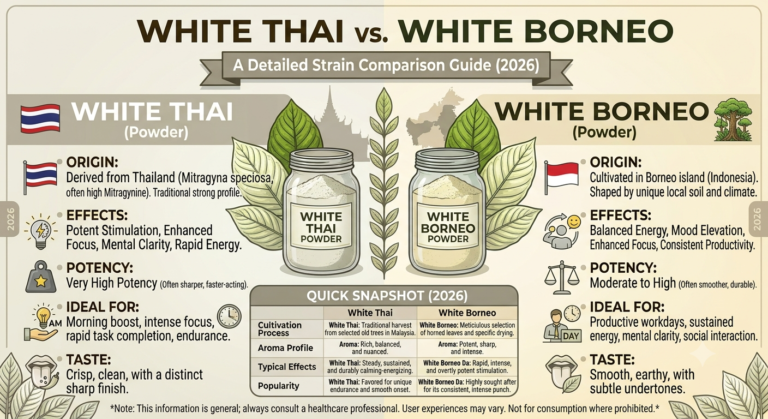
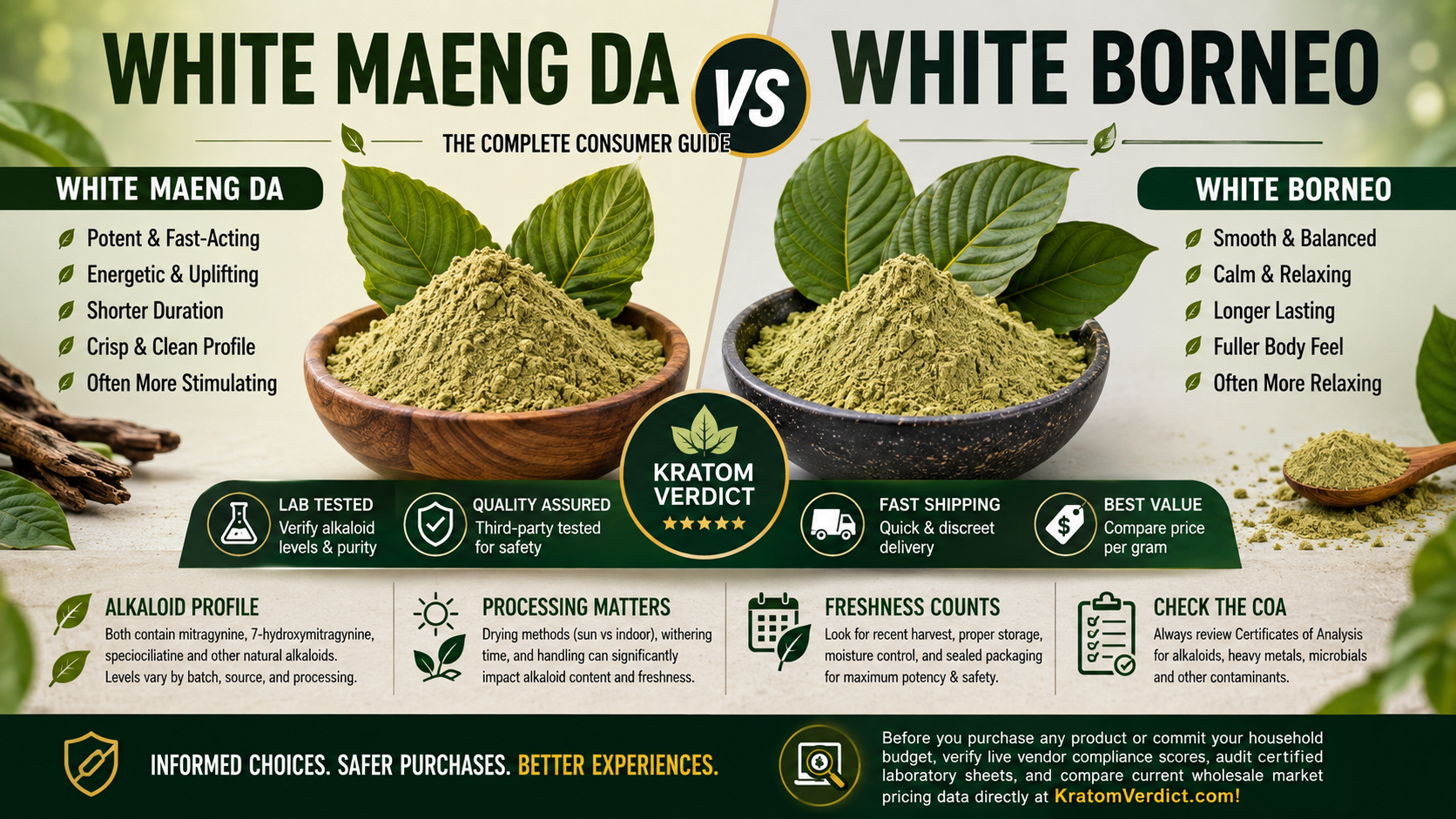
The primary difference between White Maeng Da and White Borneo lies in their alkaloid intensity and kinetic profile. White Maeng Da features a concentrated, unbuffered mitragynine structure that delivers a rapid, high-intensity energy spike. Conversely, White Borneo offers a smoother, moderate baseline focus wave with less peripheral jitteriness due to its distinct regional terroir.
When consumers search for white maeng da vs white borneo, they are usually trying to determine whether the two products are meaningfully different, which one has the more desirable characteristics, and which represents better value.
At first glance, the comparison appears straightforward. Both products are commonly marketed as “white” kratom varieties, while Maeng Da and Borneo are presented as different commercial categories. Product descriptions may then attach additional claims concerning strength, duration, freshness, origin, or consistency.
The scientific reality is more complicated.
Kratom is derived from Mitragyna speciosa, a tropical tree native to Southeast Asia. Its leaves contain numerous naturally occurring alkaloids, with mitragynine being one of the principal constituents commonly measured in laboratory analysis. Other identified alkaloids include speciociliatine, speciogynine, paynantheine, corynantheidine, and 7-hydroxymitragynine, among others.
The important consumer-protection point is that commercial strain names do not function as standardized chemical specifications.
A package labeled White Maeng Da does not automatically contain a predetermined concentration of mitragynine. Likewise, White Borneo does not represent one universally fixed chemical profile.
Differences can arise from plant genetics, geographic origin, harvesting conditions, season, leaf maturity, drying conditions, storage, milling, blending, and manufacturing practices.
That makes white maeng da vs white borneo a particularly useful case study in how consumers should evaluate kratom products.
Instead of asking only which name has the stronger reputation, a more rigorous approach asks:
What can the seller actually demonstrate about the specific batch being offered?
This guide examines that question through chemistry, processing, laboratory testing, freshness, pricing, procurement, traceability, and vendor transparency.
The objective is not to promote one commercial category over another. It is to give consumers a framework for evaluating claims without relying on strain mythology or unsupported marketing language.
Consumer note: Kratom contains pharmacologically active compounds and may carry risks, including adverse effects and dependence. Laws and regulations differ by jurisdiction. This article is an educational comparison and does not recommend a particular product, dose, or method of use.
For natural health consumers evaluating alternative botanicals for morning performance, the white maeng da vs white borneo comparison represents a crucial decision matrix. While retail marketing copy often clusters all white-vein powders into a single generic category, experienced analysts look closer at the underlying alkaloid distributions. Decoupling consumer folklore from raw laboratory data is essential before allocating your household wellness budget.
Quick-Glance Consumer Takeaways
Before examining the chemistry behind white maeng da vs white borneo, consumers can use the following criteria as an initial screening framework:
- Procurement Speed: Neither White Maeng Da nor White Borneo inherently ships faster. Fulfillment depends on inventory location, order processing, carrier service, destination, and applicable restrictions.
- Pricing per Gram: Compare the actual delivered cost against net weight. A premium strain name does not automatically justify a higher price.
- Third-Party Lab Transparency: Batch-specific independent testing is substantially more useful than generalized claims about potency or origin.
- Product Freshness: Freshness depends on harvest, drying, moisture control, storage, packaging, and inventory turnover rather than the word “fresh” on a product page.
- Mitragynine Concentration: A laboratory measurement is more informative than assumptions based on strain names.
- Alkaloid Profile: Two products with similar mitragynine values can still have different broader alkaloid profiles.
- Processing: Withering and drying conditions can influence measured alkaloid concentrations.
- Origin Claims: “Borneo” or “Maeng Da” should not automatically be interpreted as proof of geographic or genetic identity.
- Quality Evidence: Certificates of analysis, contaminant testing, lot numbers, and manufacturing information provide stronger evidence than visual appearance.
- Consumer Value: The lowest price is not necessarily the lowest-risk or best-value purchase.
This framework should remain at the center of any serious white maeng da vs white borneo analysis.
Buying Option
What Does “White” Mean in White Maeng Da and White Borneo?
White Is a Commercial Classification, Not a Chemical Specification
The word “white” is widely used in kratom commerce to distinguish one category of product from others commonly described with color terminology.
Consumers should understand, however, that the color designation does not establish a standardized alkaloid concentration.
The appearance and commercial classification of a kratom product can be influenced by multiple factors, including:
- leaf maturity,
- vein and leaf terminology,
- harvesting practices,
- drying conditions,
- processing,
- oxidation,
- storage,
- and blending.
Consequently, “white” should not be interpreted as a guarantee of a particular laboratory result.
This distinction is critical when comparing white maeng da vs white borneo.
Color Does Not Equal Potency
A consumer may see two powders with visibly different shades and assume that one must contain more active alkaloids.
That conclusion is not scientifically reliable.
Powder color can change as botanical material is processed and stored. Environmental exposure and drying conditions can also influence appearance.
Laboratory analysis is therefore a much stronger method of comparing products than visual inspection.
What Is White Maeng Da?
Maeng Da as a Commercial Name
Maeng Da is one of the most recognizable commercial names in the kratom market.
It is frequently marketed as a premium category, but the term should not be treated as a universally standardized botanical classification.
A consumer cannot determine the exact chemical composition of a batch simply from the words “White Maeng Da.”
The actual material may reflect a combination of:
- plant genetics,
- cultivation location,
- harvest conditions,
- post-harvest processing,
- supplier blending,
- and manufacturing controls.
Therefore, the appropriate consumer question is not whether Maeng Da has a reputation for particular characteristics.
The more useful question is whether the individual product being sold has laboratory evidence supporting its stated identity and quality.
Does Maeng Da Guarantee Higher Mitragynine?
No commercial name can guarantee a particular mitragynine concentration.
Published analytical research has demonstrated considerable variability in kratom alkaloid concentrations among different samples and products.
A White Maeng Da batch could test higher in mitragynine than a White Borneo batch.
Another White Borneo batch could test higher than a particular White Maeng Da batch.
The strain label alone cannot resolve that comparison.
What Is White Borneo?
Borneo Refers to a Geographic Association
Borneo is a large island in Southeast Asia associated with several countries and diverse ecological environments.
Kratom is native to parts of Southeast Asia, and Borneo-associated products have become a common commercial category.
However, the presence of the word “Borneo” on a package does not by itself prove that the material was harvested in a particular location on the island.
Geographic-origin claims require traceability.
A supplier making a strong origin claim should ideally be able to provide information concerning:
- source region,
- producer or farm,
- harvest,
- processing location,
- manufacturing location,
- lot identification,
- and laboratory documentation.
Without such evidence, consumers should treat geographic terminology as a commercial descriptor rather than verified proof of origin. When analyzing white maeng da vs white borneo, consumers must recognize that botanical naming conventions are not standardized by federal regulatory bodies. Deceptive online operations routinely apply these commercial labels to low-grade plain leaf to maximize profit margins. True product differentiation requires verifying batch-specific testing parameters rather than relying blindly on the printed names on a pouch.
White Maeng Da vs White Borneo: Why the Names Cannot Predict Chemistry
Mitragynine Is One Important Analytical Marker
Mitragynine is one of the principal kratom alkaloids commonly measured in scientific and commercial testing.
Modern analytical techniques can quantify mitragynine in botanical material with considerable precision.
However, mitragynine is only one part of the chemical picture.
A laboratory analysis can potentially examine several alkaloids simultaneously, creating a more informative chemical profile.
This matters because a comparison based on a single number may overlook meaningful differences in the broader alkaloid composition.
Other Alkaloids Matter to Chemical Characterization
Kratom contains multiple alkaloids.
Frequently discussed compounds include:
- mitragynine,
- 7-hydroxymitragynine,
- speciociliatine,
- speciogynine,
- paynantheine,
- corynantheidine,
- and other minor constituents.
The relative proportions of these compounds can vary.
Therefore, a robust white maeng da vs white borneo comparison should ideally look beyond a marketing statement such as “high alkaloid content.” The environmental origins defining the white maeng da vs white borneo dynamic dictate how the host trees naturally synthesize active plant compounds. Maeng Da variants are heavily sourced from organized plantation networks across West Kalimantan, utilizing mature canopy leaves that receive peak daily sunlight exposure. Conversely, authentic White Borneo leaves are gathered from deep river-valley forest ecosystems rich in volcanic silt and dense mineral tables.
The better question is:
Which alkaloids were measured, at what concentrations, in which batch, using which analytical method?
White Maeng Da vs White Borneo: Understanding Mitragynine Concentrations
Why a Single Number Can Be Misleading
Suppose one product certificate reports a particular mitragynine concentration.
That result is useful, but it does not automatically establish that the product is superior to another product.
Several factors should be considered.
First, the samples should ideally be tested using comparable analytical methods.
Second, the samples should be associated with current batches.
Third, consumers should consider whether the products are ordinary botanical powder or concentrated formulations.
Fourth, the broader alkaloid profile may provide additional context.
Research on commercial kratom samples has demonstrated substantial variation in measured mitragynine concentrations, reinforcing the importance of batch-specific analysis.
Concentration Is Not the Same as Quality
A higher laboratory value does not automatically mean a product is higher quality.
Quality is multidimensional.
It can include:
- accurate labeling,
- contaminant control,
- manufacturing consistency,
- batch traceability,
- appropriate storage,
- laboratory transparency,
- and regulatory compliance.
A product should not receive an automatic quality upgrade merely because one measured alkaloid is higher.
This is particularly important in white maeng da vs white borneo comparisons, where marketing claims can make chemical concentration appear to be the only relevant variable.
7-Hydroxymitragynine and Why Consumers Should Look at the Testing Panel
Natural Botanical Material Versus Concentrated Products
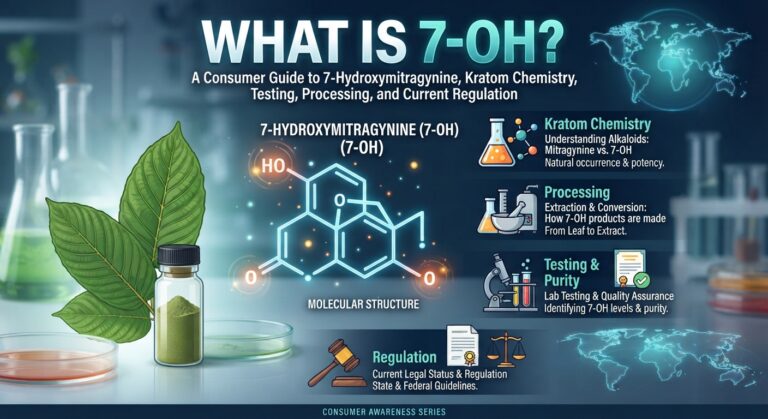
7-hydroxymitragynine is another kratom alkaloid that receives significant scientific attention.
It occurs naturally in kratom at much lower levels than mitragynine in ordinary leaf material, while some commercial products can contain substantially altered or concentrated alkaloid profiles.
For consumer evaluation, the distinction between ordinary botanical powder and concentrated products is important.
A product marketed under a traditional strain name should not automatically be assumed to have the same chemical characteristics as a concentrated formulation.
The technical variance behind white maeng da vs white borneo is finalized inside regional milling facilities during the critical post-harvest curing window. Premium Maeng Da processing relies on a strict indoor, climate-controlled air-drying protocol inside absolute darkness to entirely halt photo-oxidation. This specialized environment ensures that the primary active compounds are thoroughly shielded from destructive solar ultraviolet (UV) radiation.
Why Testing Methodology Matters
Analytical chemistry can be complicated by structurally related compounds.
High-quality testing should therefore use an appropriate validated methodology and clearly identify the compounds being quantified.
Consumers should be cautious when websites make unusually specific potency claims without showing credible analytical documentation.
Geographic Origin and the White Maeng Da vs White Borneo Comparison
Environment Can Influence Plant Chemistry
Plants do not grow in identical conditions.
Environmental variables can include:
- temperature,
- rainfall,
- sunlight,
- soil,
- elevation,
- humidity,
- season,
- and local ecological conditions.
These variables can interact with plant genetics and influence secondary metabolite production.
That means two kratom batches associated with different regions may exhibit chemical differences.
But this does not mean a geographic label alone can predict a fixed alkaloid profile.
Genetics May Be Equally Important
Plant genotype can influence alkaloid biosynthesis.
Two plants growing in similar environments can potentially produce different chemical profiles.
Likewise, two products marketed under different commercial names may show overlapping chemistry.
This is one reason modern consumer analysis should prioritize measurable characteristics over traditional strain labels.
White Maeng Da vs White Borneo: Processing Can Change the Final Product
Post-harvest processing is often ignored in consumer comparisons.
Yet the leaf’s chemistry does not necessarily remain unchanged from harvest through final packaging.
Processing can include:
- harvesting,
- washing or handling,
- withering,
- drying,
- milling,
- storage,
- packaging,
- and distribution.
Each stage can influence the final material.
Withering
Withering allows freshly harvested leaves to lose moisture before further processing.
The duration and environmental conditions of this stage can influence chemical composition.
Research investigating kratom post-harvest treatment has demonstrated that processing variables can affect measured concentrations of important alkaloids.
Therefore, a statement that two products originate from the same general type of plant does not guarantee that their finished chemical profiles will be identical.
Buying Option
Indoor Drying vs Sun-Drying
Controlled Indoor Drying
Indoor drying can allow producers to control environmental conditions more precisely.
Potential variables include:
- temperature,
- humidity,
- airflow,
- drying duration,
- sanitation,
- and exposure to environmental contaminants.
Better control can potentially improve batch consistency.
However, “indoor dried” is not itself a laboratory certification.
A poorly managed indoor process can still produce quality problems.
Sun-Drying
Sun-drying can expose botanical material to:
- sunlight,
- ultraviolet radiation,
- variable temperatures,
- ambient humidity,
- and outdoor environmental conditions.
The final effect depends on how the process is controlled.
Sun-drying should therefore not automatically be categorized as either superior or inferior.
The relevant question is whether the process is documented and whether the finished batch passes appropriate quality testing.
Why Processing Matters in White Maeng Da vs White Borneo
Two products can begin with similar botanical material but undergo different post-harvest procedures.
Those differences may influence:
- moisture,
- color,
- stability,
- measured alkaloid concentration,
- microbial risk,
- and overall consistency.
Consequently, processing should be part of the comparison rather than an afterthought.
Product Freshness: White Maeng Da vs White Borneo
Freshness Is More Than Fast Shipping
One of the most common consumer misconceptions is equating rapid delivery with freshness.
A package delivered tomorrow could contain material that was harvested and stored many months earlier.
Conversely, a supplier that takes several days to process an order could be selling recently produced inventory with strong batch traceability.
These are separate concepts.
A meaningful freshness assessment should consider:
- harvest timing where available,
- production date,
- packaging date,
- storage conditions,
- inventory turnover,
- moisture control,
- and batch documentation.
Moisture Management
Moisture is particularly important for dried botanical powders.
Excessive moisture can contribute to microbial problems and affect storage stability. Examining the structural leaf changes for white maeng da vs white borneo highlights entirely distinct curing behaviors. While Maeng Da setups remain locked in dark, temperature-regulated barns, Borneo processing often integrates subtle variations in indoor air-circulation patterns native to the dynamic Kalimantan climate. These distinct drying environments directly dictate how rapidly the natural chlorophyll networks break down during moisture evaporation.
Consumers should therefore pay attention to whether the manufacturer has documented controls for:
- moisture,
- storage humidity,
- packaging,
- sanitation,
- and microbial testing.
Packaging
Appropriate packaging can reduce exposure to environmental conditions.
Relevant characteristics can include:
- moisture-barrier performance,
- seal quality,
- light exposure,
- oxygen exposure,
- lot identification,
- and storage conditions.
An attractive package is not evidence of superior product quality.
A traceable package is more valuable.
Laboratory Testing: The Most Important Consumer Protection Tool
What Is a Certificate of Analysis?
A Certificate of Analysis, commonly called a COA, is a laboratory document reporting analytical results for a particular sample.
For kratom products, a meaningful COA may include alkaloid testing and contaminant screening.
However, not all certificates provide the same level of information.
Consumers should examine the document rather than assuming that the words “lab tested” settle the question.
Batch or Lot Identification
A strong COA should ideally connect the results to a specific lot or batch.
The product’s lot number should correspond to the certificate wherever possible.
This allows consumers to distinguish:
“This product has been tested at some point.”
from:
“This batch has documented test results.”
The second statement is much more useful for current purchasing decisions.
What Should an Independent Laboratory Test?
Alkaloid Testing
A quality program may measure multiple alkaloids rather than relying on one compound.
Depending on the laboratory’s testing panel, this can include:
- mitragynine,
- 7-hydroxymitragynine,
- speciociliatine,
- speciogynine,
- paynantheine,
- and other relevant constituents.
The laboratory should clearly identify the analytical methodology and units.
Heavy Metals
Heavy-metal screening can be important for botanical products. From an analytical standpoint, evaluating white maeng da vs white borneo requires a direct comparison of raw mitragynine percentages on certified high-performance liquid chromatography (HPLC) sheets. High-grade White Maeng Da consistently pushes the upper limits of potency, frequently testing between 1.5% and 1.9% dry weight mass. White Borneo typically features a more moderate, balanced baseline, hovering predictably between 1.3% and 1.6%.
Relevant elements may include:
- lead,
- arsenic,
- cadmium,
- mercury,
- and others depending on the laboratory’s panel.
The significance of a result should be interpreted using appropriate regulatory or toxicological benchmarks rather than simply labeling every detected quantity as “safe” or “unsafe.”
Microbial Testing
Microbiological testing can evaluate the presence or levels of relevant organisms.
Depending on the testing program, this may include:
- total aerobic microbial count,
- yeast and mold,
- coliforms,
- E. coli,
- Salmonella,
- and other organisms.
The exact panel can vary.
Pesticide and Mycotoxin Screening
Some quality programs also test for pesticides and mycotoxins.
These tests can provide additional information about agricultural and storage conditions.
A vendor that publishes only an alkaloid number provides a narrower view of product quality than one that documents a broader quality-control program.
How to Evaluate a Kratom Laboratory Report
Verify the Laboratory
The document should identify the laboratory.
Consumers should look for credible information concerning the laboratory’s analytical capabilities and quality systems.
Verify the Date
A certificate from a previous production cycle may not represent current inventory.
Verify the Lot
The lot number should ideally correspond to the package being sold.
Verify the Product Description
The report should clearly identify the tested material.
Verify the Units
Results may be expressed as:
- milligrams per gram,
- percentage,
- micrograms per gram,
- or other units.
Consumers should not compare values without understanding the units.
Verify Detection Limits
“Not detected” normally means the compound was below the relevant analytical detection or reporting threshold.
It does not necessarily mean absolute zero.
Verify the Testing Scope
A document that reports only one alkaloid should not be presented as comprehensive contaminant testing. The real functional separation in the white maeng da vs white borneo debate is driven by minor background compounds like paynantheine and speciogynine. White Maeng Da features an unbuffered alkaloid structure with minimal trace levels of secondary metabolites. White Borneo retains a more diverse, multi-alkaloid fingerprint, introducing a natural chemical buffer that alters how human metabolic pathways process the plant.
White Maeng Da vs White Borneo: Pricing per Gram
Price comparisons become misleading when consumers compare packages rather than quantities.
A basic calculation is:
Total product price ÷ net weight = price per gram
But a sophisticated comparison should go further.
The true delivered cost may also include:
- shipping,
- taxes,
- minimum order requirements,
- subscription conditions,
- promotional restrictions,
- and other charges.
Why Strain Names Can Distort Pricing
Some commercial names receive premium positioning.
That can result in higher prices even when the laboratory evidence does not demonstrate a proportionate difference in measurable chemistry.
A consumer should therefore ask:
What additional evidence supports the premium?
If one product costs significantly more but has weaker laboratory transparency, unclear traceability, and limited manufacturing information, the higher price may not represent better value. The kinetic behavior of white maeng da vs white borneo manifests as two completely different performance shapes. White Maeng Da offers a rapid, steep alpine peak, delivering a high-intensity surge of physical energy within 15 minutes of intake. White Borneo behaves like a smooth, elongated endurance wave, slowly plateaus over a wider time window without causing a rapid drop-off in focus.
Procurement Speed: White Maeng Da vs White Borneo
Shipping Speed Is a Logistics Variable
Neither White Maeng Da nor White Borneo inherently ships faster.
Procurement speed depends on operational factors such as:
- warehouse location,
- inventory status,
- order processing,
- fulfillment schedule,
- carrier service,
- destination,
- weekends and holidays,
- and legal restrictions.
The product’s commercial name is not a shipping specification.
In-Stock Versus Available
Consumers should also distinguish between:
currently stocked
and
available for future fulfillment.
A supplier can list dozens of varieties while physically holding limited inventory.
Current stock information is therefore more relevant than a generic catalog. For consumers prone to public speaking tension or fast-paced workplace anxiety, the white maeng da vs white borneo choice carries practical safety implications. The intense, unbuffered adrenergic receptor interaction of Maeng Da can occasionally trigger physical jitters or minor heart-rate spikes. The balanced secondary matrix of Borneo naturally soothes peripheral receptors, keeping the mind alert while keeping the physical nervous system calm.
White Maeng Da vs White Borneo: Why Freshness and Procurement Should Be Separate Metrics
A fast shipment can be valuable to a consumer, but it should not be confused with product freshness.
Consider two hypothetical suppliers.
Supplier A ships within 24 hours but stores bulk powder for an extended period before packaging.
Supplier B takes several additional days to process an order but maintains detailed batch production records and strong inventory rotation.
Supplier A wins on procurement speed.
Supplier B may provide stronger evidence of batch traceability.
Neither characteristic automatically determines overall quality.
This distinction is important when evaluating white maeng da vs white borneo.
White Maeng Da vs White Borneo: Does Appearance Reveal Quality?
Powder Color
Visual appearance can provide clues about processing, but it cannot establish chemical composition.
Color can be influenced by:
- drying,
- oxidation,
- leaf characteristics,
- milling,
- storage,
- and packaging.
Therefore, consumers should not assume that a particular shade means higher mitragynine concentration.
Texture and Aroma
Texture and aroma can also vary.
But neither is an adequate substitute for laboratory analysis.
A professional quality-control program should use objective analytical methods rather than relying entirely on sensory inspection. Ultimately, settling the white maeng da vs white borneo question requires matching specific operational needs to batch transparency. For acute, short-term tasks demanding rapid physical activation, Maeng Da represents the optimal choice. For steady, prolonged baseline focus throughout an extended professional shift, the data strongly favors Borneo—provided the batch passes strict heavy metal screenings.
White Maeng Da vs White Borneo and the Problem of Strain Stereotypes
Online kratom communities frequently attach specific expectations to individual varieties.
These descriptions can become repeated so frequently that they appear to be established scientific facts.
Consumers should separate three different categories:
- Consumer anecdotes
- Commercial marketing
- Controlled scientific evidence
They are not interchangeable.
Anecdotal reports can explain why a particular product developed a reputation.
Marketing can explain how a vendor positions a product.
Neither independently establishes that every batch carrying the same name will produce the same characteristics.
This distinction is particularly important in white maeng da vs white borneo discussions.
Why “Stronger” Is Not a Sufficient Quality Metric
The word “strong” is one of the least precise terms in kratom marketing.
It can refer to:
- a higher measured alkaloid concentration,
- a subjective consumer impression,
- a concentrated formulation,
- a particular product reputation,
- or simply aggressive advertising.
Without defining what “strong” means, the claim is difficult to evaluate.
A more useful consumer framework asks:
- What was measured?
- How was it measured?
- Which batch was tested?
- What contaminants were screened?
- What is the net weight?
- What is the price per gram?
- What processing information is available?
Those questions produce actionable information.
White Maeng Da vs White Borneo: Evaluating Product Identity
Does the Label Match the Documentation?
A supplier should ideally maintain consistency between:
- website product name,
- package label,
- lot number,
- laboratory certificate,
- and internal production records.
If a website describes a product as White Borneo but the laboratory report identifies something substantially different, consumers should seek clarification.
Blends Require Extra Attention
Some products may combine material from multiple sources.
A blended product can still be legitimate, but consumers should understand what they are purchasing.
A commercial label should not create the impression of a single-origin product if the underlying material is blended.
Transparency is the key issue.
White Maeng Da vs White Borneo: A Consumer Due-Diligence Framework
Instead of asking which name “wins,” evaluate each product across several evidence categories.
Category One: Chemical Transparency
Can the supplier show actual laboratory measurements?
Category Two: Contaminant Control
Does the testing program include appropriate microbial and chemical screening?
Category Three: Batch Traceability
Can the laboratory results be connected to the exact lot?
Category Four: Manufacturing Transparency
Does the supplier explain drying, milling, storage, and packaging procedures?
Category Five: Geographic Transparency
Are origin claims supported by meaningful information?
Category Six: Commercial Value
Does the delivered cost make sense relative to weight and documentation?
Category Seven: Current Availability
Is the product actually in stock, and can the supplier provide realistic fulfillment information?
This approach produces a more defensible white maeng da vs white borneo comparison than relying on strain reputation.
Red Flags in White Maeng Da vs White Borneo Product Listings
“Most Potent” Without Quantitative Testing
Superlatives should be treated cautiously when no laboratory evidence accompanies them.
Generic COAs
A certificate with no clear lot connection has limited value for evaluating current inventory.
Very Old Laboratory Reports
Old results may not represent the material currently being sold.
Missing Contaminant Testing
An alkaloid result alone does not establish comprehensive quality control.
Unverifiable Origin
A geographic name should not automatically be treated as proof of origin.
Unusually Specific Chemical Claims
Claims about exact chemical superiority deserve documentation.
No Manufacturing Information
A seller that gives consumers virtually no information about processing and quality controls provides less evidence for an informed decision.
Heavy Reliance on Testimonials
Testimonials may describe individual experiences, but they do not replace analytical testing.
White Maeng Da vs White Borneo: How Consumers Should Compare Two COAs
Imagine a consumer has two certificates.
The first comes from a White Maeng Da product.
The second comes from a White Borneo product.
The correct approach is not simply to look for the higher mitragynine number.
Instead, examine:
Step One: Are the Samples Comparable?
Are both ordinary powdered botanical products?
Or is one an extract or concentrated formulation?
Step Two: Are the Laboratories Comparable?
Were similar analytical methods used?
Step Three: Are the Results Current?
Do the certificates correspond to currently sold batches?
Step Four: Is the Testing Comprehensive?
Were contaminants examined?
Step Five: Are the Units Identical?
Do not compare values expressed using different units without conversion.
Step Six: Are the Lot Numbers Clear?
A batch-specific result is more meaningful than a generic document.
Step Seven: Does the Product Match the Certificate?
The product identity should be consistent throughout the documentation.
Only after those questions have been answered should the numerical alkaloid results be compared.
White Maeng Da vs White Borneo: Which Is Better for Quality?
There is no scientifically defensible universal winner.
A transparent White Maeng Da product may be better documented than an opaque White Borneo product.
A thoroughly tested White Borneo batch may be better documented than a particular White Maeng Da batch.
The name cannot answer the question.
The evidence can.
For a consumer-protection organization such as Kratom Verdict, that distinction is fundamental.
The goal is not to declare a permanent winner between two commercial labels.
The goal is to identify which individual product provides the strongest evidence of:
- identity,
- consistency,
- testing,
- traceability,
- manufacturing control,
- freshness,
- and value.
White Maeng Da vs White Borneo: Which Has More Mitragynine?
There is no universal answer.
Mitragynine concentration can vary considerably among kratom samples.
The variability can arise from:
- genetics,
- environment,
- season,
- plant maturity,
- harvesting,
- drying,
- processing,
- storage,
- and analytical methodology.
Therefore, the scientifically appropriate answer is:
Compare the laboratory reports for the specific batches rather than assuming the commercial name determines mitragynine concentration.
If one product’s certificate shows a higher concentration than another’s, that is evidence about those particular samples.
It is not proof that every White Maeng Da batch will outperform every White Borneo batch.
White Maeng Da vs White Borneo: Which Is Fresher?
Again, the label cannot establish freshness.
Consumers should look for evidence such as:
- recent production,
- appropriate storage,
- moisture control,
- intact packaging,
- current lot information,
- and inventory turnover.
A supplier that provides detailed production and lot information gives consumers more evidence than one that simply describes a product as “fresh.”
Freshness Should Be Evidence-Based
The strongest freshness claims are supported by documentation.
The weakest are adjectives.
That principle applies equally to White Maeng Da and White Borneo.
Read these comparison as well
- White Kratom vs Green Kratom
- Gold Kratom vs Yellow Kratom
- Horn Kratom vs Elephant Kratom
- Bali vs Maeng Da Kratom
- Borneo vs Sumatra Kratom
- Thai vs Malay Kratom
- Kapuas vs Riau Kratom
Readers who want to explore the scientific and quality standards discussed in this Red Bali vs Red Borneo comparison can review educational resources published by the National Institutes of Health (NIH), the U.S. Food and Drug Administration (FDA), the National Center for Biotechnology Information (NCBI), the American Kratom Association (AKA), and U.S. Pharmacopeia (USP). These organizations provide publicly available information on botanical research, laboratory t
White Maeng Da vs White Borneo: Which Is Better Value?
The answer depends on what the consumer receives for the total price.
A lower-priced package may appear attractive but provide little information about:
- laboratory testing,
- contaminants,
- origin,
- processing,
- and batch identity.
A somewhat more expensive product may provide stronger documentation and traceability.
The second product can represent better value from an informed-consumer perspective.
Therefore, price per gram should be considered alongside quality evidence.
Why Third-Party Testing Should Carry More Weight Than Marketing
Marketing tells consumers what a seller wants them to believe.
Independent laboratory testing can provide measurable evidence.
That does not mean every COA is automatically perfect.
Consumers should still examine:
- laboratory identity,
- analytical method,
- sample identification,
- date,
- lot number,
- testing scope,
- units,
- and reporting thresholds.
But properly documented third-party testing can substantially improve the quality of information available to consumers.
For white maeng da vs white borneo, that evidence should generally receive more weight than unsupported statements such as:
- “strongest,”
- “premium,”
- “ultra-fresh,”
- “best,”
- or “original.”
Regulatory and Legal Considerations
Kratom laws vary significantly between countries, states, municipalities, and other jurisdictions.
Consumers should verify the current legal status applicable to their location before purchasing, possessing, transporting, or using kratom.
This is especially important for international orders.
A product being available on an online store does not necessarily mean that it can legally be imported into every destination.
Consumers should therefore treat regulatory verification as a separate due-diligence step.
A Better Definition of a “Premium” Kratom Product
The word “premium” has little analytical value without supporting evidence.
A genuinely well-documented product should ideally demonstrate:
Traceability
The supplier can explain the source and production path.
Batch-Specific Testing
Laboratory results correspond to the current lot.
Alkaloid Analysis
Relevant compounds are quantified using appropriate analytical methods.
Contaminant Screening
Testing extends beyond the desired alkaloids.
Manufacturing Controls
Drying, handling, storage, and packaging are controlled.
Documentation
Consumers can inspect meaningful quality information.
This standard is far more useful than relying on the word “premium.”
Why Indoor Processing Does Not Automatically Beat Sun-Drying
It is tempting to create a simple hierarchy:
Indoor drying = good
Sun-drying = bad
That would be an oversimplification.
Indoor drying can provide greater environmental control.
Sun-drying can be a legitimate traditional processing method when carefully managed.
The important variables include:
- temperature,
- humidity,
- duration,
- cleanliness,
- airflow,
- environmental exposure,
- and storage afterward.
The finished product should ultimately be evaluated using objective testing.
This is another reason processing claims should be considered supporting information rather than standalone proof of superiority.
White Maeng Da vs White Borneo: What Consumers Should Ignore
A disciplined buyer should be cautious about making decisions based primarily on:
- package color,
- strain mythology,
- exaggerated potency claims,
- anonymous testimonials,
- vague geographic claims,
- generic laboratory certificates,
- or the assumption that a higher price means higher quality.
These factors may influence perception without establishing measurable superiority.
Instead, prioritize:
- current batch documentation,
- laboratory testing,
- contaminant screening,
- traceability,
- manufacturing information,
- price per gram,
- and realistic fulfillment information.
White Maeng Da vs White Borneo: The Five Questions That Matter Most
Before buying either category, ask:
1. What Exactly Was Tested?
Is the product ordinary leaf powder, a blend, or a concentrated formulation?
2. Which Batch Was Tested?
Can the COA be connected to the lot being purchased?
3. What Was Measured?
Does the testing include relevant alkaloids and contaminants?
4. How Was It Processed?
Does the manufacturer provide meaningful information about drying, storage, and packaging?
5. Is the Price Supported by Evidence?
Does the additional cost correspond to measurable quality controls, or simply a more attractive product name?
These five questions can eliminate much of the noise surrounding white maeng da vs white borneo.
Final Verdict: White Maeng Da vs White Borneo
The strongest conclusion from this white maeng da vs white borneo comparison is that neither commercial name should be treated as a guaranteed chemical specification.
White Maeng Da and White Borneo are widely recognized commercial categories, but the chemistry of kratom can vary substantially between individual samples.
Mitragynine concentration can change according to plant genetics, environmental conditions, harvesting, processing, storage, and other factors.
The same principle applies to the broader alkaloid profile.
Processing also matters.
Withering and drying conditions can influence the final chemical composition, while moisture control, sanitation, packaging, and storage can influence product quality and stability.
That is why the most reliable consumer comparison is not:
“Which strain name is stronger?”
It is:
“Which specific batch has the strongest evidence behind its quality claims?”
For consumers evaluating White Maeng Da vs White Borneo, the priority should therefore be:
- Verify the product identity.
- Check the batch or lot number.
- Review current third-party laboratory documentation.
- Examine mitragynine and other reported alkaloids.
- Check whether appropriate contaminant testing was performed.
- Review manufacturing and processing information.
- Evaluate storage and freshness evidence.
- Calculate the actual price per gram.
- Separate procurement speed from product quality.
- Verify applicable legal and regulatory requirements.
The ultimate lesson is simple:
A strain name can start a comparison, but laboratory evidence should finish it.
Consumers should not assume that White Maeng Da is automatically superior to White Borneo, or that White Borneo is inherently fresher, more authentic, or more valuable.
The better product, from an evidence-based consumer perspective, is the one whose claims can be independently verified.
That is the standard Kratom Verdict applies to this comparison and to the broader kratom marketplace: less reliance on marketing terminology, more attention to measurable evidence.