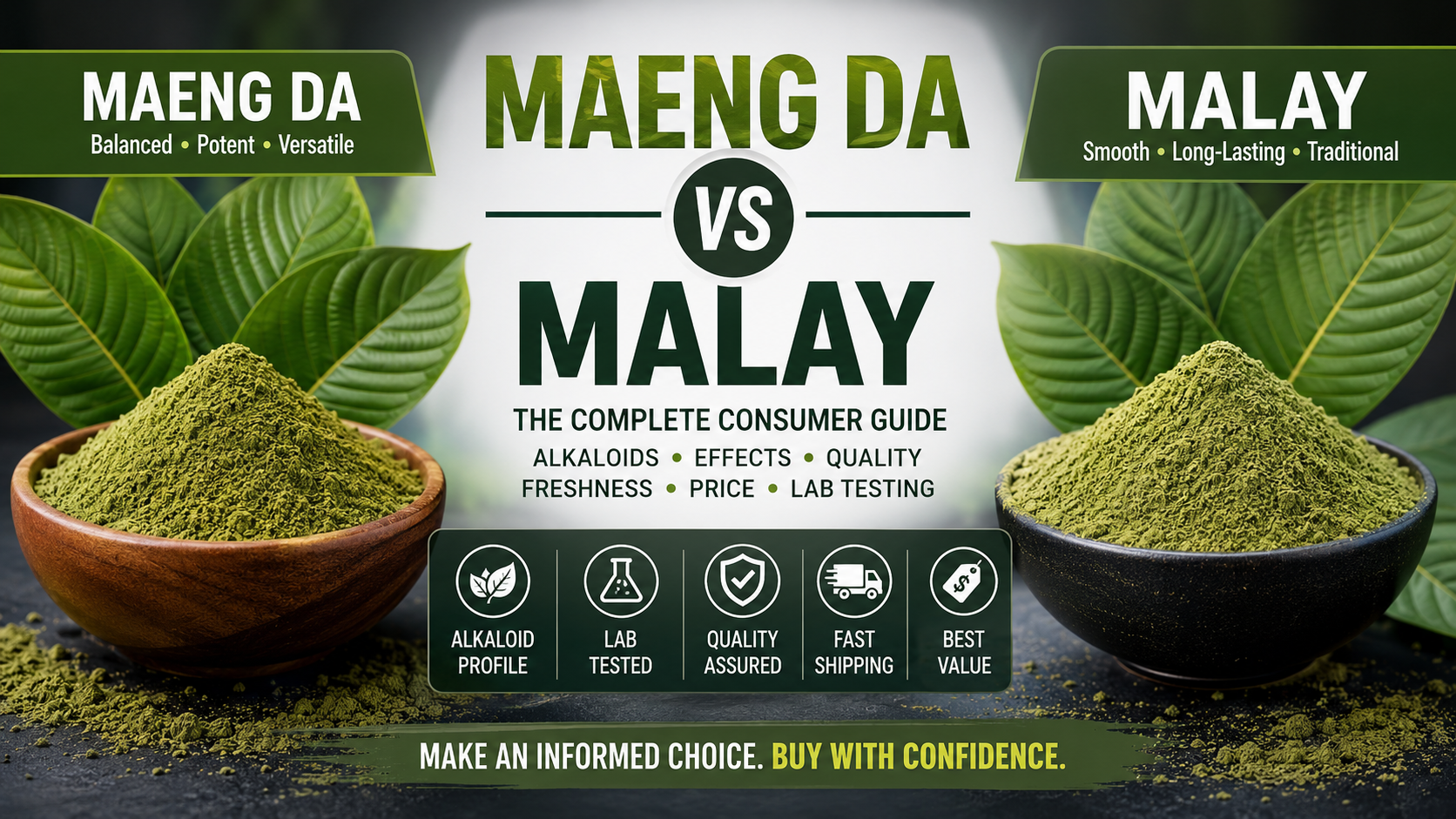
Maeng Da vs Malay Is More Complicated Than the Label Suggests
The primary difference between Maeng Da and Malay kratom lies in their post-harvest processing and alkaloid distribution. Maeng Da typically undergoes strict indoor, dark-curing to preserve a high, unbuffered concentration of mitragynine for rapid onset. Conversely, Malay utilizes a hybrid sun-drying protocol that allows secondary alkaloids like paynantheine and speciogynine to mature, providing an elongated endurance profile.
When consumers search for maeng da vs malay, they are usually looking for a straightforward answer: which type is stronger, which lasts longer, which is better quality, and which represents the better value?
The problem is that kratom naming conventions do not work like standardized pharmaceutical classifications. “Maeng Da” and “Malay” are widely used commercial names, but the names themselves do not guarantee a fixed chemical composition, geographic origin, alkaloid concentration, drying process, or laboratory-tested quality level.
That distinction is central to any serious maeng da vs malay comparison.
Kratom is derived from Mitragyna speciosa, a plant native to Southeast Asia. Its leaves contain numerous alkaloids, with mitragynine generally representing the principal alkaloid in many ordinary leaf products. Other constituents include speciociliatine, speciogynine, paynantheine, corynantheidine, and smaller quantities of 7-hydroxymitragynine.
Modern analytical research demonstrates that kratom chemistry can vary according to genetics, season, geographic origin, plant part, harvesting conditions, and post-harvest processing. Consequently, two packages carrying the same commercial name can have meaningfully different laboratory profiles.
For that reason, Kratom Verdict approaches maeng da vs malay as a consumer-quality question rather than simply a “which strain is stronger?” question.
The better question is:
What does the actual product contain, how consistently is it manufactured, and can the seller prove those claims with credible laboratory documentation?
This guide examines those questions in detail.
Important consumer note: Kratom has pharmacologically active compounds and can carry risks, including dependence and adverse effects. Laws and regulations also vary substantially by jurisdiction. This comparison is educational and does not recommend a particular product, dose, or method of use.
Buying Option
Quick-Glance Consumer Takeaways
Before going deeper into maeng da vs malay, here is the practical comparison framework a consumer should use.
- Procurement Speed: Neither “Maeng Da” nor “Malay” inherently guarantees faster fulfillment. Shipping speed depends primarily on inventory location, processing time, carrier selection, and destination restrictions.
- Pricing per Gram: The commercial name alone does not establish fair value. Compare the actual weight, laboratory documentation, manufacturing standards, and delivered cost rather than assuming a premium name represents superior chemistry.
- Third-Party Lab Transparency: This should outweigh strain labeling. A credible certificate of analysis should identify the tested sample, laboratory, testing methodology, date, and relevant analytical results.
- Product Freshness: Freshness depends on harvesting, drying, packaging, storage, moisture control, and time since production—not simply whether the package says Maeng Da or Malay.
- Chemical Consistency: Neither commercial label should be treated as a standardized alkaloid specification.
- Mitragynine Content: Laboratory analysis is more meaningful than assumptions based on color, marketing terminology, or strain reputation.
- Processing Quality: Drying and post-harvest handling can alter measured alkaloid concentrations.
- Consumer Confidence: Traceability, batch-specific testing, contamination screening, and transparent labeling provide stronger evidence than strain mythology.
That last point is particularly important when comparing maeng da vs malay.
What Do “Maeng Da” and “Malay” Actually Mean?
Maeng Da as a Commercial Category
“Maeng Da” is commonly marketed as a premium or distinctive kratom category. The name is associated with Thai-language terminology and has become widespread in international kratom commerce.
However, consumers should not assume that every product marketed as Maeng Da comes from one genetically uniform cultivar.
The label can describe a commercial product category rather than a scientifically standardized botanical variety.
This creates an important distinction between:
- botanical identity,
- geographic origin,
- cultivar or genotype,
- vein/color terminology,
- drying method,
- final powder,
- and commercial branding.
A consumer reading maeng da vs malay comparisons online may encounter strong claims about predictable effects. Those claims often go considerably further than the available scientific evidence permits.
Malay as a Commercial Category
“Malay” generally refers to a commercial category associated with Malaysia or the broader Malay region.
Again, the name should not automatically be interpreted as proof that a particular package originated from a specific Malaysian farm.
A genuine geographic-origin claim requires traceability.
Ideally, a supplier should be able to explain:
- where the botanical material originated,
- when it was harvested,
- how it was processed,
- where it was manufactured or packaged,
- which batch was tested,
- and whether the laboratory report corresponds to the exact batch being sold.
Without that information, “Malay” remains primarily a commercial descriptor.
This is one of the most important lessons from a rigorous maeng da vs malay analysis.
Maeng Da vs Malay: Why the Name Does Not Predict the Chemistry
Mitragynine Is a Better Analytical Starting Point
Mitragynine is one of the most abundant kratom alkaloids and is frequently used as a measurable marker when researchers analyze kratom material.
Validated chromatographic methods have been developed for measuring mitragynine and 7-hydroxymitragynine in kratom raw materials and finished products.
However, one laboratory result should not be mistaken for a complete description of the botanical.
A useful certificate of analysis may examine multiple alkaloids rather than reporting only one number.
That matters because two samples can have similar mitragynine concentrations while differing in their broader alkaloid profiles.
Research has identified multiple naturally occurring alkaloids in kratom, including mitragynine, speciociliatine, speciogynine, paynantheine, corynantheidine, and others. Advanced LC-MS/MS techniques can simultaneously quantify several of these constituents.
Therefore, when evaluating maeng da vs malay, consumers should resist the temptation to treat a strain name as a chemical specification.
7-Hydroxymitragynine Requires Particular Attention
7-hydroxymitragynine is naturally present in kratom leaves at much lower concentrations than mitragynine.
Research has reported trace-level quantities in authentic leaf material, while newer analytical work has highlighted substantial differences between ordinary botanical material and certain concentrated commercial products.
This distinction is important because products marketed with unusually high levels of specific alkaloids should not automatically be assumed to be equivalent to ordinary dried leaf powder.
A sophisticated laboratory program should therefore distinguish naturally occurring botanical alkaloids from concentrated or otherwise altered formulations.
Maeng Da vs Malay and the Importance of Alkaloid Profiles
Total Alkaloids Are Not the Whole Story
Consumers often ask whether Maeng Da contains more alkaloids than Malay.
There is no scientifically reliable universal rule that one commercial name always contains more alkaloids than the other.
A particular batch of Maeng Da might test higher than a particular batch of Malay.
A different harvest could produce the opposite result.
That variability is not merely theoretical.
Recent research found substantial effects from genotype, season, withering duration, and drying temperature on kratom alkaloid composition.
Therefore, the strongest comparison is not:
“Maeng Da is stronger than Malay.”
It is:
“This specific batch contains this measured alkaloid profile, according to this laboratory report.”
That is a far more defensible consumer standard.
Alkaloid Ratios Can Also Matter
A laboratory report containing multiple alkaloids can provide additional information about chemical composition.
For example, a report might identify:
- mitragynine,
- 7-hydroxymitragynine,
- speciociliatine,
- speciogynine,
- paynantheine,
- corynantheidine,
- and other measurable compounds.
The relative proportions can provide a more detailed chemical fingerprint than a single “potency” number.
This is another reason maeng da vs malay should be evaluated batch by batch rather than through generalized internet claims.
How Geography Can Influence Kratom Chemistry
Southeast Asian Origin Does Not Mean Chemical Uniformity
Kratom grows across tropical regions of Southeast Asia, but plants growing in different environments can experience different conditions.
Variables can include:
- soil composition,
- rainfall,
- temperature,
- sunlight,
- elevation,
- seasonal variation,
- plant age,
- genetics,
- harvesting practices,
- and post-harvest handling.
Recent research examining different botanical samples found significant differences associated with geographic origin and plant characteristics.
That means “Malay” cannot reasonably be treated as a guarantee of one fixed alkaloid profile.
Likewise, “Maeng Da” should not automatically be interpreted as a chemically superior category.
Genotype May Matter More Than Marketing Names
The genetic identity of the plant can influence alkaloid biosynthesis.
Two plants grown under similar conditions can potentially produce different chemical profiles because they are genetically different.
Conversely, plants marketed under different commercial names can sometimes exhibit overlapping chemical characteristics.
This is why scientifically rigorous research increasingly focuses on measurable phytochemistry rather than consumer-facing strain terminology.
Maeng Da vs Malay: Indoor Drying, Sun-Drying, and Post-Harvest Processing
Processing is one of the most overlooked variables in a maeng da vs malay comparison.
Consumers often focus on the name printed on the package while overlooking what happened between harvesting and final packaging.
Why Withering Matters
Withering is the period during which freshly harvested leaves lose moisture before or during drying.
A 2025 study investigating post-harvest processing found that withering could substantially alter measured mitragynine concentrations, with effects differing by cultivar. The study also found changes in other alkaloids, including speciogynine and paynantheine.
This demonstrates why the simplistic assumption that the plant’s alkaloid profile is fixed at harvest is inadequate.
Low-Temperature Drying
The same research found that lower drying temperatures generally preserved mitragynine, speciogynine, and paynantheine better than higher-temperature treatments in the tested materials.
That does not mean every consumer should automatically equate low-temperature processing with superior quality.
Rather, it means processing conditions are chemically relevant.
Sun-Drying
Traditional or controlled sun-drying can expose leaves to:
- sunlight,
- ultraviolet radiation,
- fluctuating temperatures,
- ambient humidity,
- environmental contaminants,
- and variable drying rates.
The actual effect depends heavily on the process.
“Sun-dried” therefore describes a processing approach—not a laboratory-certified quality grade.
Indoor Drying
Indoor drying can offer greater environmental control when properly managed.
Potential advantages include better control over:
- temperature,
- humidity,
- airflow,
- contamination exposure,
- drying time,
- and batch consistency.
But indoor production is not automatically superior.
Poorly managed indoor facilities can still produce microbial contamination or inconsistent moisture levels.
The important question is whether the producer controls and documents the process.
Why Product Freshness Matters in Maeng Da vs Malay
Freshness is frequently misunderstood.
A package being recently shipped does not necessarily mean the underlying plant material was recently harvested.
There can be substantial time between:
- harvesting,
- drying,
- milling,
- bulk storage,
- packaging,
- distribution,
- and final delivery.
Therefore, “freshness” should be evaluated using traceability rather than shipping speed alone.
Moisture Control
Moisture is a major quality-control variable for dried botanical powders.
Excessive moisture can create conditions favorable to microbial growth and can affect storage stability.
A credible manufacturer should have documented controls for:
- moisture,
- sanitation,
- storage conditions,
- packaging,
- and microbial testing.
Packaging
Good packaging should protect the powder from environmental exposure.
Relevant factors include:
- moisture barrier performance,
- light exposure,
- oxygen exposure,
- seal integrity,
- lot identification,
- and storage conditions.
A premium-looking pouch is not evidence of superior chemistry.
Batch traceability is much more valuable.
Maeng Da vs Malay: What a Real Laboratory Report Should Show
Batch Identification
A laboratory report should ideally identify the tested batch or lot.
If a website displays a laboratory certificate with no obvious connection to the batch currently being sold, its evidentiary value is reduced.
Consumers should look for matching:
- lot number,
- product name,
- manufacturing date,
- sample identification,
- and testing date.
Laboratory Identity
The report should identify the laboratory responsible for testing.
Consumers should be able to determine whether the laboratory appears to operate independently and whether the testing methodology is appropriate for the claimed analytes.
Analytical Methodology
For alkaloid analysis, chromatographic techniques such as HPLC or LC-MS/MS can provide quantitative information.
Validated analytical methods have been developed for mitragynine and 7-hydroxymitragynine testing.
More advanced analytical approaches can distinguish closely related compounds and reduce the possibility of misidentification.
Recent research specifically highlighted analytical challenges in distinguishing 7-hydroxymitragynine from related compounds, demonstrating why sophisticated confirmation can matter.
Contaminant Testing
A meaningful quality program should not stop at alkaloids.
Testing may include:
- heavy metals,
- microbial contamination,
- pesticides,
- mycotoxins,
- and other relevant contaminants.
This is particularly important because independent testing has identified variable concentrations of toxic metals and microbial contamination in kratom products.
A 2024 assessment of published independent laboratory data also found that some kratom products could exceed certain elemental exposure limits depending on consumption assumptions.
How to Read a Kratom Certificate of Analysis
A consumer does not need to be a chemist to identify several basic quality indicators.
Check the Date
An old report may not accurately represent a newer production batch.
Batch-specific testing is more useful than a generic historical certificate.
Check the Lot Number
The certificate should ideally connect to the exact material being sold.
Check the Testing Panel
Ask whether the report includes more than just mitragynine.
A comprehensive quality program may include alkaloid analysis plus contaminant screening.
Check the Units
Laboratory results may appear as:
- percent by weight,
- milligrams per gram,
- micrograms per gram,
- or other units.
Consumers should make sure they understand what is actually being measured before comparing two certificates.
Check Detection Limits
A high-quality report should identify relevant limits of detection or quantification where appropriate.
A statement such as “not detected” is not necessarily equivalent to absolute zero.
It generally means the substance was below the method’s detection or quantification capability.
Maeng Da vs Malay: Pricing per Gram
Price is one of the easiest metrics to compare incorrectly.
A package priced at $X may appear inexpensive until its actual weight is considered.
For a meaningful maeng da vs malay pricing comparison, calculate the effective cost per gram.
The basic formula is:
Total product price ÷ net product weight = price per gram
But even this calculation is incomplete.
Consumers should also consider:
- shipping charges,
- taxes where applicable,
- minimum-order requirements,
- discounts,
- subscription pricing,
- laboratory transparency,
- and product traceability.
A cheaper product without credible testing may not represent better consumer value.
Avoid Paying for a Name Alone
Commercial names can command premium pricing.
That does not automatically mean the underlying botanical material contains proportionally more measurable alkaloids.
A rational purchasing analysis should therefore ask:
What evidence supports the price difference?
If one batch costs considerably more but provides no additional laboratory transparency, traceability, or manufacturing information, the consumer should question whether the premium is justified.
Maeng Da vs Malay: Procurement Speed and Shipping Claims
Procurement speed is frequently confused with product quality.
A vendor can ship rapidly while selling poorly documented material.
Another supplier can take longer to process orders while maintaining stronger batch controls.
Therefore, shipping speed should be considered separately from quality.
What Determines Procurement Speed?
Factors can include:
- warehouse location,
- inventory availability,
- order processing time,
- carrier service,
- weekends and holidays,
- destination regulations,
- and customs requirements.
The strain name itself does not determine shipping speed.
Why “In Stock” Matters
A vendor may advertise multiple varieties but hold limited physical inventory.
Consumers seeking transparency should distinguish between:
physically stocked inventory
and
products available for future fulfillment.
That distinction becomes especially relevant when comparing current availability of Maeng Da and Malay products.
Buying Option
Maeng Da vs Malay: Product Freshness Versus Shipping Freshness
A product arriving quickly is not necessarily chemically fresher.
Imagine two scenarios.
Supplier A stores bulk powder for several months before packaging it and ships within 24 hours.
Supplier B packages well-controlled batches closer to production but takes several days longer to fulfill an order.
Supplier A may deliver faster, but Supplier B could potentially provide better batch traceability.
This is why the maeng da vs malay question should include both logistics and production history.
The consumer should not confuse:
- fast shipping,
- recent packaging,
- recent harvesting,
- and chemical freshness.
They are different concepts.
Why Color Should Not Decide Maeng Da vs Malay
Kratom consumers often use color as a shortcut for identifying product characteristics.
But color can be influenced by:
- plant genetics,
- leaf maturity,
- drying conditions,
- processing temperature,
- oxidation,
- storage,
- and blending.
Research examining post-harvest processing observed noticeable changes in powder color under different drying conditions.
Consequently, visual inspection is not a substitute for laboratory analysis.
A bright green powder is not automatically better.
A darker powder is not automatically older.
A red or brown appearance does not by itself establish superior processing.
The same principle applies to maeng da vs malay.
Read these comparison as well
- White Kratom vs Green Kratom
- Gold Kratom vs Yellow Kratom
- Horn Kratom vs Elephant Kratom
- Bali vs Maeng Da Kratom
- Borneo vs Sumatra Kratom
- Thai vs Malay Kratom
- Kapuas vs Riau Kratom
Readers who want to explore the scientific and quality standards discussed in this Red Bali vs Red Borneo comparison can review educational resources published by the National Institutes of Health (NIH), the U.S. Food and Drug Administration (FDA), the National Center for Biotechnology Information (NCBI), the American Kratom Association (AKA), and U.S. Pharmacopeia (USP). These organizations provide publicly available information on botanical research, laboratory testing, manufacturing quality standards, Certificates of Analysis (COAs), and consumer education.
Maeng Da vs Malay and the Problem of “Strain Effects”
Online discussions frequently describe Maeng Da as having a particular predictable profile and Malay as having another.
Such descriptions can be useful as consumer folklore, but they should not be confused with controlled clinical evidence.
Commercial names do not create standardized pharmaceutical preparations.
One reason is chemical variability.
Another is that consumer products may differ in:
- alkaloid concentration,
- botanical source,
- processing,
- batch age,
- extraction,
- and formulation.
A study examining real-world kratom experiences found that effects varied by product type and that firm dose-response conclusions for specific alkaloids require controlled experimentation.
Therefore, responsible maeng da vs malay content should avoid presenting anecdotal strain reputations as guaranteed outcomes.
What “Premium” Should Actually Mean
The word “premium” has limited value unless it is supported by measurable quality controls.
A genuinely stronger quality proposition should involve evidence such as:
Traceability
The supplier can identify where material originated and which batch was tested.
Batch Testing
The certificate corresponds to the material being sold.
Independent Analysis
Testing is performed by a credible laboratory rather than merely an internal quality-control document.
Contaminant Screening
The testing program looks beyond alkaloids.
Consistent Manufacturing
The supplier demonstrates repeatable processes rather than relying on subjective visual grading.
Transparent Documentation
The consumer can actually inspect relevant certificates.
These criteria are much more useful than a “premium” label.
Maeng Da vs Malay: Indoor Production and Quality Control
Controlled indoor environments can provide advantages when they are professionally managed.
A producer may be able to control:
- drying temperature,
- humidity,
- airflow,
- sanitation,
- handling,
- storage,
- and packaging.
This can potentially improve consistency.
But consumers should avoid assuming that “indoor” is inherently synonymous with better.
The critical question is:
What quality-control evidence accompanies the production method?
If a company claims superior indoor processing but provides no laboratory evidence, the claim remains largely promotional.
Why Independent Testing Is More Valuable Than Marketing Copy
Marketing language is designed to persuade.
Laboratory data is designed to measure.
Those are fundamentally different functions.
For a maeng da vs malay comparison, laboratory results can answer questions that marketing descriptions cannot.
For example:
- How much mitragynine was measured?
- Was 7-hydroxymitragynine detected?
- Were heavy metals tested?
- Were microbial contaminants tested?
- Was the sample associated with a specific lot?
- When was the sample tested?
- Which analytical method was used?
These questions transform a subjective comparison into a measurable quality assessment.
Red Flags Consumers Should Watch For
Unsupported Potency Claims
Statements such as “strongest ever” or “maximum potency” should be treated cautiously unless supported by quantitative testing.
Generic Certificates
A certificate with no lot number or clear product connection provides limited batch-level assurance.
Extremely Old Reports
An old certificate cannot automatically establish the quality of current inventory.
Missing Contaminant Testing
Alkaloid testing alone does not establish the absence of heavy metals or microorganisms.
Unclear Origin Claims
“From Malaysia” or “Thai Maeng Da” should ideally be supported by traceability rather than simply appearing on a label.
Unusually High Alkaloid Claims
Extremely high reported values deserve closer scrutiny regarding whether the product is ordinary leaf powder, an extract, or another concentrated formulation.
No Manufacturing Information
Consumers should be cautious when a seller provides virtually no information about production, storage, testing, or batch control.
Maeng Da vs Malay: A Better Consumer Scoring Framework
Instead of asking which label wins, consumers can evaluate each product using five evidence categories.
1. Chemical Transparency
Can the supplier show actual alkaloid results?
2. Contaminant Control
Can the supplier document testing for relevant contaminants?
3. Batch Traceability
Can the certificate be connected to the specific lot?
4. Manufacturing Transparency
Does the supplier explain how material is dried, processed, stored, and packaged?
5. Commercial Value
Does the total price make sense relative to weight and quality evidence?
This framework produces a more defensible answer to maeng da vs malay than simply repeating strain stereotypes.
Maeng Da vs Malay: Which One Is Better?
There is no scientifically defensible universal winner.
If the question is:
“Which commercial name guarantees a superior product?”
The answer is neither.
If the question is:
“Which individual batch has the better documented quality profile?”
That can potentially be answered through laboratory reports and manufacturing documentation.
A well-documented Malay batch may be a better consumer choice than poorly documented Maeng Da.
Likewise, a transparent Maeng Da batch may be preferable to a poorly documented Malay product.
The evidence should determine the verdict.
Maeng Da vs Malay: Which One Has More Mitragynine?
There is no universal fixed answer.
Published research demonstrates substantial variability in mitragynine concentrations across kratom materials and commercial products. One investigation of commercial samples found mitragynine concentrations ranging from 3.9 to 62.1 mg/g.
Those findings demonstrate why consumers should avoid assuming that the commercial name alone determines alkaloid concentration.
If two products are being compared, the most meaningful evidence is their respective laboratory results.
Even then, the testing methods should be comparable.
A result from one laboratory using one analytical protocol should not automatically be compared numerically with a result generated by a substantially different methodology.
Maeng Da vs Malay: Which One Is Fresher?
Again, the label cannot answer the question.
Freshness depends on:
- harvest timing,
- drying,
- moisture control,
- storage,
- packaging,
- inventory turnover,
- and distribution.
A vendor with strong inventory rotation and documented batch production can provide better evidence of freshness than a vendor that simply uses the word “fresh” in product descriptions.
Consumers should look for dates and lot information rather than relying on color or marketing language.
Maeng Da vs Malay: Which One Is Better Value?
The best value is not necessarily the lowest price.
Consider a hypothetical comparison.
Product A costs less per gram but has:
- no visible batch certificate,
- limited manufacturing information,
- unclear contaminant testing,
- and uncertain traceability.
Product B costs more per gram but has:
- batch-specific alkaloid analysis,
- contaminant screening,
- identifiable laboratory documentation,
- clear lot information,
- and transparent manufacturing controls.
Product B may represent stronger value from a consumer-risk perspective, even if its sticker price is higher.
That is the kind of analysis a serious maeng da vs malay guide should provide.
The Importance of Regulatory Awareness
Kratom’s legal status differs between jurisdictions, states, cities, and countries.
Consumers should verify current local rules before purchasing, possessing, transporting, or using kratom.
Regulatory conditions can also change.
This is particularly important for international orders, where a product that is legally marketed in one jurisdiction may face restrictions elsewhere.
Consumers should therefore evaluate legal status independently rather than assuming that online availability means universal legality.
Maeng Da vs Malay: A Practical Due-Diligence Checklist
Before Comparing Prices
Verify:
- net weight,
- delivered price,
- batch identification,
- laboratory documentation,
- and testing date.
Before Comparing Alkaloid Claims
Verify:
- testing method,
- units,
- sample identification,
- mitragynine measurement,
- 7-hydroxymitragynine measurement,
- and whether other alkaloids were analyzed.
Before Comparing Freshness
Verify:
- production date,
- packaging date where available,
- storage conditions,
- moisture control,
- and inventory practices.
Before Comparing Suppliers
Verify:
- laboratory transparency,
- contaminant testing,
- manufacturing information,
- traceability,
- customer-service transparency,
- and current legal restrictions.
This process makes maeng da vs malay a genuine consumer comparison instead of a marketing contest.
Why Third-Party Laboratory Transparency Should Be the Tie-Breaker
If two products appear similar, laboratory transparency can provide the most meaningful differentiator.
A supplier willing to publish relevant batch testing gives consumers an opportunity to independently evaluate claims.
This is especially valuable because published research has repeatedly demonstrated variability in kratom alkaloid composition and contamination risk.
The presence of a laboratory report does not automatically guarantee that a product is safe or appropriate for every individual.
But the absence of meaningful quality documentation leaves consumers with considerably less evidence.
What Kratom Verdict Looks for in a High-Quality Product
At Kratom Verdict, the consumer-protection approach should focus on evidence rather than hype.
A strong vendor profile should ideally demonstrate:
Transparent Batch Testing
Reports should correspond to actual production lots.
Alkaloid Quantification
The report should identify relevant measurable alkaloids using appropriate analytical methods.
Contaminant Screening
Testing should address relevant microbial and chemical contaminants.
Traceability
The supplier should be able to explain the product’s journey from raw botanical material to finished package.
Clear Product Identity
Commercial terminology should not replace actual product information.
Current Documentation
Quality information should be updated rather than relying indefinitely on old certificates.
Final Verdict: Maeng Da vs Malay
The most important conclusion from this maeng da vs malay investigation is simple:
The label is not the laboratory result.
Maeng Da may be marketed as a premium category, while Malay may be marketed around geographic or traditional associations. But neither name creates a guaranteed chemical profile.
Modern research shows that kratom alkaloid composition can be influenced by genetics, geography, season, plant material, withering, drying temperature, and processing.
That means the strongest consumer decision should be based on the specific batch, not merely the name printed on the package.
For shoppers comparing Maeng Da vs Malay, the priority order should therefore be:
- Verify the exact product and batch.
- Review independent laboratory testing.
- Check mitragynine and other reported alkaloids.
- Look for appropriate contaminant testing.
- Evaluate production and storage transparency.
- Compare actual price per gram.
- Assess shipping and inventory information separately from product quality.
- Confirm current legal restrictions in the destination jurisdiction.
- Avoid treating color, marketing language, or strain reputation as scientific proof.
In other words, the better question is not simply:
“Maeng Da or Malay?”
It is:
“Which specific product can demonstrate the strongest combination of laboratory transparency, traceability, manufacturing controls, freshness documentation, and reasonable market value?”
That is the standard consumers can apply across virtually every kratom category—not just Maeng Da and Malay.
Before making a decision, consumers should also remember that kratom contains pharmacologically active compounds and that scientific understanding of long-term effects, product variability, and concentrated formulations continues to develop. A cautious, evidence-based approach is therefore more appropriate than relying on exaggerated strain claims.
Before you purchase any product or commit your household budget, verify live vendor compliance scores, audit certified laboratory sheets, and compare current wholesale market pricing data directly at KratomVerdict.com!