- Written By Distinguished Professor Christopher R. McCurdy
- Reviewed by Kratom Verdict Editorial Team
- Last Updated: August 2026
- Estimated Reading Time: 17 Minutes
- Review Type: Independent Editorial Brand Review
Finding the best kratom vendors in 2026 should involve much more than comparing prices, strain names, customer testimonials or claims of “premium” quality. Kratom is a botanical product sold in a complicated regulatory environment, and meaningful differences can exist between vendors in laboratory testing, Certificates of Analysis (COAs), batch traceability, contaminant screening, product labeling and manufacturing transparency.
For Kratom Verdict, those differences matter more than marketing.
Our current shortlist includes established vendors such as Jack Botanicals, Super Speciosa, Kats Botanicals, Golden Monk and Kraken Kratom because each provides publicly verifiable quality or laboratory-testing information worth examining. However, inclusion here is not a guarantee that every product or future batch will meet the same standard.
The right question is therefore not simply, “Who sells the strongest kratom?”
It is:
Which vendors give consumers enough current evidence to independently investigate what they are buying?
That is the standard behind this guide.
Best Kratom Vendors: Our 2026 Evaluation Standard
The best kratom vendors should make verification easier rather than asking consumers to trust marketing language.
Kratom Verdict considers the following factors especially important:
- Third-party laboratory testing
- Batch-specific COA accessibility
- Lot or batch traceability
- Heavy-metal screening
- Microbial/pathogen screening
- Alkaloid reporting where appropriate
- Clear product identification
- Manufacturing transparency
- Responsible marketing claims
- Shipping disclosures
- Refund and return information
- Accessible customer support
- Publicly verifiable quality claims
No single badge automatically creates a trustworthy vendor.
Likewise, popularity does not establish product quality. A company can have thousands of reviews while providing limited information about the batch currently being sold.
For that reason, our assessment of the best kratom vendors gives substantial weight to evidence consumers can independently inspect.
Quick Comparison of Kratom Vendors Worth Investigating
| Vendor | Notable Transparency Feature | Kratom Verdict Assessment |
|---|---|---|
| Jack Botanicals | Public laboratory-testing information and contaminant screening | Strong overall testing candidate |
| Super Speciosa | Exact batch lab-report lookup and QR access | Standout traceability system |
| Kats Botanicals | Lot-specific COA lookup and testing guidance | Strong COA transparency |
| Golden Monk | Searchable COAs and disclosed testing categories | Strong contaminant-testing transparency |
| Kraken Kratom | Detailed testing protocols and COA availability | Established quality-control candidate |
This comparison is intentionally documentation-focused.
Product inventories, prices, laboratory reports and policies can change. Consumers should therefore verify current information before ordering.
The best kratom vendors are not permanently entitled to that description. They must continue earning consumer confidence through current evidence.
1. Jack Botanicals — Strong Overall Testing Transparency
Jack Botanicals deserves consideration among the best kratom vendors because it publicly describes a multi-stage laboratory-testing process and makes testing documentation available to consumers.
According to the company’s current laboratory-testing page, its kratom products undergo contaminant testing that includes heavy metals, pesticides and microbial pathogens. Jack Botanicals also identifies laboratories used for different types of analysis.
That level of specificity is more useful than simply displaying a “lab tested” badge.
Buying Option
What We Like
The company’s public testing information addresses several questions consumers should ask:
- Are contaminants tested?
- Are laboratories identified?
- Is potency testing discussed?
- Are COA documents made available?
- Are different product formats addressed?
Jack Botanicals says its testing process applies to products including powder, capsules and tablets.
What Consumers Should Still Verify
No vendor should receive unlimited trust based on a testing-policy page.
Before purchasing, check whether the laboratory documentation available corresponds to the current product and whether the relevant batch can be identified.
Consumers should also look at the actual report rather than relying solely on the company’s summary of its testing program.
Kratom Verdict Assessment
Jack Botanicals remains a strong candidate among the best kratom vendors for consumers who prioritize laboratory testing and transparent quality-control information.
Editorial disclosure: Kratom Verdict may have commercial relationships with certain companies discussed in our content. Affiliate compensation does not determine our evaluation standards or remove the need to verify vendor claims independently.
2. Super Speciosa — Standout Batch Traceability
Super Speciosa provides one of the clearest examples of what consumer-facing batch traceability can look like.
Its current laboratory lookup system allows customers to enter the batch number printed on a kratom package and retrieve the corresponding report.
According to Super Speciosa, consumers can also scan the QR code on the product to access laboratory information for the exact batch.
This matters.
A generic laboratory report may establish that a product was tested.
A batch-specific report provides considerably stronger evidence that the documentation relates to the product a consumer actually received.
Why the System Stands Out
Super Speciosa explains that its smaller batches receive identifying batch numbers and that these numbers support traceability throughout the manufacturing process.
Its product pages also display laboratory information for certain current inventory, including batch and alkaloid data.
The company warns that shipped inventory can occasionally come from a different batch than the one displayed online, in which case the QR code on the package should be used.
That qualification is useful because it acknowledges a real limitation of online batch displays.
Kratom Verdict Assessment
Among the best kratom vendors reviewed here, Super Speciosa stands out particularly strongly for consumer-facing batch traceability.
The system illustrates an important principle:
The closer the connection between the package and its laboratory report, the more useful that report becomes.
3. Kats Botanicals — Strong COA Accessibility
Kats Botanicals also provides a consumer-facing system for locating laboratory results.
Its COA page instructs consumers to use the QR code and lot number printed on product packaging to locate third-party laboratory results associated with that batch.
Kats states that each kratom product passing its testing process has a COA associated with its specific batch.
What Consumers Can Check
Kats’ own laboratory guidance tells readers to examine information including:
- Laboratory identity
- Batch or lot number
- Testing date
- Mitragynine percentage
- Heavy-metal results
- Pathogen results
These are sensible elements for consumers to investigate.
Importantly, the existence of a COA is only the beginning. Consumers should actually read the document and determine whether it corresponds to their product.
Kratom Verdict Assessment
Kats Botanicals earns consideration among the best kratom vendors because its lot-specific lookup system gives consumers a practical route from package identification to laboratory documentation.
That is substantially more useful than asking buyers to accept a general purity claim.
4. Golden Monk — Detailed Public Quality-Control Information
Golden Monk provides unusually specific public information about its quality-control process.
The company’s current quality-control page states that it conducts multiple laboratory tests per ton and describes screening for microbes, heavy metals and alkaloids.
The heavy-metal panel it describes includes:
- Lead
- Arsenic
- Mercury
- Cadmium
It also identifies microbial screening and alkaloid testing involving mitragynine and 7-hydroxymitragynine.
Golden Monk further states that batch numbers associated with testing are printed on product packaging.
Its website includes searchable product COAs covering powders and capsules.
Why This Matters
Consumers researching the best kratom vendors should distinguish between two statements:
“Our products are tested.”
and
“Here is what we test, here is the batch, and here is the documentation.”
The second provides substantially more consumer value.
Kratom Verdict Assessment
Golden Monk is a noteworthy candidate for buyers who prioritize transparent contaminant-testing information and accessible COA documentation.
As with every company in this guide, current batch documentation should still be checked before purchase.
5. Kraken Kratom — Detailed Testing Protocols
Kraken Kratom has a long history in the U.S. kratom market and publishes detailed information concerning its quality-assurance and testing procedures.
Its current testing page says products are evaluated for identity, heavy metals and microbial safety.
The company specifically identifies testing for arsenic, cadmium, lead and mercury and describes microbial analyses involving organisms or indicators including E. coli and Salmonella.
Kraken also says consumers can request Certificates of Analysis.
Longevity Is Useful—but Not Proof
Operating history can provide useful information about a vendor, but it does not prove that today’s inventory is superior.
Current evidence still matters more.
That means checking:
- The current product
- Current laboratory documentation
- Batch information
- Product labeling
- Current company policies
Kratom Verdict Assessment
Kraken remains worth investigating among established best kratom vendors, particularly because it publicly explains specific testing procedures rather than relying solely on generalized quality language.
What “Lab Tested Kratom” Should Actually Mean
Almost every serious kratom seller understands that consumers want laboratory-tested products.
Unfortunately, the phrase itself can become marketing language.
When evaluating the best kratom vendors, Kratom Verdict recommends asking five questions.
1. Who Performed the Test?
Look for an identifiable laboratory.
2. What Was Tested?
Testing only for alkaloid concentration is different from testing for contaminants.
3. Which Batch Was Tested?
A laboratory result has greater consumer value when it can be connected to a specific lot.
4. When Was It Tested?
Old documentation may not represent current inventory.
5. Can the Consumer Access the Report?
Transparency is stronger when buyers can independently examine documentation rather than requesting vague assurances from customer service.
A vendor that answers all five questions clearly provides more useful evidence than one that simply prints “third-party tested” on its packaging.
The COA Test: How to Evaluate a Kratom Vendor in Minutes
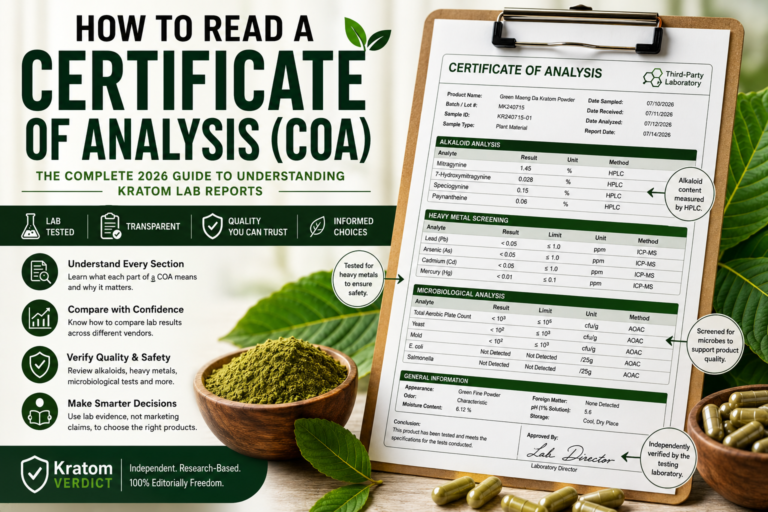
A Certificate of Analysis can seem complicated, but several basic checks require no scientific training.
Match the Lot Number
Start with the package.
Find the lot or batch number.
Then locate the same identifier on the laboratory documentation.
If there is no way to connect the two, ask why.
Check the Laboratory
Determine which laboratory performed the analysis.
Look for clear identifying information rather than assuming the vendor conducted independent testing because its marketing says so.
Check the Date
Agricultural products vary between harvests and batches.
A report should be sufficiently relevant to the inventory being evaluated.
Look for Contaminant Testing
Consumers researching the best kratom vendors should not focus exclusively on mitragynine.
Look for testing related to:
- Heavy metals
- Microbial contaminants
- Pathogens
- Alkaloid composition
Different laboratories and manufacturers may use different panels and reporting formats.
Understand “Not Detected”
Laboratory reports may use abbreviations such as ND, LOD and LOQ.
“Not detected” generally refers to a test result relative to the analytical method’s detection capabilities. It should not be casually interpreted as a philosophical guarantee that absolutely zero molecules of a substance exist.
That distinction is one reason actual laboratory reports provide more useful information than simplified marketing graphics.
Why Heavy-Metal Testing Is Important
Heavy-metal contamination is not merely theoretical.
FDA has previously analyzed commercial kratom products and reported concerns involving heavy metals. The agency’s current kratom information also references contamination concerns involving heavy metals and Salmonella.
For consumers, the practical implication is straightforward:
A potency report alone is not a complete quality picture.
Heavy-metal panels commonly examine substances such as lead, arsenic, cadmium and mercury.
This is why the best kratom vendors should provide meaningful contaminant information rather than using a mitragynine percentage as the sole evidence of product quality.
Why Microbial Testing Matters
Kratom originates as agricultural plant material.
Before reaching a consumer it may go through harvesting, drying, transportation, milling, storage and packaging.
Each stage creates quality-control considerations.
The FDA and CDC investigated a multistate Salmonella outbreak linked to kratom products in 2018. Historical events like this demonstrate why microbial screening and supply-chain controls matter.
A responsible vendor should therefore take microbiological quality seriously.
For Kratom Verdict, contaminant control is a core factor when comparing the best kratom vendors.
Buying Option
Batch Traceability: The Quality Signal Buyers Often Miss
Suppose a website displays a perfect laboratory report.
Now ask:
Does it belong to the bag being sold?
This question is surprisingly important.
Batch traceability creates a chain:
Product → Batch/Lot Number → Laboratory Report → Results
Systems used by vendors such as Super Speciosa and Kats Botanicals illustrate how this can work in practice.
Consumers can use identifiers printed on packaging to retrieve documentation associated with a particular batch.
The best kratom vendors should increasingly move toward this kind of consumer-verifiable system.
Does High Mitragynine Mean High Quality?
Not by itself.
Mitragynine is a major kratom alkaloid and its concentration can be useful product information.
But a higher number does not establish:
- Lower contaminant levels
- Better manufacturing
- Better batch traceability
- More accurate labeling
- Better customer service
- Suitability for a particular person
- Overall superiority
Potency and quality are different concepts.
Kratom Verdict therefore does not rank the best kratom vendors simply according to which company advertises the strongest product.
Natural Kratom Leaf vs Concentrated 7-OH: A Critical 2026 Distinction
The modern kratom marketplace requires consumers to pay attention to product type.
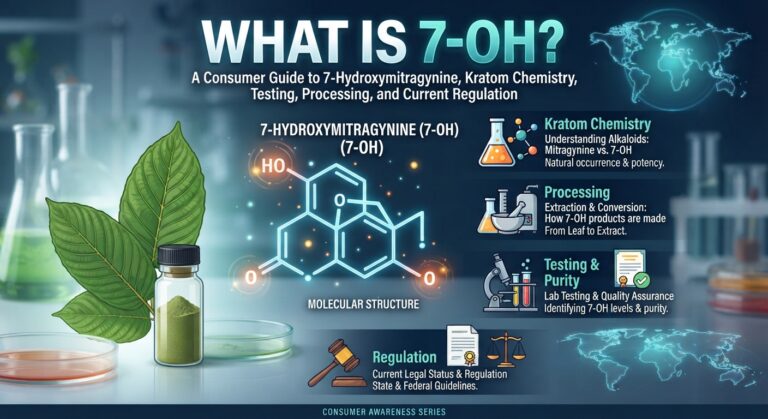
7-hydroxymitragynine, usually shortened to 7-OH, occurs naturally as a minor constituent of kratom leaf. However, highly concentrated 7-OH products have emerged as a separate regulatory and public-health concern.
FDA has specifically distinguished its actions involving concentrated 7-OH from natural kratom leaf products.
This distinction became even more important in 2026.
FDA reported that on July 1, 2026, the DEA announced the beginning of a temporary scheduling process involving 7-OH above a proposed threshold and three synthetic 7-OH derivatives not naturally occurring in the kratom plant. HHS simultaneously sought public input regarding the proposed threshold.
The regulatory process is evolving, so consumers should check current federal and state information rather than relying on older articles.
For vendor evaluation, the lesson is immediate:
Read the product label carefully.
Plain botanical leaf, conventional powder, extract and highly concentrated alkaloid products should not be treated as interchangeable.
The best kratom vendors should communicate these distinctions clearly.
Is Kratom FDA Approved?
No commercial kratom product should be assumed to be FDA approved.
FDA currently states that there are no prescription or over-the-counter drug products containing kratom or its known alkaloids legally on the U.S. market.
The agency also says kratom is not lawfully marketed as a dietary supplement or conventional food additive under its current interpretation of federal law.
This is an important consumer-protection point.
Terms such as:
- Lab tested
- GMP
- Facility registration
- Third-party tested
- AKA qualified
do not mean FDA approved.
If a seller uses regulatory-sounding language to imply that its ordinary kratom product has FDA approval, consumers should investigate carefully.
Responsible best kratom vendors should explain quality credentials accurately rather than allowing consumers to misunderstand what they mean.
What Does Current Human Research Tell Us About Kratom?
Kratom research is evolving, and responsible coverage requires acknowledging evidence that does not fit neatly into either “safe” or “dangerous” narratives.
A randomized, double-blind, placebo-controlled study published in Therapeutic Drug Monitoring in 2026 evaluated a standardized dried kratom leaf powder in 116 healthy volunteers.
The study reported no serious adverse events or deaths under the tested conditions. Treatment-emergent adverse events generally increased with dose, and the researchers concluded that the specific preparation was well tolerated at the dose ranges studied.
That is meaningful controlled human evidence.
But its limitations matter.
The participants were selected healthy adults, the study evaluated a specific characterized preparation, and its findings should not automatically be generalized to every commercial product, extract, concentrated 7-OH product, pattern of use or person with underlying medical conditions.
FDA’s broader position remains considerably more cautious. The agency warns about reported serious adverse events and states that significant scientific uncertainty remains.
The responsible conclusion is therefore neither “kratom is proven safe” nor “every kratom product has identical risk.”
The evidence depends on the product, exposure, individual and research question.
The best kratom vendors should not convert preliminary or product-specific research into sweeping medical assurances.
Medical Claims Are a Vendor Red Flag
Consumers report using kratom for many reasons, but consumer reports are not equivalent to FDA-approved medical indications.
A vendor deserves additional scrutiny if it claims its products can:
- Cure chronic pain
- Treat depression
- Treat anxiety
- Cure opioid addiction
- Replace prescribed medication
- Guarantee withdrawal relief
- Treat another disease
FDA has repeatedly acted against companies making unapproved therapeutic claims involving kratom.
A company does not become one of the best kratom vendors by making the most impressive health promises.
Responsible marketing is itself a quality signal.
Price: Cheap Kratom vs Genuine Value
Price matters to consumers, particularly when buying larger quantities.
But price-per-gram should not be the first filter.
Consider two hypothetical products.
Vendor A charges less but provides no batch-specific COA.
Vendor B costs slightly more but provides identifiable third-party laboratory documentation, lot traceability and contaminant screening.
The cheapest option may not represent the strongest documented value.
When comparing the best kratom vendors, Kratom Verdict recommends considering:
Price + testing + traceability + transparency + policies
rather than price alone.
Premium pricing does not guarantee premium quality either.
Expensive packaging and aggressive branding are not substitutes for evidence.
Shipping and Return Policies Matter
Laboratory quality is central, but a commercial vendor assessment should also consider what happens after checkout.
Before purchasing, review:
- Shipping costs
- Processing estimates
- Tracking availability
- Return window
- Refund conditions
- Opened-product restrictions
- Lost-package policies
- Customer-support channels
Policies can change, so check the current vendor website instead of relying on an old review.
The best kratom vendors should make commercial terms understandable before consumers pay.
The Kratom Verdict 12-Point Vendor Checklist
Use this framework whenever you encounter an unfamiliar seller.
1. Is the company identifiable?
Anonymous storefronts deserve extra scrutiny.
2. Are laboratory reports accessible?
Look beyond a testing logo.
3. Can the report be linked to a batch?
Batch-specific evidence is more useful.
4. Is the laboratory identifiable?
Consumers should know who generated the results.
5. Is heavy-metal screening included?
Potency alone is insufficient.
6. Is microbial testing addressed?
Agricultural contamination deserves attention.
7. Is alkaloid information provided?
This can help clarify product composition.
8. Is the product type clear?
Leaf, powder, extract and concentrated formulations should be distinguishable.
9. Are medical promises avoided?
Unapproved therapeutic claims are a warning sign.
10. Are shipping and return terms clear?
Commercial transparency matters.
11. Can customer support be reached?
A real support channel provides accountability.
12. Can major claims be independently verified?
The best kratom vendors should become more credible as you investigate them.
If a company’s credibility falls apart once you look beyond the homepage, reconsider the purchase.
Common Kratom Vendor Red Flags
Kratom Verdict recommends additional caution when a seller:
- Claims ordinary kratom is FDA approved
- Makes disease-treatment promises
- Provides no laboratory documentation
- Uses the same generic COA across unrelated products
- Provides reports with no useful batch connection
- Hides whether products are concentrated
- Treats high potency as proof of quality
- Uses unverifiable certification claims
- Provides minimal company information
- Has unclear refund or shipping terms
- Makes extraordinary claims unsupported by evidence
The best kratom vendors should not require consumers to suspend skepticism.
Transparency should survive scrutiny.
Online Kratom Vendor vs Local Smoke Shop
Buying online does not automatically guarantee better quality.
Neither does buying from a physical retailer.
The advantage of a transparent online vendor is that consumers may be able to investigate laboratory documentation, product information and company policies before purchasing.
But the relevant question remains:
Can the product itself be verified?
A physical retailer carrying well-documented products may provide better transparency than an online seller with vague testing claims.
Sales channel is therefore secondary to evidence.
How Kratom Verdict Separates Reputation From Evidence
Brand reputation can be useful.
It is not proof.
Customer reviews can help consumers understand issues such as:
- Shipping reliability
- Packaging
- Support responsiveness
- Ordering experience
They generally cannot establish:
- Heavy-metal concentration
- Microbial status
- Alkaloid composition
- Batch identity
- Laboratory accuracy
Those questions require different evidence.
This distinction is central to how we evaluate the best kratom vendors.
Consumer sentiment and laboratory documentation answer different questions, and a responsible review should not confuse them.
Frequently Asked Questions
What are the best kratom vendors in 2026?
The best kratom vendors should demonstrate current laboratory testing, batch traceability, contaminant screening, transparent labeling and responsible business practices. Jack Botanicals, Super Speciosa, Kats Botanicals, Golden Monk and Kraken Kratom are established vendors with publicly verifiable testing or quality information worth investigating. Consumers should still verify the current product and batch before buying.
Which kratom vendor has the best lab-testing transparency?
There is no single universally superior system. Super Speciosa offers particularly useful batch-specific laboratory lookup, Kats Botanicals provides lot-based COA access, Golden Monk publishes searchable COAs and testing information, Jack Botanicals describes contaminant and potency testing, and Kraken publishes detailed quality-control protocols. Compare the documentation relevant to the actual product you intend to purchase.
How do I find reputable kratom vendors online?
Start by looking for third-party laboratory documentation, identifiable batches, contaminant screening, clear product labeling, responsible claims, transparent company information and understandable commercial policies. Avoid choosing solely from advertisements or testimonials.
Should kratom vendors provide Certificates of Analysis?
COA accessibility is one of the strongest transparency signals available to consumers. A batch-specific report is generally more informative than a generic statement that products are laboratory tested.
What should a kratom COA contain?
Depending on the testing panel, useful information can include batch identification, laboratory identity, testing date, alkaloid analysis, heavy-metal screening and microbiological results. Consumers should determine exactly what a report covers rather than assuming all COAs contain the same tests.
Are AKA-qualified vendors automatically the best?
No. Industry manufacturing programs can provide useful information, but participation should be considered alongside current batch testing, COAs, contaminant screening, labeling and traceability. No single certification should replace due diligence.
Is stronger kratom higher quality?
No. Higher alkaloid concentration does not automatically mean better contaminant control, manufacturing or traceability. Kratom Verdict does not define the best kratom vendors by potency alone.
Are 7-OH products the same as regular kratom?
No. FDA distinguishes concentrated 7-OH products from natural kratom leaf, and federal regulatory activity involving concentrated 7-OH advanced substantially in 2025–2026. Consumers should identify the exact product type rather than treating all kratom-related products as equivalent.
Are expensive kratom vendors better?
Not necessarily. Price can reflect testing and manufacturing costs, but it can also reflect marketing and branding. Evaluate documented quality and transparency alongside price.
Can laboratory-tested kratom be considered completely safe?
No. Laboratory testing can provide useful information about composition and selected contaminants, but it cannot guarantee how a product will affect an individual. Health status, medications, other substances, product composition and patterns of use can matter. People with medical concerns should seek appropriately qualified professional guidance rather than relying on vendor claims.
Kratom Verdict: Final Assessment
The search for the best kratom vendors should not end with whichever company occupies the first position on a ranking table.
It should end with consumers knowing how to investigate vendors themselves.
That is the difference between a promotional ranking and a consumer guide.
Among the vendors reviewed, Jack Botanicals provides a strong overall testing-transparency proposition, while Super Speciosa stands out for its consumer-facing batch traceability system. Kats Botanicals also offers strong lot-specific COA accessibility, while Golden Monk provides detailed contaminant-testing information and searchable reports. Kraken Kratom remains notable for its detailed published quality-control protocols and long-standing market presence.
But none of those observations creates permanent approval.
The best kratom vendors must continue earning trust because batches change, inventory changes, laboratories change, suppliers change, policies change and regulations change.
Consumers should therefore verify today’s evidence.
Before purchasing, Kratom Verdict recommends asking:
Can I identify the batch?
Can I see the laboratory documentation?
Does the report actually match the product?
Were heavy metals and microbial contaminants addressed?
Is the product clearly identified as leaf, extract or another formulation?
Are company quality claims independently verifiable?
Are medical promises being avoided?
Are shipping, returns and customer-support policies clear?
These questions create a more durable buying standard than any static “top vendor” badge.
They also reveal something important about the kratom marketplace.
A company does not become trustworthy merely by telling consumers it is trustworthy.
Trust is stronger when consumers can verify the evidence for themselves.
That is why Kratom Verdict’s evaluation of the best kratom vendors prioritizes documentation, transparency, traceability and responsible communication over hype.
Our role is not to tell readers that one seller deserves unquestioned loyalty.
Our role is to investigate the details consumers should check before making decisions in the kratom market—and to update those assessments as the evidence changes.
The strongest vendor is not necessarily the one making the biggest promise. It is the one giving consumers the clearest evidence to evaluate that promise.
Sources & References
1. U.S. Food and Drug Administration — FDA and Kratom
Current federal overview covering kratom’s regulatory status, scientific research, reported adverse events, contamination concerns and FDA’s position regarding kratom products.
Source: FDA — FDA and Kratom
2. U.S. Food and Drug Administration — Hiding in Plain Sight: 7-OH Products
Current FDA information concerning concentrated 7-hydroxymitragynine products and the July 2026 federal regulatory developments involving 7-OH and synthetic kratom-related compounds.
Source: FDA — Hiding in Plain Sight: 7-OH Products
3. U.S. Food and Drug Administration — FDA Takes Steps to Restrict 7-OH Opioid Products Threatening American Consumers (2025)
FDA announcement explaining its regulatory action involving concentrated 7-OH and explicitly distinguishing that initiative from natural kratom leaf products.
Source: FDA — 7-OH Regulatory Action
4. U.S. Food and Drug Administration — Multistate Salmonella Investigation Linked to Kratom Products (2018)
Historical FDA information documenting the multistate Salmonella investigation and illustrating why microbial testing and supply-chain controls remain important consumer considerations.
Source: FDA — Kratom and Salmonella Investigation
5. Huestis MA et al. — Safety and Tolerability of Single and Multiple Daily Oral Doses of Dried Kratom Leaf Powder in a Randomized Trial in Healthy Volunteers (2026)
Randomized, double-blind, placebo-controlled human study evaluating a standardized dried kratom leaf preparation in 116 healthy volunteers.
Source: PubMed — Randomized Kratom Safety and Tolerability Study
6. Jack Botanicals — Laboratory Testing & COA Information
Official company documentation describing its laboratory-testing process, contaminant screening, identified testing laboratories and available laboratory reports.
Source: Jack Botanicals — Lab Tests
7. Super Speciosa — Laboratory Lookup
Official batch-number lookup allowing consumers to locate laboratory reports associated with individual kratom packages.
Source: Super Speciosa — Lab Lookup
8. Kats Botanicals — Certificate of Analysis Lookup
Official consumer-facing COA system using package QR codes and lot numbers to retrieve third-party laboratory results.
Source: Kats Botanicals — COA Lookup
9. Golden Monk — Kratom Quality Control Procedures
Official information describing microbial, heavy-metal and alkaloid testing as well as batch identification and public COA availability.
Source: Golden Monk — Quality Control and COAs
10. Kraken Kratom — Quality Assurance & Lab Testing
Official information describing testing for identity, heavy metals and microbial safety, together with the company’s COA-request process.
Source: Kraken Kratom — Lab Testing
Internal Resources
For additional research, readers may also find these Kratom Verdict guides useful:
Vendor Transparency
- How to Evaluate Kratom Vendors
- Vendor Transparency Checklist
- How to Identify a Trusted Kratom Vendor
- Best Kratom Vendors for Beginners
Laboratory Testing
- Third-Party Lab Testing Explained
- Kratom Lab Testing Explained
- Kratom Alkaloid Testing Guide
- How to Read a Kratom Certificate of Analysis
- How to Compare Kratom COAs
- AKA GMP Certification Explained