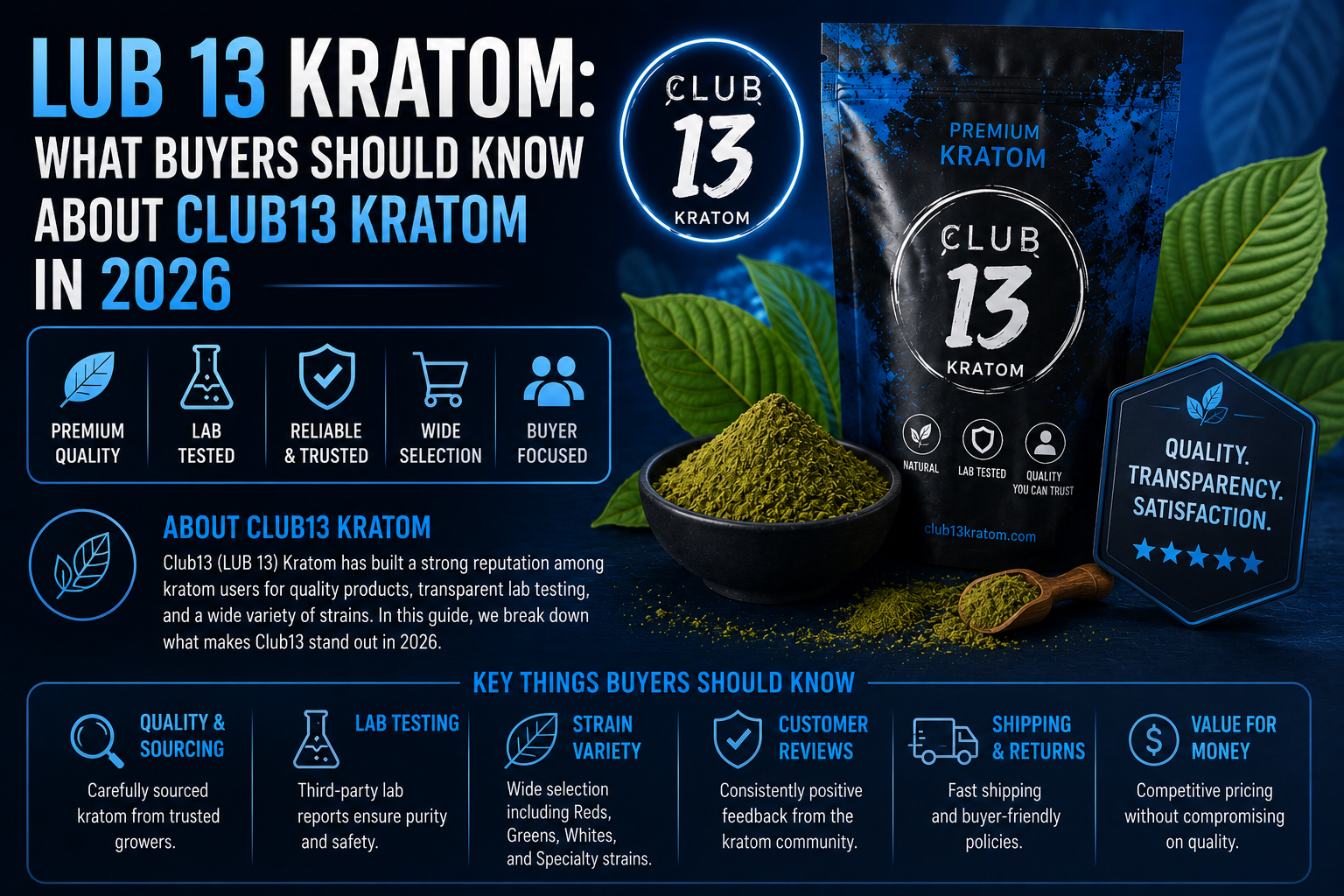
If you searched for lub 13 kratom, there is an important issue to clear up before looking at products, prices or reviews: current search evidence does not identify a prominent kratom company officially named “LUB 13.” Instead, searches for this phrase appear to overlap with Club13, an established U.S. kratom and kava company whose current website sells powders, capsules, extracts, beverages, gummies and other kratom products.
That distinction matters.
A consumer searching lub 13 kratom could reasonably be looking for Club13 Kratom after hearing the brand name verbally, encountering an incomplete product reference or entering a spelling variation into a search engine. Kratom Verdict found current Club13 product listings and company documentation, but we did not find authoritative evidence establishing “LUB 13” as a separate major kratom manufacturer.
For that reason, this guide does not invent a nonexistent brand history. Instead, it investigates the likely search intent behind lub 13 kratom, evaluates the publicly available Club13 information, examines its laboratory-testing claims and explains what consumers should verify before purchasing.
The short version: Club13 is a real kratom company with a broad current product catalog and publicly stated testing practices. Its website says products carry lot numbers connected to Certificates of Analysis and that batches undergo third-party testing. Those are useful transparency signals—but they should still be verified at the individual product and batch level.
LUB 13 Kratom: Is the Correct Brand Actually Club13?
Based on current search results, lub 13 kratom appears much more likely to refer to Club13 Kratom than to a distinct company called LUB 13.
Club13’s current official website identifies the business as Club13 Enterprises and states that it has operated since 1999. The company currently markets both kratom and kava products.
Its kratom catalog includes products such as:
- Powder
- Capsules
- Blends
- Liquid extracts
- Seltzers
- Shots
- Gummies
- Tablets
- Higher-strength formulations
This makes Club13 a plausible destination for users searching lub 13 kratom, particularly because current web searches for the exact phrase surface Club13-related product results while unrelated uses of “LUB 13” refer to non-kratom products.
Kratom Verdict therefore treats lub 13 kratom as an ambiguous or likely misspelled commercial search rather than pretending there is a verified separate kratom company under that exact name.
Buying Option
Why Search-Intent Accuracy Matters
Misspelled brand searches are common.
But they create a particular problem in kratom content.
A low-quality article can easily take a misspelled query and manufacture:
- A fictional company history
- Fake product specifications
- Invented reviews
- Unsupported laboratory claims
- Fake prices
- Fake certifications
That would be especially inappropriate for a botanical product involving health and safety considerations.
For lub 13 kratom, Kratom Verdict’s standard is different: separate what can actually be verified from what is merely inferred.
What we can verify
Club13 is a current kratom company with an active official website and product catalog.
The company says it manufactures products in its own cGMP-certified facility.
It says its kratom products are independently tested.
Current company pages say batches are screened for alkaloid content, heavy metals and microbiological contaminants.
The company also says products have lot numbers that can be used to locate laboratory reports.
What we cannot responsibly claim
We cannot establish that every person searching lub 13 kratom definitely means Club13.
We also cannot infer the quality of every current Club13 batch from a company-wide marketing statement.
That requires looking at the actual product and matching COA.
What Is Club13 Kratom?
Club13 describes itself as a kratom and kava company founded in 1999.
Its current website says the company controls sourcing, production and testing and produces products in its own facility.
Those statements come from Club13 itself and should therefore be understood as company claims, not independent scientific findings.
That distinction is important when researching lub 13 kratom.
A vendor’s official documentation is appropriate for verifying what the vendor says about:
- Manufacturing
- Product catalog
- Testing procedures
- Shipping
- Return policies
- Facility claims
It should not be treated as independent proof of clinical benefits or safety.
What Products Does Club13 Currently Sell?
Consumers arriving through a lub 13 kratom search will encounter a much broader product catalog than traditional loose kratom powder alone.
Current Club13 listings include multiple formats.
Kratom Powder
The company’s catalog includes traditional powder products marketed under commercial strain or blend names.
Examples currently listed include red, white and blended products.
Powder is comparatively straightforward to evaluate because consumers can compare:
- Net weight
- Lot number
- Price
- COA
- Mitragynine results
- Contaminant testing
Kratom Capsules
Club13 also sells capsule versions of several products.
Capsules can offer convenience, but buyers should still determine the total amount of kratom represented by the package rather than comparing capsule count alone.
Kratom Blends
The company currently markets blends combining different commercially named varieties.
For a consumer researching lub 13 kratom, blend names should be treated as product identifiers rather than scientific classifications proving a particular effect.
Extracts and Higher-Strength Products
Club13 also markets concentrated formulations.
These deserve additional scrutiny because extract products should not be compared gram-for-gram with ordinary leaf powder.
Kratom Beverages
Current offerings include kratom seltzers and shots.
These products should be evaluated based on their actual quantitative alkaloid information and ingredients rather than assuming that one bottle equals a conventional serving of leaf powder.
Club13’s Laboratory-Testing Claims
Laboratory transparency is one of the most important areas to investigate when evaluating lub 13 kratom.
Club13’s current official website says every batch is sent to a certified third-party laboratory and screened for:
- Alkaloid content
- Heavy metals
- Microbiological contaminants
Its product pages also state that products include lot numbers that consumers can use to look up corresponding laboratory reports.
That is a stronger transparency structure than simply placing the words “lab tested” on packaging.
But consumers should go one step further.
Match the COA to the actual lot number of the product being purchased.
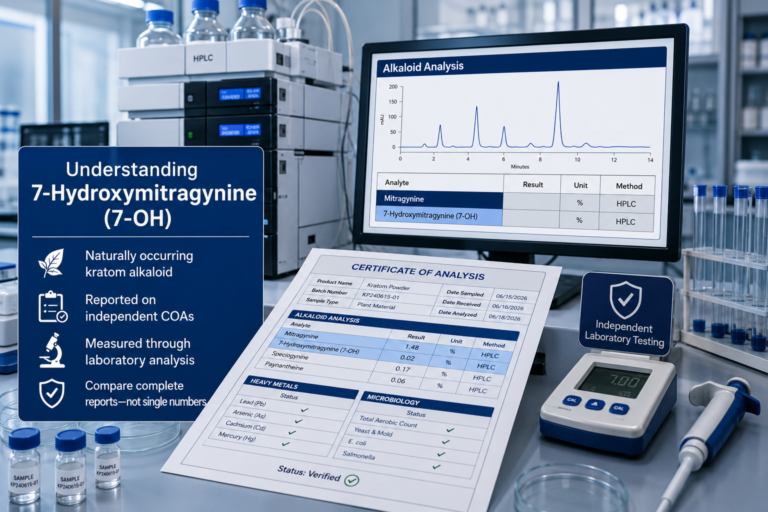
What Does a Club13 COA Actually Show?
Kratom Verdict located a Club13 Certificate of Analysis publicly hosted on the company’s domain for a sample received in April 2024.
The document identifies Club 13 Enterprises and includes a sample identifier and report ID.
The report includes testing categories for:
- Metals
- Kratom alkaloids
- Residual solvents
The specific sample reported numerical results for mitragynine and several other alkaloids, as well as measurements for arsenic, cadmium, lead and mercury.
This is useful evidence that laboratory documentation exists for at least that specific submitted sample.
However, someone researching lub 13 kratom should understand an important limitation:
A COA only documents the sample identified in that report.
It does not automatically establish the composition of another product or another batch manufactured months or years later.
The Most Important COA Rule: Match the Batch
Suppose you find a Club13 laboratory report online.
Before treating it as evidence about your product, compare:
Product name
Lot number
Sample identifier
Testing date
Laboratory
Tests performed
If your package has a different lot number, continue looking for the corresponding report.
This is one of the most useful practical checks consumers researching lub 13 kratom can perform.
A company may have excellent historical COAs while a consumer still needs documentation for the current batch.
What Should Be Tested?
A serious kratom quality-control program should consider more than alkaloid potency.
Heavy Metals
Relevant testing commonly includes metals such as:
- Lead
- Arsenic
- Cadmium
- Mercury
FDA has previously investigated heavy-metal concentrations in commercially available kratom products, making this a legitimate consumer-quality concern.
This does not mean Club13 products are contaminated.
Nor does it mean every kratom product contains unsafe metal concentrations.
It means consumers evaluating lub 13 kratom should look for actual contaminant results instead of assuming that botanical products are contaminant-free.
Microbial Contaminants
Botanical products can also face microbial-quality issues.
Testing may include organisms such as:
- Salmonella
- E. coli
- Yeast
- Mold
Club13 states that its testing program includes microbiological contaminants.
Again, the strongest verification is the batch-specific laboratory document.
Alkaloids
Mitragynine is one of the principal alkaloids associated with kratom.
Club13 says its products are tested for alkaloid content, and current product pages emphasize mitragynine testing.
For lub 13 kratom, alkaloid reporting can help consumers understand product composition, but a higher mitragynine number should not automatically be interpreted as higher quality.
Potency and quality are not the same thing.
What Science Says About Mitragynine
Mitragynine is a major psychoactive alkaloid in Mitragyna speciosa.
A 2024 review of mitragynine’s neuropharmacology described interactions involving opioid receptors as well as other neurological systems. Research continues to investigate its pharmacology, metabolism and toxicology.
Another recent review of kratom’s health effects describes a complex evidence base involving traditional use, self-reported effects, pharmacology and documented adverse outcomes.
Consumers researching lub 13 kratom should therefore be cautious about interpreting marketing categories such as:
- Energy
- Focus
- Relaxation
- Bliss
- Calm
as if they were FDA-approved therapeutic indications.
They are not.
Does Club13 Have Third-Party Testing?
Club13 currently states that its batches are tested by third-party laboratories.
Its website also hosts laboratory documentation, and Kratom Verdict found an example COA associated with Club 13 Enterprises.
That is a meaningful transparency signal.
But when deciding whether lub 13 kratom represents a trustworthy purchase, consumers should verify:
- Is the COA accessible?
- Does the lot number match?
- Is the laboratory identified?
- Are contaminant results included?
- Are alkaloids reported?
- Is the report reasonably current for the product?
- Does the document appear complete?
The phrase “third-party tested” is most useful when consumers can inspect the underlying results.
Is Club13 AKA GMP Certified?
Club13’s current About page states that the company is AKA GMP Certified.
The American Kratom Association operates a Good Manufacturing Practice Standards Program for participating kratom manufacturers.
Consumers should understand what this means—and what it does not mean.
Industry GMP participation can provide information about manufacturing standards.
It is not the same thing as FDA approval.
If a lub 13 kratom retailer or listing ever implies that AKA participation means the product itself is FDA approved, that would be misleading.
Certification terminology should always be interpreted precisely.
Is LUB 13 Kratom FDA Approved?
No kratom product should be represented to consumers as an FDA-approved kratom medicine unless an actual FDA drug approval exists.
FDA has repeatedly stated that it has not approved kratom for therapeutic use.
This matters because consumers researching lub 13 kratom may encounter language about:
- Laboratory testing
- GMP manufacturing
- Certified facilities
- Industry standards
None of those statements is equivalent to FDA approval of a drug for safety and effectiveness.
A well-tested product can still contain pharmacologically active substances and carry risks.
Club13 Powder vs Capsules
For consumers who reached Club13 while searching lub 13 kratom, powder and capsules represent two of the more conventional product formats.
| Factor | Powder | Capsules |
|---|---|---|
| Ease of price comparison | High | Moderate |
| Convenience | Moderate | High |
| Taste exposure | Higher | Lower |
| Packaging cost | Usually lower | Usually higher |
| Batch verification | Important | Important |
| COA verification | Important | Important |
| Product quantity comparison | Straightforward by weight | Requires capsule/weight information |
Neither format is inherently superior.
The more important question is whether the product is clearly identified and properly documented.
Club13 Extracts Require More Careful Comparison
Extracts are different from ordinary kratom powder because selected constituents may be concentrated.
Current Club13 listings include products with quantitative “MIT” labeling, apparently referring to mitragynine amounts in the company’s product terminology.
Consumers researching lub 13 kratom should not compare an extract shot with leaf powder solely by:
- Package weight
- Bottle size
- Number of capsules
- Price
Instead, examine the quantitative alkaloid information and ingredients.
Extract marketing can otherwise make products appear comparable when their compositions differ substantially.
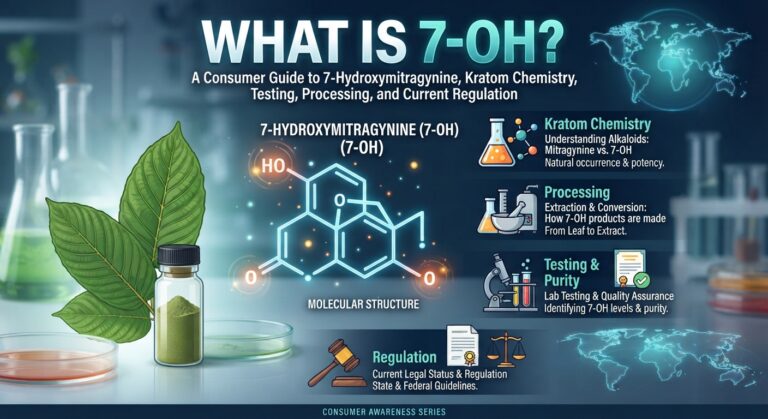
The 7-OH Question in 2026
This is now an especially important consumer issue.
7-hydroxymitragynine, commonly shortened to 7-OH, is associated with kratom chemistry but has become the focus of a separate market for concentrated products.
FDA currently distinguishes traditional kratom leaf containing naturally occurring trace 7-OH from products containing added or enhanced 7-OH.
In July 2026, FDA reported that DEA had begun a temporary scheduling process involving 7-OH above a proposed threshold and three synthetic kratom-related compounds.
That does not mean every product encountered through a lub 13 kratom search should be described as a concentrated 7-OH product.
It means consumers need to read labels carefully and distinguish:
Traditional leaf
from
Extracts
from
Products containing added or enhanced 7-OH.
Those categories should not be treated as interchangeable.
Product Claims Need Careful Interpretation
Club13’s current website organizes some products using experience-oriented categories such as energy, focus, calm and relaxation.
These descriptions should be treated as commercial product positioning.
They are not equivalent to clinical evidence proving that a particular product will produce a predictable medical outcome.
Research into kratom includes surveys, observational evidence, pharmacological studies, laboratory research, animal research and a limited human clinical literature.
That evidence does not justify promising that lub 13 kratom will:
- Treat anxiety
- Cure depression
- Eliminate chronic pain
- Treat opioid use disorder
- Replace prescription medication
- Cure withdrawal
- Treat another disease
Kratom Verdict does not endorse those claims.
Is Club13 an Established Brand?
Club13 states that it was founded in 1999.
Its active website currently contains a substantial catalog, company information, product listings and laboratory documentation.
These are meaningful indicators of an established commercial presence.
However, longevity should not replace current product verification.
A consumer researching lub 13 kratom should still examine the specific batch being purchased.
Companies can change suppliers, formulations, manufacturing practices and product lines over time.
Current evidence matters more than reputation alone.
How Transparent Is Club13?
Based on the company’s current website, several transparency elements are visible:
- Company history
- Product catalog
- Product pricing
- Lot-number references
- Laboratory-testing claims
- COA availability
- Manufacturing claims
- Product warnings
- Shipping restrictions
- Product-format information
Those are positive informational signals.
But Kratom Verdict would still want consumers researching lub 13 kratom to verify the relevant COA before treating company-wide claims as proof about a specific product.
Club13 Product Pricing
Club13’s prices vary according to format, package size and product.
Current listings show some conventional powder products beginning in the low-teens-dollar range, while concentrated beverages, extracts and other formats can cost substantially more.
Prices change.
For that reason, this article does not lock a temporary promotional price into a permanent ranking.
When comparing lub 13 kratom, evaluate:
Price per gram for comparable powders
or
Quantitative alkaloid information for extracts
rather than simply asking which package has the lowest sticker price.
Does More Expensive Mean Better?
No.
Higher price does not automatically establish:
- Greater purity
- Better contaminant control
- Higher-quality raw material
- More accurate labeling
- Better laboratory testing
Likewise, a lower price does not automatically prove poor quality.
For lub 13 kratom, value should be assessed using both price and documentation.
A lower-priced product with a matching COA can offer more meaningful transparency than an expensive product supported primarily by branding.
What About Club13 Customer Reviews?
Club13’s own website contains customer reviews and testimonials.
These can provide information about consumer perceptions.
They cannot independently prove:
- Purity
- Pharmacological effectiveness
- Safety
- Alkaloid concentration
- Contaminant levels
A person reviewing lub 13 kratom should therefore separate customer experience from laboratory evidence.
A five-star review is not a COA.
A COA is not a clinical trial.
A clinical study involving kratom generally is not proof that a specific commercial Club13 product will produce the same outcome.
Keeping those evidence categories separate is fundamental to trustworthy product research.
Who Should Be Especially Cautious?
Kratom is pharmacologically active.
People taking prescription medicines or managing health conditions should not assume that a commercially available botanical is automatically compatible with their medication or condition.
Pregnancy and breastfeeding are also situations where avoiding unsupported safety assumptions is particularly important.
Club13 itself currently includes warnings concerning pregnancy, breastfeeding and medication use.
Anyone researching lub 13 kratom because they intend to address a medical problem should discuss that issue with an appropriately qualified healthcare professional rather than treating commercial kratom as an established medical treatment.
Buying Option
How to Evaluate a LUB 13 Kratom Product Before Buying
Use this consumer framework.
1. Confirm the Brand
Determine whether the product actually says Club13.
Do not assume every search result for lub 13 kratom represents the same company.
2. Identify the Product Type
Is it:
- Powder?
- Capsule?
- Extract?
- Beverage?
- Gummy?
- Tablet?
- Concentrated alkaloid product?
Product format changes how comparisons should be made.
3. Find the Lot Number
The package should provide enough information to connect it to its manufacturing or testing documentation.
4. Locate the COA
Use the lot number to find the corresponding laboratory report.
5. Check Contaminants
Look for heavy-metal and microbial testing.
6. Examine Alkaloid Results
Check what was actually measured.
7. Read the Ingredient List
Do not assume that every lub 13 kratom product contains only plain kratom leaf.
8. Look for Added or Enhanced 7-OH
This distinction is particularly important in the 2026 market.
9. Evaluate the Claims
Avoid treating marketing language as medical evidence.
10. Compare Price Only After Quality
Price becomes meaningful once products are reasonably comparable.
Kratom Verdict Transparency Scorecard
| Consumer Question | Current Club13 Information |
| Active official website? | Yes |
| Identifiable product catalog? | Yes |
| Powder products? | Yes |
| Capsules? | Yes |
| Extracts/beverages? | Yes |
| Company claims third-party testing? | Yes |
| Lot-number COA lookup claimed? | Yes |
| Heavy-metal testing claimed? | Yes |
| Microbiological testing claimed? | Yes |
| Alkaloid testing claimed? | Yes |
| Public COA evidence located? | Yes |
| Company claims AKA GMP certification? | Yes |
| FDA-approved kratom medicine? | No |
| Does company documentation prove every batch identical? | No |
This framework gives a more useful answer to lub 13 kratom than a simple “good” or “bad” brand rating.
Major Red Flags to Watch For
Even when purchasing from an established brand, consumers should remain alert.
Potential red flags include:
- Product with no lot number
- COA that does not match the package
- Missing manufacturer information
- Broken laboratory-report links
- Unclear ingredient disclosure
- Disease-treatment claims
- “FDA approved kratom” language
- Extract concentration that cannot be understood
- Added/enhanced 7-OH not clearly disclosed
- Damaged packaging
- Retailer unable to identify the product
If you find a lub 13 kratom product through a third-party store rather than Club13 directly, checking these factors becomes even more important.
Evidence Strength: What We Actually Know
Strongly verifiable
Club13 currently operates an official commercial website.
The website lists kratom products in multiple formats.
Club13 publicly states that products are laboratory tested.
The company provides lot-number/COA information.
At least some Club13 laboratory documentation is publicly accessible.
Company-reported
The company’s manufacturing history, internal quality-control descriptions, sourcing practices and some certification claims are primarily presented by Club13 itself.
These can be reported as company claims but should not be transformed into independent findings.
Scientifically supported in general
Kratom contains pharmacologically active alkaloids including mitragynine.
Kratom products can vary in composition.
Contaminant testing is relevant for botanical products.
Kratom can produce adverse effects and carries dependence and interaction concerns.
Not established
That lub 13 kratom is a separate verified kratom brand.
That every Club13 product is identical in quality.
That any particular Club13 product is proven to treat a medical condition.
That customer testimonials establish clinical effectiveness.
Frequently Asked Questions
What is LUB 13 kratom?
Current search evidence does not clearly identify a separate major kratom manufacturer named LUB 13. The query appears to overlap strongly with Club13 Kratom, an established kratom and kava company. Consumers should confirm the actual brand name printed on the product.
Is LUB 13 kratom the same as Club13?
It appears likely that many lub 13 kratom searches are intended to find Club13, but Kratom Verdict cannot prove that every use of the phrase refers to Club13. The verified commercial kratom brand is Club13.
Is Club13 Kratom lab tested?
Club13 states that its batches undergo third-party laboratory testing for alkaloids, heavy metals and microbiological contaminants. The company also says products include lot numbers that can be used to locate COAs. Consumers should verify the report for their specific batch.
Does LUB 13 kratom have COAs?
If lub 13 kratom refers to Club13, publicly accessible Club13 laboratory documentation exists. Buyers should match the COA to the specific product lot rather than relying on an unrelated historical report.
What types of kratom does Club13 sell?
Its current catalog includes powders, capsules, blends, extracts, beverages, gummies and other formulations. Product availability can change.
Is Club13 Kratom FDA approved?
No. Laboratory testing, GMP-related claims and industry certification should not be confused with FDA approval of a kratom medicine.
Does Club13 sell kratom extracts?
Yes. Current Club13 listings include extracts and higher-strength kratom formulations. Extracts should be compared using quantitative alkaloid information rather than package weight alone.
Is LUB 13 kratom safe?
No commercial kratom product can responsibly be declared universally safe based on a brand name alone. Kratom is pharmacologically active and carries potential adverse-effect, dependence and interaction concerns. Product-level contaminant testing addresses only part of the overall risk picture.
How should I check LUB 13 kratom before buying?
Confirm the manufacturer, identify the product format, find the lot number, locate the matching COA, review contaminant and alkaloid testing, read the ingredient label and determine whether the product contains added or enhanced 7-OH.
Where can I buy LUB 13 kratom?
If the intended brand is Club13, consumers can investigate the manufacturer’s official website or authorized retail channels. Before purchasing from a third-party retailer, confirm that the product is genuine, sealed and connected to appropriate batch documentation.
Kratom Verdict: Final Assessment
The most important finding from our investigation of lub 13 kratom is surprisingly simple:
The name itself appears to be the first thing consumers need to verify.
Current search evidence does not establish a prominent separate kratom manufacturer officially called LUB 13. Instead, the commercial search trail points toward Club13, a real kratom and kava company with a current product catalog and documented commercial history.
That clarification prevents an important editorial mistake.
Kratom Verdict will not manufacture facts about a “LUB 13” company merely because the keyword exists.
If lub 13 kratom is indeed intended to mean Club13 Kratom, there are several meaningful transparency signals worth recognizing.
Club13 maintains an active official website.
It sells multiple kratom formats.
The company states that its batches undergo third-party testing.
Its website describes testing for alkaloids, heavy metals and microbiological contaminants.
It says products carry lot numbers connected with laboratory reports.
Kratom Verdict also located publicly accessible Club13 laboratory documentation.
Those are useful indicators.
But none removes the need for product-level verification.
A historical COA does not prove the composition of every future batch.
A company statement about testing does not replace reading the actual report.
An industry manufacturing certification does not mean FDA approval.
And a customer testimonial does not establish clinical effectiveness.
Consumers researching lub 13 kratom should therefore use the lot number as the bridge between marketing and evidence.
Find the product.
Identify the lot.
Open the COA.
Confirm that the report matches.
Check what was tested.
Review heavy metals and microbiological results.
Examine the alkaloid data.
Read the ingredients.
Determine whether the product is ordinary leaf, an extract or another concentrated formulation.
Pay particular attention to added or enhanced 7-OH products because the regulatory environment around concentrated 7-OH has changed substantially in 2026.
Kratom Verdict also advises against treating marketing categories such as “energy,” “focus,” “calm” or “relaxation” as established therapeutic outcomes. Kratom remains pharmacologically active, and scientific research does not convert individual commercial products into approved medical treatments.
So is lub 13 kratom worth considering?
If the phrase refers to Club13, the company presents more verifiable quality-control information than a completely anonymous kratom product with no identifiable manufacturer, batch or laboratory documentation.
That is meaningful.
It is not the same as declaring every Club13 product superior or risk-free.
Our final position is:
First verify that LUB 13 kratom actually means Club13. Then judge the specific Club13 product by its current batch documentation, COA, contaminant testing, alkaloid information, labeling and formulation—not by brand recognition alone.
That is the standard Kratom Verdict believes consumers should apply to any kratom company.
Sources & References
1. Club13 — Official Website and Current Product Catalog
Club13’s current official site provides company history, product categories, manufacturing claims and information about its testing program.
Club13 Official Website
2. Club13 — About Us / Quality & Testing Information
The company’s About page states that Club13 was founded in 1999, describes independent testing for mitragynine and microbiological contaminants, and states that the company is AKA GMP Certified. These are company-reported claims.
Club13 About Us
3. Club13 — Current Kratom Product Collection
Current catalog information showing powders, capsules, blends, beverages and other product formats, along with Club13’s statements regarding lot numbers and COA access.
Club13 Kratom Product Catalog
4. Club13 — Public Certificate of Analysis
Example laboratory report associated with Club 13 Enterprises containing alkaloid, metal and residual-solvent results for the identified submitted sample. Results apply to that sample and should not be generalized to unrelated batches.
Club13 Certificate of Analysis
5. U.S. Food and Drug Administration — Hiding in Plain Sight: 7-OH Products (Updated July 13, 2026)
FDA’s current information regarding concentrated 7-OH products and the July 2026 federal regulatory process involving 7-OH above a proposed threshold and synthetic kratom-related compounds.
FDA — Hiding in Plain Sight: 7-OH Products
6. Heywood J, Smallets S, Paustenbach D — Beneficial and Adverse Health Effects of Kratom: A Critical Review of the Literature (2024)
Peer-reviewed review discussing kratom preparations, major alkaloids, reported effects, adverse effects and limitations in the evidence base.
PubMed — Beneficial and Adverse Health Effects of Kratom
7. Annuar NAK et al. — Neuropharmacological Effects, Mechanisms, Pharmacokinetics and Toxicity of Mitragynine (2024)
Peer-reviewed review examining mitragynine pharmacology, receptor interactions, pharmacokinetics and toxicological evidence.
PubMed — Mitragynine Pharmacology Review
8. Variations of Mitragynine Content in Kratom Leaves From Southeast Asia: An Updated Review (2026)
Recent peer-reviewed review examining variability in mitragynine content and factors that can influence the chemical composition of kratom leaf material.
PubMed — Mitragynine Content Review
Related Kratom Verdict Guides
Expand your knowledge of Best Kratom Brands for Pain Relief through our independent educational guides covering botanical science, laboratory testing, Certificates of Analysis, transparency standards, and vendor evaluation.
Kratom Fundamentals
- What Is Kratom? (2026): The Complete Beginner’s Guide
- Kratom Buying Guide (2026)
- Kratom Safety & Side Effects (2026)
- Kratom Legality Guide (2026)
Laboratory & Transparency
- Kratom Alkaloids Explained
- Kratom Lab Testing Explained
- Third-Party Lab Testing Explained
- How to Read a Kratom Certificate of Analysis (COA)
- How to Verify a Kratom COA
- AKA GMP Certification Explained