Reviewed by Kratom Verdict Editorial Team
Last Updated: July 2026
Estimated Reading Time: 20–25 minutes
Review Type: Independent Editorial Review
Research Basis: Publicly available company information, Certificates of Analysis (COAs), laboratory transparency documentation, American Kratom Association resources, scientific literature, publicly available regulatory information, and independent editorial research.
Jack Botanicals Review (2026): Is This Transparency-Focused Kratom Vendor Worth Considering?
Last updated: July 2026
Kratom shopping in mid-2026 looks nothing like it did five years ago. Federal regulators are actively moving against high-concentration 7-hydroxymitragynine (7-OH) products, several states have banned kratom outright, and more than a dozen states now regulate it under Kratom Consumer Protection Act (KCPA) frameworks that demand batch testing, alkaloid disclosure, and age verification. Against that backdrop, buyers are paying far more attention to who they order from — not just what they order.
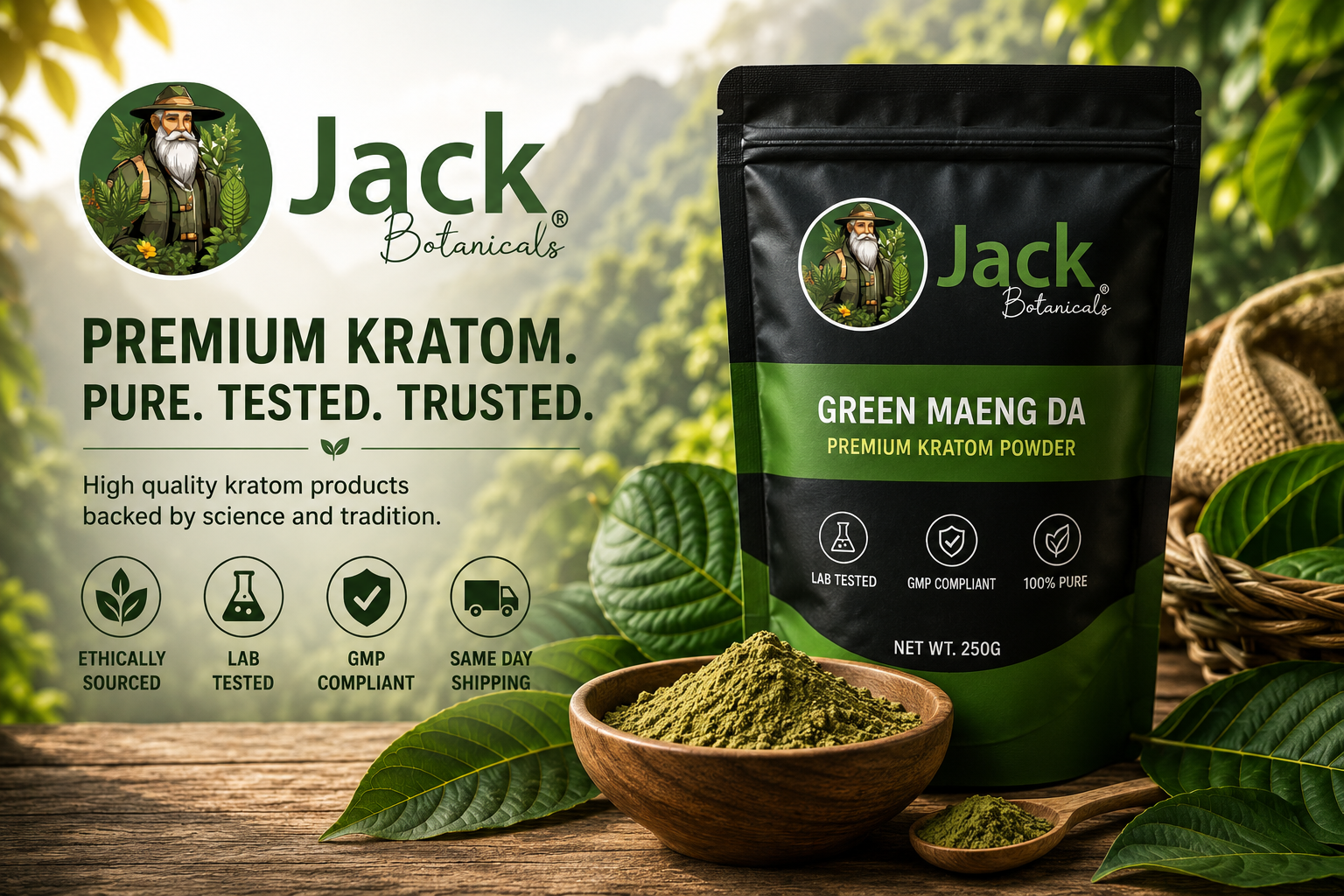
Jack Botanicals has become one of the more visible names in that conversation, largely on the strength of a transparency pitch: published Certificates of Analysis (COAs), American Kratom Association (AKA) Good Manufacturing Practices (GMP) qualification claims, and batch-level alkaloid numbers displayed on product pages. This review breaks down what that pitch actually holds up under scrutiny, what current customers report, where the vendor sits relative to the rest of the market, and what the legal landscape means for anyone ordering right now.
A quick disclosure before we start: kratom is not FDA-approved for any medical use, and this article is not medical or legal advice. It’s a consumer-facing evaluation of a specific vendor, written with the same skepticism you’d want applied to any supplement company making quality claims about itself.
Quick Summary
- What it is: An online kratom vendor selling powder and capsule products across red, green, white, and yellow vein strains, plus Maeng Da variants
- Headline claim: Multi-stage, batch-level lab testing (the vendor states nine or more tests per batch) covering alkaloid content, heavy metals, residual solvents, and microbial contamination
- Certification claim: AKA GMP-qualified vendor status
- Price position: Mid-range, with bulk-order discounts
- Best for: Buyers who prioritize documented lab testing and are comparison-shopping among established vendors
- Watch for: A meaningful share of the “independent” reviews and vendor comparisons ranking Jack Botanicals first are published on the company’s own blog or on affiliate-style sites — a detail worth knowing before you treat any single ranking as neutral
Who Is Jack Botanicals?
Jack Botanicals is a U.S.-based online kratom retailer, listing a Las Vegas, Nevada address, that positions itself around sourcing and testing transparency rather than the lowest price point in the market. The company’s marketing describes direct relationships with family-owned farms in Southeast Asia, where kratom leaves are said to be harvested at peak alkaloid maturity before being processed and shipped to the U.S. for testing.
The product catalog covers the categories most kratom buyers expect to find:
- Red vein strains (commonly associated with evening or nighttime use in vendor marketing)
- Green vein strains (marketed as balanced, daytime-friendly options)
- White vein strains (marketed toward buyers seeking more stimulating effects)
- Maeng Da variants across multiple vein colors
- Both powder and capsule formats
None of those vein-color associations are medical claims — they’re conventional industry marketing language, not something verified by clinical research, and you should treat them as such regardless of which vendor is making them.
The Core Claim: Lab Testing and Alkaloid Transparency
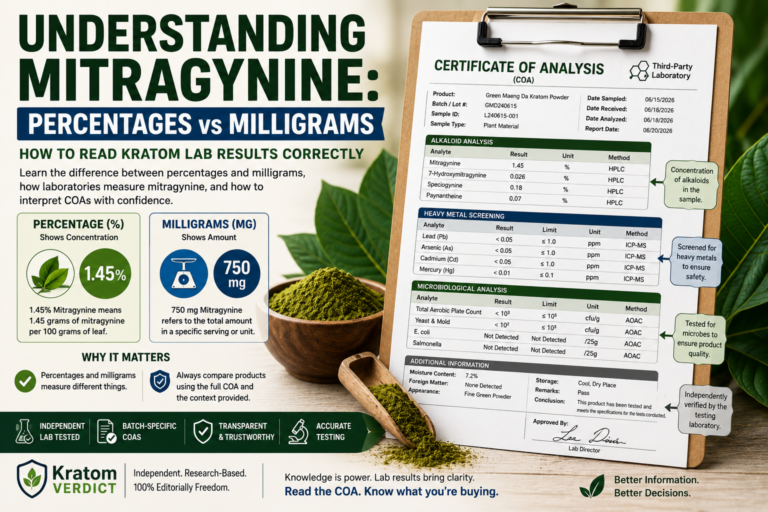
The single most-repeated claim across Jack Botanicals’ own content and third-party write-ups is the depth of its lab testing program. The vendor states that each batch undergoes nine or more independent lab tests, covering:
- Mitragynine concentration
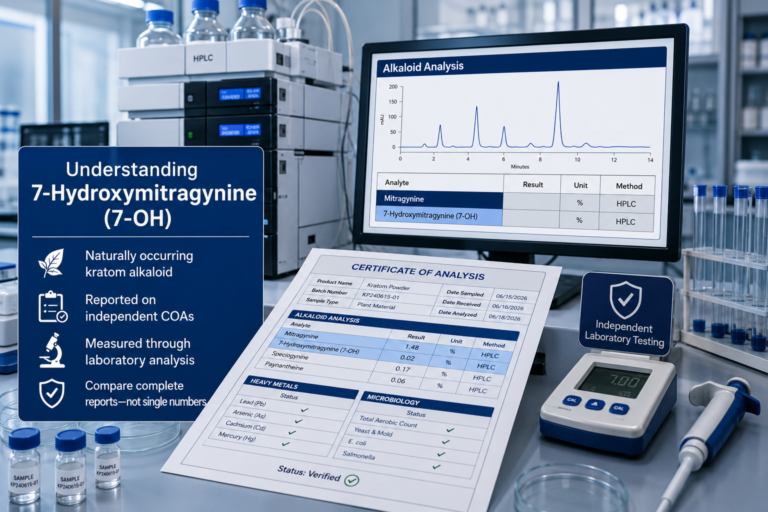
- 7-hydroxymitragynine (7-OH) levels
- Heavy metals (lead, arsenic, cadmium, mercury)
- Residual solvents
- Microbial contamination (salmonella, E. coli, yeast, and mold)
Recent batch documentation referenced in vendor materials lists a mitragynine content around 1.88%, which the company presents as evidence of consistent potency rather than a vague “premium quality” label. If accurate and independently verifiable, that level of specificity is meaningfully better than what a large share of budget kratom vendors publish, since many still rely on generic quality assurances with no accessible COA.
That said, a few caveats matter here:
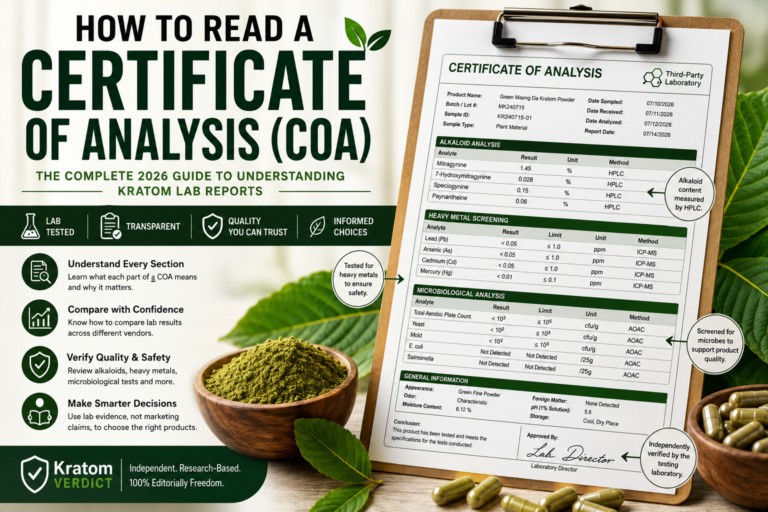
- The claim originates from the vendor. Reviews making the case that Jack Botanicals leads the market on lab testing appear on the company’s own blog and on third-party sites that read like affiliate or sponsored comparison content. That doesn’t make the underlying claim false, but it means the “nine tests per batch” figure hasn’t been confirmed by a neutral third party in what we could find. Anyone who wants a hard fact-check should pull an actual COA from the product page for the specific batch they’re ordering and check the lab name, date, and test panel directly, rather than trusting summary marketing copy.
- 7-OH disclosure now matters more than ever. With federal regulators moving specifically against elevated 7-OH concentrations in 2026 (more on that below), a vendor that discloses 7-OH levels alongside mitragynine is giving you the exact data point regulators are focused on. If a product page doesn’t show a 7-OH figure, or only shows mitragynine, that’s a gap worth asking about before you buy — from this vendor or any other.
AKA GMP Certification: What It Does and Doesn’t Mean
Jack Botanicals is described in vendor-adjacent content as AKA GMP-qualified, meaning it complies with the American Kratom Association’s Good Manufacturing Practices standards through the AKA’s audit program.
It’s worth understanding what that certification actually covers, because it’s frequently oversold in kratom marketing generally:
- What it verifies: Manufacturing hygiene, batch traceability, consistent testing protocols, and adherence to a documented quality-management process, audited on a recurring basis by the AKA’s qualification program.
- What it does not verify: That kratom is safe for any particular person, that it treats any medical condition, or that the FDA has reviewed or approved the product. The AKA is an industry advocacy and trade association, not a federal regulator, and GMP qualification is a private certification, not a government seal of approval.
If you’re comparing vendors, AKA GMP status is a reasonable differentiator — it at least means a third party looked at the manufacturing process — but it shouldn’t be read as equivalent to FDA oversight, because no kratom product currently has that.
Customer Reviews: What People Are Actually Saying
Public reviews for Jack Botanicals, concentrated on Trustpilot, skew heavily positive. Recurring themes in the customer feedback include:
- Product freshness and potency, with several reviewers specifically calling out Green Malay and red-vein strains as go-to repeat purchases
- Shipping speed, with multiple reviewers describing orders arriving faster than expected
- Customer service responsiveness, cited repeatedly as a reason for repeat business
- Confidence from visible lab documentation, with at least one reviewer noting that seeing a lab testing report directly influenced their decision to buy
On the surface, that’s a strong pattern. Two things temper it:
First, the review set is unusually uniform. A large share of reviews follow a similar structural pattern — describing past frustration with other, unnamed vendors, then describing Jack Botanicals as the brand that fixed the problem. That doesn’t prove anything is wrong, and organic reviews genuinely can cluster around similar language when a product performs consistently well. But it’s a pattern worth noticing rather than taking entirely at face value, and it’s a good reminder to weight verified purchase reviews more heavily than unverified ones on any platform.
Second, cross-reference before you commit. Because a meaningful amount of the “vendor comparison” content ranking Jack Botanicals highly traces back to sites connected to the vendor itself, it’s worth checking independent kratom communities — long-running forums and subreddits where users have no commercial relationship with any vendor — for unprompted mentions, rather than relying solely on review aggregators or blog rankings.
Pricing and Value
Jack Botanicals sits in the mid-range of the kratom market: not a discount bargain-bin vendor, but not positioned as a luxury outlier either. Bulk-order discounts are available for larger purchases, which is standard practice across most established vendors and generally the best way to bring effective cost-per-gram down if you’ve already decided to buy.
Value assessments in this category are genuinely hard to make from outside the industry, because:
- Alkaloid content varies batch to batch even within the same vendor, so a “good price” only means something relative to the specific batch’s tested potency
- Shipping costs, minimum order thresholds, and subscription discounts materially change the real price per gram
- There’s no independent, standardized pricing index across kratom vendors the way there is for, say, commodity goods
The practical takeaway: use the published COA and mitragynine percentage for the specific batch you’re considering, divide by price, and compare that ratio across two or three vendors before assuming any single listed price is competitive.
Shipping, Packaging, and Site Experience
Reviewers and vendor materials both describe a straightforward checkout process and generally reliable delivery windows. Packaging quality — moisture resistance and light protection — matters more in this category than it might for other supplements, since kratom alkaloids degrade with prolonged light and humidity exposure. Vendors that ship in resealable, opaque, or UV-protected packaging are doing right by the product; it’s a reasonable question to ask any vendor if it isn’t obvious from product photos before you order.
One detail specific to 2026: because a growing number of states now restrict kratom shipments by zip code under state bans or KCPA rules, a well-run vendor should be blocking restricted addresses automatically at checkout rather than leaving compliance to the buyer. If a vendor’s checkout doesn’t flag your address when you’re ordering from a restricted state, that is itself a red flag about how seriously that vendor takes compliance — regardless of which vendor it is.
The 2026 Legal Backdrop You Need to Understand Before Ordering
This is the part of any 2026 kratom vendor review that matters more than any single company’s marketing, and it applies no matter who you buy from.
Kratom itself remains federally legal in the U.S. As of mid-2026, kratom (mitragynine) has not been placed on any Controlled Substances Act schedule. The DEA’s 2016 attempt to emergency-schedule it was withdrawn after public and congressional pushback, and no further federal scheduling action against natural kratom leaf has moved forward since. The FDA has never approved kratom for any medical use and continues to advise consumers against use, citing risks including dependence and, in some cases, seizures — but an FDA advisory is not the same as a ban.
7-OH is a different story, and it’s moving fast. Concentrated 7-hydroxymitragynine — a compound present in trace amounts in natural kratom leaf but manufactured at far higher concentrations in some extract, tablet, and “boosted” gas-station products — is now the specific target of federal action. Following an FDA recommendation in mid-2025 that concentrated 7-OH be scheduled, the DEA published notices in the Federal Register in early July 2026 moving to temporarily classify high-concentration 7-OH alongside Schedule I substances. A required 30-day comment period means the earliest that temporary scheduling order could take effect is early August 2026, with a public comment window on the FDA/HHS side running through the end of July 2026. If finalized, that would make concentrated 7-OH products illegal to manufacture, sell, or possess nationwide, regardless of any individual state’s stance — while natural, whole-leaf kratom itself would remain unscheduled.
State law is where most of the actual risk sits. As of July 2026, kratom is fully banned in a handful of U.S. states, regulated under KCPA-style frameworks in more than a dozen others (which typically mandate lab testing, labeling, and 18+ purchase age), and unregulated in the remainder. Several additional states have pending legislation. This is exactly why a vendor’s ability to correctly identify and block shipments to restricted states matters as much as its lab-testing claims — a vendor can have a flawless COA and still put you in a legally uncertain position if it ships somewhere it shouldn’t.
Practical steps before ordering from any vendor, including this one:
- Check your state’s current status against the American Kratom Association’s state tracker or your state legislature’s site, since bills are moving through several statehouses in 2026.
- Confirm whether the specific product you’re buying is natural leaf or an extract/enhanced product with elevated 7-OH — the regulatory and safety picture differs meaningfully between the two.
- Pull the actual COA for your batch rather than relying on a vendor’s summary description of its own testing program.
- If you have any underlying liver condition, are pregnant, or are taking other medications, treat any kratom product as something to discuss with a healthcare provider first — not something to self-manage based on a vendor’s marketing copy.
How Jack Botanicals Compares to the Broader Market
Zooming out, here’s how Jack Botanicals’ positioning stacks up against the general landscape of kratom vendors in 2026:
| Factor | Jack Botanicals (as marketed) | Typical budget vendor | Typical premium/boutique vendor |
|---|---|---|---|
| Lab testing depth | Multi-panel, batch-specific (vendor-stated) | Minimal or generic | Often comparable, sometimes with third-party audit |
| COA accessibility | Published per batch | Rarely published | Usually published |
| AKA GMP status | Claimed | Uncommon | Common among established names |
| Price tier | Mid-range | Low | High |
| Catalog breadth | Moderate — core strains and Maeng Da | Wide, inconsistent quality | Narrow, curated |
| Shipping compliance (state restrictions) | Not independently verified here | Varies widely | Generally strong |
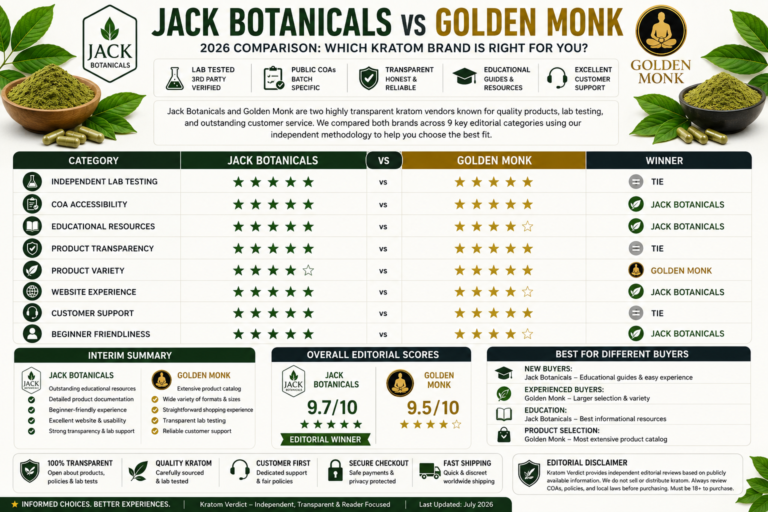
The honest takeaway: Jack Botanicals’ marketing describes a testing and certification program that, if verified batch-by-batch, would place it among the more transparent vendors in a market where transparency is genuinely scarce. Whether that holds up depends on you actually checking the COA for your order rather than the marketing summary of it — advice that applies equally to every vendor in this table, not just this one.
Pros and Cons
Potential strengths:
- Publishes batch-specific alkaloid figures (mitragynine, and reportedly 7-OH) rather than vague quality language
- Claims AKA GMP qualification, a recognized industry audit standard
- Consistent positive feedback on shipping speed and customer service responsiveness
- Product catalog covers the strain categories most buyers look for without being overwhelming
Reasons for caution:
- Much of the third-party “top vendor” content ranking Jack Botanicals first traces back to the company’s own domain or affiliate-style sites, which limits how much weight to put on those rankings as neutral evidence
- The specific “nine tests per batch” claim was not independently verifiable through neutral third-party sources at the time of writing
- No independent confirmation of shipping compliance with the growing list of state-level restrictions was available
- As with every kratom vendor, none of the health or wellness claims associated with kratom use are FDA-evaluated or approved
Frequently Asked Questions
Is Jack Botanicals legitimate? The vendor publishes batch-level lab data and claims AKA GMP qualification, both of which are markers of a more serious operation than a large share of low-cost competitors. That said, “legitimate” and “verified by a neutral third party” aren’t the same thing — check the COA on your specific order before buying.
Is kratom legal where I live? Kratom is not federally scheduled as of July 2026, but it is banned outright in several states and restricted in others. Check your state’s current status before ordering from any vendor.
What’s the difference between kratom and 7-OH products? 7-hydroxymitragynine occurs naturally in kratom leaf in small amounts, but some manufactured products concentrate it to much higher levels, producing stronger opioid-like effects. Federal regulators moved in July 2026 to temporarily schedule high-concentration 7-OH specifically, while natural kratom leaf remains unscheduled.
Does lab testing mean a kratom product is safe? Lab testing can confirm the absence of contaminants like heavy metals and microbial contaminants, and can confirm alkaloid concentration. It does not mean the FDA has approved the product or evaluated it for safety or efficacy for any use.
How do I verify a vendor’s lab testing claims myself? Request or locate the actual COA for the specific batch you’re purchasing, confirm the testing lab’s name is real and independent, and check that the test date lines up with your batch or lot number — rather than relying on a vendor’s general description of its testing program.
Bottom Line
Jack Botanicals presents a genuinely stronger transparency case than a large share of the kratom market: published batch data, a stated multi-panel testing process, and an AKA GMP qualification claim. Customer feedback on shipping and service is consistently positive. Where this review has to stop short of an unqualified endorsement is that a significant portion of the content ranking this vendor as the market’s best traces back to sources connected to the company itself, and the specific testing claims weren’t independently confirmable from neutral third parties at the time of writing.
The practical recommendation is the same one that applies to any kratom purchase in 2026: verify your state’s current legal status, pull the actual COA for your specific batch rather than trusting summary marketing language, understand whether you’re buying natural leaf or a higher-concentration extract product, and treat any wellness claims — from this vendor or any other — as unproven by regulatory standards. If you do that homework, Jack Botanicals’ published documentation gives you more to actually check than most competitors offer, which is a real point in its favor even with the caveats above.
This article is for informational purposes only and does not constitute medical, legal, or purchasing advice. Kratom has not been evaluated or approved by the FDA for any medical use, and its legal status varies by state and is changing rapidly in 2026. Consult a healthcare provider before using any kratom product, and verify current law in your jurisdiction before purchasing.