Reviewed by Kratom Verdict Editorial Team
Last Updated: July 2026
Estimated Reading Time: 5 minutes
Guide Type: Independent Editorial Strain Guide
Research Basis: Publicly available botanical information, third-party laboratory transparency, publicly available regulatory resources, scientific literature, and independent editorial research.
Search “Red Bentuangie kratom” and you’ll find dozens of near-identical pages telling you it’s “the most relaxing variant” and pointing you toward a list of “trusted vendors.” Almost none of them show you how to verify a single claim they’re making. This guide is built the other way around: fewer unverifiable claims, more tools to check things yourself — because in an unregulated market, that’s the only thing that actually protects you.
Why Red Bentuangie Gets Marketed So Aggressively
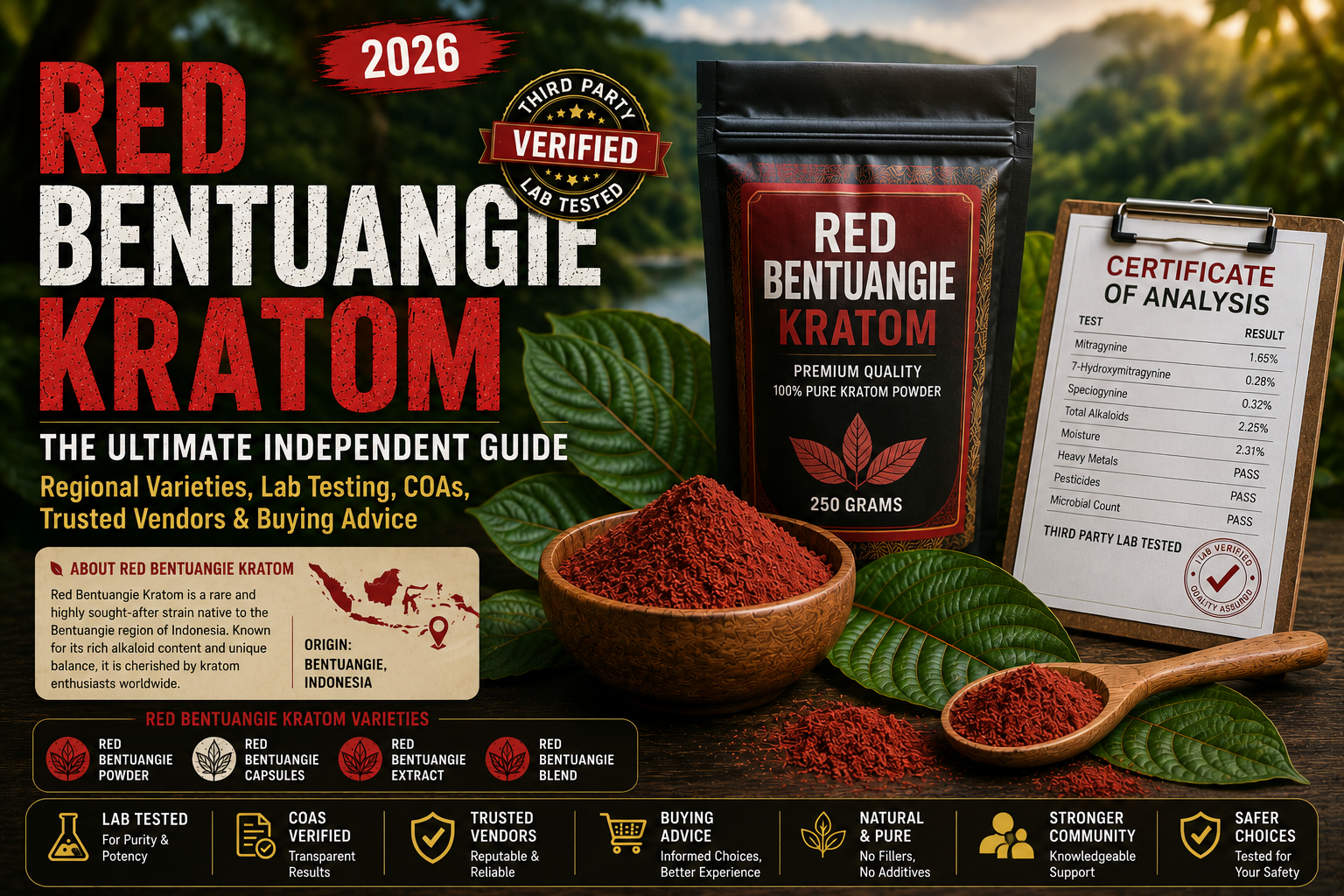
Red Bentuangie sits at the intersection of two processing traits vendors love to advertise: the “red” designation (full-maturity leaf, longest oxidation period) and Bentuangie curing (extended post-harvest fermentation). Stack both together and you get a product vendors can plausibly — and profitably — market as the most heavily processed, “strongest” option in their lineup.
Here’s the part that marketing pages skip: stacking two processing traits doesn’t create a stable, guaranteed alkaloid profile. It creates a product category where variation between batches and vendors is higher than average — which makes it one of the varieties where checking the actual lab data matters most, not least.
The Real Test: Can You Verify What’s Claimed?
Before you trust any Red Bentuangie product, run it through this five-point check. It takes about five minutes and tells you more than any “editorial review” can.
| Check | What to Look For | Red Flag |
|---|---|---|
| Batch match | COA batch number matches the number printed on your product | No batch number anywhere on packaging |
| Lab identity | Named lab is real, ISO/IEC 17025-accredited, independently searchable | Lab name is generic, unsearchable, or absent |
| Test recency | Test date is reasonably close to your purchase | Same COA reused across multiple listings/products |
| Full panel | Alkaloid content and heavy metals and microbial screening all present | Only one of the three is reported |
| AKA status | GMP membership verifiable directly on the AKA’s own site | Vendor claims membership but isn’t listed |
A vendor that passes all five isn’t guaranteed perfect — but a vendor that fails even one is telling you something real about how seriously they treat documentation.
What You’re Actually Buying: Powder, Capsules, or Extract
- Powder is your best bet for verification — least processed, easiest to match against a COA, and usually the cheapest per dose.
- Capsules trade convenience for a documentation gap: confirm whether the COA was run on the raw powder before encapsulation or the finished capsule, since potency can shift in processing.
- Extract is where marketing language runs furthest ahead of verification. “Extract” has no standardized potency definition — a vendor’s “15x extract” claim means nothing without a COA showing what that translates to in actual mitragynine content.
The Safety Context Vendors Don’t Lead With
This is the section most competing guides bury or skip, and it’s the one that matters most:
- The FDA has not approved kratom for any use and has issued warnings about contamination risk and dependency potential.
- Kratom’s active compounds, mitragynine and 7-hydroxymitragynine, act on opioid receptors — which is exactly why red variants get marketed for pain and sleep, and exactly why dependency and withdrawal are documented risks, not internet myths.
- Kratom is restricted or illegal in several states and countries — check before you buy, not after.
- If you’re reaching for a “relaxation” or “pain relief” product for a real health reason, a five-minute conversation with a doctor will tell you more than any product page will.
Verify a Vendor Yourself — Step by Step
- Pull up the vendor’s COA for the exact batch you’re considering.
- Copy the lab’s name and search it independently — accreditation bodies publish searchable directories.
- Confirm the batch number on the COA matches your product’s packaging.
- Cross-check AKA GMP membership on AmericanKratom.org directly.
- Search the vendor’s name plus “recall” or “complaint” — don’t rely solely on their own site.
If a vendor makes this easy, that’s a genuine trust signal. If they make it hard, that tells you something too.
Bottom Line
Red Bentuangie’s marketing story — full-maturity leaf, double fermentation, “strongest in the lineup” — is directionally plausible, but it’s a description of a process, not a verified guarantee of what’s in any given bag. The five-minute verification check above will tell you more than any ranked vendor list, including the ones you’ll find elsewhere. Use it before you buy, and talk to a doctor first if you’re using kratom for a health condition rather than curiosity.
Sources for Further Reading
- U.S. Food and Drug Administration — public statements on kratom safety and regulatory status
- American Kratom Association — GMP program directory (industry self-regulation, not government oversight)
- Journal of Ethnopharmacology and Frontiers in Pharmacology — peer-reviewed research on Mitragyna speciosa alkaloids
- Kew Science, Plants of the World Online — botanical reference for Mitragyna speciosa
This article is for general educational purposes and isn’t medical advice. It doesn’t endorse or recommend the use of kratom, and doesn’t recommend specific vendors or brands.