Reviewed by Kratom Verdict Editorial Team
Last Updated: July 2026
Estimated Reading Time: 5 minutes
Guide Type: Independent Editorial Strain Guide
Research Basis: Publicly available botanical information, third-party laboratory transparency, publicly available regulatory resources, scientific literature, and independent editorial research.
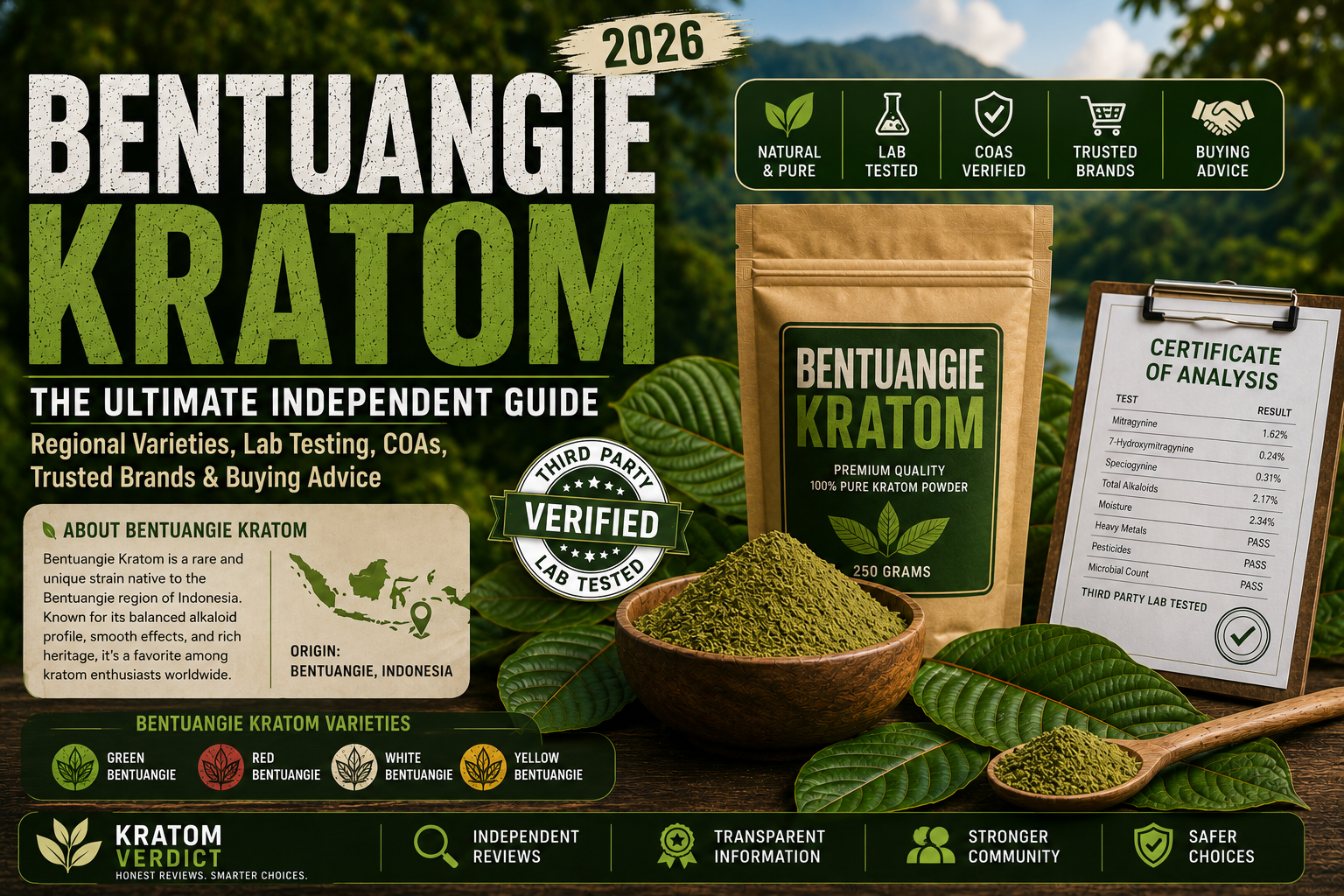
“Bentuangie” is one of the most searched — and most misunderstood — terms in the kratom market. Most guides treat it like a strain, similar to Bali or Maeng Da. It isn’t. This guide explains what Bentuangie actually refers to, how it relates to the five color variants sold under that name, what genuine lab documentation looks like, and the safety context that most buying guides leave out entirely.
What “Bentuangie” Actually Means
Bentuangie is a processing method, not a growing region or a botanical strain. All kratom — regardless of variety — comes from Mitragyna speciosa, a tree in the coffee family (Rubiaceae) native to Indonesia and other parts of Southeast Asia.
Where most kratom names describe where a leaf was grown (Bali, Borneo, Sumatra, Malay) or when it was harvested (red, green, white, yellow, gold — referring to vein color and oxidation), “Bentuangie” describes an extended post-harvest fermentation process. Leaf is typically left to cure longer than standard processing allows, which vendors say produces a more consistent, milder alkaloid profile compared to unfermented leaf of the same harvest.
That claim is plausible as a description of the process — extended fermentation does chemically alter plant material — but it isn’t independently standardized or verified batch-by-batch by any regulatory authority. In practice, “Bentuangie” tells you about a production method a vendor says they used, not a guaranteed, lab-confirmed result.
The Five Bentuangie Varieties, Compared Honestly
Vendors combine Bentuangie curing with the five standard color/maturity designations. Here’s what each combination actually claims — and what it doesn’t guarantee:
| Variety | Harvest/Oxidation Claim | Common Marketing Angle | What’s Actually Verified |
|---|---|---|---|
| Red Bentuangie | Full maturity, longest oxidation | “Strongest,” relaxation-focused | Only what a batch-specific COA confirms |
| Green Bentuangie | Mid-maturity, moderate oxidation | “Balanced” middle-ground option | Only what a batch-specific COA confirms |
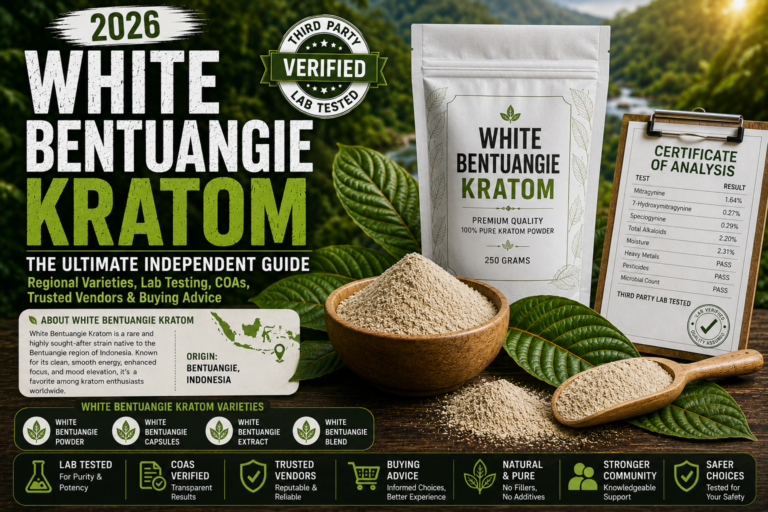
| White Bentuangie | Early harvest, minimal oxidation | Hybrid/less common positioning | Only what a batch-specific COA confirms |
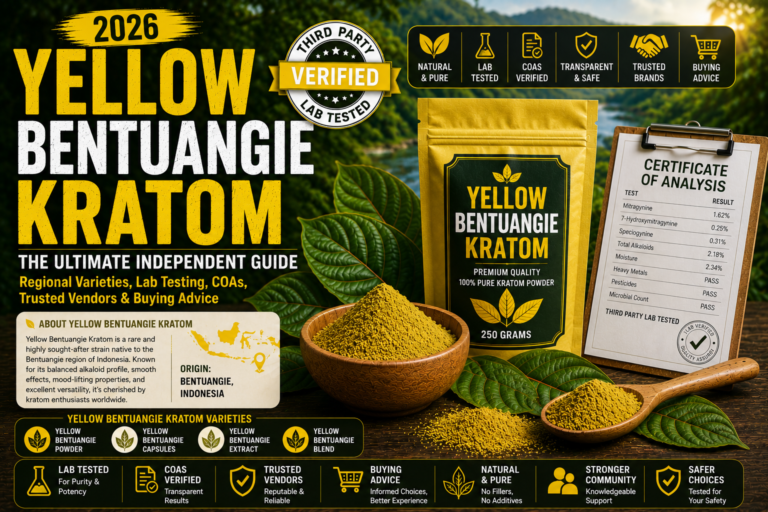
| Yellow Bentuangie | Specific drying/curing blend | Newer, “specialty” framing | Only what a batch-specific COA confirms |
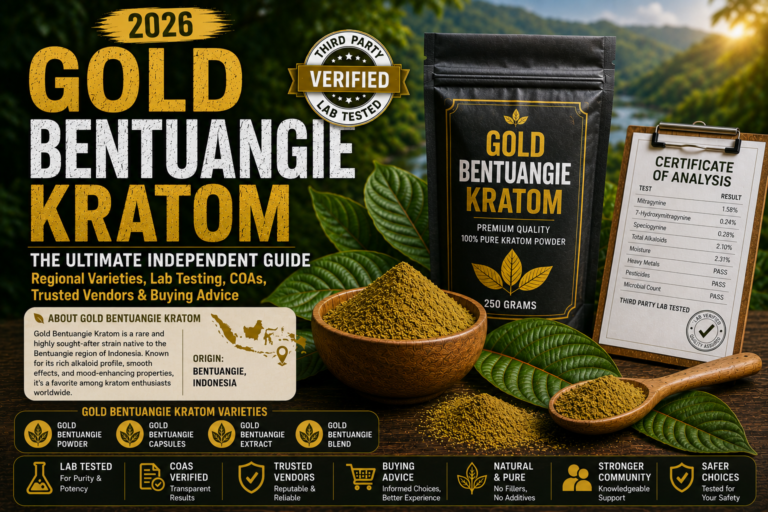
| Gold Bentuangie | Vendor-specific curing blend | Premium/newer market positioning | Only what a batch-specific COA confirms |
The pattern across all five is intentional to point out: the marketing angle changes, but the verification requirement doesn’t. Every variety name is a claim about process, not a guarantee about contents. A batch-specific Certificate of Analysis is the only thing that actually tells you what’s in the product you’re holding.
What Buyers Are Actually Searching For in 2026
Search behavior around this category has shifted noticeably toward documentation-first queries rather than pure product discovery — reflecting a broader consumer trend toward verifying claims before purchasing in unregulated supplement categories. Common patterns include:
- Batch-specific and lab-specific questions (“which lab tested this batch,” rather than just “is this lab tested”)
- Direct COA-reading questions (“how do I read a kratom COA”)
- Regulatory questions (“is kratom legal in [state],” “has the FDA approved kratom”)
- Comparative/verification questions across variants and vendors, rather than single-product reviews
This guide — and the five variety-specific guides linked above — are structured around answering exactly those questions directly, rather than around generic strain descriptions.
How to Read a Certificate of Analysis (COA)
Regardless of which Bentuangie variety you’re considering, a legitimate COA should include:
| COA Element | What to Check |
|---|---|
| Batch/lot number | Matches the number printed on your product’s packaging |
| Testing lab name | Independently named, ISO/IEC 17025-accredited — verify this yourself |
| Test date | Recent relative to purchase, not reused across unrelated batches |
| Alkaloid content | Mitragynine percentage at minimum |
| Heavy metal screening | Lead, arsenic, cadmium, mercury |
| Microbial screening | Salmonella, E. coli, yeast/mold counts |
If any of these is missing, treat the “lab tested” claim as unverified until you can confirm it directly with the lab.
The Safety and Regulatory Context Every Buyer Should Know
This section applies to every Bentuangie variety, and it’s worth reading in full before purchasing any of them:
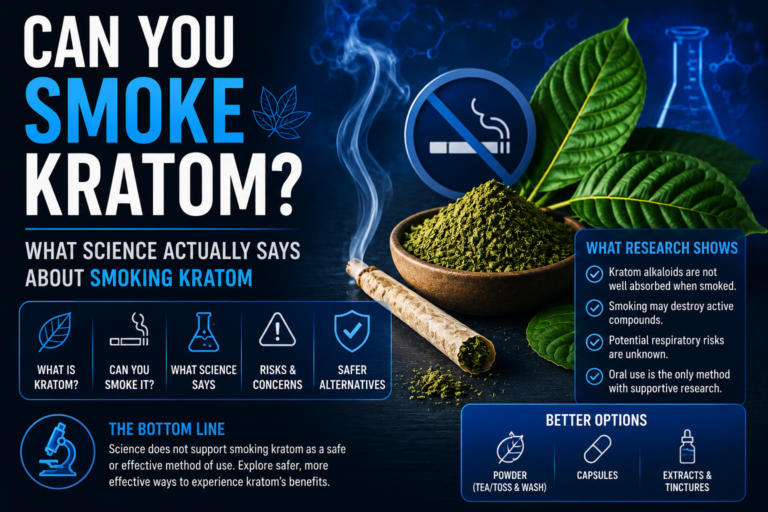
- The FDA has not approved kratom for any medical use and does not classify it as a safe dietary supplement. The agency has issued warnings about contamination (including past salmonella-linked recalls) and about dependency risk.
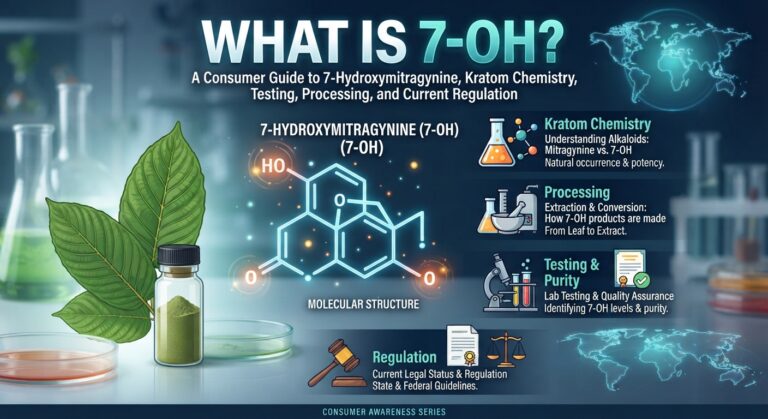
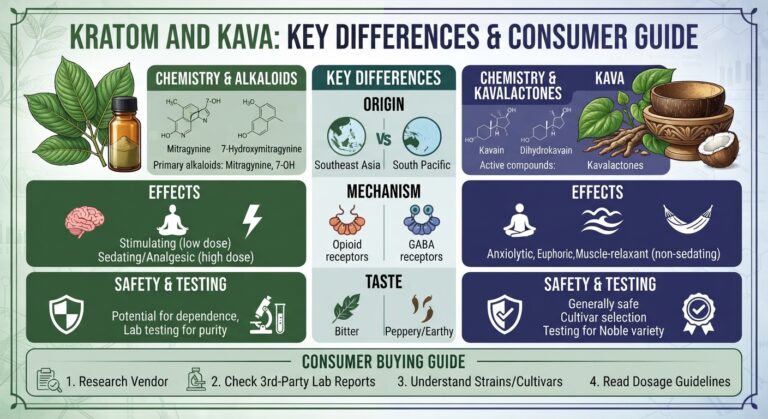
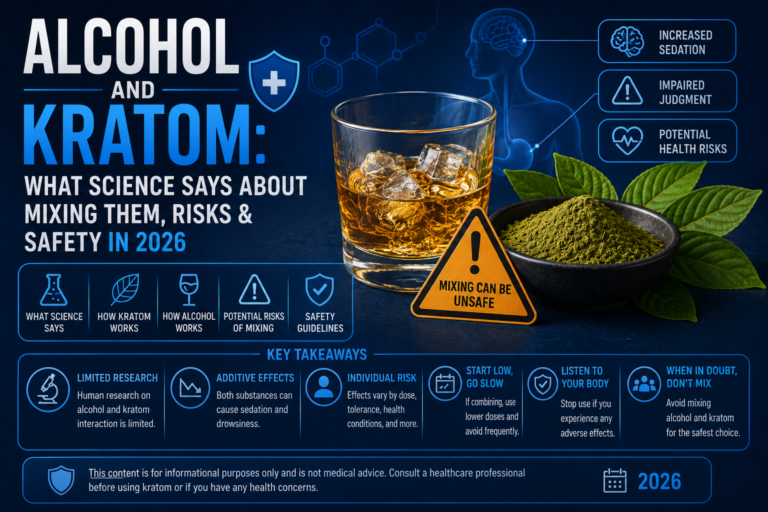
- Kratom’s primary active compounds, mitragynine and 7-hydroxymitragynine, act on opioid receptors. This is directly relevant to why people use kratom for pain, sleep, or opioid withdrawal management — and directly relevant to why dependency, withdrawal, and interaction risks (particularly with alcohol or other opioids) are real, documented concerns rather than fringe claims.
- Kratom’s legal status varies by state and country — several U.S. states and multiple countries restrict or ban it outright. Confirm your local law before ordering.
- The American Kratom Association (AKA) offers a voluntary industry GMP certification. It’s a useful signal of vendor effort, but it is industry self-regulation, not independent government oversight, and membership should be verified directly on the AKA’s own site rather than taken on a vendor’s word.
If you’re considering any Bentuangie product for a specific health reason, a conversation with a licensed healthcare provider will tell you more than any buying guide, including this one.
How to Vet a Vendor, Regardless of Variety
- Pull the COA for the specific batch you’re buying — not a generic “our products are tested” page.
- Independently search the named testing lab. Confirm it’s real, accredited, and performs this type of analysis.
- Match the batch number on the COA to the number on your packaging.
- Verify AKA membership directly on AmericanKratom.org, not from the vendor’s claim alone.
- Search for recall or complaint history using the FDA’s import alert list and general web search.
- Read shipping, return, and refund policies. Vague policies often correlate with vague testing claims.
Powder, Capsules, or Extract — Across Any Variety
- Powder is easiest to verify against a COA and typically the least processed form.
- Capsules add a documentation question: was the COA run pre- or post-encapsulation?
- Extract carries the least standardized potency terminology industry-wide — treat specific potency claims here with the most scrutiny, regardless of which color variety is being marketed.
Bottom Line
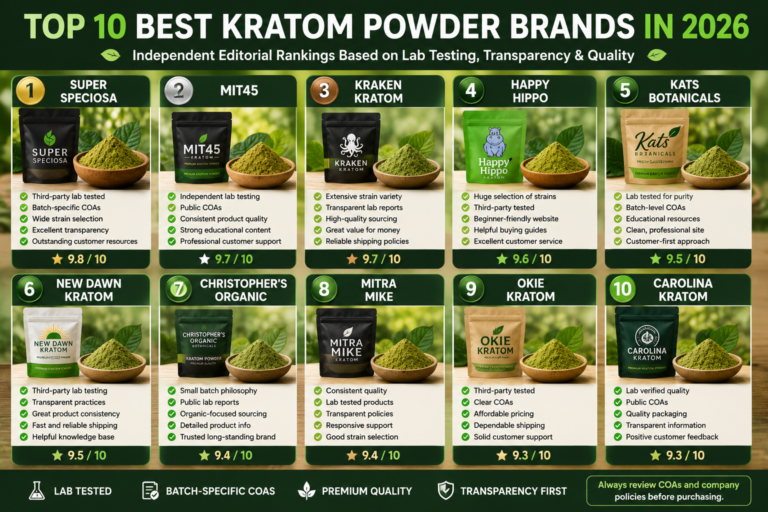
“Bentuangie” describes a curing process, not a strain, a guarantee, or a regulatory category. The five color variants sold under that name each carry their own marketing story about maturity and oxidation — but every one of those stories is a claim about process, verifiable only through a real, batch-specific COA. No brand list, including any published elsewhere, substitutes for checking that documentation yourself and confirming the lab behind it is real.
Explore Each Variety in Depth
- Red Bentuangie Kratom Guide
- Green Bentuangie Kratom Guide
- White Bentuangie Kratom Guide
- Yellow Bentuangie Kratom Guide
- Gold Bentuangie Kratom Guide
Sources for Further Reading
- U.S. Food and Drug Administration — public statements on kratom safety and regulatory status
- American Kratom Association — GMP program directory (industry self-regulation, not government oversight)
- Journal of Ethnopharmacology and Frontiers in Pharmacology — peer-reviewed research on Mitragyna speciosa alkaloids
- Kew Science, Plants of the World Online — botanical reference for Mitragyna speciosa
This article is for general educational purposes and isn’t medical advice. It doesn’t endorse or recommend the use of kratom, and doesn’t recommend specific vendors or brands.