Reviewed by Kratom Verdict Editorial Team
Last Updated: July 2026
Guide Type: Independent Editorial Strain Guide
Research Basis: Publicly available botanical information, third-party laboratory transparency, publicly available regulatory resources, scientific literature, and independent editorial research.
Red Maeng Da Kratom has a reputation as the strongest red-vein strain on the market, and consumer survey data backs that up: roughly two-thirds of red-vein kratom users say they prefer Maeng Da over any other red variety. That popularity, combined with genuinely high potency variance between vendors, makes this one of the strains where the gap between a well-sourced product and a mislabeled one is largest — and most consequential for the buyer.
This guide covers what Red Maeng Da actually is, what a legitimate lab report should show, how it compares to standard red strains, and exactly what to check before you buy.
Disclosure: This site earns commissions when you purchase through some vendor links below. That doesn’t change our evaluation criteria — we’re upfront about it because transparency is the whole point of this guide.
What Is Red Maeng Da Kratom?
“Maeng Da” translates roughly to “pimp grade” in Thai — a quality designation, not a geographic one. Unlike many kratom strains, Red Maeng Da isn’t a naturally occurring variety; it was selectively and cross-cultivated in Thailand specifically to maximize alkaloid density. After Thailand banned kratom cultivation in 1943, production shifted to Indonesia, where most Red Maeng Da sold today is grown — commonly in regions like JongKong, Kapuas Hulu, and Borneo.
The “red” designation reflects both the vein color at harvest and a drying process: red-vein leaf typically undergoes more outdoor drying and oxidation, which increases 7-hydroxymitragynine (7-OH) concentration relative to green or white processing of the same genetic stock. That combination of selective breeding plus red-vein processing is what gives Red Maeng Da its reputation as the most potent version of an already high-alkaloid strain family.
Alkaloid Profile: What the Numbers Actually Mean
- Mitragynine is the primary driver of Red Maeng Da’s reputation. Quality batches from reputable vendors commonly test between 1.5% and 2%+, notably higher than the 0.5%–1.5% range typical of standard kratom strains. Independent research has found mitragynine generally accounts for roughly two-thirds of total alkaloid content in Maeng Da samples specifically. Product testing below 1% is generally considered a sign of mislabeling or low-grade sourcing rather than authentic Red Maeng Da.
- 7-OH runs higher in Red Maeng Da than in green or white Maeng Da variants, a direct result of the red-vein oxidation process. Natural leaf typically shows 7-OH in the range of roughly 0.01%–0.06% — far below the concentrated levels found in the synthetic 7-OH products currently facing DEA scheduling action (see our separate guide on that topic), but meaningfully elevated compared to white-vein processing of the same stock.
A legitimate Certificate of Analysis (COA) needs to show both figures, from a named third-party (ideally ISO-accredited) lab, tied to a specific batch number — not a certificate that’s a year or more old being reused across every current shipment.
What Users Report About Red Maeng Da’s Effects
No vendor or publisher can legitimately make a medical claim about kratom — it hasn’t been evaluated by the FDA for treating any condition, and claims of guaranteed pain relief should be treated with skepticism regardless of the source. What’s widely and consistently reported is a profile leaning toward physical comfort and relaxation, generally considered more sedating than white or green Maeng Da, with some users describing functional energy at lower doses that shifts toward more pronounced relaxation as the dose increases. Red Maeng Da is commonly described as roughly 25%–40% more potent than standard red-vein strains at equivalent doses, which is why experienced-user guidance frequently suggests starting meaningfully lower than your usual red-vein serving when trying this strain for the first time.
Individual response depends heavily on tolerance, body weight, and the specific batch’s tested potency — treat any effect description, including this one, as a general reference point rather than a guarantee.
Red Maeng Da vs. Standard Red Strains
| Strain | Mitragynine Range | Typical Character |
|---|---|---|
| Red Maeng Da | 1.5%–2%+ | Most potent red strain; stronger relaxation and comfort effects |
| Standard Red Bali/Borneo | ~0.5%–1.5% | Milder sedation, more beginner-friendly evening use |
| Green Maeng Da (for comparison) | ~1.0%–1.9% | Balanced energy, less sedating than red processing |
This kind of direct, sourced comparison is the substantive product-category context Google’s quality rater guidelines look for — demonstrating real understanding of how processing and strain family affect potency, rather than repeating one vendor’s superlative claims.
Why Vendor Quality Varies So Much for This Strain
Red Maeng Da’s high demand and premium positioning make it a common target for corner-cutting:
- Mislabeled or diluted product — standard red-vein leaf sold under the higher-value Maeng Da name
- Inflated potency claims — labels stating 1.5%+ mitragynine with no COA to back it
- Reused or outdated COAs — lab results from many months (or over a year) prior presented as current
- In-house rather than independent testing — a “tested” claim that doesn’t specify a named third-party lab
The American Kratom Association’s GMP certification program remains the strongest publicly verifiable standard available. Always confirm a vendor’s current status directly through the AKA’s own published list, not a badge displayed on the vendor’s own site.
Also Research
- What Is Kratom?
- Maeng Da Kratom
- Green Maeng Da Kratom
- White Maeng Da Kratom
- Gold Maeng Da Kratom
- Kratom Alkaloids Explained
- Kratom Lab Testing Explained
- How to Read a Kratom COA
- How to Verify a Kratom COA
- Kratom Buying Guide
- Kratom Safety & Side Effects
- Kratom Legality Guide
Vendor Evaluation Checklist
Before buying Red Maeng Da from any source, verify:
- A current, batch-specific COA from a named, independent (ideally ISO-accredited) lab, showing mitragynine %, 7-OH %, heavy metals, and microbial testing
- AKA GMP certification, cross-checked directly through the AKA
- A matching lot/batch number between the COA and the product packaging
- Independent reviews mentioning this specific strain, not just general brand reputation (Reddit’s r/kratom is a common source)
- Clear disclosure if the product is a vein blend — some Red Maeng Da capsules combine red and white vein powder for a more balanced profile, which should be stated plainly
- A genuine return or satisfaction policy
Common Product Formats
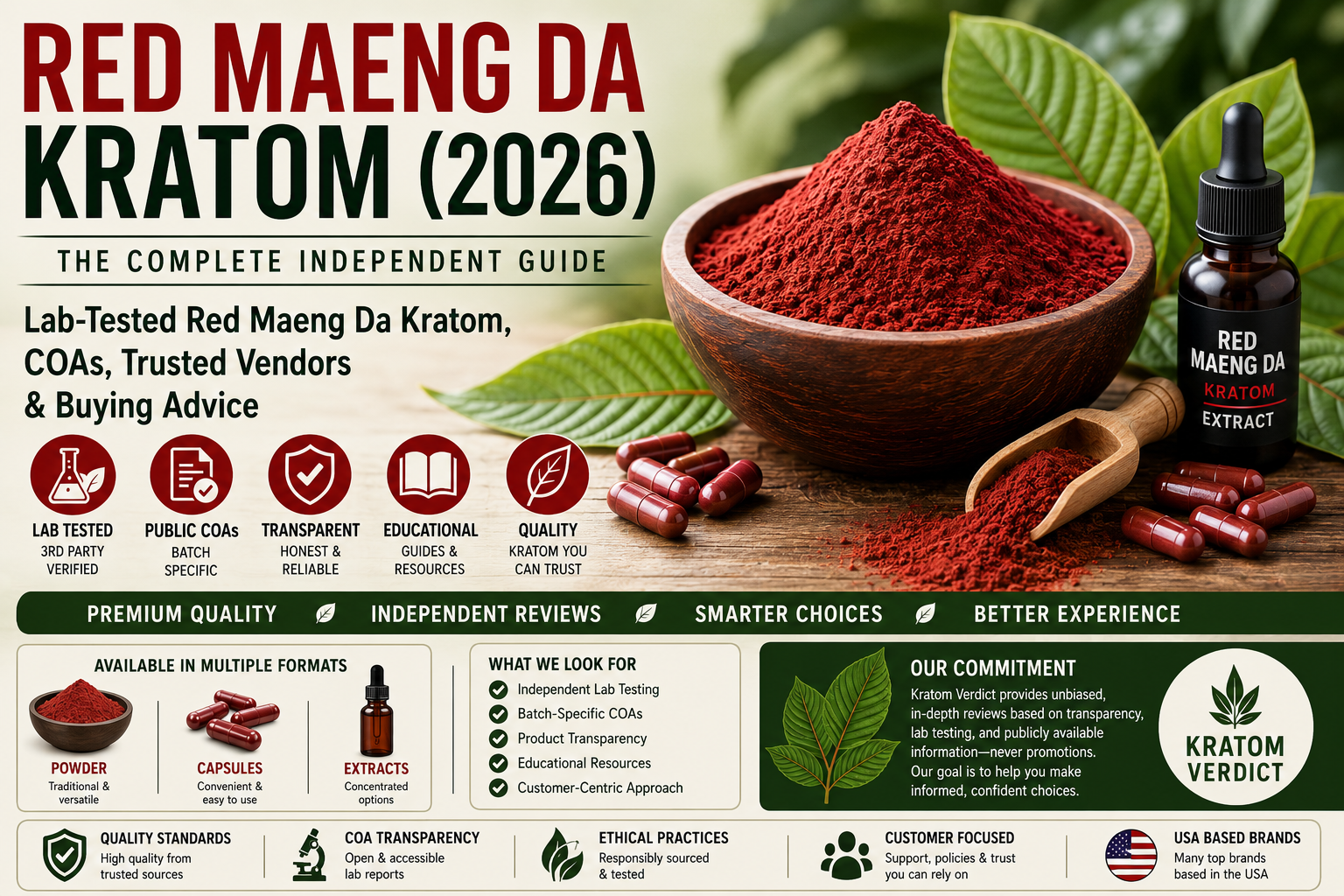
- Powder — most cost-effective, can be mixed into juice or a cold beverage to offset bitterness (heat is generally avoided, since it can degrade alkaloids)
- Capsules — pre-measured convenience; some are pure single-vein, others are red/white blends
- Tablets — pressed, pre-measured, easy to transport
- Extracts — significantly more concentrated, requiring much smaller and more carefully measured servings
A Note on Use and Starting Points
We’re not going to hand you a single “correct” dose — tolerance, body weight, and batch potency vary too much for a one-size-fits-all number to be responsible. What’s commonly cited across experienced users and vendors is that, because Red Maeng Da tests meaningfully stronger than standard red-vein strains, it’s worth starting lower than your usual red-vein serving rather than treating it as a direct substitute — some guidance suggests starting a full gram or more below what you’d normally take. Give it time to take effect (onset is commonly reported in the 20–30 minute range) before considering more. If you’re new to kratom or currently take other medications, talk to a healthcare provider first — kratom has documented interactions with several drug classes, and combining it with alcohol or other CNS depressants meaningfully increases risk.
Readers interested in learning more about Red Maeng Da Kratom, laboratory testing, botanical quality standards, and consumer education can consult publicly available information from the American Kratom Association (AKA), the American Herbal Products Association (AHPA), the U.S. Food and Drug Administration (FDA), the National Institutes of Health (NIH), and the National Center for Biotechnology Information (NCBI). These organizations publish educational resources related to botanical products, laboratory standards, consumer safety, and scientific research.
Legal Status Check
Red Maeng Da follows the same state-by-state legal patchwork as kratom generally. As of mid-2026, it remains legal at the federal level and in most U.S. states, with roughly nine states maintaining outright bans and 30+ operating under Kratom Consumer Protection Act frameworks requiring age verification and testing compliance. Confirm your specific state’s current law — including the state you’re shipping to — before ordering.
Frequently Asked Questions
Is Red Maeng Da stronger than regular Red Bali or Red Borneo? Yes, generally. Red Maeng Da is commonly reported as 25%–40% more potent than standard red-vein strains at equivalent doses, owing to its selectively bred, higher-alkaloid genetic stock.
Is Red Maeng Da a good strain for beginners? Most guidance points away from that — its higher potency makes it easier to take more than intended if you’re used to standard red strains. Experienced-user sources commonly suggest starting a gram or more below your usual red-vein dose.
Why does Red Maeng Da have more 7-OH than white or green Maeng Da? Red-vein processing involves more outdoor drying and oxidation, which naturally increases 7-hydroxymitragynine concentration relative to the same genetic stock processed as green or white vein.
What mitragynine percentage counts as authentic Red Maeng Da? Reputable vendors generally report 1.5%–2%+ mitragynine. Products testing below 1%, without a clear batch-specific explanation, are commonly flagged as mislabeled or low-grade.
How do I verify a vendor’s lab results are legitimate? Look for a COA from a named, independent (ideally ISO-accredited) lab, dated to match the specific batch/lot number on your product’s packaging — not a generic “lab tested” claim or a document that’s over a year old.
The Bottom Line
Red Maeng Da’s reputation as the most potent red-vein strain is backed by real alkaloid data, but that same premium positioning is exactly what attracts vendors willing to sell mislabeled or diluted product under the name. Confirm a current, batch-specific COA from an independent lab, check AKA GMP status directly through the American Kratom Association, and start lower than you would with a standard red strain until you know how a specific batch affects you.