Reviewed by Kratom Verdict Editorial Team
Last Updated: July 2026
Guide Type: Independent Editorial Strain Guide
Research Basis: Publicly available botanical information, third-party laboratory transparency, publicly available regulatory resources, scientific literature, and independent editorial research.
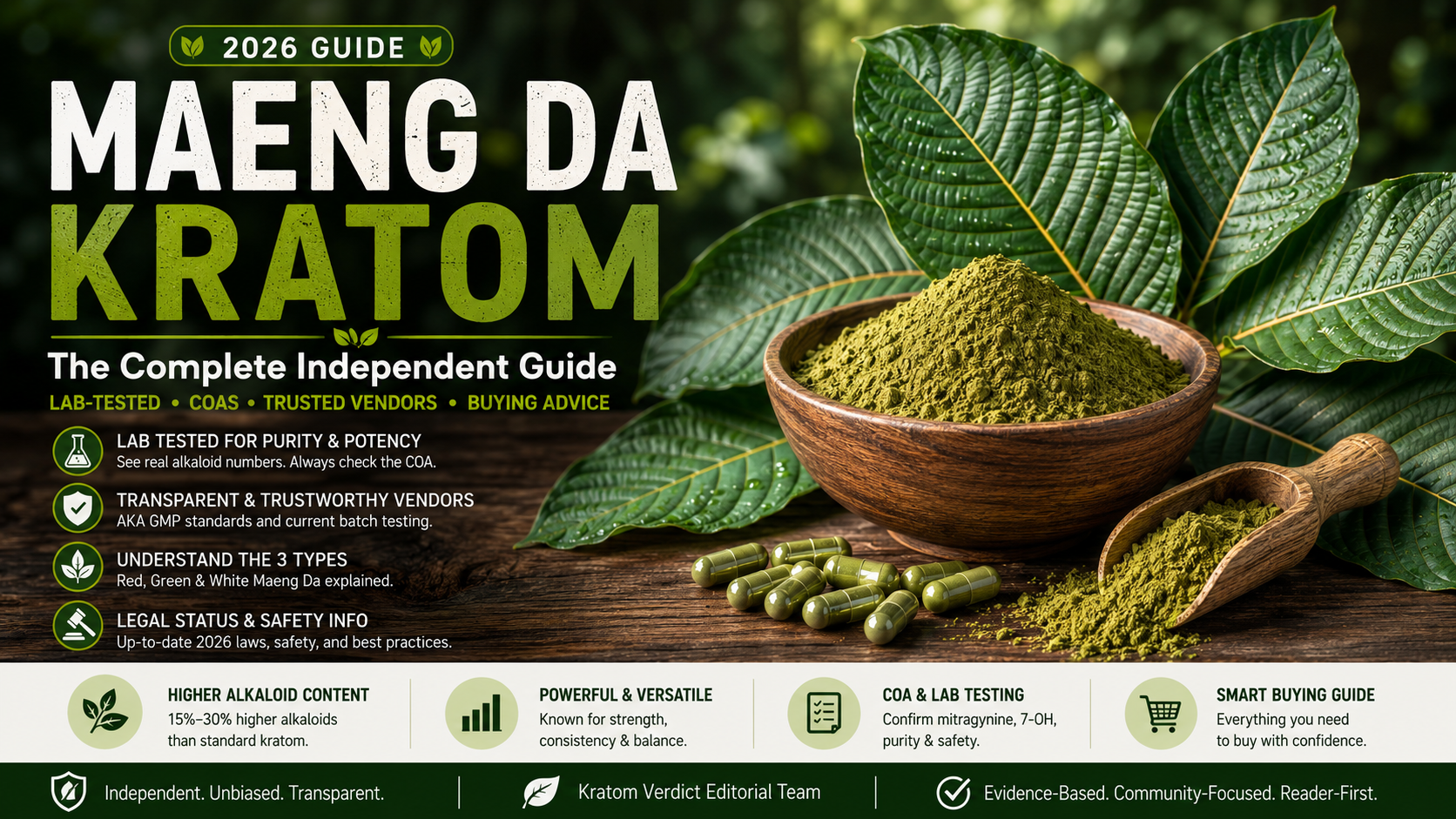
Maeng da Kratom is one of the most recognized and widely available kratom varieties sold today. This independent guide explains what this Kratom is, how it differs from other commercial strain names, how laboratory testing and Certificates of Analysis (COAs) help verify product quality, and what buyers should evaluate before choosing a vendor. Throughout this guide, we focus on transparency, independent research, and publicly available information rather than marketing claims.
this kratom consistently ranks as the highest-selling strain category in the kratom market, and lab data backs up why: alkaloid concentrations running roughly 15%–30% higher than standard varieties. That’s also exactly why it’s the most counterfeited name in the industry — high demand for a premium-priced product creates a strong incentive for vendors to slap “Maeng Da” on leaf that doesn’t earn it.
This guide is the category overview: what “Maeng Da” actually means, how it differs across red, white, and green processing, and the buying framework that applies no matter which version you’re shopping for. If you already know which vein color you want, our dedicated guides go deeper on each: Red Maeng Da, White Maeng Da, and Green Maeng Da.
Disclosure: This site earns commissions when you purchase through some vendor links below. That doesn’t change our evaluation criteria — we’re upfront about it because transparency is the whole point of this guide.
What Does “Maeng Da” Actually Mean?
“Maeng Da” translates roughly to “pimp grade” in Thai slang — a quality designation, not a place name. That’s the single most important thing to understand before buying: unlike “Bali” or “Borneo,” kratom doesn’t tell you where the leaf came from. It tells you the leaf was selectively bred or specially processed to concentrate alkaloid content beyond what standard kratom trees produce.
The strain has genuine origins in Thailand, where farmers historically cross-cultivated plants for maximum alkaloid density. After Thailand banned kratom cultivation in 1943, production shifted primarily to Indonesia, and today the overwhelming majority of this kratom sold — across all three vein colors — is grown and processed there, commonly in regions like Borneo, JongKong, and Kapuas Hulu, alongside supply from Malaysia.
Because “Maeng Da” is a market category rather than a botanical variety, naming isn’t standardized across vendors. Different brands sell products under this name with meaningfully different alkaloid profiles, and some blend vein types entirely rather than selling single-origin leaf. That’s exactly why the buying framework in this guide matters more than the name on the label.
The Three of this kratom Types: Quick Comparison
Vein color reflects harvest timing and drying method, and it’s the single biggest factor shaping how a given kratom product actually feels.
| Type | Mitragynine Range | 7-OH Level | Typical Character | Best For |
|---|---|---|---|---|
| White Maeng Da | 1.4%–1.8%+ | Very low (often <0.01%) | Fast, intense stimulation | Experienced users wanting maximum energy/focus |
| Green Maeng Da | 1.0%–1.9% | Low-moderate | Balanced “functional energy,” faster tolerance buildup | All-day use, energy without the harder edge |
| Red Maeng Da | 1.5%–2%+ | Elevated relative to white/green | Strongest relaxation and comfort effects | Evening use, experienced users |
A useful way to think about it: white Maeng Da kratom leans hardest into mitragynine-driven stimulation, red Maeng Da’s extra drying/oxidation increases 7-OH and shifts the profile toward comfort and relaxation, and green Maeng Da kratom sits in the middle. All three share the same underlying genetic advantage — that’s the “Maeng Da” part — but processing determines where on that spectrum a given product lands.
Why Lab-Verified Alkaloid Content Matters More for this brandThan Most Strains
Because kratom commands a price premium and isn’t tied to a verifiable growing region, it’s disproportionately targeted by mislabeling. A few patterns show up consistently across the market:
- Standard-grade leaf sold under the Maeng Da name at a markup, with no potency data to justify it
- Vein-blended products (for example, red/white or green/white mixes) marketed as if they were single-origin
- Reused or outdated COAs — a certificate from many months prior presented as current
- In-house-only testing with no named, independent lab behind the results
The American Kratom Association’s GMP certification program remains the strongest publicly verifiable standard in an otherwise unregulated market. Always confirm a vendor’s current status directly through the AKA’s own published list rather than a certification badge shown on the vendor’s own site.
Vendor Evaluation Checklist (Applies to All Three Types)
Before buying any Maeng Da kratom product, verify:
- A current, batch-specific COA from a named, independent (ideally ISO-accredited) lab, showing mitragynine %, 7-OH %, heavy metals, and microbial testing
- AKA GMP certification, cross-checked directly through the AKA’s published vendor list
- A matching lot/batch number between the COA and your actual product packaging
- Clear disclosure of vein blending, if applicable — the label should say so, not imply single-origin leaf
- Independent reviews mentioning the specific vein type, not just general brand reputation (Reddit’s r/kratom is a common source for strain-specific feedback)
- A genuine return or satisfaction policy
A Documented Reason This Matters: Real Recall History
This isn’t a hypothetical caution. In November 2025, a vendor recalled its Green Maeng Da kratom powder after a state agriculture department identified potential Salmonella contamination during routine retail testing. It’s a specific, verifiable example of why microbial testing on a current COA isn’t optional — for any vein color, not just green.
Common Kratom Formats
- Powder — most cost-effective, fastest onset, requires manual measuring
- Capsules — pre-measured convenience; check whether the product is single-vein or a blend
- Tablets — pressed, pre-measured, easy to transport
- Extracts — significantly more concentrated, requiring much smaller and more carefully measured servings
Also Research
- What Is Kratom?
- Kratom Alkaloids Explained
- Kratom Lab Testing Explained
- How to Read a Kratom COA
- How to Verify a Kratom COA
- Kratom Buying Guide
- Kratom Safety & Side Effects
- Kratom Legality Guide
A Note on Use
We won’t hand you a single “correct” dose for any kratom type — tolerance, body weight, and batch potency vary too much for a one-size-fits-all number to be responsible advice. The general principle that applies across all three: because Maeng Da kratom tests meaningfully higher in alkaloid content than standard strains, it’s worth starting lower than you would with a non-Maeng-Da product from the same vein color, giving it time to take effect before considering more, and rotating strains periodically, since regular users commonly report tolerance building faster with high-potency strains like these. If you’re new to kratom or currently take other medications, talk to a healthcare provider first — kratom has documented interactions with several drug classes.
Legal Status Check
this kratom follows the same state-by-state legal patchwork as kratom generally, regardless of vein color. As of mid-2026, it remains legal at the federal level and in most U.S. states, with roughly nine states maintaining outright bans and 30+ operating under Kratom Consumer Protection Act frameworks requiring age verification and testing compliance. Some 2026 state legislation has specifically targeted mitragynine content thresholds, so it’s worth confirming your state’s current specifics rather than assuming kratom’s general legal status covers every product form.
Frequently Asked Questions
Is this a specific region or type of kratom tree? No. It’s a quality/market designation referring to selectively bred or specially processed leaf with a denser alkaloid profile — not a geographic origin like Bali or Borneo, despite the naming convention feeling similar.
Is all kratom actually from Thailand? No — while the name originated there, the vast majority of this kratom sold today, across all vein colors, is grown and processed in Indonesia, particularly Borneo, following Thailand’s 1943 cultivation ban.
Why does “Maeng Da” vary so much between vendors? Because it’s a market category rather than a regulated botanical term, there’s no industry standard defining exactly what qualifies. Some vendors sell single-origin leaf; others blend vein types under the same name. Always check the batch-specific COA rather than assuming consistency across brands.
How do I know if a Maeng Da kratom product’s lab results are legitimate? Look for a COA from a named, independent lab, dated to match the specific batch/lot number on your product’s packaging — including microbial results, not just an alkaloid percentage.
Readers interested in learning more about this kratom, laboratory testing, botanical quality standards, and consumer education can consult publicly available information from the American Kratom Association (AKA), the American Herbal Products Association (AHPA), the U.S. Food and Drug Administration (FDA), the National Institutes of Health (NIH), and the National Center for Biotechnology Information (NCBI). These organizations publish educational resources related to botanical products, laboratory standards, consumer safety, and scientific research.
The Bottom Line
this magical kratom earns its premium reputation on real alkaloid data — it genuinely tests higher than standard kratom across all three vein colors. But that same premium status is exactly what attracts vendors willing to sell mislabeled, diluted, or under-tested product under the name. Confirm a current, batch-specific COA, check AKA GMP status directly through the American Kratom Association, and pick your vein color based on the effect profile you’re after using the comparison above — then dig into our dedicated Red, White, and Green kratom guides for the full details on your specific choice.