Reviewed by Kratom Verdict Editorial Team
Last Updated: July 2026
Estimated Reading Time: 7 minutes
Guide Type: Independent Editorial Strain Guide
Research Basis: Publicly available botanical information, third-party laboratory transparency, publicly available regulatory resources, scientific literature, and independent editorial research.
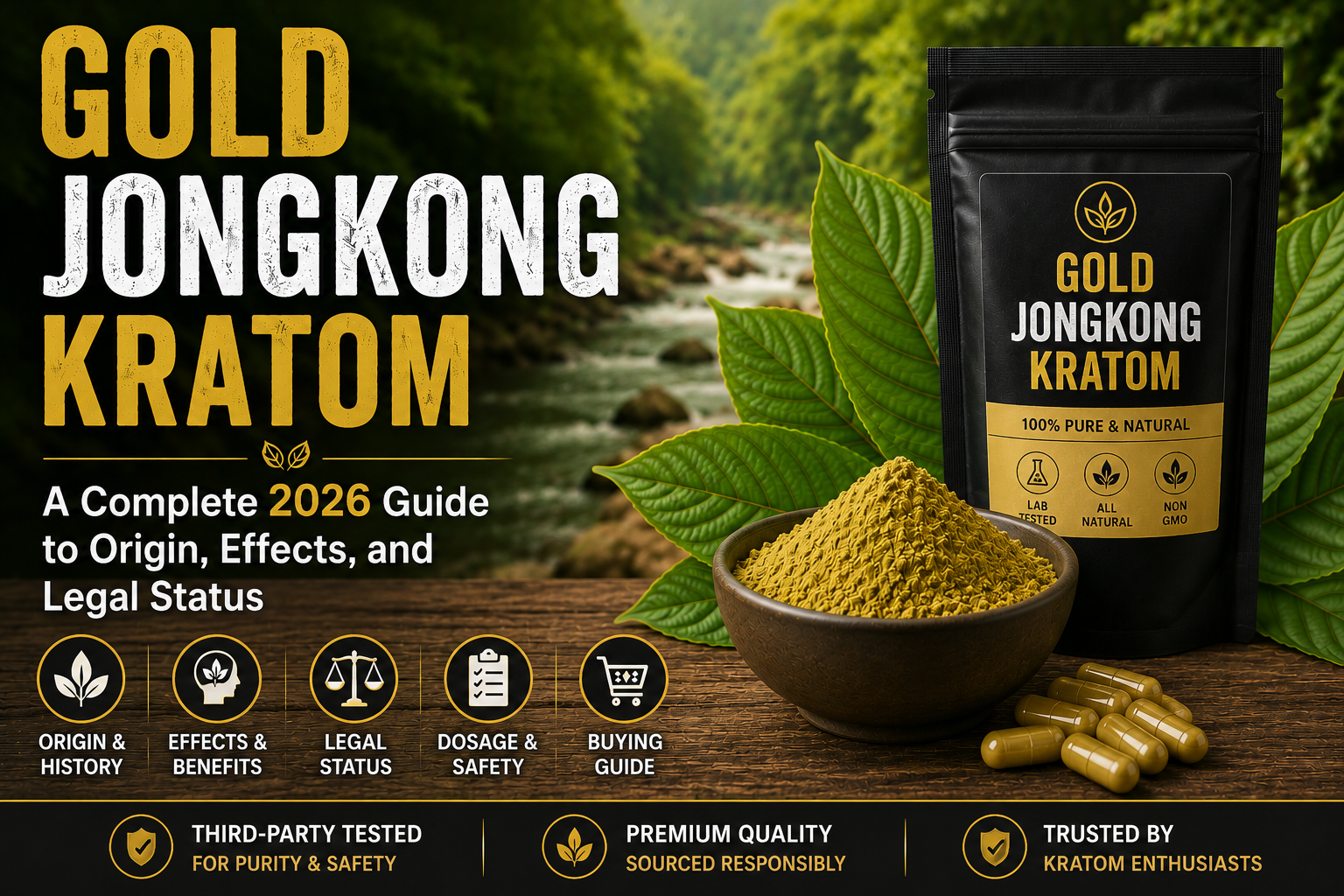
Gold Jongkong kratom occupies an unusual spot in the Jongkong family: unlike Red, Green, and White Jongkong, it isn’t defined by a naturally occurring leaf color. It’s a blended strain, and that blending process is exactly what gives it its distinct, “best of both worlds” reputation. Here’s a current, balanced look at what Gold Jongkong actually is, what users report, and the legal landscape as of 2026.
What Is Gold Jongkong Kratom?
Gold Jongkong is made by combining Green Jongkong and White Jongkong powders, typically in a ratio around 60% green to 40% white, though the exact blend varies by vendor. The result ranges in color from light gold to a deeper yellow, depending on the proportions used. This is worth understanding clearly: “gold” kratom, across the industry, doesn’t describe a unique vein color harvested from the tree — it’s a formulation, created by blending or, in some cases, using an extended curing process on existing leaf.
Both source strains — Green and White Jongkong — are grown in the Jongkong region of West Kalimantan, on the Indonesian side of Borneo, an area known for fertile, mineral-rich soil along the Kapuas River that’s frequently credited with the region’s high alkaloid yields.
Alkaloid Profile
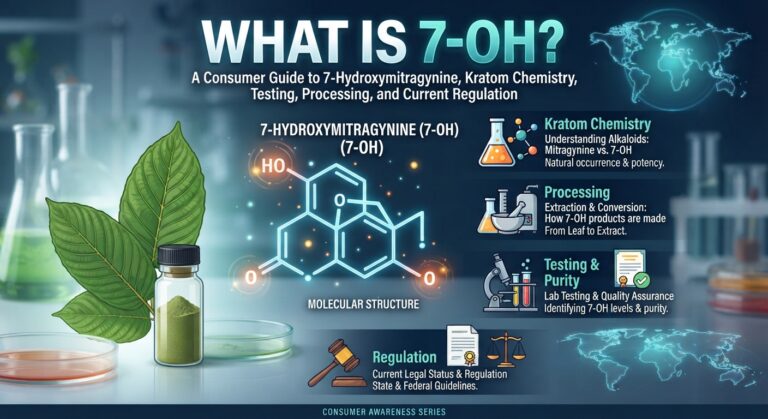
Because Gold Jongkong is a blend, its alkaloid profile — driven primarily by mitragynine and smaller natural amounts of 7-hydroxymitragynine (7-OH) — reflects a combination of its parent strains rather than a single distinct chemistry. In practice, this means Gold Jongkong tends to sit between Green Jongkong’s balanced profile and White Jongkong’s more concentrated, stimulating one, though the exact ratio a vendor uses will shift where on that spectrum a given batch lands.
Reported Effects (User Reports, Not Medical Claims)
As with any kratom product, it’s important to note the FDA has not approved kratom for any medical use, and the following reflects user and vendor reporting rather than clinical evidence. With that caveat, Gold Jongkong is commonly described as:
- Balanced and versatile — positioned as usable during the day or evening, depending on the blend ratio
- Mild energy and mood lift — without the strong stimulation associated with pure White Jongkong or the heavier sedation of red strains
- Mental clarity — some users report feeling clear-headed and even-keeled rather than wired or drowsy
- A “middle ground” option — often recommended to users who find White Jongkong too intense or Green Jongkong too mild
Because Gold Jongkong’s composition varies by vendor, effects can differ noticeably from one brand’s product to another — more so than with single-vein strains.
Gold Jongkong vs. Other Jongkong Strains
| Strain | Composition | Typical Positioning |
|---|---|---|
| Gold Jongkong | Blend of Green + White (commonly ~60/40) | Balanced, flexible day/evening use |
| Green Jongkong | Pure green-vein leaf | Balanced daytime strain |
| White Jongkong | Green-vein leaf plus reincorporated stems/veins | Strong stimulation, sharp focus |
| Red Jongkong | Pure red-vein leaf | Sedating, evening use |
Because it’s a formulated blend rather than a distinct harvest, Gold Jongkong is best understood as a way to fine-tune the effect profile of Jongkong kratom rather than as its own botanical variety.
Kratom Legal Status in 2026: What You Need to Know
Kratom’s legal status has shifted meaningfully in 2026, and this applies to Gold Jongkong exactly as it does to any other kratom product.
Federal status: Whole-leaf kratom — including the green and white leaf that make up Gold Jongkong — remains unscheduled under the federal Controlled Substances Act. The DEA has not classified natural kratom leaf as a controlled substance, and a 2016 attempt at emergency scheduling was withdrawn after significant public and congressional pushback.
7-OH scheduling action: On July 1, 2026, the DEA moved to temporarily place concentrated and synthetic 7-hydroxymitragynine — along with several related lab-made compounds — into Schedule I, with HHS support. This targets concentrated and synthesized 7-OH products specifically, not natural blended leaf products like Gold Jongkong, which contain 7-OH only in low, naturally occurring amounts.
State-by-state patchwork: As of mid-2026, kratom is banned in roughly seven states — including Alabama, Arkansas, Connecticut, Indiana, Louisiana, Vermont, and Wisconsin — plus Washington, D.C. Rhode Island became the first state to reverse a kratom ban, moving to a regulated framework (21+ age limits, lab testing, labeling requirements) effective April 1, 2026. Other states, such as California, have used food-safety statutes to pull kratom products from retail shelves even without a dedicated ban law, and additional restriction or ban bills remain active in several state legislatures.
Bottom line: Because rules change at both the state and federal level, verify current local law before purchasing, possessing, or shipping Gold Jongkong kratom.
Safety Considerations
- The FDA has never approved kratom as a dietary supplement, food additive, or drug, and maintains it has no approved medical use.
- CDC data published in early 2026 showed a sharp rise in kratom-related poison control exposure reports over the past decade, with 2025 alone accounting for a large share of that increase.
- Because Gold Jongkong blends two strains, its effects — and its onset and duration — can be less predictable batch to batch than single-vein products, which is worth factoring in if you’re new to it.
- Risks associated with kratom more broadly, including dependence with regular heavy use and rare reports of liver toxicity, apply to blended products like Gold Jongkong as much as to any other kratom strain.
If you already use kratom regularly and have concerns about dependence, or notice symptoms like unusual fatigue or withdrawal-type effects, talk to a healthcare provider. Kratom dependence is treatable, and your state’s legal status has no bearing on whether care is available to you.
Buying Gold Jongkong: What to Check
- Disclosed blend ratio — reputable vendors will tell you the green-to-white ratio used, since it directly affects the product’s character
- Third-party lab testing for alkaloid content, heavy metals, microbials, and 7-OH concentration by dry weight
- Kratom Consumer Protection Act (KCPA) compliance, where applicable in your state
- Sourcing transparency on both parent strains (Green and White Jongkong)
- Age-gating (21+), now standard practice across most reputable vendors
Frequently Asked Questions
Is Gold Jongkong a natural strain? No. Unlike Red, Green, and White Jongkong, Gold Jongkong is a blend — typically Green and White Jongkong powder combined — rather than a strain harvested at a distinct vein color.
What ratio of Green to White is used in Gold Jongkong? It varies by vendor, but a common approach is roughly 60% Green Jongkong to 40% White Jongkong, adjusted to taste by individual brands.
Is Gold Jongkong stronger than Green Jongkong? Not necessarily stronger, but typically more stimulating, since it incorporates White Jongkong. The exact intensity depends on the blend ratio a given vendor uses.
Is Gold Jongkong kratom legal? It depends on your state. As of 2026, kratom leaf is legal in most U.S. states but banned in a handful of others, while concentrated 7-OH products face additional federal restriction. Always confirm current state and local law before buying.
Where does Gold Jongkong kratom come from? Its parent strains, Green and White Jongkong, are both grown in the Jongkong region of West Kalimantan, Indonesia, on the island of Borneo.
This article is for informational purposes only and does not constitute medical or legal advice. Kratom is not FDA-approved for any medical use, and its legal status varies by state and changes frequently. Consult a healthcare provider before using kratom, and verify current local law before purchasing or possessing any kratom product.