Reviewed by Kratom Verdict Editorial Team
Last Updated: July 2026
Estimated Reading Time: 5 minutes
Guide Type: Independent Editorial Strain Guide
Research Basis: Publicly available botanical information, third-party laboratory transparency, publicly available regulatory resources, scientific literature, and independent editorial research.
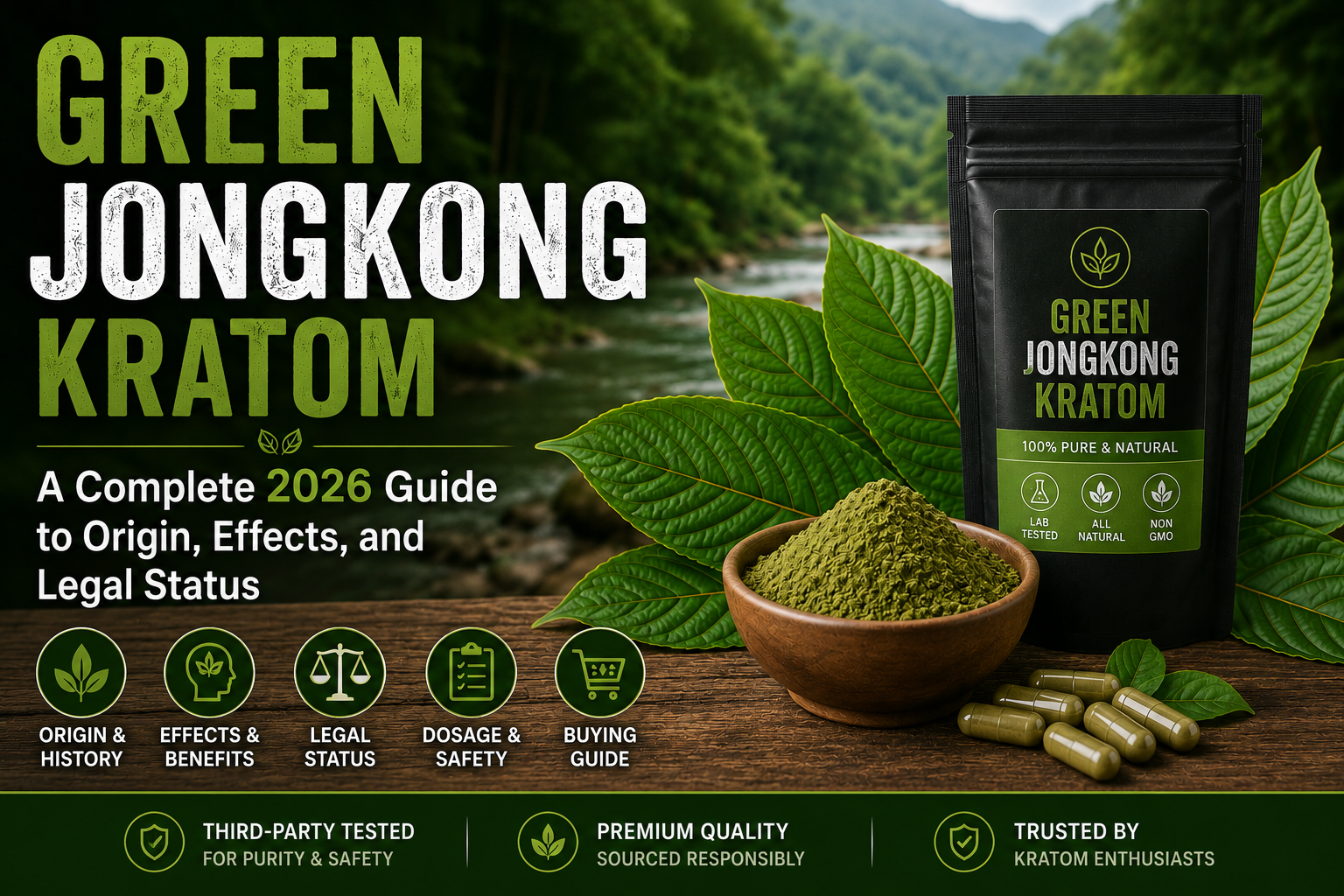
Green Jongkong kratom has become one of the more talked-about green-vein strains in the botanical community — prized for being harder to source than mainstream varieties like Bali or Maeng Da, and for its reputation as a “balanced” option among green strains. This guide covers where Green Jongkong comes from, what makes it different, what users report, and — critically — the current legal landscape, which has shifted significantly in 2026.
What Is Green Jongkong Kratom?
Green Jongkong is a green-vein variety of Mitragyna speciosa, the tropical tree native to Southeast Asia commonly known as kratom. It’s named after the Jongkong district in West Kalimantan, on the Indonesian side of Borneo, where the trees grow along the Kapuas River. The region’s humid climate and rich riverside soil are often cited as reasons the leaf develops a distinctive alkaloid profile.
Because Jongkong is a more remote growing region than better-known kratom hubs, true Jongkong leaf has historically been harder to source at scale — which is part of why it carries something of a “specialty strain” reputation among long-time kratom users.
Green Jongkong’s Alkaloid Profile
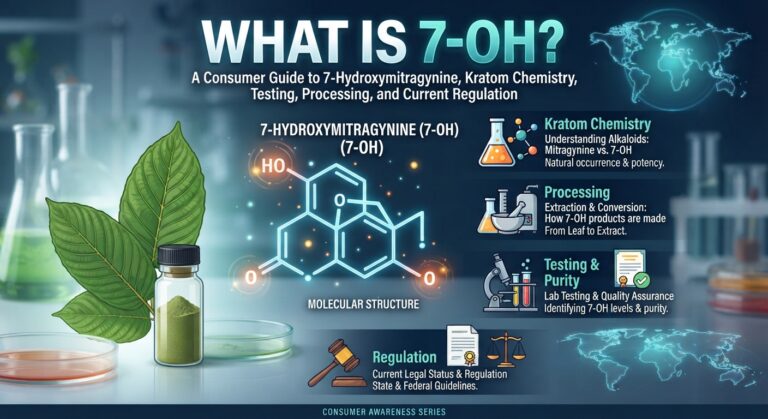
Like all kratom varieties, Green Jongkong’s character comes down to its alkaloid content — primarily mitragynine and, in smaller natural amounts, 7-hydroxymitragynine (7-OH). These compounds interact with opioid receptors in the body, which is the basis for the range of effects users report. Green-vein strains, including Jongkong, are generally described by the community as sitting between the more stimulating white-vein and more sedating red-vein varieties — though individual experience varies widely and there’s limited rigorous clinical research to confirm specific effects.
Reported Effects (Anecdotal, Not Medical Claims)
It’s worth being direct here: the FDA has not approved kratom for any medical use, and claims about its effects are based on user reports and community consensus rather than controlled clinical trials. With that caveat, Green Jongkong is commonly described by users as:
- A “middle ground” strain — less stimulating than white strains, less sedating than reds
- Associated with mood support and general daytime use
- Often compared to Green Maeng Da, though users report it as somewhat milder
If you’re considering kratom for a specific health concern, that’s a conversation to have with a healthcare provider, not a decision to base on product marketing or forum anecdotes.
Green Jongkong vs. Other Popular Strains
| Strain | Typical Positioning | Often Compared To |
|---|---|---|
| Green Jongkong | Balanced, daytime | Green Maeng Da, Green Malay |
| Red Jongkong | More sedating | Red Bali, Red Bentuangie |
| White Jongkong | More stimulating, less common | White Maeng Da |
Vendors and reviewers frequently note that Green Jongkong works well as a “base” strain — some blend it with red or white varieties to shift the effect profile.
Kratom Legal Status in 2026: What’s Changed
Kratom’s legal status is genuinely in flux right now, more so than most botanical products, and anyone researching Green Jongkong should treat this as the most important section.
Federal status: Kratom leaf itself remains unscheduled under the federal Controlled Substances Act — the DEA has not classified it as a controlled substance, and a 2016 attempt to emergency-schedule it was withdrawn after significant public pushback. However, the regulatory picture around concentrated 7-OH products changed sharply in mid-2026.
7-OH scheduling action: On July 1, 2026, the DEA moved to temporarily place concentrated and synthetic 7-hydroxymitragynine — along with several related lab-made compounds — into Schedule I, a move supported by HHS. This action specifically targets synthesized and concentrated 7-OH products, not natural, whole-leaf kratom containing 7-OH below a low threshold. In other words: raw leaf strains like Green Jongkong are treated differently from concentrated extracts under this action.
State-by-state patchwork: As of mid-2026, kratom is banned in roughly seven states — including Alabama, Arkansas, Connecticut, Indiana, Louisiana, Vermont, and Wisconsin — plus Washington, D.C. Rhode Island notably became the first state to reverse a kratom ban, replacing prohibition with a regulated framework (21+ age limits, lab testing, labeling) effective April 1, 2026. Meanwhile, states like California have used food-safety law to pull kratom products from retail shelves even without a specific ban statute, and several more states have active ban or restriction bills moving through their legislatures.
The bottom line: Because this landscape is changing month to month, always verify your specific state and even local (city/county) rules before purchasing, possessing, or shipping kratom — what was legal last year, or even last month, may not be today.
Safety Considerations
This is worth taking seriously rather than glossing over. Public health data has flagged rising concerns:
- The FDA has never approved kratom as a dietary supplement, food additive, or drug product, and maintains it has no approved medical use.
- CDC data published in early 2026 showed a sharp rise in kratom-related poison control exposure reports over the past decade, with 2025 alone accounting for a large share of the total increase.
- Regulators and clinicians have pointed to risks including liver toxicity, respiratory depression at high doses, and physical dependence with regular use — concerns that intensified around high-concentration 7-OH products specifically.
If you already use kratom regularly and are concerned about dependence, or if you experience symptoms like jaundice, unusual fatigue, or withdrawal-like effects, that’s worth discussing with a doctor. Kratom dependence is treatable, and your state’s legal status for kratom has no bearing on whether treatment or medical care is available to you.
Buying Green Jongkong: What Quality-Conscious Shoppers Check
If you’re evaluating vendors, the current industry-standard markers of a more trustworthy product include:
- Third-party lab testing for alkaloid content, heavy metals, microbials, and (increasingly) 7-OH concentration by dry weight
- Kratom Consumer Protection Act (KCPA) compliance, where applicable in your state
- Clear sourcing information — reputable vendors are often specific about growing region and harvest practices
- Age-gating (21+), which is now standard practice even in states without a legal requirement
Frequently Asked Questions
Is Green Jongkong the same as Green Maeng Da? No, though they’re often compared. Both are green-vein strains and share some alkaloid similarities, but they come from different growing regions and are frequently described as having different intensity levels, with Jongkong often characterized as the milder of the two.
Is Green Jongkong kratom legal? It depends entirely on your state. As of 2026, kratom leaf is legal in most U.S. states but banned in a handful of others, and concentrated 7-OH products face additional federal restrictions. Always check current state and local law before purchasing.
What’s the difference between Green Jongkong and 7-OH products? Green Jongkong, as a natural leaf strain, contains 7-OH only in small, naturally occurring amounts. Concentrated or synthetic 7-OH products are a separate category that has come under significantly more regulatory scrutiny in 2026, including a DEA move toward Schedule I classification.
Where does Green Jongkong kratom come from? The Jongkong district of West Kalimantan, Indonesia, along the Kapuas River on the island of Borneo.