Reviewed by Kratom Verdict Editorial Team
Last Updated: July 2026
Estimated Reading Time: 14 minutes
Guide Type: Independent Editorial Strain Guide
Research Basis: Publicly available botanical information, third-party laboratory transparency, publicly available regulatory resources, scientific literature, and independent editorial research.
Editorial Note
Jongkong Kratom is one of the most frequently misunderstood regional names in the kratom industry.
Some vendors describe it as a unique “super strain.”
Others market it as though it were genetically different from every other kratom product available.
Neither description accurately reflects the current understanding of how regional kratom names are used within the commercial marketplace.
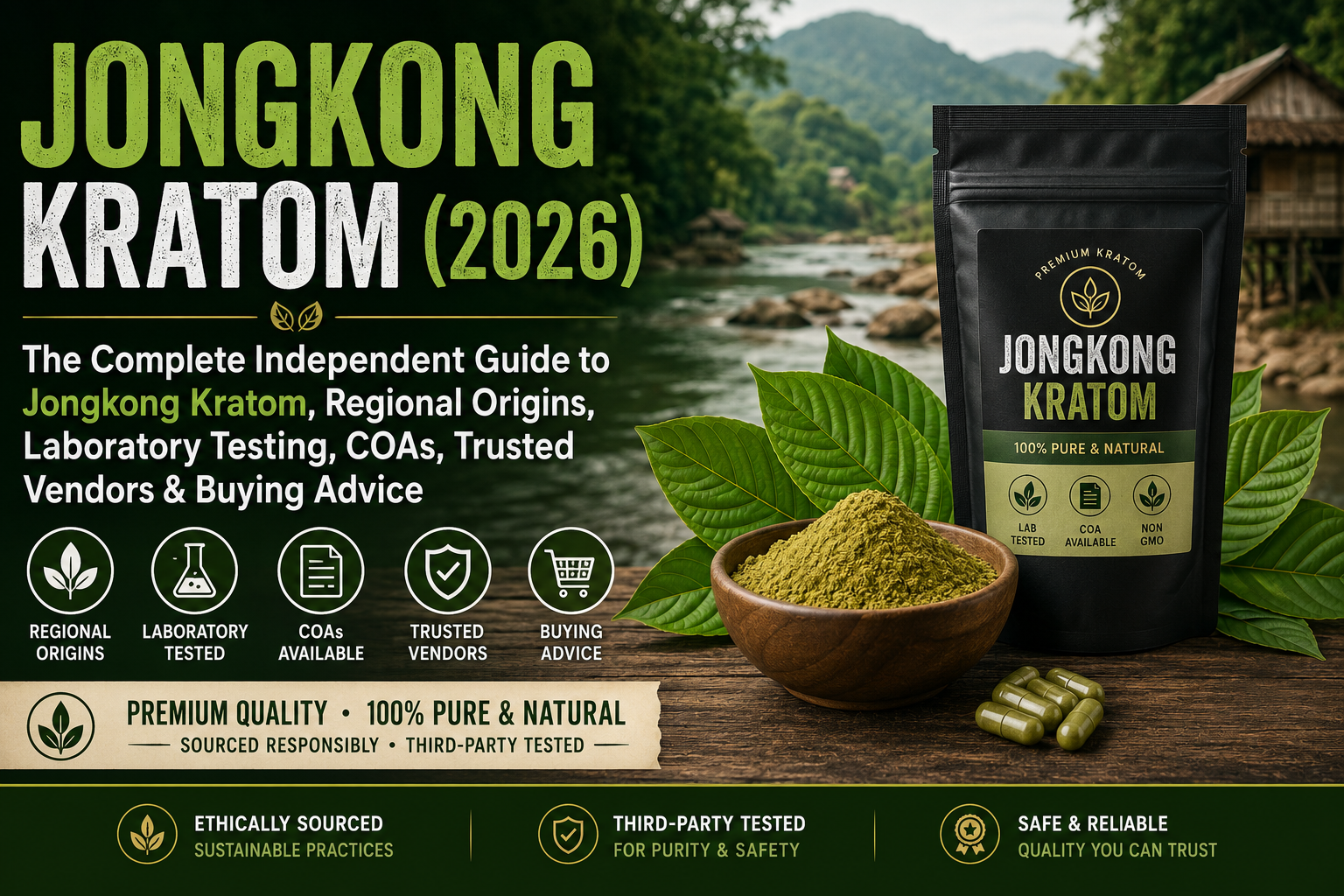
Jongkong is primarily a geographic designation associated with the Jongkong district of West Kalimantan, Indonesia—one of the regions historically connected with commercial kratom cultivation and processing.
That distinction matters.
Regional names do not automatically describe a specific chemical profile, cultivation method, or manufacturing standard.
Two products sold as “Jongkong Kratom” may differ because of:
- Harvest season
- Leaf maturity
- Drying techniques
- Storage conditions
- Processing methods
- Quality-control standards
- Laboratory testing procedures
This means buyers should evaluate the evidence supporting a product rather than the regional name printed on the label.
Throughout this guide we examine:
- What Jongkong Kratom actually is
- Why regional names can be misleading
- How production methods influence commercial products
- How to evaluate laboratory reports
- What separates transparent vendors from marketing-driven companies
- How to compare Jongkong products objectively using publicly available documentation
Quick Editorial Assessment
| Editorial Category | Assessment |
|---|---|
| Transparency Potential | ⭐⭐⭐⭐⭐ |
| COA Verification Importance | ⭐⭐⭐⭐⭐ |
| Batch Traceability Importance | ⭐⭐⭐⭐⭐ |
| Manufacturing Complexity | Moderate |
| Regional Standardization | Low |
| Importance of Independent Testing | Very High |
| Overall Editorial Confidence | High (when supported by complete documentation) |
What Is Jongkong Kratom?
Jongkong Kratom refers to kratom products associated with the Jongkong region of West Kalimantan, Indonesia.
Unlike scientific botanical classifications, commercial regional names generally describe where leaves are believed to originate or where they are processed rather than identifying a separate botanical species.
Every authentic Jongkong product originates from the same species:
Mitragyna speciosa
This tropical evergreen tree grows naturally throughout parts of Southeast Asia.
The regional name does not indicate that Jongkong trees belong to a different species or that they possess a universally consistent chemical composition.
Instead, regional names help identify commercial sourcing areas within Indonesia’s kratom supply chain.
Why Regional Names Can Be Misunderstood
One of the largest misconceptions in the kratom marketplace is that every regional name represents a completely different plant.
Current evidence does not support that conclusion.
Regional names such as:
- Jongkong
- Kapuas
- Hulu Kapuas
- Ketapang
- Bentuangie
generally describe commercial sourcing or processing traditions rather than genetically distinct cultivars.
Several factors influence the characteristics of the harvested material:
- Soil composition
- Climate
- Rainfall
- Elevation
- Harvest timing
- Drying conditions
- Storage practices
- Manufacturing decisions
As a result, products carrying the same regional name should not automatically be assumed to be chemically identical.
Why Laboratory Testing Matters More Than Regional Names
Because regional names alone cannot guarantee product consistency, laboratory testing becomes one of the most valuable tools available to consumers.
A responsible vendor should provide a batch-specific Certificate of Analysis that allows buyers to verify the exact product being sold.
A comprehensive COA should include:
- Product identification
- Batch or lot number
- Independent laboratory name
- Test date
- Mitragynine analysis
- 7-Hydroxymitragynine analysis
- Heavy metal screening
- Microbiological testing
This documentation enables consumers to evaluate measurable information instead of relying solely on product descriptions.
Understanding the Jongkong Supply Chain
Before a package labeled “Jongkong Kratom” reaches a customer, it typically passes through several stages.
Stage 1 — Cultivation
Mitragyna speciosa trees are cultivated and harvested within producing regions of Indonesia.
Environmental conditions may influence the harvested leaves, although these factors do not create entirely separate botanical species.
Stage 2 — Harvesting
Leaves are collected at maturity before entering post-harvest handling.
Harvest timing, weather conditions, and handling practices can all affect the quality of the raw material.
Stage 3 — Drying and Processing
Fresh leaves are dried using controlled methods.
Depending on the manufacturer, additional curing or processing techniques may also be applied before milling.
Processing methods often contribute more variation than the regional name itself.
Stage 4 — Milling
The dried material is milled into a fine powder suitable for packaging or further manufacturing into capsules and other product formats.
Stage 5 — Laboratory Testing
Responsible manufacturers submit finished batches for independent analysis.
Testing commonly includes:
- Alkaloid analysis
- Heavy metal screening
- Microbiological testing
- Batch identification
These reports form one of the strongest objective indicators of transparency.
Stage 6 — Packaging and Distribution
Products should clearly display:
- Product name
- Batch number
- Net weight
- Manufacturer information
- COA access (where available)
- Storage recommendations
Accurate labeling improves traceability and allows consumers to connect a purchased product with the corresponding laboratory documentation.
The Question Every Buyer Should Ask
Instead of asking:
“Is Jongkong Kratom better than other regional products?”
A more useful question is:
“Which company provides enough independently verifiable evidence for me to evaluate the product with confidence?”
That shift—from marketing to documentation—is the foundation of the Kratom Verdict editorial methodology and the standard applied throughout this guide.
Why Two Jongkong Products Can Be Completely Different
One of the biggest surprises for many buyers is discovering that two products labeled “Jongkong Kratom” may look, smell, and test differently.
This is not necessarily evidence that one product is authentic and the other is not.
Instead, it reflects the reality that the commercial kratom supply chain contains numerous variables before a finished product reaches consumers.
Some of the factors that influence the final product include:
- Harvest season
- Leaf maturity
- Weather conditions
- Drying environment
- Milling procedures
- Storage conditions
- Manufacturing quality standards
- Laboratory testing practices
For this reason, regional names alone cannot guarantee product consistency.
Objective laboratory documentation provides a far more reliable basis for comparison.
Understanding a Jongkong Certificate of Analysis (COA)
A Certificate of Analysis is the most important document available when evaluating a Jongkong product.
Rather than relying on marketing claims, a COA provides measurable information generated by an independent laboratory.
A complete report should clearly identify:
| COA Section | Why It Matters |
|---|---|
| Product identification | Confirms which product was tested |
| Batch or lot number | Links the report to the purchased product |
| Independent laboratory | Identifies who performed the testing |
| Test date | Indicates when analysis occurred |
| Mitragynine analysis | Reports one measured alkaloid |
| 7-Hydroxymitragynine analysis | Reports another measured alkaloid |
| Heavy metal screening | Documents contaminant testing |
| Microbiological analysis | Evaluates microbial contamination |
The most useful COAs are easy for customers to access and clearly connected to specific product batches.
Batch Traceability
Batch traceability is one of the strongest indicators of transparency.
Responsible companies should allow customers to verify that the laboratory report corresponds to the exact package they purchased.
Look for:
✔ Batch number printed on the package
✔ Matching batch number on the COA
✔ Clearly identified laboratory
✔ Recent testing date
✔ Product identification matching the label
If these details cannot be connected, consumers have less confidence that the published report represents the purchased product.
Heavy Metal Screening
Responsible manufacturers routinely test for common heavy metals.
A professional laboratory report may include screening for:
- Lead
- Arsenic
- Mercury
- Cadmium
Heavy metal analysis is a routine component of comprehensive quality assurance and should be reviewed together with the rest of the laboratory documentation rather than in isolation.
Microbiological Testing
Microbiological analysis evaluates whether a product has been screened for common microbial contaminants.
Testing may include:
- Salmonella
- Escherichia coli (E. coli)
- Yeast
- Mold
- Total aerobic microbial count
These results help demonstrate that quality-control procedures extend beyond alkaloid testing alone.
Beyond Alkaloid Numbers
Many buyers compare products using only a single alkaloid value.
That approach overlooks much of the information contained within a Certificate of Analysis.
A responsible evaluation also considers:
- Product identification
- Batch traceability
- Independent laboratory
- Heavy metal screening
- Microbiological analysis
- Testing date
- Completeness of documentation
A complete laboratory report provides significantly more context than any single analytical measurement.
Comparing Vendors Objectively
Instead of comparing marketing descriptions, evaluate vendors using measurable criteria.
| Evaluation Category | Questions to Ask |
|---|---|
| Laboratory Transparency | Are batch-specific COAs publicly available? |
| Batch Traceability | Does the lot number match the report? |
| Manufacturing Transparency | Does the company explain its quality-control process? |
| Product Labeling | Is the package clearly labeled? |
| Consumer Education | Does the company explain how to interpret laboratory reports? |
| Customer Support | Can buyers easily request additional information? |
Using consistent evaluation criteria helps reduce reliance on advertising claims.
Common Marketing Myths About Jongkong Kratom
Because regional names are popular, marketing language sometimes creates unrealistic expectations.
Myth 1 — Every Jongkong Product Is Identical
Reality:
Production methods and quality-control procedures vary between manufacturers.
Myth 2 — Regional Name Equals Higher Quality
Reality:
A regional designation alone does not verify manufacturing standards or laboratory testing.
Transparency and documentation remain far better indicators.
Myth 3 — Color Determines Quality
Reality:
Appearance may vary because of harvesting, drying, storage, and processing methods.
Product quality cannot be determined from color alone.
Myth 4 — Higher Price Guarantees Better Quality
Reality:
Price does not automatically reflect transparency or manufacturing standards.
Consumers should evaluate the supporting documentation rather than assuming cost reflects quality.
Buying Checklist
Before purchasing Jongkong Kratom, our editorial team recommends confirming the following.
| Verification Item | Complete |
|---|---|
| Batch-specific COA available | □ |
| Independent laboratory identified | □ |
| Batch number matches product | □ |
| Heavy metal screening completed | □ |
| Microbiological testing completed | □ |
| Product labeling complete | □ |
| Manufacturer information available | □ |
| Customer support accessible | □ |
| Return policy published | □ |
| Educational resources available | □ |
Companies that consistently satisfy these criteria generally demonstrate stronger transparency and documentation.
Mid-Article Editorial Assessment
| Editorial Category | Assessment |
|---|---|
| Laboratory Transparency | Excellent |
| COA Accessibility | Excellent |
| Batch Traceability | Excellent |
| Manufacturing Transparency | Very Good |
| Product Labeling | Very Good |
| Consumer Education | Very Good |
| Overall Documentation Quality | High |
At this stage of the review, one conclusion becomes clear: the name “Jongkong” alone does not provide enough information to evaluate a product. Independent laboratory testing, batch traceability, manufacturing transparency, and complete documentation remain the most reliable tools for comparing Jongkong Kratom across different vendors.
How to Choose a High-Quality Jongkong Kratom Product
One of the biggest mistakes consumers make is assuming that every product labeled “Jongkong Kratom” represents the same material.
Because there is no universal production standard governing commercial regional names, responsible purchasing should focus on vendor transparency rather than branding alone.
Before purchasing, verify that the company provides:
✔ Batch-specific Certificate of Analysis (COA)
✔ Independent third-party laboratory testing
✔ Heavy metal screening
✔ Microbiological testing
✔ Batch traceability
✔ Transparent manufacturing information
✔ Complete product labeling
✔ Accessible customer support
✔ Published return and shipping policies
The more independently verifiable information a company provides, the easier it becomes to compare products objectively.
How We Compare Jongkong Vendors
Every Jongkong vendor reviewed by Kratom Verdict is evaluated using the same editorial framework.
Laboratory Transparency
Can buyers easily access batch-specific laboratory reports?
Batch Traceability
Can the batch number printed on the package be matched with the published Certificate of Analysis?
Manufacturing Transparency
Does the company explain its sourcing, quality-control procedures, testing program, and manufacturing standards?
Product Labeling
Does the packaging clearly identify:
- Product name
- Batch number
- Net weight
- Manufacturer
- Storage information
- COA availability
Consumer Education
Does the company help customers understand:
- Laboratory reports
- Batch numbers
- Product documentation
- Quality-control procedures
Educational resources contribute significantly to long-term consumer confidence.
Common Buying Mistakes
During our editorial research, several purchasing mistakes appear repeatedly.
Mistake 1 — Buying Based Only on the Regional Name
The name “Jongkong” identifies a commercial regional designation.
It does not guarantee identical production methods or laboratory results.
Mistake 2 — Ignoring Batch Numbers
Responsible companies connect laboratory reports directly to individual production batches.
If this connection cannot be verified, confidence in the documentation decreases.
Mistake 3 — Looking Only at One Alkaloid Value
Many consumers compare only mitragynine measurements.
A responsible evaluation should also include:
- Heavy metal screening
- Microbiological testing
- Laboratory identity
- Batch traceability
- Product labeling
Complete documentation provides a much stronger basis for comparison than a single analytical value.
Mistake 4 — Assuming Higher Prices Mean Better Products
Pricing alone does not indicate transparency.
Some competitively priced vendors publish excellent documentation, while expensive products may provide limited publicly available information.
Evidence should always take priority over price.
Mistake 5 — Trusting Marketing Language
Statements such as:
- Premium Jongkong
- Ultra-Potent
- Exclusive Harvest
- Superior Regional Quality
should never replace independently verifiable laboratory documentation.
Marketing language does not improve editorial confidence without supporting evidence.
Frequently Asked Questions
Is Jongkong Kratom a different species?
No.
Jongkong products originate from Mitragyna speciosa, the same botanical species as other commercial kratom products.
The regional designation identifies a sourcing area rather than a separate species.
Why do Jongkong products vary between vendors?
Several factors influence commercial products, including:
- Harvest timing
- Drying conditions
- Storage practices
- Manufacturing procedures
- Quality-control systems
Because no universal production standard exists, differences between products are expected.
Why is laboratory testing so important?
Laboratory testing provides objective documentation that consumers can independently evaluate.
A complete Certificate of Analysis helps verify:
- Product identity
- Batch traceability
- Heavy metal screening
- Microbiological analysis
- Analytical testing performed by an independent laboratory
What should I verify before purchasing?
Responsible buyers should confirm:
- Batch-specific COA
- Matching lot number
- Independent laboratory
- Product identification
- Complete contaminant screening
- Transparent manufacturing information
These factors provide a stronger basis for comparison than marketing claims.
Can appearance determine product quality?
No.
Color, texture, and aroma may vary because of harvesting, drying, storage, and manufacturing differences.
Visual appearance alone cannot confirm quality or transparency.
What is the single most important factor?
Our editorial team considers complete, independently verifiable laboratory documentation to be the strongest indicator of transparency.
Companies openly publishing batch-specific Certificates of Analysis consistently demonstrate higher editorial confidence.
Final Editorial Verdict
Jongkong Kratom illustrates why regional names should be viewed as starting points rather than guarantees.
The name provides useful information about commercial sourcing, but it does not automatically describe manufacturing practices, laboratory standards, or product consistency.
Consumers who understand this distinction are better positioned to compare vendors objectively.
Throughout our editorial evaluation, several characteristics consistently separated stronger companies from weaker ones:
- Publicly available batch-specific Certificates of Analysis
- Independent third-party laboratory testing
- Clear batch traceability
- Heavy metal and microbiological screening
- Transparent manufacturing information
- Accurate product labeling
- Educational resources explaining laboratory documentation
Rather than searching for the “best” Jongkong product based solely on its name, buyers should evaluate the quality of the evidence supporting that product.
That evidence-based approach provides a stronger foundation for informed purchasing decisions than branding or promotional claims alone.
The Kratom Verdict Editorial Principles
Every regional guide published by Kratom Verdict follows the same independent editorial methodology.
Evidence Before Marketing
Editorial conclusions are based on publicly verifiable information rather than advertising.
Transparency Before Popularity
Well-known vendors do not automatically receive stronger editorial confidence.
Objective documentation remains the deciding factor.
Consumer Education Matters
Companies helping customers understand Certificates of Analysis, batch traceability, and manufacturing standards contribute positively to editorial confidence.
Manufacturing Transparency Builds Trust
Clear documentation regarding production methods, quality-control procedures, and laboratory testing strengthens consumer confidence.
Independent Verification
Whenever possible, buyers should independently verify:
- Certificates of Analysis
- Batch numbers
- Laboratory identity
- Heavy metal testing
- Microbiological screening
- Product labeling
Independent verification remains one of the strongest consumer protections available when evaluating regional kratom products.
Final Recommendation
If you are considering Jongkong Kratom, focus on the quality of the documentation rather than the popularity of the regional name.
The most trustworthy vendors are those that openly publish batch-specific Certificates of Analysis, maintain clear batch traceability, identify independent laboratories, explain their manufacturing standards, and provide sufficient information for customers to independently verify product quality.
An evidence-based purchasing approach consistently provides a stronger basis for comparison than relying on regional branding or marketing language.
Sources
- U.S. Food and Drug Administration (FDA) — Public guidance relating to kratom and botanical products.
- American Kratom Association (AKA) — Current Good Manufacturing Practices (cGMP) Standards Program.
- ISO/IEC 17025 — International standard for testing and calibration laboratory competence.
- National Center for Biotechnology Information (NCBI/PubMed) — Peer-reviewed scientific literature relating to Mitragyna speciosa.
- Publicly available manufacturer documentation, Certificates of Analysis (COAs), product labeling, and educational materials reviewed during independent editorial research.
Editorial Disclosure
Kratom Verdict is an independent editorial publication. Editorial conclusions are based on publicly available information evaluated using a consistent methodology. Affiliate relationships, where applicable, do not influence editorial scores, rankings, or recommendations.
Medical & Legal Disclaimer
This guide is provided for educational and informational purposes only. Kratom is not approved by the U.S. Food and Drug Administration for the diagnosis, treatment, cure, or prevention of any disease. This article evaluates transparency, documentation, manufacturing practices, and consumer information rather than medical effectiveness or product safety. Readers should review applicable local laws, independently examine batch-specific Certificates of Analysis, and consult qualified healthcare professionals before considering kratom or related botanical products.