- Reviewed by Kratom Verdict Editorial Team
- Last Updated: July 2026
- Estimated Reading Time: 18–22 minutes
- Guide Type: Independent Editorial Strain Guide
Research Basis: Publicly available botanical information, third-party laboratory transparency, publicly available regulatory resources, scientific literature, and independent editorial research. Understanding What is Red Borneo Kratom begins with reviewing regional naming conventions, manufacturing information, and laboratory documentation. Red Borneo Kratom should be evaluated using Certificates of Analysis rather than marketing claims. Comparing verified information allows consumers to assess Red Borneo Kratom more confidently before purchasing.
Quick Answer
Red Borneo Kratom is a commercial marketplace designation that combines a regional reference (“Borneo”) with a processing designation (“Red”). It is not a scientifically recognized botanical strain or officially standardized cultivar of Mitragyna speciosa. Because there is no international authority defining what qualifies as Red Borneo Kratom, products marketed under this name may differ substantially in cultivation, harvesting, post-harvest processing, alkaloid composition, and manufacturing quality.
Consumers evaluating Red Borneo Kratom should prioritize objective documentation rather than commercial branding. A current batch-specific Certificate of Analysis (COA), independent laboratory testing, contaminant screening, and transparent manufacturing information provide a stronger basis for assessing product quality than product names or promotional claims.
What “Red Borneo Kratom” Actually Means
Red Borneo Kratom combines two commercial descriptors that refer to different aspects of a product rather than identifying a unique botanical variety.
Understanding each component individually helps explain why products sold under the same commercial name may differ significantly between manufacturers. Independent Red Borneo Kratom laboratory reports help verify product quality through analytical testing. Reviewing Red Borneo Kratom lab testing together with Red Borneo Kratom laboratory analysis provides objective information about each production batch. Reliable documentation allows buyers to compare Red Borneo Kratom using scientific evidence.
What “Borneo” Refers To
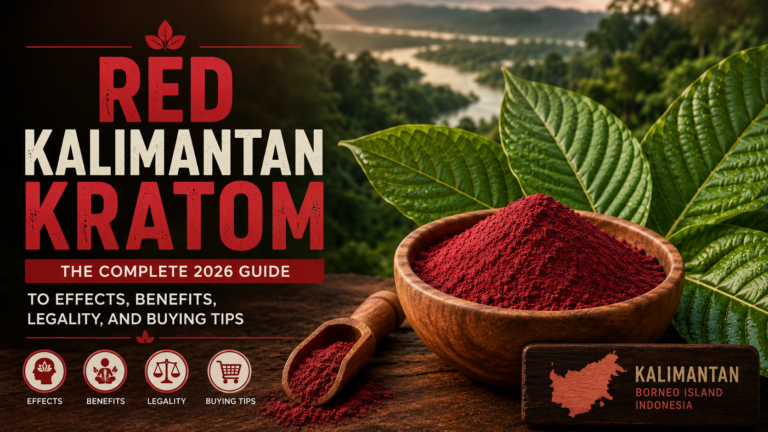
The word Borneo refers to the world’s third-largest island, shared by Indonesia, Malaysia, and Brunei. Indonesian Borneo (Kalimantan) has become one of the world’s largest commercial sources of kratom exported to international markets, although Mitragyna speciosa naturally occurs across several regions of Southeast Asia.
Products marketed as Borneo Kratom may:
- Originate from Indonesian Borneo
- Be cultivated in different regions of Kalimantan
- Be blended with botanical material from neighboring areas
- Use “Borneo” primarily as a commercial marketplace designation
For this reason, the commercial name alone should not be interpreted as proof of precise geographic origin.
What “Red” Refers To
Unlike geographic names, Red generally refers to post-harvest processing rather than cultivation location.
Within today’s commercial kratom marketplace, Red products are commonly associated with drying and curing techniques that differ from those used for products marketed as Green or White varieties. However, there is no internationally accepted production standard defining exactly how Red Kratom must be produced. Manufacturers use different harvesting schedules, drying methods, oxidation periods, curing practices, and finishing procedures.
Depending on the manufacturer, production methods may include:
- Extended drying
- Controlled curing
- Moisture-controlled finishing
- Modified oxidation
- Proprietary post-harvest processing
Consequently, two products marketed as Red Borneo may differ substantially despite carrying identical commercial names.
Red Borneo Is Not a Botanical Strain
One of the most common misconceptions within today’s kratom marketplace is that Red Borneo represents a distinct botanical species.
Current botanical research does not support that conclusion.
All commercially available kratom originates from the same tropical evergreen tree:
Scientific Name: Mitragyna speciosa.
Commercial names such as:
- Red Borneo
- Green Borneo
- White Borneo
- Gold Borneo
- Yellow Borneo
- Maeng Da
- Horn
- Bentuangie
describe combinations of:
- Geographic sourcing
- Harvest timing
- Leaf appearance
- Drying methods
- Post-harvest processing
- Commercial branding
rather than different plant species.
Understanding this distinction helps consumers separate botanical science from commercial terminology.
Botanical Background
Mitragyna speciosa belongs to the Rubiaceae family—the same botanical family that includes coffee.
Its accepted native distribution includes:
- Borneo
- Malaysia
- Indonesia
- Thailand
- Myanmar
- Cambodia
- Vietnam
- Papua New Guinea
Warm temperatures, abundant rainfall, fertile soils, and tropical humidity create favorable growing conditions.
Although environmental factors influence naturally occurring alkaloid concentrations, scientists do not recognize Red Borneo as a separate botanical variety.
Why Commercial Names Cannot Predict Product Quality
Consumers frequently expect products carrying identical commercial names to possess similar chemical composition.
Scientific evidence demonstrates that agricultural products naturally exhibit variation.
Several factors contribute to this variability.
Climate
Seasonal weather patterns influence plant development and naturally occurring alkaloid production throughout the growing cycle.
Soil Composition
Mineral availability differs between growing regions and contributes to natural variation in plant chemistry.
Harvest Timing
Leaves harvested at different stages of maturity may exhibit different naturally occurring alkaloid profiles.
Drying and Processing
Post-harvest drying, curing, blending, and finishing procedures influence the characteristics of the finished botanical material.
Because Red products are created using different manufacturer-specific processing methods, differences between suppliers should be expected.
Storage
Temperature, humidity, packaging, and storage duration all influence product stability before sale.
Manufacturing Practices
Grinding, milling, blending, packaging, transportation, and storage introduce additional variables that differ between manufacturers.
Modern scientific research continues to demonstrate that geographical origin, environmental conditions, harvest timing, and post-harvest processing all contribute to measurable differences in kratom alkaloid composition, reinforcing the importance of laboratory verification over product names alone.
Understanding Red Borneo Processing
Among commercial kratom categories, Red products are generally marketed using drying and curing methods intended to distinguish them from products marketed as Green, White, Gold, or Yellow varieties.
However, there is no governing organization defining:
- Drying duration
- Moisture targets
- Temperature requirements
- Harvest maturity
- Storage conditions
- Processing methods
Manufacturers therefore retain considerable flexibility when producing products marketed as Red Borneo.
Consumers should recognize that identical commercial names do not guarantee identical manufacturing practices. Every Red Borneo Kratom production batch should include documentation identifying analytical results and laboratory information. Reviewing a Red Borneo Kratom COA, understanding a Red Borneo Kratom certificate of analysis, and learning how to verify Red Borneo Kratom improves purchasing confidence while evaluating Red Borneo Kratom.
Why Documentation Matters More Than Marketing
Red Borneo Kratom products frequently display descriptions such as:
- Premium Grade
- Superior Quality
- Small Batch
- Fresh Harvest
- Third-Party Tested
- Laboratory Verified
- Hand Selected
While these statements may accurately describe a company’s internal quality-control procedures, they do not independently verify product quality.
Objective documentation provides measurable evidence.
Among the most valuable documents available to consumers is a batch-specific Certificate of Analysis (COA), which reports laboratory findings relating to the exact production batch being sold rather than making generalized claims about an entire product line. Independent Red Borneo Kratom third-party testing supports transparency by confirming laboratory verification from qualified facilities. Reviewing Red Borneo Kratom third-party testing together with documented quality procedures helps consumers compare Red Borneo Kratom objectively before selecting products from different manufacturers.
Related Strain Articles
- Borneo Kratom
- Green Borneo Kratom
- White Borneo Kratom
- Red Bali Kratom
- Red Malay Kratom
- Red Indo Kratom
- Red Maeng Da Kratom
- Borneo vs. Sumatra Kratom
- Thai vs. Malay Kratom
- Bali vs. Maeng Da Kratom
Building an Evidence-Based Evaluation
The commercial name Red Borneo Kratom cannot independently verify:
- Botanical identity
- Geographic sourcing
- Manufacturing consistency
- Alkaloid composition
- Contaminant screening
- Laboratory testing
- Product traceability
These questions are answered through documentation rather than branding.
Consumers who understand this distinction are better positioned to evaluate products objectively using measurable laboratory evidence instead of relying primarily on marketing terminology. Learning how Red Borneo Kratom is processed provides insight into harvesting, drying, and packaging practices. Reviewing Red Borneo Kratom manufacturing standards together with Red Borneo Kratom sourcing information allows consumers to evaluate Red Borneo Kratom using documented production transparency.
Regulatory and Safety Context
Understanding Red Borneo Kratom requires more than recognizing its commercial name or reported region of origin. A comprehensive evaluation should also include the current regulatory landscape, scientific understanding of Mitragyna speciosa, and the quality-control practices that help consumers evaluate products objectively.
Although kratom has a long history of traditional use in parts of Southeast Asia, regulatory approaches differ considerably around the world. Some jurisdictions regulate kratom as a consumer product, while others restrict or prohibit its sale or possession. Because regulations continue to evolve, consumers should verify the laws applicable to their own jurisdiction before purchasing or possessing Red Borneo Kratom.
FDA Position on Kratom
In the United States, the Food and Drug Administration (FDA) has not approved kratom for the diagnosis, treatment, cure, or prevention of any disease.
The FDA also states that kratom is not recognized as an approved dietary supplement under current federal standards.
The agency has published information regarding:
- Product contamination
- Variable alkaloid concentrations
- Adulterated botanical products
- Potential interactions with medications
- Dependence and withdrawal concerns
- Previous Salmonella-related recalls involving certain imported kratom products
These public statements should not be interpreted as applying equally to every Red Borneo Kratom product. Instead, they emphasize the importance of manufacturing transparency, laboratory testing, and careful evaluation of product documentation.
Legal Status
Kratom regulations vary considerably between countries and, in some cases, between states or municipalities.
Some governments prohibit its sale or possession entirely.
Others regulate kratom under food safety or consumer-product legislation.
Before purchasing Red Borneo Kratom, consumers should verify current laws applicable to their own location rather than relying solely on vendor information.
Current Scientific Understanding
Research into Mitragyna speciosa continues to expand.
Scientists are investigating:
- Botanical variation
- Alkaloid chemistry
- Agricultural influences
- Pharmacology
- Toxicology
- Analytical testing
- Quality-control procedures
- Environmental factors affecting composition
Although commercial names such as Red Borneo remain useful marketplace identifiers, scientific studies generally evaluate kratom according to measurable botanical and chemical characteristics rather than marketing terminology. Analytical laboratories perform Red Borneo Kratom alkaloid testing to identify naturally occurring botanical compounds. These scientific reports support transparency by documenting measurable laboratory results. Reviewing this information allows consumers to compare Red Borneo Kratom products while evaluating Red Borneo Kratom objectively.
Understanding Kratom Alkaloids
Researchers have identified more than forty naturally occurring alkaloids in Mitragyna speciosa.
Among these compounds, two receive the greatest scientific attention.
Mitragynine
Mitragynine is generally the predominant naturally occurring alkaloid present in kratom leaves.
Current scientific research investigates:
- Natural concentration differences
- Geographic variation
- Environmental influences
- Pharmacological activity
- Biological metabolism
- Analytical measurement techniques
Because naturally occurring concentrations vary according to environmental and agricultural conditions, laboratory testing remains necessary to determine the alkaloid profile of an individual production batch. A practical Red Borneo Kratom buying guide encourages consumers to review laboratory reports before comparing products. Researching the best Red Borneo Kratom vendors helps buyers identify companies committed to documentation and transparency. Comparing verified information strengthens confidence when selecting Red Borneo Kratom.
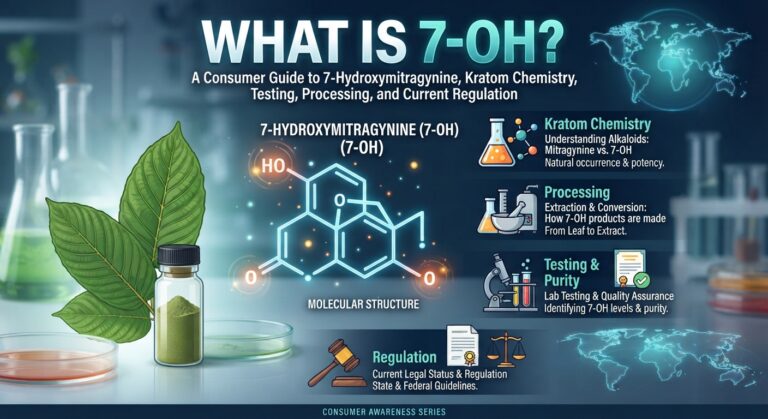
7-Hydroxymitragynine (7-OH)
7-Hydroxymitragynine is naturally present in much lower concentrations than mitragynine.
Scientific studies have demonstrated that both compounds interact with opioid receptors, making kratom an ongoing subject of pharmacological and toxicological research.
Researchers continue examining:
- Natural occurrence
- Biological activity
- Product variability
- Metabolism
- Public health implications
As scientific evidence expands, understanding of these compounds continues to develop.
Why Laboratory Testing Matters
Because naturally occurring alkaloid concentrations vary according to cultivation, harvest timing, drying methods, curing procedures, storage conditions, and manufacturing practices, commercial names such as Red Borneo cannot reliably predict a product’s chemical composition.
Independent laboratory testing provides objective measurements regarding:
- Alkaloid composition
- Product identity
- Batch traceability
- Contaminant screening
Laboratory documentation therefore provides a stronger basis for product evaluation than commercial branding alone. Reliable Red Borneo Kratom manufacturers explain documented Red Borneo Kratom quality standards together with established Red Borneo Kratom quality control procedures. Publishing this information demonstrates accountability and helps consumers evaluate Red Borneo Kratom using objective manufacturing documentation instead of advertising.
Understanding Certificates of Analysis (COAs)
A Certificate of Analysis (COA) is a laboratory document reporting analytical findings for a specific production batch.
Unlike marketing materials, a COA provides measurable data obtained through scientific laboratory analysis.
A meaningful COA should correspond to the exact batch or lot number printed on the product packaging.
Generic laboratory reports reused across multiple production batches provide considerably less assurance than current batch-specific documentation.
What Every COA Should Include
| COA Component | Why It Matters |
|---|---|
| Batch or Lot Number | Confirms the report corresponds to the purchased product. |
| Sample Identification | Establishes traceability between production and testing. |
| Laboratory Name | Identifies the analytical laboratory performing the analysis. |
| Test Date | Demonstrates that testing is current. |
| Alkaloid Analysis | Reports measured alkaloid concentrations. |
| Heavy Metal Screening | Evaluates lead, arsenic, cadmium, and mercury. |
| Microbiological Testing | Screens for Salmonella, E. coli, yeast, and mold. |
| Laboratory Authorization | Indicates formal completion of testing procedures. |
Comprehensive documentation enables consumers to evaluate products using objective evidence rather than marketing claims.
Why Batch Numbers Matter
One of the simplest quality checks consumers can perform is comparing the batch number printed on the product packaging with the batch number listed on the Certificate of Analysis.
Matching numbers indicate that the laboratory tested the same production batch being sold.
If the numbers differ—or if no batch identification appears—the report provides considerably less assurance regarding traceability.
Understanding ISO/IEC 17025 Accreditation
Many independent laboratories operate under ISO/IEC 17025, the internationally recognized accreditation standard for testing laboratory competence.
This accreditation evaluates:
- Technical competence
- Equipment calibration
- Personnel qualifications
- Testing methodologies
- Quality management systems
- Documentation procedures
- Measurement traceability
ISO/IEC 17025 accreditation does not certify the quality or safety of Red Borneo Kratom itself.
Instead, it demonstrates that the laboratory follows internationally recognized analytical standards. Consumers should understand Red Borneo Kratom legality 2026 before purchasing because regulations differ by jurisdiction. Proper Red Borneo Kratom storage also helps preserve botanical quality by protecting products from moisture and heat. Following recommended storage practices helps maintain Red Borneo Kratom quality.
Heavy Metal Screening
Because kratom is cultivated in natural environments, laboratory testing commonly includes heavy metal analysis.
Routine screening generally evaluates:
Lead
Lead accumulation is generally considered undesirable because prolonged exposure may present health concerns.
Arsenic
Naturally occurring arsenic may be present in certain soils and water sources, making routine analysis valuable for botanical products.
Cadmium
Cadmium contamination may occur through environmental exposure and is therefore commonly included within heavy metal testing programs.
Mercury
Although mercury is detected less frequently, comprehensive heavy metal panels generally include mercury alongside other commonly monitored elements.
Microbiological Testing
Microbiological screening helps determine whether botanical materials contain potentially harmful microorganisms.
Routine laboratory reports commonly include:
Salmonella
Testing for Salmonella has received increased attention following previous recalls involving contaminated imported botanical products.
Escherichia coli (E. coli)
Analysis helps evaluate sanitation throughout harvesting, processing, and packaging.
Yeast and Mold Counts
Elevated yeast or mold levels may indicate excessive moisture or inadequate storage conditions.
Routine testing helps identify these issues before products reach consumers.
Total Aerobic Plate Count
This measurement estimates the overall microbial population within a sample.
Although elevated counts do not necessarily indicate dangerous contamination, they may provide useful information regarding production and storage quality.
Alkaloid Analysis Is Only One Component of Quality
Consumers frequently compare products according to alkaloid percentages.
Although alkaloid analysis provides useful information, it represents only one component of a comprehensive quality assessment.
Responsible evaluation also considers:
- Heavy metal screening
- Microbiological testing
- Laboratory accreditation
- Batch traceability
- Manufacturing transparency
- Documentation quality
Together, these factors provide a more complete understanding of product quality than alkaloid concentrations alone.
Common Red Flags When Reviewing COAs
Consumers should carefully examine laboratory reports for warning signs, including:
- Missing batch numbers
- Undated reports
- Generic reports reused across multiple products
- Missing heavy metal analysis
- No microbiological testing
- Cropped laboratory documents
- No laboratory identification
- Accreditation claims that cannot be independently verified
- “Third-Party Tested” statements without supporting documentation
Transparency generally provides stronger evidence than promotional language.
Why “Lab Tested” Is Only the Beginning
Many Red Borneo Kratom products display statements such as:
- Third-Party Tested
- Laboratory Verified
- Premium Quality
- Independently Tested
These phrases may accurately describe a company’s internal quality-control procedures.
However, meaningful transparency requires supporting documentation. Reliable Red Borneo Kratom authentication begins by reviewing laboratory documentation, while Red Borneo Kratom transparency is demonstrated through publicly available Certificates of Analysis and sourcing information. Together, these practices help consumers compare Red Borneo Kratom products using independently verified scientific evidence.
A current, batch-specific Certificate of Analysis issued by an independently identified laboratory provides substantially more useful information than marketing statements alone.
How to Evaluate a Red Borneo Kratom Vendor
Selecting a Red Borneo Kratom product involves more than comparing prices or reading promotional descriptions. Because there is no universally accepted production standard for products marketed under the Red Borneo designation, consumers benefit from evaluating the documentation and transparency provided by the manufacturer rather than relying on the commercial name itself.
Instead of depending on “best vendor” lists or marketing rankings, consider whether the company provides independently verifiable information that supports objective purchasing decisions.
1. Review the Certificate of Analysis (COA)
One of the first questions consumers should ask is whether the company provides a current, batch-specific Certificate of Analysis (COA).
A comprehensive COA should include:
- Batch or lot number
- Test date
- Independent laboratory identification
- Alkaloid analysis
- Heavy metal screening
- Microbiological testing
Current batch-specific reports provide significantly more useful information than generic laboratory documentation.
2. Verify Batch Traceability
Compare the batch number printed on the product packaging with the batch number shown on the Certificate of Analysis.
Matching numbers indicate that the laboratory tested the same production batch being offered for sale.
If no batch identification appears—or if the numbers differ—the report provides considerably less assurance regarding traceability.
3. Verify the Testing Laboratory
The laboratory performing the analysis should be clearly identified.
Consumers may independently verify:
- Laboratory accreditation
- Contact information
- Scope of analytical services
- Testing capabilities
Independent verification provides greater confidence than relying solely on marketing statements.
4. Examine Contaminant Testing
Quality assessment should extend beyond alkaloid measurements.
Comprehensive laboratory reports commonly include testing for:
- Lead
- Arsenic
- Cadmium
- Mercury
- Salmonella
- Escherichia coli
- Yeast
- Mold
These analyses provide valuable information regarding manufacturing quality and product documentation.
5. Evaluate Company Transparency
Transparent manufacturers generally provide clear information regarding:
- Manufacturing practices
- Customer support
- Shipping procedures
- Return policies
- Privacy practices
- Terms and conditions
Although transparency alone cannot guarantee product quality, it enables consumers to make more informed purchasing decisions.
6. Be Cautious of Unsupported Medical Claims
Consumers should carefully evaluate companies making statements such as:
- Guaranteed medical benefits
- Disease treatment
- FDA approved
- Prescription alternative
- Clinically proven cure
At present, kratom has not been approved by the U.S. Food and Drug Administration for medical use.
Responsible manufacturers generally avoid unsupported therapeutic claims and instead emphasize product documentation and manufacturing transparency.
Understanding the American Kratom Association (AKA) GMP Program
Some manufacturers voluntarily participate in the American Kratom Association (AKA) Good Manufacturing Practices (GMP) Standards Program.
The program encourages participating companies to implement structured manufacturing and quality-control procedures.
Areas commonly addressed include:
- Manufacturing documentation
- Product testing
- Batch traceability
- Record management
- Facility standards
- Quality assurance procedures
Participation may indicate a greater emphasis on manufacturing consistency and documentation.
However, consumers should understand what participation does—and does not—represent.
What AKA GMP Participation Can Suggest
Participation may indicate that a manufacturer has voluntarily adopted industry standards intended to improve manufacturing consistency, documentation, and quality-management practices.
It may also reflect greater attention to process control throughout production.
What AKA GMP Participation Does Not Mean
Participation does not constitute:
- FDA approval
- Government certification
- Proof of product safety
- A guarantee that every production batch is identical
- Independent verification of every marketing statement
Consumers should continue evaluating laboratory documentation for individual batches regardless of GMP participation.
Buying Considerations
When comparing Red Borneo Kratom products, consumers may find it useful to ask objective questions rather than relying on promotional language.
Examples include:
- Is a recent batch-specific COA available?
- Does the laboratory report match the product packaging?
- Is the testing laboratory independently identifiable?
- Does the report include heavy metal screening?
- Is microbiological testing available?
- Are manufacturing practices explained clearly?
- Are customer support and company policies easy to locate?
These questions generally provide more meaningful information than descriptive marketing claims.
Powder, Capsules, and Extracts
Red Borneo Kratom is commonly available in several different forms.
Each format presents different documentation considerations.
Powder
Powder remains the least processed form and generally provides the clearest relationship between harvested botanical material and laboratory documentation.
Advantages include:
- Fewer manufacturing stages
- Easier batch traceability
- Direct comparison with laboratory reports
Capsules
Capsules provide convenience but involve additional manufacturing processes after the original powder has been produced.
Consumers may wish to determine whether laboratory testing applies to:
- Raw botanical powder
- Finished capsules
- Both production stages
Extracts
Extract products require particularly careful evaluation because extraction methods vary considerably between manufacturers.
The term “extract” alone does not specify:
- Extraction method
- Standardization procedure
- Alkaloid concentration
- Relative potency
Supporting laboratory documentation becomes especially valuable when evaluating concentrated botanical products.
Frequently Asked Questions
Is Red Borneo Kratom a separate botanical species?
No.
Red Borneo is a commercial marketplace designation rather than a separately recognized botanical species.
All commercially available kratom originates from Mitragyna speciosa.
Does every Red Borneo product undergo identical processing?
No.
Manufacturers use different harvesting, drying, curing, blending, finishing, and storage procedures because there is no internationally standardized production method for products marketed as Red Borneo.
Can the product name predict alkaloid content?
Not reliably.
Natural alkaloid concentrations vary according to environmental conditions, harvest timing, processing methods, and manufacturing practices.
Batch-specific laboratory testing provides considerably more accurate information.
Does a Certificate of Analysis guarantee product safety?
No.
A COA reports laboratory findings for the tested sample but cannot eliminate every possible production or storage risk.
Nevertheless, it remains one of the most valuable quality-control documents available to consumers.
Does ISO/IEC 17025 accreditation certify Red Borneo Kratom?
No.
ISO/IEC 17025 applies to laboratory competence rather than botanical products.
It demonstrates that analytical testing follows internationally recognized technical standards.
Should purchasing decisions rely primarily on vendor reputation?
Vendor reputation may provide useful context, but purchasing decisions are generally better supported by current laboratory documentation, batch traceability, contaminant screening, and manufacturing transparency.
Bottom Line
Red Borneo Kratom is best understood as a commercial marketplace designation that combines a regional sourcing reference with a processing description rather than identifying a scientifically standardized botanical variety. The “Borneo” portion of the name generally reflects a commercial association with the island of Borneo, while the “Red” designation commonly refers to post-harvest drying and curing methods that vary between manufacturers. Because there is no internationally accepted production standard governing these terms, products marketed as Red Borneo may differ significantly in cultivation, processing, alkaloid composition, and quality-control practices.
Consumers seeking reliable information should prioritize objective documentation over branding. A current, batch-specific Certificate of Analysis issued by an independently identified laboratory—covering alkaloid analysis, heavy metal screening, microbiological testing, and batch traceability—offers a more dependable basis for evaluating Red Borneo Kratom than product names or promotional claims. Transparency, independent testing, and evidence-based evaluation remain the strongest indicators of responsible manufacturing practices.
Sources for Further Reading
- U.S. Food and Drug Administration (FDA) — Public information regarding kratom safety, regulatory status, import alerts, and consumer advisories.
- American Kratom Association (AKA) — Information regarding the voluntary Good Manufacturing Practices (GMP) Standards Program.
- Kew Science – Plants of the World Online — Botanical reference for Mitragyna speciosa.
- Journal of Ethnopharmacology — Peer-reviewed research concerning kratom botany, chemistry, and pharmacology.
- Frontiers in Pharmacology — Scientific publications examining kratom alkaloids, toxicology, and emerging evidence.
- National Center for Biotechnology Information (NCBI/PubMed) — Database of peer-reviewed biomedical literature relating to Mitragyna speciosa and its naturally occurring alkaloids.
Editorial Disclaimer
This article is provided solely for educational and informational purposes. It does not constitute medical, legal, or professional advice and should not be interpreted as a recommendation to purchase or use any kratom product. Kratom is not approved by the U.S. Food and Drug Administration for the diagnosis, treatment, cure, or prevention of any disease. Laws governing kratom vary between countries, states, and local jurisdictions, and readers should verify applicable regulations before purchasing or possessing kratom products. Individuals considering kratom for any health-related reason should consult a qualified healthcare professional rather than relying on vendor marketing or online content.