Reviewed by Kratom Verdict Editorial Team
Last Updated: August 2026
Estimated Reading Time: 18 Minutes
Article Type: Independent Brand Comparison & Buying Guide
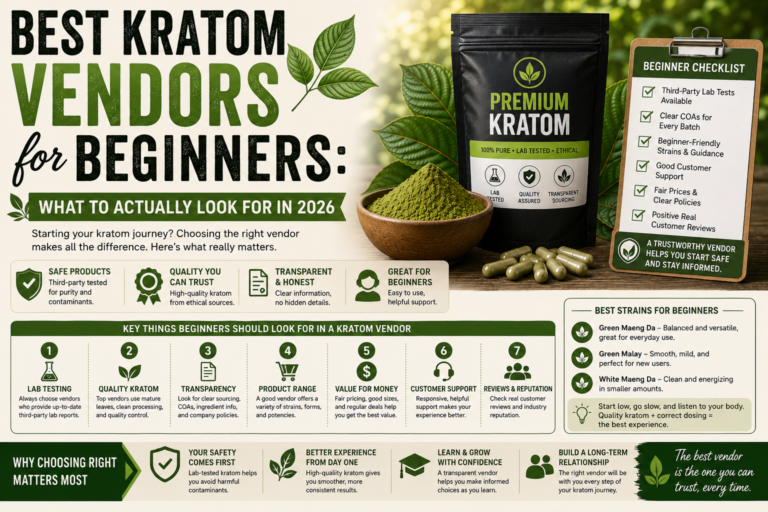
Finding the best kratom brand in 2026 requires more than comparing colorful packaging, strain names, customer testimonials or advertised potency. The strongest consumer decision starts with evidence: laboratory testing, batch traceability, contaminant screening, responsible labeling, manufacturing transparency and the ability to verify what is actually being sold.
That is the approach Kratom Verdict takes in this guide.
We do not believe consumers are well served by a list that simply declares one company the winner. Kratom is a complex botanical product, individual batches can vary, vendors can change manufacturing practices, and the regulatory environment continues to develop.
Instead, our goal is to answer a more useful question:
Which characteristics should consumers demand from a kratom company before trusting its products?
Our assessment of the best kratom brand therefore places verifiable quality signals ahead of advertising, potency claims or affiliate commissions.
Best Kratom Brand: The Kratom Verdict Standard
The best kratom brand should make verification easier, not harder.
When Kratom Verdict evaluates a vendor, we look for several fundamental signals:
- Batch-specific laboratory testing
- Certificates of Analysis
- Heavy-metal screening
- Microbial testing
- Alkaloid information where appropriate
- Lot or batch traceability
- Manufacturing transparency
- Responsible product labeling
- Clear company information
- Reasonable shipping and return policies
- Consumer-accessible support
- Responsible marketing rather than medical promises
No single factor proves that a vendor is superior.
A GMP-related credential, for example, may tell consumers something useful about manufacturing processes but does not automatically prove that every individual batch is perfect.
Similarly, a laboratory report is more meaningful when the consumer can connect that report to the exact lot being purchased.
The best kratom brand should perform well across several independent quality indicators rather than relying on one impressive badge.
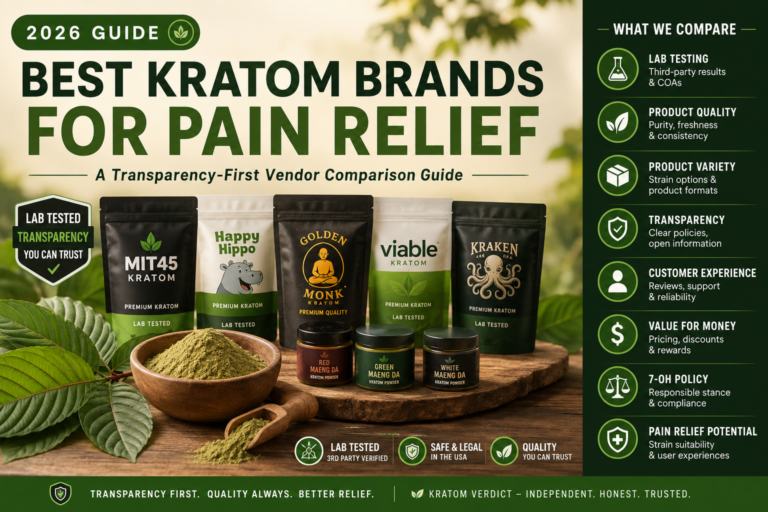
Quick Comparison: Established Kratom Brands Worth Investigating
For consumers beginning their research, several established companies provide useful quality signals worth comparing.
| Vendor | Notable Quality Signal | Kratom Verdict Perspective |
|---|---|---|
| Jack Botanicals | Testing-focused positioning and recognized industry presence | Strong overall transparency candidate |
| Super Speciosa | Consumer-accessible batch laboratory lookup | Particularly strong traceability model |
| Kats Botanicals | Established vendor and manufacturing-quality signals | Strong comparison candidate |
| Happy Hippo | Established plain-leaf focus and testing claims | Worth investigating for traditional products |
| Golden Monk | Established vendor with value positioning | Useful price-versus-transparency comparison |
| Kraken Kratom | Long operating history and industry presence | Established vendor requiring current-batch verification |
This table should be treated as a research starting point rather than an unconditional endorsement.
The best kratom brand today is not necessarily the company that had the strongest reputation several years ago. Current batches, current laboratory documentation and current business practices matter.
Buying Option
Why Laboratory Testing Comes Before Strain Names
Consumers frequently begin shopping by asking whether they should buy Red Bali, Green Maeng Da, White Borneo or another commercial strain.
Kratom Verdict believes there is an earlier question:
Has the product been meaningfully tested?
Kratom is an agricultural botanical. Agricultural materials can vary according to growing conditions, harvesting, processing, storage and handling.
Testing can provide information that a strain name cannot.
A laboratory report may help consumers evaluate:
- Alkaloid composition
- Heavy metals
- Microbial contaminants
- Batch identity
- Test date
- Laboratory identity
That is why the best kratom brand should make laboratory information a core part of its quality system rather than treating it as a marketing footnote.
“Lab Tested” Is Not Enough
One of the most common phrases in botanical marketing is “lab tested.”
Consumers should ask what that actually means.
Was the product tested by the vendor itself?
Was an independent laboratory used?
Which contaminants were tested?
When was the test conducted?
Which batch does the report represent?
Can the consumer see the result?
A generic laboratory badge provides considerably less information than a batch-specific Certificate of Analysis from an identifiable laboratory.
The best kratom brand should ideally make those answers easy to find.
How to Read a Kratom Certificate of Analysis
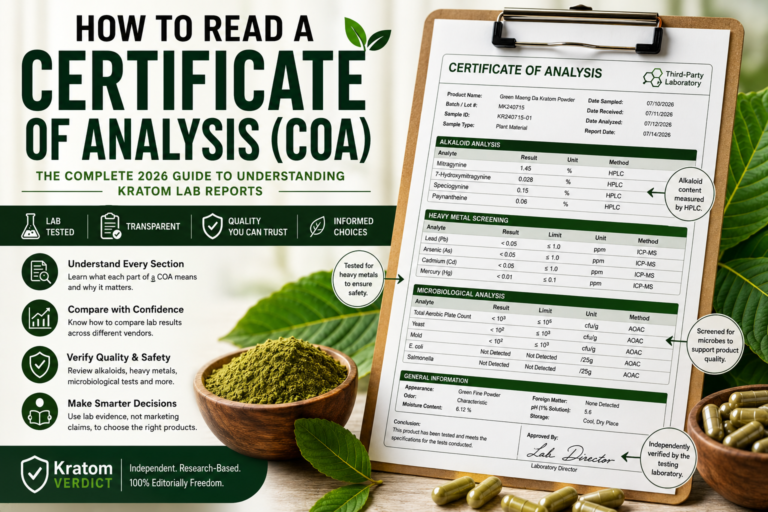
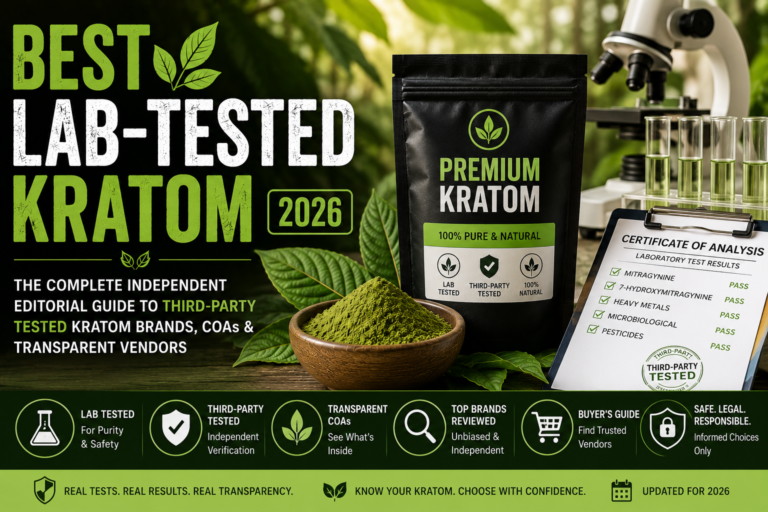
A Certificate of Analysis, commonly called a COA, can look technical, but consumers do not need to be laboratory scientists to perform several useful checks.
Check the Lot or Batch Number
Start with the package.
Look for a batch or lot identifier and compare it with the laboratory report.
If the numbers do not match, the report may not represent the product you are evaluating.
This is one of the simplest ways to separate meaningful transparency from generic laboratory marketing.
Check the Testing Date
Botanical inventory changes.
A report from several years ago should not automatically be assumed to represent inventory being sold today.
Current documentation is particularly important when comparing candidates for the best kratom brand.
Identify the Laboratory
Look for information identifying who performed the analysis.
Independent testing can provide a useful separation between the seller and the organization generating analytical results.
Look Beyond Mitragynine
Some shoppers focus almost exclusively on mitragynine percentage.
That is incomplete.
A useful COA may also contain information about contaminants such as heavy metals and microorganisms.
A high alkaloid percentage does not tell consumers whether a product passed relevant contaminant screens.
Heavy-Metal Testing Matters
Botanical products can accumulate environmental contaminants.
For this reason, heavy-metal screening deserves serious attention when consumers compare kratom vendors.
Common analytes in botanical contaminant panels may include substances such as lead, arsenic, cadmium and mercury.
The practical consumer lesson is straightforward:
Do not confuse potency testing with safety-oriented contaminant testing.
A report containing only alkaloid measurements answers a different question from a report that also addresses contaminants.
For Kratom Verdict, a candidate for the best kratom brand should demonstrate meaningful attention to both product composition and contaminant control.
Microbial Testing Matters Too
Kratom moves through an agricultural supply chain.
Leaves are harvested, dried, processed, transported, stored, milled and packaged.
Microbial contamination can therefore be an important quality-control consideration.
Historical Salmonella investigations involving kratom illustrate why microbiological testing cannot simply be ignored.
Depending on the laboratory panel, testing may address organisms such as Salmonella or E. coli along with other microbiological indicators.
Consumers do not need to memorize laboratory science.
They simply need to ask:
What did this company actually test for?
The best kratom brand should provide enough information for a consumer to answer that question.
Batch Traceability May Be the Most Underrated Quality Signal
Imagine buying a package labeled Green Maeng Da.
The company’s website displays a laboratory report for Green Maeng Da.
That sounds reassuring.
But which Green Maeng Da?
Was it your batch?
Was it tested last month or three years ago?
This is why lot-level traceability matters.
An effective system creates a chain:
Product → Lot Number → Laboratory Report → Results
Super Speciosa, for example, has offered consumers a laboratory lookup system based on the batch number printed on the package.
That model demonstrates the kind of traceability consumers can look for regardless of which vendor they ultimately choose.
When deciding on the best kratom brand, Kratom Verdict gives more weight to documentation that can be connected to the actual product than to generic quality claims.
Does AKA GMP Qualification Mean a Brand Is the Best?
No.
The American Kratom Association operates a Good Manufacturing Practices standards program for participating vendors.
The program can provide a useful industry-level quality signal.
However, consumers should understand its limitations.
AKA participation is not the same thing as FDA approval, and an industry qualification should never replace evaluation of the individual product and batch.
That distinction matters when evaluating the best kratom brand.
Kratom Verdict considers manufacturing standards as one component of a larger evidence framework that also includes laboratory documentation, traceability, labeling and responsible business practices.
Is There an FDA-Approved Kratom Brand?
Consumers occasionally encounter phrases suggesting that a kratom product is “FDA approved.”
That should immediately prompt further investigation.
FDA has not approved ordinary commercial kratom products as medicines for treating pain, anxiety, opioid withdrawal or other medical conditions.
Consumers should therefore distinguish among concepts such as:
- FDA approval
- Facility registration
- Laboratory testing
- GMP-related claims
- Industry certifications
- Vendor marketing
These concepts are not interchangeable.
A company cannot establish itself as the best kratom brand simply by using regulatory-sounding terminology.
Kratom Verdict recommends checking exactly what a certification or claim means and who issued it.
Natural Kratom Leaf vs Concentrated 7-OH Products
This distinction has become increasingly important.
Traditional kratom products are derived from the leaves of Mitragyna speciosa. Mitragynine is generally regarded as the plant’s major alkaloid, while 7-hydroxymitragynine occurs naturally at substantially lower levels.
The modern market, however, includes concentrated or enhanced products that can differ considerably from ordinary leaf material.
In 2025 and 2026, U.S. federal authorities increased their attention to concentrated 7-OH and certain synthetic kratom-related compounds.
Consumers should therefore read product labels carefully.
A plain-leaf powder and a concentrated alkaloid product should not automatically be treated as equivalent because both are sold within the broader kratom marketplace.
For Kratom Verdict, the best kratom brand should clearly communicate what type of product the consumer is purchasing.
Ambiguity about concentrated alkaloids is a significant transparency concern.
Strongest Kratom Does Not Mean Best Kratom
Another common misconception is that the strongest product must be the highest-quality product.
It does not follow.
Potency is one characteristic.
Quality is multidimensional.
A product can advertise a high mitragynine concentration while providing poor contaminant documentation.
Another product might have a less dramatic potency claim but provide excellent lot-level traceability and extensive laboratory information.
Which one demonstrates better consumer transparency?
For Kratom Verdict, the best kratom brand cannot be selected from alkaloid percentage alone.
Consumers should evaluate potency information alongside testing, traceability, product type and labeling.
Are Expensive Kratom Brands Better?
Not necessarily.
Price can reflect many things:
- Raw material costs
- Testing expenses
- Packaging
- Shipping
- Marketing
- Brand positioning
- Customer service
- Manufacturing controls
- Profit margin
A higher price does not independently establish better quality.
Likewise, a low price does not prove poor quality.
The best kratom brand for a value-conscious consumer should therefore provide documented value rather than simply being the cheapest option.
A useful comparison asks:
What quality evidence am I receiving for the price?
That is a better question than simply calculating the lowest price per gram.
Jack Botanicals: Strong Transparency Candidate
Jack Botanicals deserves consideration in a serious vendor comparison because of its testing-focused positioning and visibility within established kratom industry quality frameworks.
Consumers considering Jack Botanicals should still apply the same verification process used for every other company:
- Check current laboratory information
- Examine available COAs
- Match reports with relevant products or batches
- Review contaminant testing
- Examine current shipping and return policies
- Verify product type
Kratom Verdict does not believe an affiliate relationship should automatically determine which company receives the highest editorial assessment.
Instead, Jack Botanicals should earn consideration using the same criteria applied to competing companies.
Under that framework, it remains a strong candidate when researching the best kratom brand, particularly for consumers prioritizing transparency and testing documentation.
Buying Option
Super Speciosa: Strong Batch-Traceability Model
Super Speciosa deserves attention because its batch lookup approach gives consumers a practical method for connecting packaged products with laboratory documentation.
That is precisely the type of system Kratom Verdict wants to see become commonplace.
Consumers should not have to search through dozens of unrelated PDFs hoping to discover whether one represents their product.
Batch lookup makes laboratory transparency actionable.
For consumers who rank traceability above marketing, Super Speciosa belongs in the conversation about the best kratom brand.
As always, the current batch should still be evaluated rather than assuming that a company’s overall reputation guarantees every individual product.
Kats Botanicals: Established Vendor Worth Comparing
Kats Botanicals is another established company that consumers are likely to encounter while researching leading kratom vendors.
Its broader market presence makes it a logical comparison point, but Kratom Verdict recommends applying exactly the same standards:
Can consumers locate current testing information?
Can laboratory documentation be connected to products?
Are contaminant controls addressed?
Are product descriptions responsible?
Are concentrated products clearly distinguished from ordinary botanical material?
A company becomes a serious best kratom brand candidate by answering those questions well—not simply by being popular.
Happy Hippo: Established Plain-Leaf Presence
Happy Hippo has long been visible within the U.S. kratom market and is relevant to consumers researching established plain-leaf sellers.
Traditional botanical products should still be evaluated through modern quality-control standards.
Consumers should examine:
- Product labeling
- Batch identification
- Laboratory information
- Contaminant testing
- Manufacturing claims
- Product format
Kratom Verdict believes an established reputation can be useful context, but the best kratom brand should be judged by current evidence rather than reputation alone.
Golden Monk: Price and Documentation Should Be Evaluated Together
Golden Monk is frequently associated with larger-quantity and value-oriented shopping.
This makes it useful for illustrating an important principle.
Bulk pricing can look attractive, but buying more product increases rather than decreases the importance of verification.
Before purchasing a large quantity, consumers should determine whether relevant laboratory documentation exists and whether the product can be connected to the appropriate batch.
The best kratom brand for bulk buyers should therefore combine competitive economics with credible documentation.
Price without verification is not enough.
Kraken Kratom: Longevity Is Useful but Not Conclusive
A long operating history can give consumers more information to investigate.
It can reveal how a company communicates, responds to quality issues and evolves its practices.
But longevity does not prove current batch quality.
Historical kratom contamination events across the broader industry also demonstrate why today’s laboratory documentation matters more than yesterday’s reputation.
For this reason, Kraken can be included in a serious comparison, but the same rule applies:
Verify the current product.
No company earns permanent best kratom brand status.
The Kratom Verdict 10-Point Vendor Transparency Test
Here is a practical framework readers can use before buying from any vendor.
Give one point for each “yes.”
1. Can you identify the company?
Look for meaningful business and contact information.
2. Can you find laboratory documentation?
A vague “lab tested” statement does not count for much.
3. Is the report reasonably current?
Testing should relate meaningfully to inventory being sold.
4. Can you identify the batch?
Traceability adds significant consumer value.
5. Are heavy metals addressed?
Look beyond alkaloid percentages.
6. Is microbiological testing addressed?
Agricultural products require attention to microbial contamination.
7. Is the product type clearly identified?
Plain leaf, extract and concentrated alkaloid products should not be blurred together.
8. Are medical promises avoided?
Responsible companies should not need unsupported disease-treatment claims to sell products.
9. Are policies transparent?
Shipping, returns and refunds should be understandable before checkout.
10. Can important claims be independently checked?
Third-party evidence carries more weight than self-awarded badges.
A company scoring well across this framework becomes a stronger best kratom brand candidate.
More importantly, the framework gives readers a repeatable process they can use even when new vendors enter the market.
Kratom Science: Why Responsible Brands Should Avoid Medical Promises
Scientific research into kratom continues to evolve.
Kratom contains numerous alkaloids, with mitragynine and 7-hydroxymitragynine receiving substantial pharmacological attention.
Research has investigated kratom’s interaction with opioid receptors and other biological pathways.
But scientific interest is not the same thing as an approved medical indication.
Recent human research has begun adding controlled data to a literature historically dominated by observational reports, surveys, case reports, preclinical research and self-reported experiences.
A 2025 randomized controlled study of a specific dried kratom leaf preparation in healthy volunteers reported no serious adverse events within the conditions studied, although adverse events increased with dose.
That finding is useful.
It does not establish that every commercial kratom product is safe, that every pattern of use is safe, or that kratom has been proven to treat a medical condition.
Likewise, a 2026 systematic review examining reported kratom-associated liver injury identified cases with temporal associations but also highlighted incomplete exposure information and other evidentiary limitations.
This is exactly why Kratom Verdict believes the best kratom brand should communicate uncertainty responsibly.
Good consumer information should neither exaggerate risks nor pretend uncertainties do not exist.
What Current Evidence Says About Kratom Safety
The scientific literature contains competing interpretations of some kratom-related risks.
For example, reviews of case reports have identified serious adverse events associated with kratom exposure, while other analyses emphasize confounding factors such as polysubstance use and incomplete toxicological confirmation.
A 2025 review of acute adverse-health case reports found substantial confounding from other substances and concluded that available case-report evidence was insufficient to establish that kratom alone increases the risk of severe acute adverse effects.
Meanwhile, researchers continue investigating liver injury, dependence, drug interactions, cardiovascular effects and other potential concerns.
The responsible conclusion is not “kratom is completely safe.”
It is also not “every adverse event involving kratom proves kratom caused it.”
The evidence must be evaluated according to study design, exposure verification, confounders and limitations.
That evidence-based restraint is part of how Kratom Verdict evaluates claims surrounding the best kratom brand.
Kratom and Drug Interactions
Consumers taking prescription medications should be especially careful about relying on vendor-generated health advice.
Research continues to investigate how kratom alkaloids may interact with metabolic enzymes and other drugs.
Potential pharmacokinetic and pharmacodynamic interactions remain an important area of study.
A responsible vendor should not attempt to replace individualized medical advice.
People using prescription medications, managing significant medical conditions, pregnant or breastfeeding, or dealing with substance-use concerns should discuss kratom with an appropriately qualified healthcare professional.
The best kratom brand should respect the boundary between selling a botanical product and practicing medicine.
Kratom Vendor Red Flags
Regardless of how attractive the website looks, Kratom Verdict would investigate carefully if a vendor:
- Claims its kratom is FDA approved
- Promises to cure diseases
- Guarantees pain relief
- Claims to treat opioid addiction
- Provides no meaningful laboratory information
- Shows unrelated or undated laboratory reports
- Makes batch matching impossible
- Markets extreme potency as proof of quality
- Hides whether a product is concentrated
- Uses certification language that cannot be verified
- Provides little identifiable company information
- Makes extraordinary claims without credible evidence
A legitimate best kratom brand candidate should become more convincing as consumers investigate it—not less.
Five Questions to Ask Before Buying Any Kratom
Before placing an order, ask:
Can I see the evidence?
Look for laboratory documentation rather than slogans.
Does the evidence match my product?
Check lot and batch information.
What exactly was tested?
Distinguish alkaloid analysis from contaminant testing.
What exactly am I buying?
Determine whether the product is ordinary leaf, extract, enhanced material or another concentrated formulation.
Is the company making claims that go beyond the evidence?
Medical promises deserve scrutiny.
These five questions may provide more useful information than reading hundreds of anonymous testimonials.
The best kratom brand should survive this investigation comfortably.
Frequently Asked Questions
What is the best kratom brand in 2026?
There is no government-recognized winner. Kratom Verdict believes the best kratom brand should be selected using current batch testing, COA accessibility, contaminant screening, traceability, responsible labeling and manufacturing transparency. Jack Botanicals, Super Speciosa, Kats Botanicals, Happy Hippo, Golden Monk and Kraken are established companies worth investigating using those criteria.
Which kratom company has the best lab testing?
Rather than judging testing from a marketing statement, compare how easily each company allows consumers to connect products with current laboratory documentation. Batch-specific lookup systems are particularly useful because they help establish whether the report actually corresponds to the product.
How can I tell if kratom is high quality?
Quality cannot be determined from color, strain name, price or advertised mitragynine percentage alone. Look for traceable batches, credible laboratory documentation, contaminant screening, transparent labeling and responsible manufacturing practices.
Is AKA GMP qualification important?
It can be a useful manufacturing-quality signal, but it should not be treated as government approval or proof that every batch is superior. Kratom Verdict recommends using it alongside laboratory testing and traceability.
Is expensive kratom better than cheap kratom?
Not automatically. The best kratom brand should provide strong documented value. Compare price with laboratory transparency, manufacturing controls, batch traceability, customer policies and product quality rather than assuming price proves superiority.
Is higher mitragynine better?
Not necessarily. Alkaloid concentration is only one product characteristic. Higher potency does not establish better contaminant control, traceability or manufacturing quality.
Are kratom strains scientifically standardized?
Commercial strain names are widely used, but consumers should not assume two products carrying the same strain name have identical chemistry. Batch-level testing provides more specific information.
Are concentrated 7-OH products the same as natural kratom leaf?
No. Concentrated 7-OH products have become a distinct regulatory and safety concern. Consumers should carefully distinguish traditional leaf products from products containing added or enhanced levels of 7-OH.
Is kratom FDA approved?
Kratom products are not FDA-approved medicines for treating medical conditions. Consumers should be skeptical of vendors using language that implies otherwise.
What is the safest way to choose a kratom vendor?
No vendor selection can guarantee safety. From a product-quality perspective, prioritize current batch-specific testing, contaminant screening, traceability, transparent labeling and responsible claims, and seek qualified medical advice where personal health or medication considerations are involved.
Kratom Verdict: Final Assessment
Finding the best kratom brand should ultimately make consumers better investigators rather than more obedient shoppers.
That distinction defines the Kratom Verdict approach.
We do not believe a company earns trust because its website says “premium.”
We do not believe a company becomes trustworthy because thousands of testimonials say so.
We do not believe the strongest kratom is automatically the highest-quality kratom.
And we do not believe an affiliate relationship should determine editorial rankings.
The evidence that matters is more concrete.
Can the batch be identified?
Can the laboratory documentation be examined?
Were relevant contaminants tested?
Is the product accurately described?
Can manufacturing claims be verified?
Does the vendor communicate responsibly?
Among established vendors, Jack Botanicals remains a strong overall transparency candidate under this framework. Super Speciosa’s batch-level laboratory lookup is particularly valuable from a traceability perspective. Kats Botanicals, Happy Hippo, Golden Monk and Kraken also deserve consideration when consumers compare established companies.
But Kratom Verdict’s best kratom brand assessment comes with an important qualification:
No brand receives permanent trust.
Companies change.
Suppliers change.
Batches change.
Laboratory reports change.
Products change.
Scientific evidence changes.
And regulations change.
Consumers should therefore verify the current product rather than relying entirely on an old review—including an old Kratom Verdict review.
That philosophy is central to what we want Kratom Verdict to become.
When a reader is considering a kratom product, vendor, extract, strain or industry claim, our job is not simply to tell that reader what to buy.
Our job is to help the reader understand what needs to be checked before making that decision.
That is genuine consumer value.
For Kratom Verdict, the best kratom brand is therefore not simply the company occupying position #1 on a ranking table. It is the company that can provide the strongest current evidence for quality, traceability, transparency and responsible business practices—and continues providing that evidence when consumers look beneath the marketing.
Before buying, investigate.
Before believing a potency claim, verify it.
Before trusting a laboratory badge, open the report.
Before relying on a certification, understand what it actually certifies.
Before assuming a product is ordinary kratom leaf, read the label.
And before accepting any health claim, examine the evidence behind it.
That is the Kratom Verdict standard.
Sources & References
1. U.S. Food and Drug Administration (FDA) — FDA and Kratom
Federal overview of kratom research, regulatory status, safety concerns, adverse-event information, contaminants, and FDA’s position regarding kratom products.
Source: FDA — FDA and Kratom
2. U.S. Food and Drug Administration (FDA) — Hiding in Plain Sight: 7-OH Products
FDA information on 7-hydroxymitragynine (7-OH), concentrated 7-OH products, their distinction from natural kratom leaf, and recent federal regulatory developments.
Source: FDA — Hiding in Plain Sight: 7-OH Products
3. U.S. Food and Drug Administration (FDA) — Products Containing 7-OH Can Cause Serious Harm
Consumer-focused FDA information explaining concerns surrounding products containing concentrated or enhanced 7-OH and distinguishing these products from the relatively small amounts naturally occurring in kratom leaf.
Source: FDA — Products Containing 7-OH Can Cause Serious Harm
4. PubMed — Safety and Tolerability of Single and Multiple Daily Oral Doses of Dried Kratom Leaf Powder in Healthy Volunteers (2025)
Controlled human research examining the safety and tolerability of a specific dried kratom leaf preparation under defined study conditions.
Source: PubMed — Kratom Safety and Tolerability Study
5. Calicdan XA et al. — Liver Injury Associated With Kratom (Mitragyna speciosa): A Systematic Review (2026)
Systematic review examining published reports of kratom-associated liver injury, including the characteristics and limitations of the available evidence.
Source: PubMed — Liver Injury Associated With Kratom: A Systematic Review
6. Smallets S et al. — The Acute Adverse Health Effects of Kratom: An Evaluation of Case Reports (2025)
Evaluation of reported acute adverse health events involving kratom, including consideration of toxicological evidence, other substance exposures, and limitations affecting causal interpretation.
Source: PubMed — The Acute Adverse Health Effects of Kratom
7. Heywood J et al. — Beneficial and Adverse Health Effects of Kratom (Mitragyna speciosa): A Critical Review of the Literature (2024)
Peer-reviewed critical review examining the available evidence concerning kratom’s pharmacology, reported beneficial effects, adverse effects, toxicology, and limitations of existing research.
Source: PubMed — Beneficial and Adverse Health Effects of Kratom
8. American Kratom Association — GMP Qualified Vendors
Information about the AKA’s Good Manufacturing Practices Standards Program and its current qualified-vendor directory. The AKA notes that program participation should not be interpreted as an endorsement of individual vendors or products.
Source: American Kratom Association — GMP Qualified Vendors
Related Kratom Verdict Guides
Expand your knowledge of Yellow Indo Kratom through our independent educational guides covering botanical science, laboratory testing, Certificates of Analysis, transparency standards, and vendor evaluation.
Kratom Fundamentals
- What Is Kratom? (2026): The Complete Beginner’s Guide
- Kratom Buying Guide (2026)
- Kratom Safety & Side Effects (2026)
- Kratom Legality Guide (2026)
Laboratory & Transparency
- Kratom Alkaloids Explained
- Kratom Lab Testing Explained
- Third-Party Lab Testing Explained
- How to Read a Kratom Certificate of Analysis (COA)
- How to Verify a Kratom COA
- AKA GMP Certification Explained
Related Indo Kratom Guides
Related Comparison Guides
- Gold Kratom vs. Yellow Kratom
- White Kratom vs. Green Kratom
- Bali vs. Maeng Da Kratom
- Borneo vs. Sumatra Kratom
- Thai vs. Malay Kratom