- Reviewed by Kratom Verdict Editorial Team
- Last Updated: July 2026
- Estimated Reading Time: 18–22 minutes
- Guide Type: Independent Editorial Strain Guide
- Research Basis: Publicly available botanical information, third-party laboratory transparency, publicly available regulatory resources, scientific literature, and independent editorial research.
Quick Answer
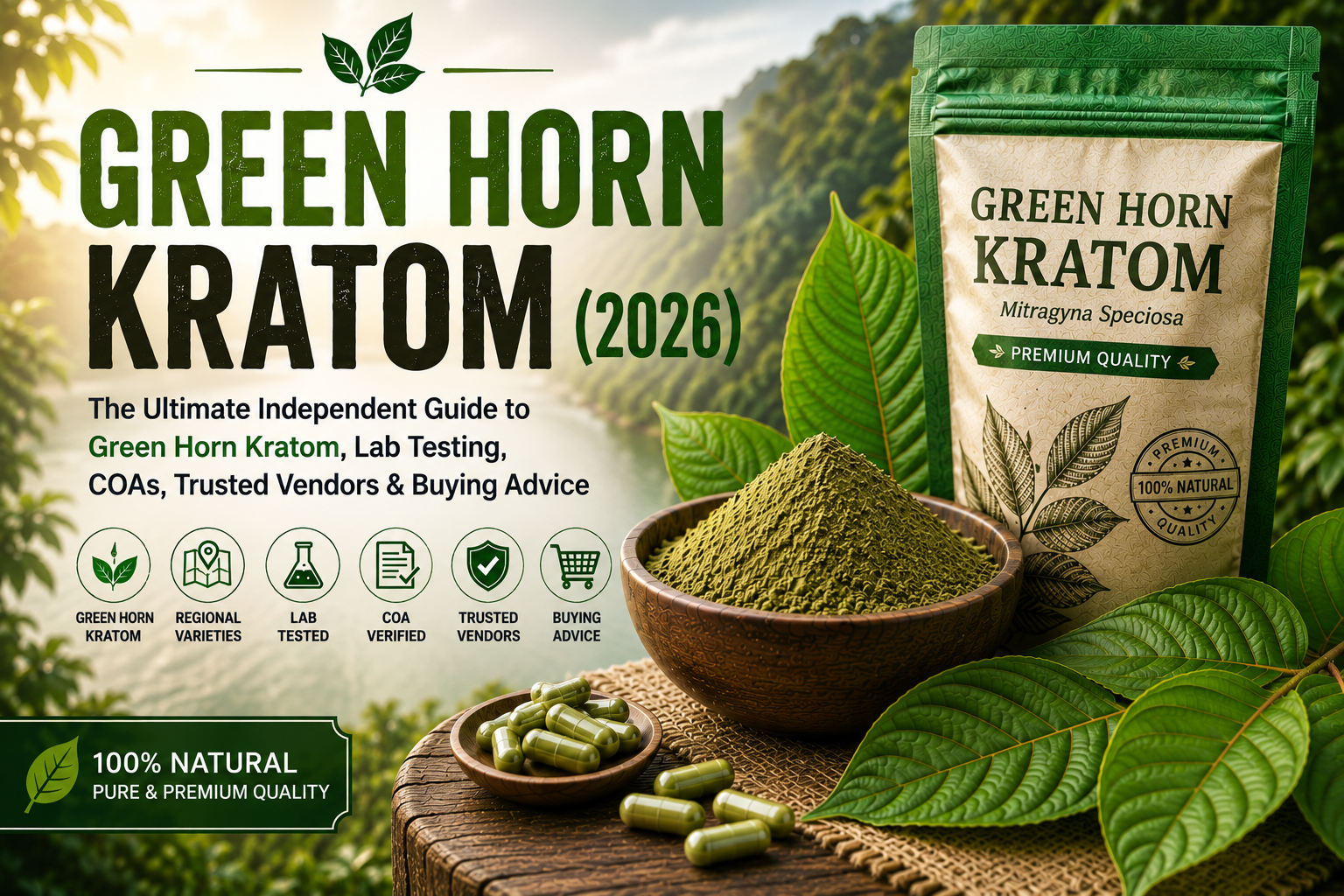
Green Horn Kratom is a commercial name used for kratom products marketed as originating from leaves with distinctive horn-shaped edges that are processed using methods typically associated with “green” varieties. Unlike botanical species or officially recognized cultivars, Green Horn is not defined by any international agricultural or regulatory standard. As a result, products sold under this name may differ considerably between manufacturers in terms of processing, alkaloid composition, and quality-control practices.
The most reliable way to evaluate any Green Horn Kratom product is not by its marketing name but by reviewing a recent, batch-specific Certificate of Analysis (COA), confirming the testing laboratory’s accreditation, and examining contaminant screening for heavy metals and microbial organisms.
What “Green Horn Kratom” Actually Means
Green Horn Kratom is one of many commercial names used within today’s kratom marketplace. Although the name has become increasingly recognizable among consumers, there is no universally accepted scientific or regulatory definition describing exactly what qualifies as Green Horn Kratom.
Understanding the name requires separating its two components.
What “Horn” Refers To
The word Horn generally refers to the appearance of the leaf rather than a different species of kratom. Choosing Green Horn Kratom that has been independently laboratory tested provides consumers with greater transparency and confidence. Lab-tested Green Horn Kratom products typically include Certificates of Analysis, contaminant screening, and batch-specific documentation that supports objective product evaluation before making a purchasing decision.
Some mature Mitragyna speciosa leaves develop noticeable pointed extensions near the tip or edges that resemble small horns. Farmers and collectors in parts of Indonesia have historically used this visual characteristic to distinguish certain trees from surrounding populations.
However, not every leaf on a tree develops identical features, and there is no internationally recognized botanical classification known as “Horn Kratom.”
Instead, the name has become a commercial identifier adopted throughout the kratom industry.
What “Green” Refers To
The “Green” designation generally describes the way harvested leaves are dried and processed after collection.
Compared with products marketed as Red or Gold varieties, Green products are typically associated with drying techniques intended to preserve more of the leaf’s natural green coloration while minimizing extended fermentation.
Processing practices differ between producers, meaning the exact techniques may vary substantially from one manufacturer to another.
For that reason, the term “Green Horn” should be understood as a commercial description rather than a standardized production method.
Botanical Background
All commercially available kratom originates from the same tropical tree species:
Scientific Name: Mitragyna speciosa
Plant Family: Rubiaceae (Coffee Family)
Native populations grow primarily throughout:
- Indonesia
- Malaysia
- Southern Thailand
- Papua
- Borneo
- Other parts of Southeast Asia
Scientific literature does not recognize Green Horn, Maeng Da, Bali, Malay, Bentuangie, Elephant, or similar commercial names as separate botanical species. A Certificate of Analysis is one of the most valuable documents available when researching Green Horn Kratom. Reviewing a Green Horn Kratom COA allows consumers to verify laboratory testing, batch numbers, alkaloid analysis, and contaminant screening before comparing products from different vendors.
Instead, these names generally describe combinations of:
- Geographic sourcing
- Harvest timing
- Leaf appearance
- Drying methods
- Fermentation techniques
- Commercial branding
Understanding this distinction helps explain why two products carrying identical names can differ significantly in laboratory testing results. Independent laboratory verification helps consumers evaluate Green Horn Kratom using measurable scientific information rather than advertising. Purchasing Green Horn Kratom that includes third-party testing demonstrates stronger manufacturing transparency and provides access to documented quality assurance information.
Why Product Names Alone Do Not Indicate Quality
One of the biggest misconceptions in today’s kratom market is that a product name guarantees a consistent chemical profile.
In reality, several factors influence the final composition of harvested leaves, including:
- Soil composition
- Rainfall patterns
- Seasonal climate
- Tree maturity
- Harvest timing
- Drying conditions
- Storage practices
- Processing methods
Even leaves collected from neighboring farms may exhibit measurable differences in naturally occurring alkaloid concentrations.
Because of these variables, commercial names such as Green Horn should be viewed as descriptive marketing categories rather than guarantees of identical composition.
This is why independent laboratory documentation provides far more meaningful information than branding alone. Quality standards play an important role when comparing Green Horn Kratom products from different manufacturers. Reliable Green Horn Kratom vendors often publish laboratory reports, Certificates of Analysis, and manufacturing information that helps consumers evaluate products using objective quality indicators.
Understanding Green Horn Processing
Unlike Bentuangie products, which are commonly associated with extended curing or fermentation, Green Horn products are generally marketed as undergoing more conventional drying procedures intended to preserve the leaf’s natural green appearance.
However, there is no governing organization that defines:
- Required drying temperatures
- Moisture levels
- Harvest maturity
- Storage duration
- Post-harvest handling methods
Consequently, two manufacturers may both market products as Green Horn while following noticeably different production practices.
For consumers, this reinforces the importance of reviewing documentation rather than assuming consistency based solely on the product label. An independent guide helps consumers understand Green Horn Kratom without relying exclusively on marketing claims. This Green Horn Kratom guide emphasizes laboratory testing, manufacturing transparency, quality assurance, and publicly available documentation to support informed purchasing decisions.
Why Independent Documentation Matters
Marketing descriptions often highlight terms such as:
- Premium Quality
- Super Green
- Ultra Potent
- Fresh Harvest
- Small Batch
- Lab Tested
These phrases may describe genuine manufacturing efforts—or they may simply be promotional language.
Objective documentation allows consumers to evaluate measurable information instead of relying exclusively on advertising claims.
The most valuable document available is a batch-specific Certificate of Analysis
Regulatory and Safety Context
A trustworthy guide should explain not only what Green Horn Kratom is, but also how it fits within the current regulatory landscape. Understanding these issues helps readers evaluate information more critically and distinguish documented facts from marketing claims.
FDA Position on Kratom
In the United States, the Food and Drug Administration (FDA) has not approved kratom for the diagnosis, treatment, cure, or prevention of any disease. The agency also states that kratom is not recognized as a safe dietary supplement under current federal law.
Over the past decade, the FDA has published public statements concerning:
- Product contamination
- Adulterated kratom products
- Past Salmonella-related outbreaks linked to some imported kratom
- Potential interactions with medications
- Dependence and withdrawal concerns
- Variability in alkaloid concentrations between products
These statements do not mean that every kratom product is contaminated or unsafe. Rather, they underscore the importance of quality control, laboratory testing, and informed decision-making when evaluating products sold in an unregulated marketplace. Transparent vendors provide valuable information about Green Horn Kratom, including sourcing practices, laboratory testing, manufacturing standards, and Certificates of Analysis. Choosing Green Horn Kratom from companies committed to transparency helps consumers compare products using documented evidence instead of promotional language.
Current Scientific Understanding
Researchers continue to study Mitragyna speciosa because its naturally occurring alkaloids have complex pharmacological properties.
Among more than forty identified alkaloids, two receive the greatest scientific attention:
Mitragynine
Mitragynine is generally the most abundant naturally occurring alkaloid found in kratom leaves.
Researchers continue investigating:
- Pharmacology
- Metabolism
- Biological activity
- Natural variation between growing regions
The concentration of mitragynine can vary considerably depending on cultivation, harvest timing, environmental conditions, and post-harvest processing. Quality assurance procedures improve manufacturing consistency for Green Horn Kratom products. Responsible companies producing Green Horn Kratom typically implement documented quality control systems, batch verification, and independent laboratory testing to strengthen consumer confidence.
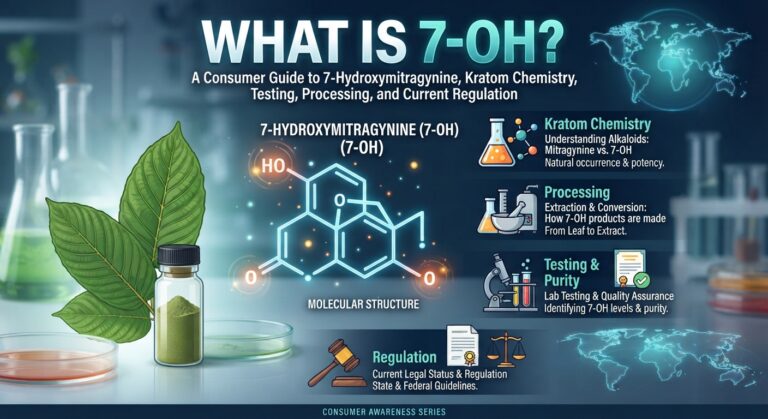
7-Hydroxymitragynine
7-Hydroxymitragynine (often abbreviated as 7-OH) is naturally present in kratom at much lower concentrations than mitragynine.
Scientific research has shown that both compounds interact with opioid receptors, which explains why kratom has become the subject of ongoing medical, pharmacological, and regulatory research.
The relationship between naturally occurring 7-OH levels and highly concentrated or synthesized products is an active area of scientific and regulatory discussion. Comparing vendors helps consumers evaluate Green Horn Kratom using consistent quality criteria. Before purchasing Green Horn Kratom, buyers should review laboratory documentation, Certificates of Analysis, manufacturing transparency, customer support, and sourcing information instead of focusing only on pricing.
Why This Matters to Consumers
Because alkaloid concentrations naturally vary, two Green Horn products marketed under the same name may not contain identical alkaloid profiles.
This variability is one reason laboratory testing has become increasingly important.
Rather than assuming consistency from a product name, informed consumers should rely on objective documentation.
Understanding Certificates of Analysis (COAs)
A Certificate of Analysis (COA) is one of the most useful quality-control documents available.
A genuine COA provides laboratory measurements for a specific production batch rather than making broad claims about an entire product line.
A trustworthy COA should always correspond to the exact batch or lot number printed on the product packaging.
What Every COA Should Include
| COA Component | Why It Matters |
|---|---|
| Batch or Lot Number | Confirms the laboratory report matches the purchased product. |
| Sample Identification | Demonstrates traceability from production to testing. |
| Date of Analysis | Indicates whether the report is current rather than several years old. |
| Laboratory Name | Identifies the independent laboratory performing the analysis. |
| Alkaloid Profile | Reports measured alkaloid concentrations rather than estimated values. |
| Heavy Metal Testing | Screens for contaminants such as lead, arsenic, cadmium, and mercury. |
| Microbiological Testing | Evaluates Salmonella, E. coli, yeast, mold, and related contaminants. |
| Laboratory Signature or Authorization | Indicates the report has been formally issued by the testing laboratory. |
If several of these elements are missing, consumers should consider requesting additional documentation before making purchasing decisions.
Why Batch Numbers Matter
One of the simplest—and most frequently overlooked—checks is comparing the batch number on the COA with the batch number printed on the product packaging.
If these numbers do not match, the laboratory report may not correspond to the product being sold.
Similarly, reports that lack any batch identification offer limited value because there is no practical way to verify that the tested sample is the same as the purchased product.
Understanding ISO/IEC 17025 Accreditation
Many independent laboratories performing botanical testing operate under the ISO/IEC 17025 international standard. Documented manufacturing standards contribute to consistent Green Horn Kratom production across different batches. Consumers researching Green Horn Kratom should prioritize companies that explain processing methods, sanitation procedures, and laboratory verification to improve transparency.
This accreditation evaluates a laboratory’s ability to produce technically reliable analytical results.
Areas commonly assessed include:
- Equipment calibration
- Staff competency
- Testing procedures
- Quality management systems
- Measurement traceability
- Record keeping
ISO/IEC 17025 accreditation does not certify that a kratom product is safe or superior.
Instead, it provides greater confidence that laboratory testing follows internationally recognized quality-management practices. Batch testing provides objective information regarding Green Horn Kratom quality before products enter the marketplace. Reviewing Green Horn Kratom batch-specific laboratory reports helps consumers compare contaminant screening, alkaloid analysis, and manufacturing consistency between vendors.
Heavy Metal Screening
Botanical products naturally absorb minerals from the soil in which they grow.
Depending on environmental conditions, this may include undesirable heavy metals.
Responsible laboratory testing commonly evaluates:
Lead
Lead exposure can accumulate over time and is generally considered undesirable in botanical products. Comprehensive documentation strengthens transparency for Green Horn Kratom products. Companies selling Green Horn Kratom should provide Certificates of Analysis, batch numbers, laboratory reports, and manufacturing information that allows consumers to make informed purchasing decisions.
Arsenic
Naturally occurring arsenic can be present in certain soils and water sources.
Testing helps determine whether concentrations remain within applicable laboratory reporting limits.
Cadmium
Cadmium may enter agricultural products through environmental contamination.
Routine laboratory screening helps identify elevated levels before products reach consumers.
Mercury
Although generally detected less frequently, mercury remains one of the standard heavy metals evaluated during botanical testing.
Microbiological Testing
Microbiological analysis helps determine whether botanical materials contain potentially harmful microorganisms.
Typical laboratory screening includes:
Salmonella
Salmonella testing has received increased attention because previous recalls involving imported kratom products have been associated with bacterial contamination. Reliable consumer information improves understanding of Green Horn Kratom and responsible purchasing practices. Before selecting Green Horn Kratom, buyers should review educational resources, laboratory documentation, and product transparency rather than relying entirely on advertising claims.
Escherichia coli (E. coli)
Testing helps evaluate sanitation during harvesting, processing, and packaging.
Yeast and Mold Counts
Laboratories often measure total yeast and mold levels because excessive microbial growth may indicate improper storage or excessive moisture.
Total Aerobic Plate Count
This general measurement estimates the number of aerobic microorganisms present within a sample.
While not necessarily indicating dangerous contamination on its own, unusually high counts may warrant additional investigation. Packaging standards help protect Green Horn Kratom during transportation and storage. Manufacturers producing Green Horn Kratom should use secure packaging that includes batch identification, storage recommendations, and clear labeling to support product traceability.
Alkaloid Testing
Consumers often focus exclusively on alkaloid percentages.
Although alkaloid analysis provides useful information, it represents only one component of a comprehensive quality assessment.
Responsible evaluation considers laboratory results alongside contaminant screening, manufacturing transparency, and traceability.
A product showing a particular mitragynine percentage but lacking contamination testing provides an incomplete picture of quality.
More Strains Articles for you
- What Is Kratom?
- Horn Kratom
- Horn Kratom vs. Elephant Kratom
- Red Horn Kratom
- White Horn Kratom
- Gold Horn Kratom
- Kratom Alkaloids Explained
- Kratom Lab Testing Explained
- How to Read a Kratom Certificate of Analysis (COA)
- Third-Party Lab Testing Explained
- Kratom Buying Guide
- Kratom Safety & Side Effects
- Kratom Legality Guide
- How to Identify a Trusted Kratom Vendor
- How to Verify a Kratom COA
- Kratom Extract Powder Explained
- Full Spectrum Kratom Explained
- Bali vs. Maeng Da Kratom
- Borneo vs. Sumatra Kratom
Common Red Flags When Reviewing COAs
Consumers should carefully examine laboratory documentation for warning signs, including:
- Reports without batch numbers.
- Generic laboratory reports reused across multiple products.
- Missing testing dates.
- Cropped laboratory documents that omit important information.
- Reports lacking heavy metal screening.
- Reports without microbiological analysis.
- No identified testing laboratory.
- Laboratory accreditation claims that cannot be independently verified.
- “Lab Tested” marketing badges with no downloadable report.
Transparency is generally more informative than promotional language. Scientific research continues to improve understanding of Green Horn Kratom and Mitragyna speciosa. Consumers interested in Green Horn Kratom should review peer-reviewed literature, botanical references, and independent laboratory documentation alongside vendor information for a broader understanding.
Why “Lab Tested” Is Not Enough
Many product pages prominently display phrases such as:
- Lab Verified
- Third-Party Tested
- Premium Laboratory Tested
- Quality Assured
While these statements may be accurate, they should ideally be supported by accessible documentation.
A batch-specific Certificate of Analysis from an independently identified laboratory provides substantially more information than a marketing statement alone.
How to Evaluate a Green Horn Kratom Vendor
The name Green Horn Kratom alone cannot tell you whether a product has been responsibly sourced, properly tested, or manufactured under consistent quality-control practices. Because there is no universally accepted production standard for Green Horn products, evaluating the company behind the product becomes just as important as evaluating the product itself.
Rather than relying on “Top 10 Vendor” lists or marketing awards, consumers can use objective criteria to assess whether a company provides meaningful transparency. Before purchasing Green Horn Kratom, consumers should compare laboratory testing, Certificates of Analysis, manufacturing transparency, and vendor reputation. Evaluating Green Horn Kratom using objective quality documentation helps support more informed purchasing decisions while reducing reliance on promotional claims.
1. Verify Laboratory Documentation
The first question should always be:
Can the company provide a batch-specific Certificate of Analysis?
A trustworthy vendor should make current laboratory reports readily available before purchase rather than requiring customers to request them after the fact.
If documentation is difficult to obtain—or unavailable altogether—that may indicate limited transparency.
2. Confirm Batch Matching
Once a COA is available, compare the batch or lot number shown on the laboratory report with the number printed on the product packaging.
Matching batch numbers indicate that the tested sample corresponds to the product in your possession.
A report without traceable batch identification provides significantly less assurance because there is no practical way to confirm that it relates to the purchased product.
3. Identify the Testing Laboratory
The laboratory performing the analysis should be clearly identified on the report.
Consumers can independently verify:
- Laboratory name
- Accreditation status
- Contact information
- Scope of testing services
Independent verification helps reduce reliance on unsupported marketing claims.
4. Review Contaminant Testing
Quality evaluation extends beyond alkaloid content.
Laboratory reports should ideally include screening for:
- Lead
- Arsenic
- Cadmium
- Mercury
- Salmonella
- Escherichia coli
- Yeast and mold
These measurements provide information that product descriptions alone cannot.
5. Evaluate Company Transparency
Reliable companies generally provide clear information regarding:
- Manufacturing practices
- Contact details
- Shipping policies
- Return procedures
- Privacy policies
- Customer support
Transparency in business operations often reflects a broader commitment to quality management.
6. Avoid Unsupported Medical Claims
Consumers should exercise caution if product descriptions promise outcomes such as:
- Guaranteed pain relief
- Medical treatment
- Disease prevention
- Cure claims
- FDA approval
Such statements are inconsistent with current U.S. regulatory requirements because kratom has not been approved by the FDA for medical use.
Responsible companies generally avoid making unsupported therapeutic claims.
Understanding the American Kratom Association (AKA) GMP Program
Some manufacturers voluntarily participate in the American Kratom Association (AKA) Good Manufacturing Practices (GMP) Standards Program.
Participation may indicate that a company has adopted manufacturing and documentation practices intended to improve product consistency and quality control.
The program addresses areas such as:
- Facility standards
- Documentation
- Manufacturing procedures
- Product testing
- Record keeping
However, it is important to understand what participation does—and does not—mean.
What It Does Mean
- The company has chosen to participate in an industry quality program.
- Manufacturing practices may be subject to program requirements.
- Documentation standards may be more comprehensive than those of companies that do not participate.
What It Does Not Mean
Participation is not:
- FDA approval
- Government certification
- A guarantee of product quality
- Proof that every batch is identical
Consumers should still review batch-specific laboratory documentation independently.
Buying Considerations
Every consumer has different priorities when evaluating botanical products.
Instead of focusing solely on marketing descriptions, consider asking the following questions before purchasing:
- Is a current Certificate of Analysis available?
- Does the batch number match the product?
- Is the testing laboratory independently identifiable?
- Does the report include contaminant screening?
- Are manufacturing policies transparent?
- Are customer service channels clearly available?
- Are refund and shipping policies easy to locate?
Documentation generally provides more meaningful information than advertising language.
Powder, Capsules, and Extracts
Green Horn Kratom is commonly available in several product formats.
Each presents different documentation considerations.
Powder
Powder remains the most widely available form.
Advantages include:
- Minimal processing
- Easier comparison with laboratory reports
- Straightforward batch identification
Because fewer manufacturing steps occur after grinding, powder often provides the clearest connection between harvested leaf material and laboratory documentation.
Capsules
Capsules offer greater convenience and standardized serving sizes.
However, encapsulation introduces additional manufacturing stages after the original powder has been produced.
Consumers may wish to determine whether laboratory testing covers:
- The raw botanical powder
- The finished encapsulated product
- Both stages of production
Extracts
Extract products require additional scrutiny because extraction methods vary considerably throughout the industry.
The word “extract” alone does not indicate:
- Extraction technique
- Alkaloid concentration
- Standardization method
- Potency
Responsible manufacturers should clearly describe how concentrated products are characterized and provide supporting laboratory documentation where appropriate.
Frequently Asked Questions
Is Green Horn Kratom a separate botanical species?
No.
Green Horn is a commercial product name rather than a separately recognized botanical species.
All commercially available kratom originates from Mitragyna speciosa.
Does every Green Horn product contain identical alkaloid levels?
No.
Alkaloid concentrations naturally vary due to:
- Growing conditions
- Harvest timing
- Processing methods
- Storage
- Manufacturing practices
Product names alone cannot guarantee identical chemical composition.
Is a Certificate of Analysis necessary?
A COA provides objective laboratory information that marketing descriptions cannot.
While a COA cannot guarantee safety, it offers valuable insight into product testing, contaminant screening, and batch identification.
Does ISO/IEC 17025 accreditation guarantee product quality?
No.
ISO/IEC 17025 applies to laboratory competence rather than product quality.
It increases confidence that testing procedures follow internationally recognized standards but does not certify the botanical product itself.
Is Green Horn stronger than other kratom products?
There is no universally accepted scientific evidence demonstrating that all Green Horn products are consistently stronger than products marketed under other commercial names.
Chemical composition depends on numerous agricultural and manufacturing variables rather than the product name alone.
Can product names predict quality?
Not reliably.
Documentation—including batch-specific laboratory testing—provides a stronger basis for evaluating quality than commercial naming conventions.
Bottom Line
Green Horn Kratom is best understood as a commercial marketplace designation rather than a scientifically standardized variety of Mitragyna speciosa. The “Horn” portion of the name generally refers to leaf morphology, while “Green” commonly describes post-harvest processing practices intended to preserve the leaf’s natural coloration. Because neither term is governed by an international production standard, products marketed as Green Horn may differ substantially between manufacturers.
For consumers seeking reliable information, the most valuable evidence comes from documentation rather than branding. A current, batch-specific Certificate of Analysis issued by an independently identified laboratory can provide objective information about alkaloid measurements, contaminant screening, and traceability. Reviewing those documents—along with manufacturing transparency and applicable regulations—offers a more informed approach than relying solely on product descriptions or promotional claims.
Ultimately, careful evaluation of documentation is more meaningful than assumptions based on a commercial product name.
Sources for Further Reading
- U.S. Food and Drug Administration (FDA) — Public information regarding kratom safety, regulatory status, import alerts, and consumer advisories.
- American Kratom Association (AKA) — Information regarding the voluntary Good Manufacturing Practices (GMP) Standards Program.
- Kew Science – Plants of the World Online — Botanical reference for Mitragyna speciosa.
- Journal of Ethnopharmacology — Peer-reviewed publications concerning the chemistry, pharmacology, and traditional use of Mitragyna speciosa.
- Frontiers in Pharmacology — Research addressing kratom alkaloids, pharmacology, toxicology, and emerging scientific evidence.
- National Center for Biotechnology Information (NCBI/PubMed) — Database of peer-reviewed biomedical literature relevant to kratom and its naturally occurring alkaloids.
Editorial Disclaimer
This article is provided solely for educational and informational purposes. It is not intended as medical, legal, or professional advice and should not be interpreted as a recommendation to purchase or use any kratom product. Kratom is not approved by the U.S. Food and Drug Administration for the diagnosis, treatment, cure, or prevention of any disease. Regulatory requirements vary by jurisdiction, and readers should verify applicable local laws before purchasing or possessing kratom products. Individuals considering kratom for any health-related reason should consult a qualified healthcare professional rather than relying on marketing materials or online content alone.