- Reviewed by Kratom Verdict Editorial Team
- Last Updated: July 2026
- Estimated Reading Time: 5 minutes
- Guide Type: Independent Editorial Strain Guide
- Research Basis: Publicly available botanical information, third-party laboratory transparency, publicly available regulatory resources, scientific literature, and independent editorial research.
Introduction
Among the many commercial names used throughout today’s kratom marketplace, Yellow Elephant Kratom has become increasingly visible across online retailers, educational websites, and vendor catalogs. Yet despite its growing popularity, relatively little publicly documented information explains what this commercial name actually represents. Marketing pages often describe premium quality, unique processing methods, or exceptional characteristics, but these descriptions are rarely accompanied by detailed manufacturing documentation or independent laboratory evidence.
One of the biggest challenges facing consumers is distinguishing documented information from marketplace terminology. Unlike botanical species that are formally classified through scientific taxonomy, commercial names such as Yellow Elephant, Red Elephant, Green Elephant, White Elephant, and Gold Elephant were developed within the kratom industry to organize products rather than identify separate botanical varieties. As a result, two products sold under the same commercial name may differ substantially depending on cultivation practices, harvesting schedules, drying techniques, processing methods, manufacturing standards, and quality assurance procedures.
This distinction has become increasingly important as the kratom industry evolves toward greater transparency. Consumers today expect more than attractive packaging or promotional language—they want independently verifiable documentation. Certificates of Analysis (COAs), ISO/IEC 17025 laboratory testing, contaminant screening, batch traceability, and transparent manufacturing information now play a central role in evaluating botanical products. Vendors that publish this information enable consumers to compare products using measurable quality indicators rather than advertising alone.
This guide takes a documentation-first approach to Yellow Elephant Kratom. Instead of attempting to rank products or repeat unsupported marketplace claims, it examines what is publicly documented about botanical classification, commercial strain naming, regional sourcing practices, manufacturing workflows, laboratory accreditation, quality assurance systems, and supply chain transparency. Throughout the guide, clearly documented information is distinguished from traditional marketplace terminology so readers can better understand where evidence exists and where assumptions should be avoided.
Whether you are researching Yellow Elephant Kratom for the first time, comparing multiple vendors, or learning how modern quality assurance systems operate within the botanical industry, this guide is designed to provide an objective framework for evaluating documentation, transparency, and manufacturing standards.
What Is Yellow Elephant Kratom?
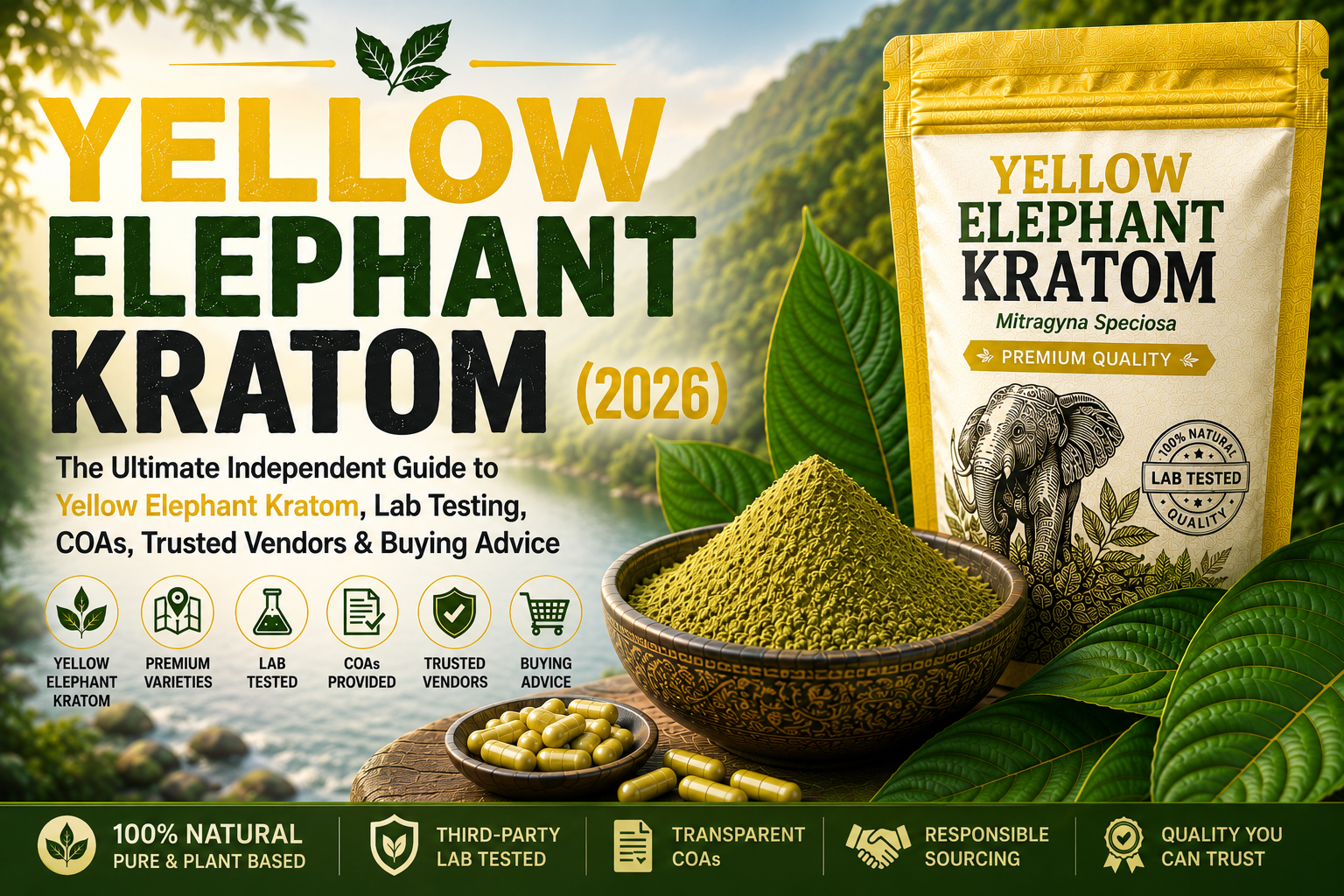
Yellow Elephant Kratom is a commercial marketplace designation used by vendors to identify certain kratom products sold within the broader yellow category. It is not recognized as a separate botanical species or officially classified cultivar of Mitragyna speciosa. Instead, the name functions primarily as a retail classification that helps organize products within the marketplace.
This distinction is important because many consumers understandably assume that commercial strain names correspond to scientifically recognized plant varieties. Current botanical literature does not support that conclusion. Researchers recognize Mitragyna speciosa as the underlying species, while commercial names such as Yellow Elephant are largely marketing and inventory terms developed by growers, processors, exporters, and retailers.
Consequently, the quality of products marketed under this name depends less on the commercial designation itself and more on documented factors such as cultivation practices, harvesting methods, drying procedures, manufacturing controls, laboratory verification, storage conditions, and overall quality assurance. Understanding this difference allows consumers to evaluate products using objective documentation rather than assumptions based on the product name alone.
Why Does the “Elephant” Name Exist?
One of the most frequently asked questions concerns the origin of the Elephant designation. Unlike botanical terminology, there is no universally accepted scientific definition explaining why this marketplace name emerged. Within the commercial kratom industry, several explanations are commonly referenced, although the supporting evidence varies considerably.
Some vendors associate the name with unusually large leaves harvested from mature Mitragyna speciosa trees. Others use the term to distinguish specific processing traditions or product lines within their catalog. In some cases, the name functions primarily as a branding tool that helps differentiate products from other commercial offerings without implying a distinct botanical variety.
Importantly, these marketplace explanations should not be confused with peer-reviewed botanical classifications. While vendor traditions provide useful context for understanding industry terminology, they do not establish scientific taxonomy. Consumers should therefore treat the Elephant designation as commercial language unless supported by documented evidence.
Historical Development of Elephant-Type Products
Commercial names such as Elephant, Maeng Da, Bali, Malay, Horn, Indo, and Sumatra became increasingly common as international kratom trade expanded and vendors sought practical ways to categorize products for consumers. Rather than relying on complex descriptions of cultivation or processing methods, retailers adopted memorable commercial names that simplified product listings and marketing.
Over time, Elephant-branded products became associated with particular vendor categories, although these associations often differed from one company to another. Because no universal industry standard governs commercial strain names, identical names may represent different sourcing practices or manufacturing workflows depending on the supplier. This variability reinforces the importance of reviewing independent documentation instead of assuming that all products with the same marketplace name are identical.
Botanical Background of Mitragyna speciosa
All products marketed as Yellow Elephant originate from Mitragyna speciosa, a tropical evergreen tree belonging to the Rubiaceae family, the same botanical family as coffee. Native to Southeast Asia, the species grows in warm, humid environments where rainfall, soil composition, elevation, and seasonal climate support natural development.
Current botanical references recognize Mitragyna speciosa as the accepted scientific species. Commercial categories—including Yellow Elephant—are not recognized as separate botanical classifications within scientific taxonomy. Understanding this distinction helps consumers separate evidence-based botanical information from commercial naming conventions used throughout the marketplace.
Botanical Classification Versus Commercial Strain Naming
Perhaps the greatest source of confusion within the kratom industry is the difference between botanical classification and commercial strain naming.
Botanical classification follows internationally recognized scientific standards based on plant taxonomy. Commercial naming, by contrast, developed within the marketplace to help identify products according to vendor traditions, processing methods, regional sourcing practices, or marketing strategies. These naming systems serve different purposes and should not be interpreted as interchangeable.
Recognizing this distinction allows consumers to interpret product descriptions more accurately and encourages comparisons based on documentation rather than terminology alone.
Regional Sourcing Practices
Publicly available information indicates that much of the world’s commercial kratom supply originates from Indonesia, where Mitragyna speciosa is cultivated across several regions. Vendor descriptions may reference locations such as West Kalimantan, Kapuas, Ketapang, Borneo, or Sumatra when discussing sourcing practices.
However, regional references should be interpreted carefully. A product marketed under a regional name does not necessarily indicate that every production stage—from harvesting to packaging—occurred exclusively within that location. Supply chains may involve collection from multiple growing areas before processing, laboratory testing, packaging, and export. When evaluating regional claims, consumers should prioritize vendors that provide documented sourcing information and batch traceability rather than relying solely on geographic marketing language.
Supply Chain Transparency
Modern consumers increasingly expect visibility into the journey of botanical products from cultivation to retail distribution. Supply chain transparency has therefore become an important quality indicator.
A transparent supply chain may include documentation covering cultivation, harvesting, transportation, drying, milling, laboratory sampling, packaging, storage, export, import, and final distribution. While not every manufacturer publishes every stage of this process, companies that provide detailed documentation allow consumers to better understand how products move through the production system before reaching the marketplace.
Why Documentation Matters More Than Marketing
Historically, many botanical products were purchased primarily on reputation or branding. Today’s marketplace increasingly rewards documented quality instead. Independent laboratory reports, Certificates of Analysis, ISO/IEC 17025 laboratory accreditation, contaminant screening, batch identification, and manufacturing transparency provide measurable information that can be evaluated objectively.
Rather than asking whether one commercial name is “better” than another, informed consumers are increasingly asking whether the documentation supports the claims being made. This shift toward evidence-based evaluation represents one of the most significant developments within the modern kratom industry.
What This Guide Will Cover
The remainder of this guide examines Yellow Elephant Kratom through the lens of documentation and transparency rather than promotional language. Upcoming sections explain manufacturing workflows, harvesting practices, laboratory accreditation, contaminant screening, COA interpretation, vendor evaluation, packaging trends, storage recommendations, regulatory developments, supply chain traceability, industry misconceptions, and practical buying considerations. The objective is to help readers understand how to evaluate documentation critically while distinguishing verified information from marketplace tradition.
From Tree to Finished Product: Understanding the Manufacturing Workflow
After mature Mitragyna speciosa leaves are harvested, they pass through multiple production stages before becoming a packaged botanical product. Although individual manufacturers use different operational procedures, the overall workflow generally includes harvesting, transportation, sorting, drying, milling, laboratory sampling, quality assurance, packaging, storage, export, and retail distribution.
Each stage introduces opportunities for variation. Environmental conditions, handling methods, sanitation procedures, equipment maintenance, moisture control, and documentation standards all contribute to overall product consistency. For this reason, informed consumers increasingly evaluate manufacturing transparency rather than relying solely on commercial product names.
Understanding this workflow also explains why two products sold under the same marketplace designation may differ significantly in quality documentation and production standards.
Harvest Timing and Leaf Selection
Harvesting begins with selecting mature leaves from healthy Mitragyna speciosa trees. Publicly available agricultural information indicates that harvest timing can vary according to regional climate, rainfall patterns, seasonal growth cycles, and cultivation practices.
Some commercial descriptions suggest that Yellow Elephant products originate from particularly mature leaves, while others describe specialized harvesting practices. These explanations, however, are generally based on vendor terminology rather than peer-reviewed botanical evidence. Consumers should therefore distinguish documented agricultural practices from commercial marketing descriptions.
Responsible manufacturers frequently inspect harvested leaves for visible quality before they enter subsequent processing stages.
Does “Yellow” Represent a Botanical Variety?
One of the most common misconceptions concerns the meaning of “Yellow.”
Current botanical literature does not recognize Yellow Elephant as a separate botanical variety of Mitragyna speciosa. Instead, the yellow designation generally reflects commercial processing terminology used throughout the marketplace.
Different manufacturers may use different production techniques when categorizing products within yellow product lines. Because no universal industry standard defines these commercial categories, consumers should avoid assuming that identical names always represent identical manufacturing methods.
This distinction between marketplace terminology and botanical classification remains one of the most important concepts for understanding modern kratom products.
Drying Science and Environmental Control
Drying is one of the most technically important stages of botanical processing because moisture management directly affects product stability during storage and transportation.
Manufacturers may use indoor drying rooms, covered drying facilities, controlled ventilation systems, or other documented procedures depending on operational capabilities. Environmental variables—including temperature, humidity, airflow, and drying duration—are typically monitored to reduce excess moisture while preserving botanical material.
Although drying practices differ among producers, companies that openly explain their procedures generally demonstrate greater manufacturing transparency.
Milling and Particle Consistency
Once drying is complete, botanical material is milled into powder suitable for packaging and laboratory sampling.
Modern milling systems often include:
- Stainless-steel equipment
- Particle-size control
- Equipment sanitation
- Metal detection
- Batch separation
- Dust management
Consistent particle size contributes to product uniformity while reducing variation between packaged units. Manufacturers documenting these procedures provide consumers with greater insight into production quality.
Quality Assurance Throughout Production
Quality assurance extends beyond laboratory testing.
Responsible manufacturers often implement documented procedures covering:
- Incoming raw material inspection
- Equipment sanitation
- Personnel hygiene
- Cross-contamination prevention
- Batch documentation
- Production records
- Packaging verification
- Warehouse inspection
These procedures help maintain production consistency while supporting traceability throughout manufacturing.
ISO/IEC 17025 Laboratory Accreditation
When reviewing laboratory documentation, one of the most valuable indicators is ISO/IEC 17025 accreditation.
ISO/IEC 17025 is an internationally recognized laboratory quality standard demonstrating that testing facilities operate under documented quality systems and validated analytical procedures.
Accredited laboratories typically maintain:
- Equipment calibration
- Staff competency documentation
- Method validation
- Sample traceability
- Internal quality controls
- External proficiency testing
- Measurement uncertainty documentation
Although accreditation does not guarantee a specific product outcome, it strengthens confidence in laboratory processes and analytical reliability.
High-Performance Liquid Chromatography (HPLC)
Many accredited laboratories use High-Performance Liquid Chromatography (HPLC) when analyzing botanical samples.
HPLC allows laboratories to measure naturally occurring alkaloids using validated analytical procedures.
Laboratory reports commonly identify:
- Sample identification
- Analytical method
- Calibration standards
- Instrument conditions
- Reported alkaloid concentrations
- Quality control checks
Understanding the analytical method used provides additional context when reviewing laboratory documentation.
Heavy Metal Screening Using ICP-MS
Heavy metal analysis is another important component of modern botanical quality assurance.
Many laboratories perform testing using Inductively Coupled Plasma Mass Spectrometry (ICP-MS) because it offers highly sensitive elemental analysis.
Common screening panels evaluate metals such as:
- Lead
- Arsenic
- Cadmium
- Mercury
Publishing these reports demonstrates that manufacturers support independent contaminant screening rather than relying exclusively on internal quality controls.
Microbiological Analysis
Microbiological evaluation helps determine whether botanical products meet established laboratory criteria.
Testing commonly includes:
- Total aerobic count
- Yeast count
- Mold count
- Coliform screening
- Escherichia coli
- Salmonella
Microbiological analysis represents an important component of comprehensive quality documentation because microbial contamination cannot be detected through visual inspection alone.
Understanding Certificates of Analysis (COAs)
A Certificate of Analysis provides independent documentation for a specific production batch.
Consumers should review:
- Laboratory name
- Accreditation status
- Testing date
- Sample identification
- Batch number
- Analytical methods
- Reported results
- Authorized laboratory signature
Whenever possible, the batch number shown on the COA should correspond with the number printed on the product packaging.
Batch Traceability and Documentation
Batch traceability allows manufacturers to connect finished products with production records from harvesting through final packaging.
Effective traceability systems often document:
- Raw material collection
- Production date
- Milling batch
- Laboratory sample
- Packaging lot
- Warehouse records
- Distribution records
Strong documentation improves transparency while supporting recall capability if quality concerns arise.
Supply Chain Transparency
Modern consumers increasingly expect visibility throughout the botanical supply chain.
Transparent companies may provide information regarding:
- Cultivation
- Collection
- Processing
- Laboratory testing
- Export
- Import
- Packaging
- Distribution
Although every company publishes different levels of detail, broader documentation generally improves consumer confidence.
Packaging Standards and Product Protection
Packaging serves multiple functions beyond marketing.
Well-designed packaging protects botanical material from:
- Moisture
- Oxygen
- Ultraviolet light
- Physical contamination
- Shipping damage
Professional packaging commonly includes lot numbers, storage recommendations, manufacturer identification, and traceability information, helping consumers verify documentation more effectively.
Proper Storage Practices
Storage conditions continue influencing botanical quality after purchase.
General recommendations include:
- Store inside airtight containers.
- Avoid direct sunlight.
- Protect from excessive humidity.
- Keep products in cool, dry environments.
- Minimize repeated exposure to air.
These practices help maintain product integrity while reducing environmental degradation during long-term storage.
Evaluating Vendor Documentation
Consumers comparing products should review more than pricing or promotional claims.
A comprehensive evaluation includes:
- Current Certificates of Analysis
- ISO/IEC 17025 laboratory information
- Batch traceability
- Manufacturing transparency
- Product specifications
- Quality assurance procedures
- Customer support
- Educational resources
Companies providing complete documentation generally make objective product comparisons easier.
Practical Buying Framework
Before selecting any botanical product marketed under a commercial name, consumers should ask:
- Is an independent COA available?
- Is laboratory accreditation identified?
- Does the batch number match?
- Are manufacturing procedures explained?
- Is quality assurance documented?
- Are storage recommendations provided?
- Does the company explain its sourcing practices?
- Are educational materials available?
Using consistent evaluation criteria helps consumers compare products using documentation rather than advertising language.
Emerging Industry Trends
The botanical industry continues moving toward greater transparency.
Several important developments include:
- Wider publication of Certificates of Analysis
- Increased use of ISO/IEC 17025 laboratories
- QR-code laboratory reports
- Improved batch traceability
- Enhanced contaminant screening
- Greater supply chain visibility
- Expanded manufacturing documentation
- More consumer education regarding quality assurance
These trends suggest that documentation and transparency will continue becoming increasingly important indicators when evaluating botanical products.
Frequently Asked Questions (Expanded FAQ)
Is Yellow Elephant Kratom a separate botanical species?
No. Current botanical references recognize Mitragyna speciosa as the underlying species. Yellow Elephant Kratom is a commercial marketplace designation rather than a scientifically recognized botanical classification. Consumers should distinguish commercial strain names from formal botanical taxonomy when researching products.
Why do vendors use the name “Yellow Elephant”?
There is no universally accepted industry definition. Some vendors associate the name with particular processing methods, while others use it as a branding or inventory category. Publicly available scientific literature does not define Yellow Elephant as an official botanical variety.
Does every Yellow Elephant product come from the same region?
Not necessarily. Commercial products may originate from different cultivation areas or combine material processed through different supply chains. Regional names should not automatically be interpreted as proof of exclusive geographic origin unless supported by documentation.
Can two Yellow Elephant products be different?
Yes. Differences in cultivation, harvesting, processing, drying, laboratory testing, storage, and quality assurance may result in significant variation between products carrying the same commercial name.
Why are Certificates of Analysis important?
Certificates of Analysis provide independent laboratory documentation that allows consumers to review batch-specific analytical information instead of relying entirely on marketing claims.
What should consumers verify on a COA?
A COA should ideally include:
- Laboratory name
- Batch number
- Testing date
- Analytical methods
- Alkaloid analysis
- Heavy metal screening
- Microbiological testing
- Laboratory authorization
Why is ISO/IEC 17025 accreditation valuable?
ISO/IEC 17025 accreditation demonstrates that a laboratory follows internationally recognized quality management requirements for testing and calibration activities, increasing confidence in documented analytical procedures.
Does premium packaging indicate better quality?
No. Professional packaging may improve product protection, but packaging alone cannot verify manufacturing quality. Independent laboratory documentation provides stronger evidence than appearance.
How often should laboratory reports be updated?
Ideally, laboratory reports should correspond to current production batches rather than being reused indefinitely across multiple production lots.
Why does batch traceability matter?
Batch traceability connects finished products with production records, laboratory testing, packaging, and distribution, improving transparency and supporting quality assurance.
Common Consumer Misconceptions
One of the most common misconceptions is that Yellow Elephant represents a unique botanical strain recognized by plant science. Current botanical literature does not support this interpretation. Instead, Yellow Elephant functions as a commercial marketplace name developed within the kratom industry.
Another misconception is that products sharing identical commercial names must originate from identical manufacturing processes. In practice, production methods, sourcing practices, quality assurance procedures, and laboratory testing protocols may differ considerably among manufacturers.
Consumers also frequently assume that premium branding guarantees superior quality. While branding may reflect marketing strategy, documented manufacturing standards, independent laboratory testing, Certificates of Analysis, and supply chain transparency provide far more meaningful information for objective product evaluation.
Industry Trends Shaping the Botanical Marketplace
The botanical industry continues evolving toward greater transparency as manufacturers respond to increasing consumer demand for verifiable documentation. More companies now publish independent Certificates of Analysis, implement digital batch tracking systems, and provide QR-code access to laboratory reports.
Supply chain transparency has also improved, with some manufacturers documenting cultivation, processing, laboratory testing, packaging, and distribution in greater detail than was common only a few years ago. These developments make it easier for consumers to evaluate products using measurable information rather than promotional claims alone.
Transparency Checklist Before Purchasing
Before comparing products marketed under this commercial name, consumers should consider whether a manufacturer provides:
- Current Certificate of Analysis
- Independent laboratory testing
- ISO/IEC 17025 laboratory information
- Batch identification
- Manufacturing transparency
- Quality assurance documentation
- Storage recommendations
- Product traceability
- Customer support information
- Educational resources
A vendor publishing these materials generally offers greater transparency than one relying primarily on advertising language.
Vendor Evaluation Framework
Rather than selecting products based solely on price or branding, consumers may benefit from evaluating documentation using a structured framework.
Questions worth asking include:
- Is independent laboratory testing available?
- Does the company publish recent COAs?
- Are batch numbers clearly displayed?
- Is manufacturing information explained?
- Does the company discuss sourcing practices?
- Are laboratory methods identified?
- Is customer support accessible?
- Are educational resources available?
Using consistent evaluation criteria makes product comparisons more objective.
SEO Long-Tail Keyword Expansion
What Is Yellow Elephant Kratom?
Understanding Yellow Elephant Kratom begins with recognizing that it is a commercial marketplace designation rather than a separate botanical species. Consumers researching Yellow Elephant Kratom should prioritize independently documented information including laboratory testing, manufacturing transparency, and Certificates of Analysis when comparing products.
Yellow Elephant Kratom Laboratory Testing
Independent laboratory testing allows consumers researching Yellow Elephant Kratom to compare measurable analytical information instead of relying exclusively on promotional descriptions. Reviewing Yellow Elephant Kratom laboratory reports improves understanding of contaminant screening, alkaloid analysis, microbiological testing, and documented quality assurance.
Yellow Elephant Kratom COA
Every Yellow Elephant Kratom Certificate of Analysis should correspond to a specific production batch. Reviewing a Yellow Elephant Kratom COA helps consumers verify laboratory identification, analytical methods, testing dates, batch numbers, and quality documentation before evaluating products.
Yellow Elephant Kratom Buying Guide
A responsible Yellow Elephant Kratom buying guide focuses on transparency, documentation, and objective evaluation. Consumers comparing Yellow Elephant Kratom products should examine manufacturing standards, Certificates of Analysis, batch traceability, laboratory accreditation, and customer documentation before making purchasing decisions.
Yellow Elephant Kratom Quality Standards
Evaluating Yellow Elephant Kratom requires reviewing documented quality standards rather than advertising language. Consumers researching Yellow Elephant Kratom should compare manufacturing procedures, laboratory verification, contaminant screening, packaging controls, and supply chain documentation.
Yellow Elephant Kratom Transparency
Transparency has become one of the strongest indicators of responsible manufacturing for Yellow Elephant Kratom. Manufacturers offering Yellow Elephant Kratom should ideally publish laboratory reports, Certificates of Analysis, manufacturing documentation, and quality assurance information that consumers can independently review.
How to Verify Yellow Elephant Kratom
Consumers can verify Yellow Elephant Kratom by reviewing Certificates of Analysis, matching batch numbers, examining laboratory documentation, and evaluating manufacturing transparency. Verifying Yellow Elephant Kratom through documented evidence provides greater confidence than relying on marketing terminology alone.
Yellow Elephant Kratom Third-Party Testing
Third-party testing helps manufacturers demonstrate transparency for Yellow Elephant Kratom products. Independent laboratories evaluating Yellow Elephant Kratom commonly perform botanical identity verification, alkaloid analysis, heavy metal screening, microbiological testing, and contaminant evaluation.
Yellow Elephant Kratom Manufacturing Standards
Documented manufacturing standards help consumers compare Yellow Elephant Kratom products objectively. Responsible manufacturers producing Yellow Elephant Kratom frequently explain harvesting procedures, drying systems, sanitation protocols, milling operations, packaging controls, and quality assurance systems.
Yellow Elephant Kratom Batch Testing
Batch testing improves traceability throughout botanical manufacturing. Reviewing Yellow Elephant Kratom batch documentation allows consumers to compare laboratory testing, production records, analytical procedures, and supply chain transparency before purchasing.
Yellow Elephant Kratom Supply Chain
Supply chain documentation has become increasingly important when evaluating Yellow Elephant Kratom products. Manufacturers providing Yellow Elephant Kratom traceability information help consumers understand cultivation, processing, laboratory testing, packaging, export, and distribution practices.
Yellow Elephant Kratom Documentation
Documentation provides a stronger basis for evaluating Yellow Elephant Kratom than marketing claims alone. Reviewing Yellow Elephant Kratom documentation helps consumers compare laboratory reports, Certificates of Analysis, manufacturing procedures, and quality assurance systems objectively.
Yellow Elephant Kratom Vendor Comparison
Comparing vendors selling Yellow Elephant Kratom requires evaluating laboratory reports, manufacturing transparency, sourcing information, customer support, quality documentation, and educational resources. A structured comparison encourages evidence-based purchasing decisions.
Yellow Elephant Kratom Explained
The term Yellow Elephant Kratom is best understood as a marketplace classification rather than a scientific botanical category. Learning how Yellow Elephant Kratom is processed, documented, and tested provides a clearer understanding of product evaluation.
Yellow Elephant Kratom Independent Guide
This Yellow Elephant Kratom independent guide emphasizes documentation, laboratory science, supply chain transparency, manufacturing standards, and quality assurance. Readers using a Yellow Elephant Kratom independent guide should prioritize objective evidence rather than promotional language.
Internal Links
- What Is Kratom?
- Elephant Kratom
- Red Elephant Kratom
- Green Elephant Kratom
- White Elephant Kratom
- Gold Elephant Kratom
- Horn Kratom vs. Elephant Kratom
- Kratom Alkaloids Explained
- Kratom Lab Testing Explained
- How to Read a Kratom Certificate of Analysis (COA)
- Third-Party Lab Testing Explained
- Kratom Buying Guide
- Kratom Safety & Side Effects
- Kratom Legality Guide
- How to Identify a Trusted Kratom Vendor
- How to Verify a Kratom COA
- Kratom Extract Powder Explained
- Full Spectrum Kratom Explained
- Bali vs. Maeng Da Kratom
- Borneo vs. Sumatra Kratom
External Authority References
Readers who want to explore Yellow Elephant Kratom beyond vendor descriptions should consult independent scientific, botanical, and regulatory resources. These organizations publish information about Mitragyna speciosa, laboratory quality systems, Certificates of Analysis, manufacturing practices, regulatory developments, and peer-reviewed research, helping consumers distinguish documented evidence from marketplace terminology.
Links to Embed
- U.S. Food and Drug Administration (FDA) —
- American Kratom Association (AKA) —
- Kew Science – Plants of the World Online —
- Journal of Ethnopharmacology —
- Frontiers in Pharmacology —
- National Center for Biotechnology Information (NCBI/PubMed) —
Final Editorial Assessment
Yellow Elephant Kratom should be evaluated through the quality of its documentation rather than the strength of its branding. Commercial names alone cannot establish botanical identity, manufacturing quality, or supply chain integrity. Independent laboratory testing, current Certificates of Analysis, ISO/IEC 17025-accredited laboratory work where applicable, batch traceability, and transparent quality assurance systems provide a stronger foundation for informed product evaluation.
Consumers who consistently compare documentation, manufacturing transparency, sourcing information, and laboratory verification are better positioned to assess botanical products objectively, regardless of the commercial name used by a vendor.